Zero Carbon living…didn’t quite work out. Didn’t they do some calculations on this first? Sheesh.
Looks like some sort of Noah’s Ark sort of design. I suppose that was the idea.
Zero Carbon living…didn’t quite work out. Didn’t they do some calculations on this first? Sheesh.
Looks like some sort of Noah’s Ark sort of design. I suppose that was the idea.
now some nice thermal insulating straw bales with earth friendly clay coating, at a MUCH lower cost. would have provided a warm winter/cool summer refuge, and gee its OLD tech that is proven, same as mudbrick.
fools
I would’ve told those kids, as I do at home, to stop complaining and put a sweater on.
This comes under the same looniness banner as the big new solar farm which is being built in Cornwall because ‘Cornwall is the sunniest county in the UK’…
Er – WHAT..?? Would this be the same Cornwall that I went to for rainy two-week holidays as a child – or lived next to in Devon for many years of glowering skies and horizontal rain..?
Nah – can’t be. These guys would have done their homework, wouldn’t they..? Same as the stationary wind farm near Milton Keynes which I pass regularly – situated as it is in the least windy part of the UK…
Oh – of course – its the SUBSIDIES – silly me….
Bah to you nay-sayers! The uber-green class room has done exactly what it was meant to do. It has allowed politicians to pay off supporters with funding and jobs, while simultaneously hyping up the meme of manmade climate change and the need for government to control and tax every bit of energy usage — all this, while brain washing children that they must expect less and less from the future.
Mission accomplished!
While some may say this Living Ark classroom is totally worthless, I’m sure it is not – It serves as a world class bad example!
Nature is a tough teacher, She gives the test first and the lesson afterwards. We learn from experience, and negative experiences are usually the best instructors.
They should use it for all classes related to environmental studies so students understand that it is cold in England in the winter and warm in the summer, a fact many of them, and their teachers, have never had the time nor inclination to learn.
This may be the best £25,000 that school board ever spent!
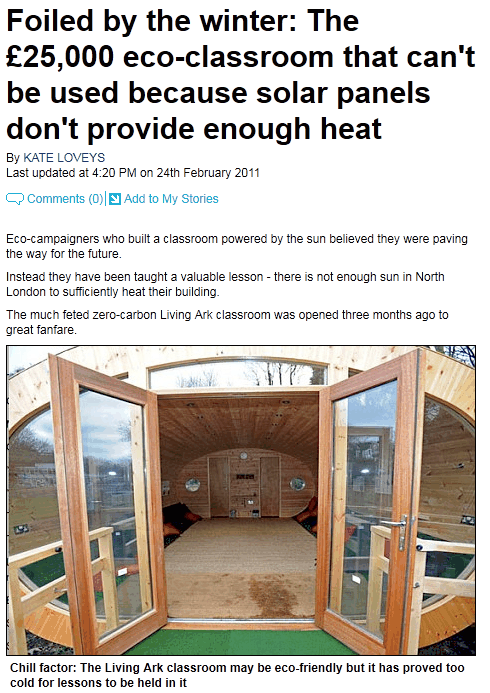
Oh, by the way, it IS at least pretty inside. It would make a nice cottage in the woods, or rather it would, once you had added a minimal kitchen and bathroom, a few chairs and a fold down bed. Oh, and a nice little wood stove for heat!
Sort of like a canal barge on stilts.
Will the ideologs ever learn that they cannot defy the laws of physics…
There’s no need to waste any time on calculations – just go to a local DIY store and buy a pack of solar powered garden lights. Ours have only just started working again, after being virtually useless for the last 3 months.
I’ve said it before, and I’ll say it again – if all the customers on “Green” energy tariffs ONLY had power when the wind is blowing and/or the sun is shining, we wouldn’t be spending massive sums of money on useless projects like this.
The calculations would work if England got a barbecue winter, that’s the problem with warmists they thing that “global warming” means that it has turn tropical everywhere.
Well it could work if you jammed enough kids in there but then there’s the carbon pollution problem they might have overlooked somewhat. Hang on a minute…!!
Perhaps they could try shutting the door.
/sarc
There is a balance to be struck between insulation to keep heat in and windows to get light and heat in. Looks to me like they haven’t got that balance right. With no vestibule either, any heat inside will race outside whenever someone comes or goes.
Jumping jacks?
A piece from Haringay Council:
http://www.haringey.gov.uk/index/environment_and_transport/going-green/climatechange/lcz/lcz-projects-and-schemes.htm
and the ZEDFactory website:
http://www.zedfactory.com/projects_products.html
have illustrations of the same design, but it is not the design finally built but these designs are modular.
So the design appears to be attributable to the ZEDFactory, and it is certainly similar to some of their work, and I expect that they do their calculations.
We may have to look elsewhere to see what has gone wrong.
They appear to have a number of similar designs powered by solar, wind and for winter a stove.
One has to ask what happened to the stove?
Either it is missing, or is not permitted for use in a classroom, or just as plausibly that it is nobody’s job to light it. A stove pipe is visible in the ZEDFactory picture.
I have only looked into this because we have known how to do these calculations for at least 50 years to both my knowledge and practice. Today we can do them a lot better using finite element simulations amognst other techniques.
Architects tend to try and produce structures that are fit for purpose. If the requested building was intended for winter use, the design would be suitable for winter use.
A lot can go wrong, and perhaps something as simple as a requirement to light and feed a stove proved to be an intellectual challenge too far.
Alex
Say, that looks like Norwegian wood …
Did they have to use kids in the experiment? The use of wood is a little extravagant for an experiment and calling it an ark does not go well with what looks like ground water seeping into the floor.
I think we are due a nice credit note from the idiot that did the study as to its effectiveness.
Stupid hippies.
The wood is clearly Scots Pine, probably from Scandinavia. Now building school houses in wood is neither extravagant or experimental, it has been done for centuries in Scandinavia, nor is it be more expensive than using other materials if it is done right. And of course wooden buildings work perfectly well in winter, even in extreme cold, if properly built and insulated (which “The Ark” isn’t – the walls are too thin for proper insulation). I suppose the problem is that the best insulation materials like rock-wool or cellulose foam are “unnatural”.
I would suggest buying a prefabricated building from Scandinavia next time rather than just the timber.
Ralph,
Assuming the busses are generating electricity from a hydrogen fuel cell the efficiency is roughly equal to the efficiency of the reformation process (80%) times the compression process (70%) times the tank to wheel efficiency (40%) or 22%. The efficiency of burning nat gas directly is between 20% and 25%. At the very least a wash if not an advantage to using nat gas directly
LOL
England was the “Great Empire”. They became great based on technology. Now they have many “teachers/politicians” instructing our kids. Physics is a science based on “how you ‘feel’ things should be”.
Well, I feel that anyone going to this school will become a good politician, not intelligent, producers that will help society.
gigo – holds for teachers and students.
From this type of instruction came the “‘political grant based’ climate gate scientists”.
I have learned one thing from history -> “Whoever is in power will take you and your children as slaves.”
I’m an old school designer of intermediate scale technology and can answer to these first-semester college hippy eco-tards:
1) I see what you did there.
2) You’re doing it wrong.
I’m very curious as to what on earth would suggest to anyone anywhere that there was enough energy from the sun in winter time England to heat anything substantial?!?
@tty
It does occur to me that importing the wood from Scandinavia rather defeats the purpose of the zero-emission part.
Ralph,
Diesel engines run in the 22% – 25% efficiency range but, the following quote indicates that these busses should never be built on cost alone.
“Mayor Ken Livingstone said the £750,000 buses were the “greenest, cleanest and quietest ever”. “
Found this info on NY state renewable power site. It indicates that SMR is 70% efficient not 80% as I guessed (drops system efficiency to 20% instead of 22%). Also requires the burning of polluting fuel and produces CO2 so is not zero emission as claimed
Production Process
The steam methane reforming (SMR) process consists of the
following two steps.
1. Reformation of Natural Gas
The first step of the SMR process involves methane reacting with steam at 750-800°C (1380-1470ºF) to produce a synthesis gas (syngas), a mixture primarily made up of hydrogen (H2) and carbon monoxide (CO).
2. Shift Reaction
In the second step, known as a water gas shift (WGS) reaction, the carbon monoxide produced in the first reaction is reacted with steam over a catalyst to form hydrogen and carbon dioxide (CO2). This process occurs in two stages, consisting of a high temperature shift (HTS) at 350ºC (662ºF) and a low temperature shift (LTS) at 190-210ºC (374-410ºF).
HYDROGEN FACT SHEET
Hydrogen Production –
Steam Methane Reforming (SMR)
Table 1. Production Technology Scorecard
Steam Reforming
Description
Steam reforming converts methane (and other hydrocarbons in natural gas) into hydrogen and carbon monoxide by reaction with steam over a nickel catalyst.
Feedstock
Natural gas
Energy
Natural gas. May be driven by heat from nuclear power plants.
Other
70% efficient. Will require carbon sequestration.
Yep, it’s a design from zedfactory. These people have also designed BedZed:
http://en.wikipedia.org/wiki/BedZED
and now they propose a new development PortZed – sustainable living in 70 off-grid apartments.
http://www.guardian.co.uk/environment/2011/feb/24/portzed-self-powered-apartment
Includes the usual PV plus batteries arrangement… Which might even work most of the time; but is, given todays prices and England’s low insolation, highly uneconomic…
Interesting quote: “But there are studies showing that if you give people renewable energy they think, oh good, it’s free, and their energy use actually goes up. ”
That, and if you like spending a ton of money on entering a large pyschological experiment, …