Zero Carbon living…didn’t quite work out. Didn’t they do some calculations on this first? Sheesh.
Looks like some sort of Noah’s Ark sort of design. I suppose that was the idea.
Zero Carbon living…didn’t quite work out. Didn’t they do some calculations on this first? Sheesh.
Looks like some sort of Noah’s Ark sort of design. I suppose that was the idea.
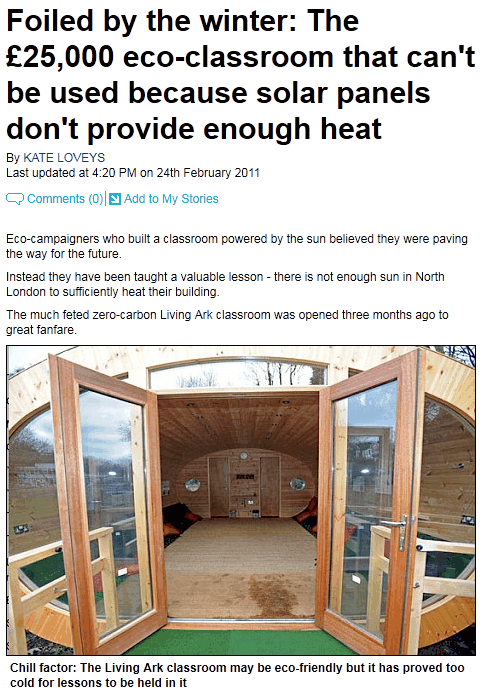
Well, at least the KIDS learned a valuable lesson about environmental reality. They seldom miss the irony of adult folly.
Actually, I think that having demonstrated the value of this “resource” they should build a whole lot more of them, following the windmill model. Large government subsidies and carbon credits are sure to follow. With concerted effort, ALL classrooms could be converted to “Arks.” Like windmills, if they are only usable half the time, simply build a lot of extras in warmer (or cooler) places, like Panama and Nova Scotia and ship the kids there – using sailboats of course. Looks like those Arks might float, if you turned them upside down…
Re: Jack Savage
Jack, lets assume that a conventional classroom costs the same £25000 as this eco classroom. A conventional classroom can be used for the full 9 months of the school terms. This one, however, can not be used in winter because of the lack of heating which means it will not be available for between 20-25% of the school terms. This means that in real terms the eco classroom costs between 25 and 33% more than a conventional classroom.
A second point is that the number of children attending school is constant throughout the year and therefore the school needs an extra classroom just to cover when this one is not usable.
The pupils should all wrap up warm, put pedals under their desks so they can generate power, whilst keeping fit, keeping warm and demonstrating that human ingenuity is boundless and prepare for their eco future. They can sell the solar panels and have a party.
It’s a darn good thing that they got the “warmer” winter that the Met Office predicted or it would have really frozen a student or two.
Maybe in the year 2100 London will be warm enough in the winter.
Or maybe not.
“Didn’t they do some calculations on this first? ” These eco-nuts cannot do calculations.
I wonder how one manufactures the door hardware, the double pane glass — transports building material to the site, takes pictures of the “ark”, and otherwise uses the infrastructure and manpower of an industrial society all without emitting CO2? Even the premise is stunningly arrogant on the face of it.
So after reading the report in the local newspaper, it is clear that what has been built is in fact a summer house in the school garden – noting unusual in that, they were building them in Victorian days from the same “carbon neutral” material … wood.
Of course it will rot over time – not carbon neutral.
The large doors that open directly to the outside are another odd feature of this building. Even if the air in the building was warm, it would stream out any time the doors were opned to allow teh children to enter or leave
I think the project is a roaring success. It demonstrates EXACTLY what life in a carbon free world with 60-cent (U.S.) per kWh solar power will be like.
It’s really kind of bizarre. Solar seems to have a magnetic attraction for those who live in marginal to unsuitable places like Vermont, England and Germany. Yet in less cloudy climates, closer to the equator, where solar could reasonably make a modest contribution to heating and powering things, it largely languishes.
And yes, you’d think that anyone with the engineering skills to solarize something would at least WAG the energy budget before setting to work.
They probably factored in the heating effect of all the kids, trouble is they probably had to keep on their coats and hence no heating effect. Bet it boils in the summer.
Science should be done in the real world not just in models, a real scientist would know that…
So a single room filled with energetic youngsters fails but we are still led to believe by the advertising that a two story house inhabited by a couple of old age pensioners would benefit from solar panels. I suppose that our forward thinking government must be looking at the cost to the state of old age pension then to be promoting this type of lunacy!
Afterthought: Perhaps the classroom can be salvaged. First, install some heat. Second, turn the heat off on Fridays and teach mandatory units on Mondays on subjects such as the virtues of planning before you act.
If it wasn’t for the fact that we taxpayers have little choice but to fund these absurd follies I’d be splitting my sides laughing.
Of course if used in the pejorative. the “Living Ark” takes on a whole new, and perhaps fitting, meaning.
Way OT, but I have noticed a distinct lack of activity in the last few days at RC, and an incredible spike at JC. WUWT? Olive branches all around?
Charlotte Linacre, Campaign Manager at the TaxPayers’ Alliance said “All this will teach kids is how poorly planned and costly local authorities projects can be.”
It would be a real pity if that is all it taught them. The utter idiocy and wastefulness of the Carbon hysteria and eco-zealotry is one lesson that comes to mind. Kids are usually a lot smarter than “adults” give them credit for, though. They are probably snickering about it already.
… and not a desk in sight.
David,
Even with tax breaks, windmills are pretty much useless.
You would think that a solar heating system salesman would starve to death very quickly in England , but evidently not.
Whats the big deal? If space is an issue just run an electrical extension cord out there and plug in a couple of space heaters. And from the looks of it a few lamps too.
I think it has taught a bunch of kids a great lesson, albeit not the intended one.
She said: ‘We’re delighted to have the Living Ark – its a tremendous resource both for the school and the local community and is an important part of the Muswell Hill low carbon zone initiative.’
Today Muswell Hill. Tomorrow the world!
This is more than a simple failure to do arithmetic.
It is the trust in an authority that doing something must be the right thing to do. Anybody who bothers to check the facts will quickly see that wishful thinking doesn’t by itself produce anything useful; and that it is in fact much more likely to waste resources including the enthusiasm and trust of people when they see the monument to their own folly.
Government subsidies encourage people not to think of the detail. They dangle the carrot of free money and for the victims, that means that they switch off their critical thought processes. A common feature is avoiding to think about where the governments get their money to pay as subsidies.
e.g. When I question people who’ve installed subsidised, marginally-effective, grid-connected PV solar systems I confront them with a few facts, resulting in them revealing their wilful ignorance because they don’t believe have to pay for their error in judgement. The parting question is: Would you have decided on the system if you’d had to pay the full price?
Subsidies produce the worst effects of bureaucracy in the wider population: that there is no penalty for failure. And that produces waste.
Maybe they can turn it into a rest area for that solar highway we were talking about a few days ago.
From an efficiency standpoint, couldn’t this “Ark” get retrofitted with modern conventional heating and still be more efficient? Then in the other 70% of the school year it could be off grid and just use the conventional heating for the part of the London winter that is too cold and cloudy to use the solar.
I am all for construction techniques that lower energy usage as long as it is cost effective overall, but I do it out of a belief in properly using the resources we have and not expending them needlessly. (I have been called a bit of a miser by my family). My fear is that they hid and misrepresented the construction and maintenance costs of this project to skew the impression of the public. I am not sure that 25,000 pounds is that out of line for a classroom if all other expenses are similar, but they have got to get the auxiliary environmental controls right if they expect to teach in this facility.