It’s not the climate, but the tide of opinion that’s changing in Europe and around the globe

Guest post by Dr. Hans Labohm
The upcoming climate change (and wealth redistribution) summit in Cancun – coupled with Bjorn Lomborg’s ongoing publicity campaign for his new film – makes one thing painfully obvious. The fight against the delusion of dangerous man-made global warming remains an uphill struggle.
For decades the climate debate has been obfuscated by cherry-picking, spin-doctoring and scare-mongering by the UN’s Intergovernmental Panel on Climate Change (IPCC) and other climate alarmists, including the environmental movement and mainstream media. Their massive effort to overstate the threat of man-made warming has left its imprint on public opinion.
But the tide seems to be turning. The Climate Conference fiasco in Copenhagen, Climategate scandal and stabilization of worldwide temperatures since 1995 have given rise to growing doubts about the putative threat of “dangerous global warming” or “global climate disruption.” Indeed, even Phil Jones, director of the University of East Anglia’s Climatic Research Unit and one of the main players in Climategate, now acknowledges that there has been no measurable warming since 1995, despite steadily rising atmospheric carbon dioxide.
People are paying attention, and opinion polls in many countries show a dramatic fall in the ranking of climate change among people’s major concerns. They are also beginning to understand that major rain and snow storms, hurricanes and other weather extremes are caused by solar-driven changes in global jet streams and warm-cold fronts, not by CO2, and that claims about recent years being the “warmest ever” are based on false or falsified temperature data.
In various parts of the world, the climate debate displays different features. The US and other parts of the non-European Anglo-Saxon world feature highly polarized and politicized debates along the left/right divide. In Europe, all major political parties are still toeing the “official” IPCC line. In both arenas, with a few notable exceptions, skeptical views – even from well-known scientists with impeccable credentials – tend to be ignored and/or actively suppressed by governments, academia and the media.
However, skepticism about manmade climate disasters is gradually gaining ground nevertheless.
In my own country, The Netherlands, for instance, it has even received some official recognition, thus dissolving the information monopoly of climate alarmists. The Standing Committee on Environment of the Lower House even organized a one-day hearing, where both climate chaos adherents and disaster skeptics could freely discuss their different views before key parliamentarians who decide climate policy.
This hearing was followed by a special seminar organized by the Royal Netherlands Academy of Sciences, using the same format but focusing on scientific topics. The Academy will soon publish a report about this seminar.
Europe often brags about its emission trading scheme (ETS), regarding itself as the vanguard of an international climate policy. In the European view, the Copenhagen climate summit should have produced a worldwide extension and sharpening of its ETS. But the vast majority of countries in the world refused to follow Europe’s example, so the meeting turned into a fiasco. Its follow-up in Cancun at year’s end will surely produce a similar result. And for good reason.
Contrary to official claims, Europe’s experience with ETS is dismally bad. The system is expensive and prone to massive fraud. More importantly, it serves no useful purpose.
The European Environmental Agency tracks Europe’s performance regarding the reduction of CO2 emissions. Its latest report states: “The European Union’s greenhouse gas inventory report … shows that emissions have not only continued their downward trend in 2008, but have also picked up pace. The EU-27’s emissions stood 11.3% below their 1990 levels, while EU-15 achieved a reduction of 6.9% compared to Kyoto base-year levels.”
On the face of it, the scheme seems to be pretty successful. However, much of the downward trend was due to the global economic recession, not to the ETS. Moreover, both climate chaos proponents and climate disaster skeptics agree that the scheme will have no detectable impact whatsoever on worldwide temperatures – perhaps 0.1 degrees – though this crucial piece of information has been carefully and deliberately shielded from the public eye.
What about renewable energy as an alternative? Consider these EU costs for various sources of electricity in cents per kilowatt-hour: nuclear 4, coal 4, natural gas 5, onshore wind 13, biomass 16 … solar 56!
Obviously, the price tag for renewables is extremely high, compared to hydrocarbons. The additional costs can be justified either by imminent fossil fuel scarcity (the “oil peak”), which would send petroleum and coal prices through the roof, or by the threat of man-made global warming. But on closer inspection neither argument is tenable.
The authoritative International Energy Agency does not foresee any substantial scarcity of oil and gas in the near to medium future, and coal reserves remain sufficient for centuries to come. As to global warming, the absence of a statistically significant increase in average worldwide temperatures since 1995 obliterates that assertion.
Meanwhile, recent peer-reviewed studies indicate that increasing CO2 levels in the atmosphere (natural or man-made) have minimal effects on climate change – while others demonstrate that, on balance, this plant-fertilizing gas is beneficial, rather than harmful, for mankind and the biosphere.
All this argues for a closer look at the cost/benefit relationship of investing in renewable energy projects, to prevent a massive waste of financial and natural resources on unreliable and thus uncompetitive forms of energy. Since every cloud has a silver lining, the ongoing economic crisis might give extra impetus toward that end.
______________
Hans Labohm is a former professor at the Dutch Institute of International Relations and guest teacher at the Netherlands Institute for Defense Studies. He has been an IPCC reviewer and has written extensively on global warming, petroleum economics and other topics.
Climate change no longer scary in Europe
It’s not the climate, but the tide of opinion that’s changing in Europe and around the globe
Dr. Hans Labohm
The upcoming climate change (and wealth redistribution) summit in Cancun – coupled with Bjorn Lomborg’s ongoing publicity campaign for his new film – makes one thing painfully obvious. The fight against the delusion of dangerous man-made global warming remains an uphill struggle.
For decades the climate debate has been obfuscated by cherry-picking, spin-doctoring and scare-mongering by the UN’s Intergovernmental Panel on Climate Change (IPCC) and other climate alarmists, including the environmental movement and mainstream media. Their massive effort to overstate the threat of man-made warming has left its imprint on public opinion.
But the tide seems to be turning. The Climate Conference fiasco in Copenhagen, Climategate scandal and stabilization of worldwide temperatures since 1995 have given rise to growing doubts about the putative threat of “dangerous global warming” or “global climate disruption.” Indeed, even Phil Jones, director of the University of East Anglia’s Climatic Research Unit and one of the main players in Climategate, now acknowledges that there has been no measurable warming since 1995, despite steadily rising atmospheric carbon dioxide.
People are paying attention, and opinion polls in many countries show a dramatic fall in the ranking of climate change among people’s major concerns. They are also beginning to understand that major rain and snow storms, hurricanes and other weather extremes are caused by solar-driven changes in global jet streams and warm-cold fronts, not by CO2, and that claims about recent years being the “warmest ever” are based on false or falsified temperature data.
In various parts of the world, the climate debate displays different features. The US and other parts of the non-European Anglo-Saxon world feature highly polarized and politicized debates along the left/right divide. In Europe, all major political parties are still toeing the “official” IPCC line. In both arenas, with a few notable exceptions, skeptical views – even from well-known scientists with impeccable credentials – tend to be ignored and/or actively suppressed by governments, academia and the media.
However, skepticism about manmade climate disasters is gradually gaining ground nevertheless.
In my own country, The Netherlands, for instance, it has even received some official recognition, thus dissolving the information monopoly of climate alarmists. The Standing Committee on Environment of the Lower House even organized a one-day hearing, where both climate chaos adherents and disaster skeptics could freely discuss their different views before key parliamentarians who decide climate policy.
This hearing was followed by a special seminar organized by the Royal Netherlands Academy of Sciences, using the same format but focusing on scientific topics. The Academy will soon publish a report about this seminar.
Europe often brags about its emission trading scheme (ETS), regarding itself as the vanguard of an international climate policy. In the European view, the Copenhagen climate summit should have produced a worldwide extension and sharpening of its ETS. But the vast majority of countries in the world refused to follow Europe’s example, so the meeting turned into a fiasco. Its follow-up in Cancun at year’s end will surely produce a similar result. And for good reason.
Contrary to official claims, Europe’s experience with ETS is dismally bad. The system is expensive and prone to massive fraud. More importantly, it serves no useful purpose.
The European Environmental Agency tracks Europe’s performance regarding the reduction of CO2 emissions. Its latest report states: “The European Union’s greenhouse gas inventory report … shows that emissions have not only continued their downward trend in 2008, but have also picked up pace. The EU-27’s emissions stood 11.3% below their 1990 levels, while EU-15 achieved a reduction of 6.9% compared to Kyoto base-year levels.”
On the face of it, the scheme seems to be pretty successful. However, much of the downward trend was due to the global economic recession, not to the ETS. Moreover, both climate chaos proponents and climate disaster skeptics agree that the scheme will have no detectable impact whatsoever on worldwide temperatures – perhaps 0.1 degrees – though this crucial piece of information has been carefully and deliberately shielded from the public eye.
What about renewable energy as an alternative? Consider these EU costs for various sources of electricity in cents per kilowatt-hour: nuclear 4, coal 4, natural gas 5, onshore wind 13, biomass 16 … solar 56!
Obviously, the price tag for renewables is extremely high, compared to hydrocarbons. The additional costs can be justified either by imminent fossil fuel scarcity (the “oil peak”), which would send petroleum and coal prices through the roof, or by the threat of man-made global warming. But on closer inspection neither argument is tenable.
The authoritative International Energy Agency does not foresee any substantial scarcity of oil and gas in the near to medium future, and coal reserves remain sufficient for centuries to come. As to global warming, the absence of a statistically significant increase in average worldwide temperatures since 1995 obliterates that assertion.
Meanwhile, recent peer-reviewed studies indicate that increasing CO2 levels in the atmosphere (natural or man-made) have minimal effects on climate change – while others demonstrate that, on balance, this plant-fertilizing gas is beneficial, rather than harmful, for mankind and the biosphere.
All this argues for a closer look at the cost/benefit relationship of investing in renewable energy projects, to prevent a massive waste of financial and natural resources on unreliable and thus uncompetitive forms of energy. Since every cloud has a silver lining, the ongoing economic crisis might give extra impetus toward that end.
______________
Hans Labohm is a former professor at the Dutch Institute of International Relations and guest teacher at the Netherlands Institute for Defense Studies. He has been an IPCC reviewer and has written extensively on global warming, petroleum economics and other topics.
Climate change no longer scary in Europe
It’s not the climate, but the tide of opinion that’s changing in Europe and around the globe
Dr. Hans Labohm
The upcoming climate change (and wealth redistribution) summit in Cancun – coupled with Bjorn Lomborg’s ongoing publicity campaign for his new film – makes one thing painfully obvious. The fight against the delusion of dangerous man-made global warming remains an uphill struggle.
For decades the climate debate has been obfuscated by cherry-picking, spin-doctoring and scare-mongering by the UN’s Intergovernmental Panel on Climate Change (IPCC) and other climate alarmists, including the environmental movement and mainstream media. Their massive effort to overstate the threat of man-made warming has left its imprint on public opinion.
But the tide seems to be turning. The Climate Conference fiasco in Copenhagen, Climategate scandal and stabilization of worldwide temperatures since 1995 have given rise to growing doubts about the putative threat of “dangerous global warming” or “global climate disruption.” Indeed, even Phil Jones, director of the University of East Anglia’s Climatic Research Unit and one of the main players in Climategate, now acknowledges that there has been no measurable warming since 1995, despite steadily rising atmospheric carbon dioxide.
People are paying attention, and opinion polls in many countries show a dramatic fall in the ranking of climate change among people’s major concerns. They are also beginning to understand that major rain and snow storms, hurricanes and other weather extremes are caused by solar-driven changes in global jet streams and warm-cold fronts, not by CO2, and that claims about recent years being the “warmest ever” are based on false or falsified temperature data.
In various parts of the world, the climate debate displays different features. The US and other parts of the non-European Anglo-Saxon world feature highly polarized and politicized debates along the left/right divide. In Europe, all major political parties are still toeing the “official” IPCC line. In both arenas, with a few notable exceptions, skeptical views – even from well-known scientists with impeccable credentials – tend to be ignored and/or actively suppressed by governments, academia and the media.
However, skepticism about manmade climate disasters is gradually gaining ground nevertheless.
In my own country, The Netherlands, for instance, it has even received some official recognition, thus dissolving the information monopoly of climate alarmists. The Standing Committee on Environment of the Lower House even organized a one-day hearing, where both climate chaos adherents and disaster skeptics could freely discuss their different views before key parliamentarians who decide climate policy.
This hearing was followed by a special seminar organized by the Royal Netherlands Academy of Sciences, using the same format but focusing on scientific topics. The Academy will soon publish a report about this seminar.
Europe often brags about its emission trading scheme (ETS), regarding itself as the vanguard of an international climate policy. In the European view, the Copenhagen climate summit should have produced a worldwide extension and sharpening of its ETS. But the vast majority of countries in the world refused to follow Europe’s example, so the meeting turned into a fiasco. Its follow-up in Cancun at year’s end will surely produce a similar result. And for good reason.
Contrary to official claims, Europe’s experience with ETS is dismally bad. The system is expensive and prone to massive fraud. More importantly, it serves no useful purpose.
The European Environmental Agency tracks Europe’s performance regarding the reduction of CO2 emissions. Its latest report states: “The European Union’s greenhouse gas inventory report … shows that emissions have not only continued their downward trend in 2008, but have also picked up pace. The EU-27’s emissions stood 11.3% below their 1990 levels, while EU-15 achieved a reduction of 6.9% compared to Kyoto base-year levels.”
On the face of it, the scheme seems to be pretty successful. However, much of the downward trend was due to the global economic recession, not to the ETS. Moreover, both climate chaos proponents and climate disaster skeptics agree that the scheme will have no detectable impact whatsoever on worldwide temperatures – perhaps 0.1 degrees – though this crucial piece of information has been carefully and deliberately shielded from the public eye.
What about renewable energy as an alternative? Consider these EU costs for various sources of electricity in cents per kilowatt-hour: nuclear 4, coal 4, natural gas 5, onshore wind 13, biomass 16 … solar 56!
Obviously, the price tag for renewables is extremely high, compared to hydrocarbons. The additional costs can be justified either by imminent fossil fuel scarcity (the “oil peak”), which would send petroleum and coal prices through the roof, or by the threat of man-made global warming. But on closer inspection neither argument is tenable.
The authoritative International Energy Agency does not foresee any substantial scarcity of oil and gas in the near to medium future, and coal reserves remain sufficient for centuries to come. As to global warming, the absence of a statistically significant increase in average worldwide temperatures since 1995 obliterates that assertion.
Meanwhile, recent peer-reviewed studies indicate that increasing CO2 levels in the atmosphere (natural or man-made) have minimal effects on climate change – while others demonstrate that, on balance, this plant-fertilizing gas is beneficial, rather than harmful, for mankind and the biosphere.
All this argues for a closer look at the cost/benefit relationship of investing in renewable energy projects, to prevent a massive waste of financial and natural resources on unreliable and thus uncompetitive forms of energy. Since every cloud has a silver lining, the ongoing economic crisis might give extra impetus toward that end.
______________
Hans Labohm is a former professor at the Dutch Institute of International Relations and guest teacher at the Netherlands Institute for Defense Studies. He has been an IPCC reviewer and has written extensively on global warming, petroleum economics and other topics.
Al Gored says:
November 22, 2010 at 12:48 pm
‘The BBC has been like Monty Python’s Ministry of Truth for a long time, and it is starting to catch up with them.’
I’m afraid it’s far more like George Orwell’s Ministry of Truth than Python’s.
eadler: ‘There is no evidence that temperature data has been falsified. The last 12 months have been the warmest in the insturmental temperature record. ‘
I was just reading this when I had to go to the window to watch a squadron of pigs flying by.
Anthony:
Remove the Video posting by Garhighway. Why? Because it BEGINS by using “inflamatory language” (WUWT, “Pseudo Science Blog”.)
Sorry, YOU snip serious ad hominims all the time. I don’t want to see space given to the AWG crowd for that. They have their own “spaces”.
Max
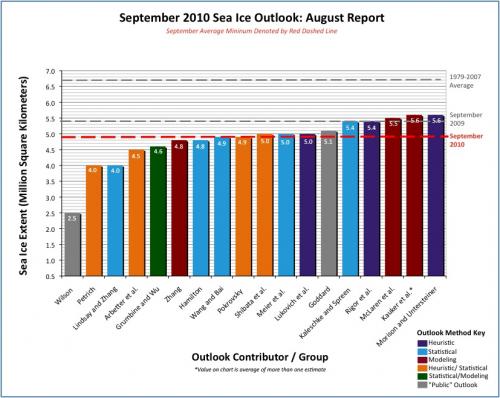
REPLY: Well not only that, but “Greenman” got the attribution wrong too. I wrote the intro about Bastardi, the rest was Steve Goddard, but “Greenman” has never played fair, so he doesn’t show that part, nor does he show all the other forecasts by scientists at that time that were also wrong.
See here for the SEARCH 2010 summary of forecasts by other groups. Goddard (sixth from the right in grey) came in at 5.1 and did better than some other scientists did.
– Anthony
matt v. says:
November 22, 2010 at 1:52 pm
Yes, the rate of warming for the last decade has been much lower, but the article and the claim was about warming since 1995, and that was what I addressed.
I think you meant to say ‘IPCC forecast of 0.2C/decade’.
Rhoda R – we have elections too in the UK – but the new ‘lot’ recently elected are as blinkered and collectively pig-headed as the previous lot. Can you believe it – they are still charging ahead relentlessly with wind farms, shovelling Renewable Obligation Certificates at them because, let’s face it, that’s the only way they are remotely viable.
However – in the rest of Europe we may have some respite because the politicos have got the euro to worry about – you know, that wonderful ‘one-size-fits-all’ currency project which was fine while the breeze (sorry) was blowing benignly, but now its turned into a gale and the fertilizer has hit the fan, its all starting to unravel. Something of course which us ‘armchair economists’ could work out without even resorting to a calculator – but – hey – what do we know..? We’re just climate skeptics/deniers/flat-earthers – no hope for us…
‘Wealth redistribution’ is becoming almost as much of a joke as man-made climate change…
We often complain about the complicity of the MSM in the AGW crap. I wish someone could give me a breakdown as to the involvement of media barons in carbon investments. It could also be that they are towing the line in line with the WW2 spirit because they have been gullible. Don’t be surprised about gullible.
http://www.businessandmedia.org/specialreports/2006/fireandice/fireandice.asp
http://newsbusters.org/node/11640
http://www.almanac.com/sites/new.almanac.com/files/1895_cvr1_0.png
http://www.time.com/time/magazine/article/0,9171,944914,00.html
http://www.washingtontimes.com/news/2007/sep/19/inside-the-beltway-69748548/
RichieP says:
November 22, 2010 at 2:09 pm
“Al Gored says:
November 22, 2010 at 12:48 pm
‘The BBC has been like Monty Python’s Ministry of Truth for a long time, and it is starting to catch up with them.’
I’m afraid it’s far more like George Orwell’s Ministry of Truth than Python’s.”
The BBC just wishes it was. But the combination of the accents and how silly their correspondents are makes it more Monty-Python-ridiculous than scary. Their main pre-Climategate climate-crisis reporter, David Shukman, was truly hilarious with his almost daily doomsday stories… even the way he said “glaciers” and “catastrophic” made me laugh.
Now they’re covering The Warming like Monty Python’s dead parrot sketch – it’s alive I say! – although they sure have quieted down on that front. It seems like days, perhaps even weeks, since I saw a wet polar bear in their daily “news” spew.
Brian H says:
November 22, 2010 at 12:52 pm
Quite right, Brian, and the clarification is appreciated. In either case, AGW is a long way from being a viable scientific theory, in the scientific meaning of the word. Sadly, the the primary scientists (Mann, Jones, et. al.), and policy makers treat AGW as if it’s been elevated to the most lofty of heights, that of scientific law.
Even IEA insiders are starting to come out and openly say their estimate of world reserves are grossly exaggerated. The author also seems unaware that Phil Jones is no longer director of CRU.
This is a poorly written propaganda article that uses vague and inaccurate generalities to support a predetermined stance.
Antony would do well to reduce the quantity of posts and verify the quality, IMHO. This sort of article damages the credibility of the site.
Wombat said:
Phil Jones said “… the trend for the period 1995 to 2009 … (0.12C per decade) is positive, but not significant at the 95% significance level. The positive trend is quite close to the significance level. Achieving statistical significance in scientific terms is much more likely for longer periods, and much less likely for shorter periods.”
What are Phil Jones’ qualifications in applied mathematics? Is he in any way equipped to pronounce on statistics in this way?
As far as I can tell, he is the discredited head of a small department in the 299th best university in the world. To get into UEA to read Climate Science, you need only be in the top 53% of your year academically, i.e. average.
Where did this average mind, at an average institution, gain his expertise in statistics; and who, with demonstrated expertise in this area has peer-reviewed his work?
Based on the work done by Girma Orssengo posted on WUWT earlier, the historical GLOBAL MEAN TEMPERATURE ANOMALY [GMTA] can be best visualized to consist of a LINEAR anomaly component rising on the average rate of 0.0059 C per year[ since 1880] or [0.0045 C /year going back 150 years per IPCC figures] plus an OSCILLATING component having a sinusoidal[ COSINE] like function with an amplitude of approximately 0.3C These two anomalies add and interact to produce an approximate 60 year cycle with alternating 30 years of COOLING with 0.42C temperature drop and 30 years of WARMING with a 0.77C temperature rise http://wattsupwiththat.files.wordpress.com/2010/04/predictions-of-gmt.pdf
We just peaked on the last warm cycle in the early 2000’s and have now started a 30 year cool cycle which mayl drop the global temperature anomaly by 0.42C by 2030.
These are the indicated temperature anomalies [hadcrut3] for the next cool cycle. Short term variation due to ENSO, volcanic eruptions, etc.] add or subtract to these approximate yearly figures.
2010 [0.391C] mean to end of OCT /2010
2015 [0.28 C]
2020 [0.16C]
2025 [0.076C]
2030 [0.06C]
Based on the colder anomaly of 0.06C by 2030, the temperatures are likely to be similar to those of the late 1970’s and early 1980’s. [1979(0.049C) and 1980(0.076C).Just look up what happened in the late 1970’s
In my judgment, the up coming colder global climate during the next few years and stretching into several decades may eventually convince the Europeans that global warming as currently presented is not real and they better prepare for what really lies ahead.
Unfortunately expert forecasts do fail but some people believe them anyway, so I don’t know if anything will convince some
[Lots of discussion about that earlier: It may be that the short oscillation is adding (and subtracting) from an 800 year longer oscillation, rather than a simple linear increase. In any case, one needs to account for the RWP, Dark Ages, MWP, and LIA … as well as today’s Modern Warming Period. Robt]
CRU Orders Removal of Climate Realist Article From the Express Newspaper.
http://ourmaninsichuan.wordpress.com/
Pointman
JUST TO REMIND EVERONE.
http://s446.photobucket.com/albums/qq187/bobclive/?action=view¤t=jones1_Join_to_AVI_1.mp4
Won’t someone send Tony a few thousand back numbers of Private Eye?
Dellingpole and Monckton may be neck and neck in the sad new Spectator’s pythonia praecox run, but the good old Ministry of Truth seems to have come to rest in the Pseud’s Corner shrubbery here at WUWT.
Use the force Nuke, said old Ben
HHmmm can you say split atoms not birds
This picture is so hilarious, I very nearly added it to my Facebook profile as a sardonic commentary. But I was afraid that some of my ignorant friends would think I was serious.
matt v. says:
November 22, 2010 at 1:52 pm
BTW, lest you should find yourself thinking that the low rate of global warming of the last ten years, to which you draw attention, is in some respect significant, do take a look at the following graph of the HADCRUT series since 1975:
http://www.woodfortrees.org/plot/hadcrut3gl/from:1975/plot/hadcrut3gl/from:1975/trend/plot/hadcrut3gl/from:2003/trend/plot/hadcrut3gl/from:1990/to:1997/trend/plot/hadcrut3gl/from:1979/to:1987/trend
I’ve marked upon it three periods, each of about eight years’ duration, in which the least squares fit is obviously negative. Clearly, the periods exist within an overall warming trend. Such periods of cooling in an overall warming trend are inevitable where there is an overall warming trend of nearly 0.2C per decade and annual variability of up to +or-0.2C per year (ie where the data is ‘noisy’): that is also why they are not significant.
Getting excited about such periods of cooling and claiming that they show we are about to descend into a longer period of cooling is not justified.
@Leif Svalgaard
Leif Svalgaard says:
November 22, 2010 at 10:12 am
“They are also beginning to understand that major rain and snow storms, hurricanes and other weather extremes are caused by solar-driven changes in global jet streams and warm-cold fronts”
There is no evidence of that either.”
There are some studies that found a link between jet stream position and sun cycle.
The jet streams have also been moving southwards for 3-4 years straight now which is btw opposite of what they predicted global warming would do.
Same trend has been seen around other minimums. They also coincidence with harsh winter in europe and the freeze of dutch canal.
The dutch canal usually freeze once every solar cycle, which happens to be during minimum, but now this has happened for years in a row coincidencing with the ongoing grand minimum.
@Leif Svalgaard
http://www.sciencedaily.com/releases/2010/04/100415080848.htm
someone wrote :
Dr. Labohm, is this the first time you say it out loud? That you are a Denier?
Does this mean more and more professors dare speak out? Or have they all been speaking out all the time, but ignored by media?
Labohm is nor a professor, nor a dr. He’s a retired economist who never worked a day in research but (mainly) worked for the Ministry of foreign affairs.
Above that, in Holland he receives lots of criticism of intellectual dishonesty because he never corrects the errors in his work but keeps repeating the same errors / half-thruths while pretending he never heared the rebuttals he receives and doesn’t know what he knows is wrong or misleading.
Most of the discussions are in Dutch (but with babelfish you should be able to understand most of what’s said on blogs like De Dagelijkse Standaard) but luckily a Dutch blogger wrote a blogpost brilliantly illustrating Labohm’s way of repeating the same misleading facts : http://jules-klimaat.blogspot.com/2009/03/labohm-again-sigh.html
There are credible climate skeptics like dr Lindzen or dr Spencer, but i’m afraid Hans labohm is not one of them.
Slioch says:
November 22, 2010 at 4:05 pm
And you trust the data, watch the video in my earlier post.
Slioch says:
November 22, 2010 at 4:05 pm
“Getting excited about such periods of cooling and claiming that they show we are about to descend into a longer period of cooling is not justified.”
Alternately: “Getting excited about such periods of warming and claiming that they show we are about to descend into a longer period of warming is not justified.”
The WWF has some warped minds working at it.
SLIOCH
You said
“Getting excited about such periods of cooling and claiming that they show we are about to descend into a longer period of cooling is not justified.”
Ten year of flat global temperatures is a sign of pending change.
The historical periods of cooling and warming are real and they will happen again unless you can alter the forces of nature.Just look at any historical temperature data.
You miss the whole point of what is the effect of these more significant cooler periods. They moderate the climate of the planet over a century. By 2100 the natural planetary cycle projects an anomaly of only 0.63 C since there are likely going to be two cooling cycles ahead and only one warming cycle during the next 90 years .IPCC project anywhere from 2.4 C to 5.3 C anomaly increase by 2100 in a straightline. They anticipate no cooling of any kind. Below is how Girma Orrssengo put it in his article. If one projects a year’s temperature based only on 4 summer periods rather than a summer, fall, winter and spring, it will make big difference . Agw supportes are saying there will only be summers for the next 100 years.
……”the century [20th] started when the oscillating anomaly was at its minimum near 1910 with GMTA of –0.64 deg C and ended when it was at its maximum near 2000 with GMTA of 0.48 deg C, giving a large global warming of 0.48+0.64=1.12 deg C. This large warming was due to the rare events of two global warming phases of.77 deg C each but only one cooling phase of 0.44 deg C occurring in the 20th century, giving a global warming of 2*0.77-0.42=1.12 deg C.
In contrast to the 20th century, from Figure 3, there will be nearly no change in GMTA in the 21st century. This is because the century started when the oscillating anomaly was at its maximum near 2000 with GMTA of 0.48 deg C and will end when it is at its minimum near 2090 with GMTA of 0.41 deg C, giving a negligible change in GMTA of 0.41-0.48=-0.07 deg C. This negligible change in GMTA is due to the rare events of two global cooling phases of 0.42 deg C each but only one warming phase of 0.77 deg C occurring in the 21st century, giving the negligible change in GMTA of 0.77-2*0.42=-0.07 deg C. “
tommy says:
November 22, 2010 at 4:16 pm
There are some studies that found a link between jet stream position and sun cycle.
“weather extremes are caused by solar-driven changes in global jet streams and warm-cold fronts”
That found a coincident occurrence of regional changes. The quote states the connection as a fact rather than a suggestion.