By Steve Goddard
Summer has come to a premature and frosty end at Santa’s workshop.

http://psc.apl.washington.edu/northpole/webphotos/noaa2.jpg
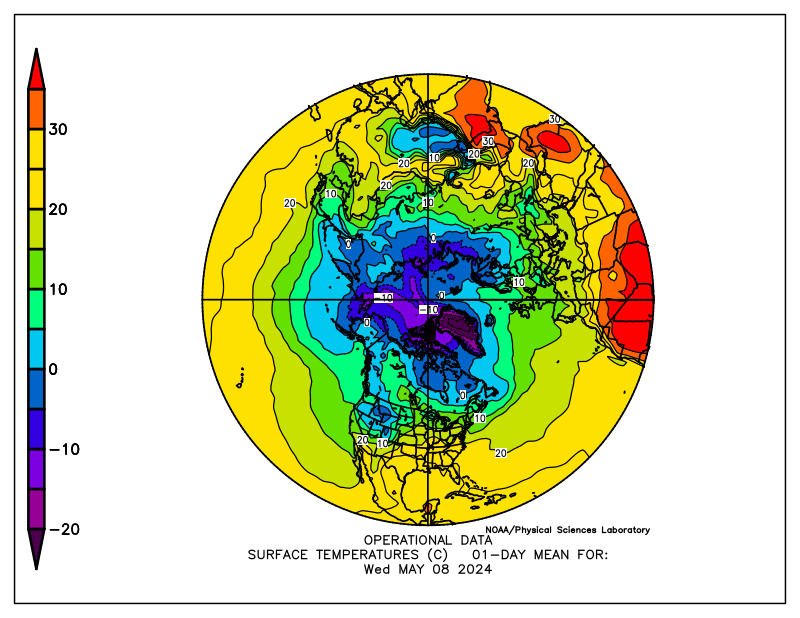
It has been the coldest summer on record north of 80N, and temperatures have dropped below freezing ahead of the average date.

The entire ice covered region is now below freezing.

http://www.esrl.noaa.gov/psd/map/images/fnl/sfctmp_01.fnl.gif
It also appears that the summer melt season will be the shortest on record. The maximum was reached very late in March, and it appears likely that we are headed for an early minimum.

Mark Serreze at NSIDC has stated :
As the climate warms, the summer melt season lengthens …”
He was also reported as saying :
Mark Serreze of the center forecast the ice decline this year (2010) would even break 2007’s record.
Another interesting fact is that we are almost certain to see a large increase in the amount of multi-year ice (MYI) next year. The reason being that almost all of the 1-2 year old ice (turquoise) in the NSIDC map below will become classified as MYI next spring.

We have seen a remarkably rapid recovery from the 2008 low volume.
PIOMAS continues to report record low volumes of ice, despite all evidence to the contrary. The image below shows in red how far off the mark their August 15 forecast was. Their modeling error will get much worse over the next two weeks – because they model much of the thick multi-year ice in the Beaufort Sea and Arctic Basin as only a few tens of centimetres thick.

With the cold temperatures, ice area loss has almost stopped.

http://arctic-roos.org/observations/satellite-data/sea-ice/observation_images/ssmi1_ice_area.png
However, ice extent continues to drop – because the Arctic Oscillation has turned negative and winds are compacting the ice towards the pole. This bodes well for continued growth of ice in 2011.

http://www.ijis.iarc.uaf.edu/seaice/extent/AMSRE_Sea_Ice_Extent.png
PIPS shows average ice thickness increasing, due to the compression of the ice.

There has not been a lot of ice loss during August. The modified NSIDC image below shows in red, areas that have lost ice since August 1. Note that the Greenland Sea appears to have lost ice. This is due to the fact that there has been very little transport out of the Arctic Basin through the Fram Strait, which again bodes well for ice gain in 2011.

The modified NSIDC image below shows ice gain since 2007.

NSIDC maps continue to show more gain (16%) than their graphs (10%.) I have not been able to get a satisfactory explanation from them about the cause of that discrepancy. DMI shows a 25% gain in 30% concentration ice over 2007.
My forecast (dashed line below) minimum of 5.5 million (JAXA) continues to look conservative. It all comes down to what the winds do over the next few weeks. If the winds keep compressing the ice, the minimum may go a little below 5.5. If the winds quiesce, the minimum may come in a little above 5.5 – which is looking like a pretty good number right now. Some people at NSIDC started out with a 5.5 forecast this year, but seem to have backed away from it since.

Academic theories about the Northwest Passage becoming a commercial shipping opportunity appear pretty clueless.
“The plans that you make can change completely,” he says. This uncertainty, delay, liability, increased insurance and other costs of using the Northwest Passage are likely to deter commercial shipping here. A ship with a reinforced hull could possibly make it intact through the passage. But if it got stuck, it would cost thousands of dollars for an icebreaker like the Amundsen to come to the rescue. So even if the Northwest Passage is less ice-choked than before, the route may not become a shipping short-cut in the near future, as some have predicted.
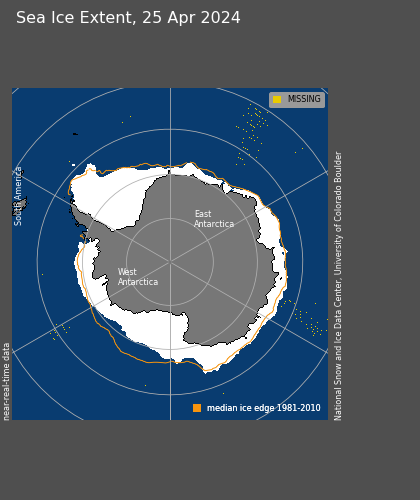
The South Pole will almost certainly set a record for most sea ice this season. It is almost there, and there are still several months of growth remaining.

http://www.iup.uni-bremen.de:8084/amsr/ice_ext_s.png

http://nsidc.org/data/seaice_index/images/daily_images/S_daily_extent.png
As seen below, the symmetry between the North and South Pole is impressive through the satellite record. They always seem to move opposite each other and produce an approximately constant amount of sea ice. It would be nice if the experts focused on solving this relationship rather than making up forced explanations like the “Ozone Hole” – which has just started forming for the year and will be gone before Christmas.

UIUC North/south anomalies overlaid on top of each other.
http://arctic.atmos.uiuc.edu/cryosphere/IMAGES/seaice.anomaly.arctic.png
http://arctic.atmos.uiuc.edu/cryosphere/IMAGES/seaice.anomaly.antarctic.png
(Note to posters and ice experts. Before you embarrass yourself making comments about how seasons are out phase at opposite poles, remember that this is normalised data and the period is in excess of 30 years.)
Conclusions:
The “long term trend” (30 years) in Arctic ice continues to be downwards, and would be even if the ice minimum was a record high this summer. But the three year trend shows strong growth of extent, thickness and age. Meanwhile, Antarctic ice is blowing away the record books. Yet the press continues to spread massive disinformation about the state of ice at both poles. Who could possibly be responsible for that?
Sponsored IT training links:
Get COG-112 materials along with 352-001 dumps to practice and pass 000-977 exam in timely and cost saving manners.
Discover more from Watts Up With That?
Subscribe to get the latest posts sent to your email.






How can they keep showing the Arctic on fire (Temperature wise) while the Arctic temperatures are well below normal all summer?
“Walt Meier says:
August 15, 2010 at 8:37 am
Also, the article that says Mark Serreze forecast this year would break 2007′s record is not a direct quote and is incorrect. Mark is not a forecaster, so he didn’t forecast anything. Second, I’ve never heard him say that we would break the record; he may have said “we could break the record”, which was a possibility.”
Thanks for stopping by. You may be right, however:
Unfortunately, If Dr. Serreze says “we could break the record”, it gets reported as:
“Mark Serreze of the center forecast the ice decline this year would even break 2007’s record”
http://www.allheadlinenews.com/articles/7018784377
Using “weasel” words like this has destroyed the credibility of NSDIC in my mind. Your data is informative, the rhetoric sucks!
Walt,
The video below shows Antarctic ice anomalies overlaid on Arctic ice anomalies since 2001. It flips the data across the x-axis, shifts six months to account for winter/summer, and does a vertical shift to normalize magnitudes. Note how closely they track.
[youtube=http://www.youtube.com/watch?v=b-hrRCTtwVs]
Steven,
Any chance that Tamino will “cherry-pick” 2007 Artic Sea Ice Extent as a starting point for all future analysis?
R.Gates,
I thought you always dismissed extent and only thought volume important, what was that last post aout? I think you are projecting “selective” and “cherry-picking” upon others as your posts seem to track with which data supports your position best at a particular time?
Question: So if winds start to compact the ice and extent ends up below 5.5mkm2 but area is higher than last year how or when will PIOMASS be validated, discredited or even discussed? I mean they have been showing volume dropping off a cliff, but that does not seem realistic with where we are at and where we are likely to end up this year.
I believe Mark Serreze’s duties at NSIDC include contributing to newspaper articles like these:
From the UK Telegraph:
North Pole ice ‘may disappear by September’
By Paul Eccleston
Published: 2:45PM BST 27 Jun 2008
Ice at the North Pole may disappear completely within the next few months for the first time in 20,000 years.
.
.
.
Scientists who monitor the Arctic say the volume of Arctic ice peaked in March and has been in dramatic decline since.
“There is supposed to be ice at the North Pole – not water,” said Mark Serreze of the US National Snow and Ice Data Centre (NSIDC) in Colorado.
The Centre has been predicting that the Arctic Ocean could be virtually ice-free by 2012 but that point may be reached within months rather than years.
.
.
What say you, Walt Meier?
Steven Goddard, this isn’t entirely true. On Feb. 9th Anthony Watts wrote the following:
Steven Goddard writes below that he agrees with the prediction I made in late 2009 that we’d see another 500,000 km2 of Arctic sea ice recovery in 2010.
500K square km more than 2009 would be 5.88 million square km.
It wasn’t until your Sea Ice News #10 from June 23rd that you committed yourself to a hard number and a data set:
I’m forecasting a summer minimum of 5.5 million km², based on JAXA. i.e. higher than 2009, lower than 2006.
Now, would that be absolute minimum or September average?
This is Tom Wagner from NASA telling us that Greenland is warming at 3.5 degrees per decade. (presumably oF, not oC).
http://edition.cnn.com/video/#/video/world/2010/08/11/am.summer.wx.extremes.wagner.cnn?iref=allsearch
Any substance in these claims?
.
Three clear errors right of the bat;
1) “The entire ice covered region is now below freezing.” Not so.
http://www.esrl.noaa.gov/psd/map/images/fnl/sfctmp_01.fnl.gif
The above figure clearly shows the 0C-2.5C contoured area as coincident with the current ice pack.
So “The entire ice covered region is now below freezing.” is a factually incorrect statement.
2) “The reason being that almost all of the 1-2 year old ice (“First-year (< one year) ice") in the NSIDC map below will become classified as MYI next spring."
This is also a factually incorrent statement.
The area in turquoise is clearly labeled "First-year ( aqua blue, aqua blue -> dark green, dark green -> dark green.
3) “The image below shows in red how far off the mark their August 15 forecast was.”
The above statement and image are not from the latest current Zhang forecast dated August 5, 2010;
http://psc.apl.washington.edu/zhang/IDAO/seasonal_outlook.html
http://psc.apl.washington.edu/zhang/IDAO/z.gif
4) “Note that the Greenland Sea appears to have lost ice.” Appears?
In fact, that area of NE Greenland fast ice has been breaking up like gangbusters over the past 1-2 weeks as can be seen directly in the Terra/Aqua MODIS imagery.
So what “appears to have lost ice.” is in fact “is losing ice.”
” Walt Meier says:
August 15, 2010 at 8:37 am
Mark (Serreze) is not a forecaster, so he didn’t forecast anything.”
In this
http://www.arcus.org/files/search/sea-ice-outlook/2010/07/pdf/pan-arctic/meieretaljulyoutlook.pdf
Meier et al. talk about an “outlook”, and not a forecast, but here
http://www.arcus.org/search/seaiceoutlook/2010/july
words like estimate, prediction and (yes, in line 18) FORECAST are used. Since Serreze IS a member of Meier et al., who ARE doing a forecast of arctic ice, “Mark is not a forecaster” can only mean that his contribution to Meier et al. is regarded as useless.
From http://www.theglobeandmail.com/news/national/arctic-sea-ice-heading-for-new-record-low/article1575212/ and I quote…
> “Could we break another record this year? I think it’s
> quite possible,” said Mark Serreze of the National Snow
> and Ice Data Center in Boulder, Colo.
> “We are going to lose the summer sea-ice cover. We can’t
> go back.”
If the last 2 sentences aren’t a forecast, I don’t know what is. By the way, the Arctic was ice-free for 248,000,000 of the past 250,000,000 years. Yet, it did go back. So much for Mark Serreze’s claims.
Günther
5.5 million is the only number I have given for 2010.
Ralph
A lot of people cherry picked Greenland temperature/ice trends from 2003-2007 to write articles.
I must have missed the article where tamino objected.
Walt said:
“Also, the article that says Mark Serreze forecast this year would break 2007′s record is not a direct quote and is incorrect. Mark is not a forecaster, so he didn’t forecast anything. Second, I’ve never heard him say that we would break the record; he may have said “we could break the record”, which was a possibility.”
But Walt, we are all of forecasters because we all take in information which we then use to predict future events, I forecast my team will win because they won last time, I forecast rain because my knee injury aches. We all of us make forecasts of future events all the time and I can assure you that you do not need to be a forecaster to proclaim an educated opinion about future events in your own field of endeavour, indeed Mark did make a forecast because he stated what he believed a future event may turn out to be based on his experience and knowledge. Its pretty obvious that Mark did not state that ‘the sea ice may break the 2007 record OR it may not break the 2007 record. It is a matter of fact that Mark firmly stated his belief that Arctic sea ice would decline and he used his professional standing to make that forecast to the media knowing full well they would not make the differences between himself and lets say Joe Bastardi. Am I correct in assuming that you would take a forecast from Joe more seriously than from Mark simply because Joe is a highly experienced and gifted weather forecaster and Mark is just a climate scientist?
Loyalty is commendable however blind loyalty is neither commendable or ethical.
” Günther Kirschbaum says:
August 15, 2010 at 11:32 am
Now, would that be absolute minimum or September average?”
This “500K square km more than 2009 would be 5.88 million square km” looks like absolute minimum (but not JAXA), as is my estimate of 5, but they
http://www.arcus.org/search/seaiceoutlook/index.php
are outlooking the “September mean arctic sea ice extend”, which makes more sense, since one day cannot destroy your forecast. So Goddard really should confirm; his dashed forecast-line is in the JAXA diagram.
Dr Meier
Your participation on WUWT is welcomed, but your posts were (shall we say) something of a wind-up.
OK, Mark Serreze is not a forecaster. The NSIDC and Mark therefore have a duty to make this clear when he expresses his views in public. A disclaimer like this would do the trick: “Mark’s comments are his personal view and not those of the NSIDC. Mark is not a forecaster”
You describe someting as “a possibility”. It therefore rank with equal validity to the fairies at the bottom of my garden. Those mischievous fairies always disappear when I look for them, but I cannot rule them out as a possibility. How does this advance good scientific reasoning?
Steven’s video is an excellent reply to your challenge( i.e. “Before you make claims about “symmetry” between the two, you really need to at least do a basic correlation calculation.”)
Flip one series over, shift to broadly align the two and then scale to roughly equal magnitude. Would be very interesting to see what maximum correlation the NSIDC can come up with.
Would you have a shot at it and get back here please?
Am I correct in stating that an Arctic sea ice extent recovery over the next 3 years would put the theory of positive feedback at the Arctic in serious trouble?
Then there’s this:
http://www.ldeo.columbia.edu/res/div/ocp/pub/gorodetskaya/irina_ipccpaper.pdf
What do you think of this paper R. Gates?
Excellent and succinct as ever Mr. Watts, thank you.
stevengoddard says:
August 15, 2010 at 10:36 am
R Gates,
I have no idea what you are talking about. My forecast has never changed since day one.
What R. Gates said was probably a case of projecting.
“By the way, the Arctic was ice-free for 248,000,000 of the past 250,000,000 years.”
How do you know this? I haven’t a clue, because the vast majority of that period was before I was born…
It’s actually snowing at Santa’s workshop:
http://psc.apl.washington.edu/northpole/webphotos/noaa2.jpg
AGW? What AGW?
stevengoddard says:
August 15, 2010 at 11:19 am
Your transposition of the two anomalies does show correlation at times, and at other times there is still a magnitude of difference/phase inversion. There has to be several factors at play affecting the Polar regions, and not all of them are active at any given time.
So, it would be nice if we had the numerical form of the anomalies, then they could be smoothed out to show the relationship more clearly.
Evidence is king. Did any ships make it/ are there any trying to make it, through the NW Passage?
stevengoddard says:
August 15, 2010 at 11:19 am
It flips the data across the x-axis, shifts six months to account for winter/summer, and does a vertical shift to normalize magnitudes. Note how closely they track.
Nice!
Can I request you make what you did to make the video into a post?
It’s more evidence that global warming is not happening since the Poles are not doing as global warming says they should.
What the correlation between north and south ice shows is that something else is going on here.
It would suggest to me that arctic ixe decreases are even less of a concern.
Frank K. says:
August 15, 2010 at 11:23 am
Frank, no one at NSIDC has ever predicted a seasonally ice-free Arctic by 2012. That prediction was made by a scientist at the Naval Postgraduate School.