Guest post by Steven Goddard
Scientific American recently reported on the dodgy concept that climate change causes volcanoes, when in fact it is quite the opposite.

Wikipedia : An early 19th-century illustration of Krakatoa
In 1883, Krakatoa produced massive amounts of ash during an eruption estimated to the equivalent of 200 megatons – or 13 times larger than the Hydrogen Bomb detonated at Bikini Island. Average global temperatures dropped by about 1.2°C during the following year as a result of ash blocking the sun.
It has been hypothesized by a volcanologist at Los Alamos, that the Dark Ages were triggered by agricultural collapse following the 535AD eruption of Krakatoa.
Modern history has its origins in the tumultuous 6th and 7th centuries. During this period agricultural failures and the emergence of the plague contributed to: (1) the demise of ancient super cities, old Persia, Indonesian civilizations, the Nasca culture of South America, and southern Arabian civilizations; (2) the schism of the Roman Empire with the conception of many nation states and the re-birth of a united China; and (3) the origin and spread of Islam while Arian Christianity disappeared. In his book, Catastrophe An Investigation into the Origins of the Modern World, author David Keys explores history and archaeology to link all of these human upheavals to climate destabilization brought on by a natural catastrophe, with strong evidence from tree-ring and ice-core data that it occurred in 535 AD.
With no supporting evidence for an impact-related event, I worked with Keys to narrow down the possibilities for a volcanic eruption that could affect both hemispheres and bring about several decades of disrupted climate patterns, most notably colder and drier weather in Europe and Asia, where descriptions of months with diminished sun light, persistent cold, and anomalous summer snow falls are recorded in 6th-century written accounts. Writings from China and Indonesia describe rare atmospheric phenomena that possibly point to a volcano in the Indonesian arc. Although radiocarbon dating of eruptions in that part of the world are spotty, there is strong bathymetric and volcanic evidence that Krakatau might have experienced a huge caldera eruption. Accordingly, I encouraged a scientific expedition to be led by Haraldur Sigurdsson to the area.
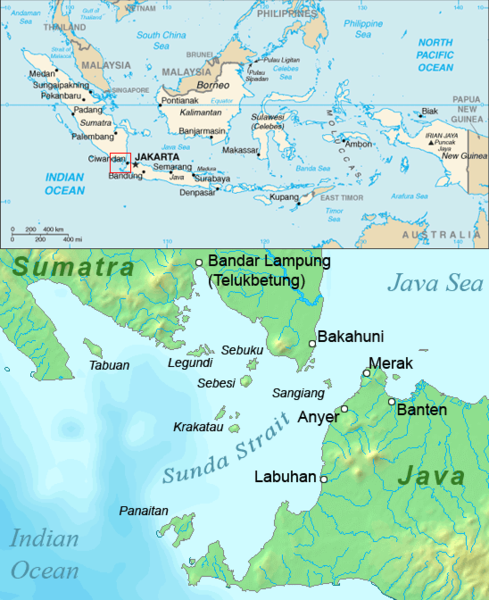
The expedition found a thick pyroclastic deposit, bracketed by appropriate radiometric dates, that suggests such a caldera collapse of a Proto-Krakatau did occur perhaps in the 6th century. Bathymetry indicates a caldera some 40 to 60 km in diameter that, with collapse below sea level, could have formed the Sunda Straits, separating Java from Sumatra, as suggested by ancient Javanese historical writings. Such a caldera collapse likely involved eruption of several hundred cubic kilometers of pyroclastic debris, several times larger than the 1815 eruption of Tambora. This hypothetical eruption likely involved magma-seawater interaction, as past eruptions of Krakatau document, but on a tremendous scale. Computer simulations of the eruption indicate that the interaction could have produced a plume from 25 to >50 km high, carrying from 50 to 100 km3 of vaporized seawater into the atmosphere. Although most of the vapor condenses and falls out from low altitudes, still large quantities are lofted into the stratosphere, forming ice clouds with super fine (<10 micrometer) hydrovolcanic ash.
Discussions with global climate modelers at Los Alamos National Laboratory led me to preliminary calculations that such a plume of ash and ice crystals could form a significant cloud layer over much of the northern and southern hemispheres. Orders of magnitude larger than previously studied volcanic plumes, its dissipation and impact upon global albedo, the tropopause height, and stratospheric ozone are unknown but certainly within possibilities for climate destabilization lasting years or perhaps several decades. If this volcanic hypothesis is correct, the global, domino-like effects upon epidemics, agriculture, politics, economics, and religion are far-reaching, elevating the potential role of volcanism as a major climate control, and demonstrating the intimate link between human affairs and nature.
More recent volcanic events which lowered global temperatures, were the 1991 eruption of Mount Pinatubo and the 1983 eruption of El Chichón.
http://www.woodfortrees.org/graph/uah/from:1978/plot/rss/from:1978
A 2002 study reported in Science demonstrated that feedback from water vapor in the atmosphere was largely responsible for the 1984 cooling.
Global Cooling After the Eruption of Mount Pinatubo: A Test of Climate Feedback by Water Vapor
The 1815 eruption of Mt. Tambora (the largest eruption in modern history) led to the Year Without a Summer in 1816.

The explosion is estimated to have been at scale 7 on the Volcanic Explosivity Index.[17] It had roughly four times the energy of the 1883 Krakatoa eruption. An estimated 160 cubic kilometers (38 cubic miles) of pyroclastic trachyandesite was ejected, weighing approximately 1.4×10¹⁴ kg (see above).This has left a caldera measuring 6–7 km (3.7–4.3 mi) across and 600–700 m (2,000–2,300 ft) deep.[2] The density of fallen ash in Makassar was 636 kg/m².[18] Before the explosion, Mount Tambora was approximately 4,300 metres (14,100 ft) high,[2] one of the tallest peaks in the Indonesian archipelago. After the explosion, it now measures only 2,851 metres (9,354 ft).[19]
The 1815 Tambora eruption is the largest observed eruption in recorded history (see Table I, for comparison).[2][4] The explosion was heard 2,600 kilometres (1,600 mi) away, and ash fell at least 1,300 kilometres (810 mi) away.[2] Pitch darkness was observed as far away as 600 kilometres (370 mi) from the mountain summit for up to two days. Pyroclastic flows spread at least 20 kilometres (12 mi) from the summit.
Mt. St Helens erupted 30 years ago next month. Like the Icelandic volcanoes, it was covered with thick ice and snow.

Mt. St. Helens prior to the eruption : Britannica Image
Meltwater from the ice and snow contacted the rising magma, leading to a huge amount of steam pressure and a massive explosion on May 18 following the collapse of the north flank.
I was involved in some experimental research around that time, which demonstrated that the amount of ash and the explosivity of volcanoes is primarily dependent on the amount of water which comes in contact with the magma underground. It can be concluded that the glaciers in Iceland are contributing to the ash, not the other way around – and that volcanoes cause climate change, not the other way around.
Brian J. Soden,1* Richard T. Wetherald,1 Georgiy L. Stenchikov,2 Alan Robock2The sensitivity of Earth’s climate to an external radiative forcing depends critically on the response of water vapor. We use the global cooling and drying of the atmosphere that was observed after the eruption of Mount Pinatubo to test model predictions of the climate feedback from water vapor. Here, we first highlight the success of the model in reproducing the observed drying after the volcanic eruption. Then, by comparing model simulations with and without water vapor feedback, we demonstrate the importance of the atmospheric drying in amplifying the temperature change and show that, without the strong positive feedback from water vapor, the model is unable to reproduce the observed cooling. These results provide quantitative evidence of the reliability of water vapor feedback in current climate models, which is crucial to their use for global warming projections.
Discover more from Watts Up With That?
Subscribe to get the latest posts sent to your email.

The city of Auckland in New Zealand is built on around 50 dormant volcanos. They are covered in grass, parks or buildings, but in the sub-tropical climate there and at just above sea level, not an ounce of ice or snow in sight; so why don’t they all blow?
“”” Alexander (06:28:46) :
The city of Auckland in New Zealand is built on around 50 dormant volcanos. They are covered in grass, parks or buildings, but in the sub-tropical climate there and at just above sea level, not an ounce of ice or snow in sight; so why don’t they all blow? “””
Well Alexander, I always thought it was more like 60; but who’s counting; once you get used to 50 Volcanoes in your back yard; why quibble over ten more.
And the lack of ice or snow on any of them is only half of the problem; in some cases; like Mt Roskill for example, they have actually tried to dig down to the magma; to the point where they carted the whole damn mountain away to spread around on the roads. That’s kinda like giving your index finger to Thor, during a thunderstorm; which can also be done in Auckland. Well Kiwis are quite used to the index finger salute.
If my memory serves me correctly, NZ actually declared war on Germany, 12 hours before Great Britain did; some sort of timing synchronisation snafu.
Well we might have looked little bit stupid if Britain had changed their mind at the last minute.
I do remember one Guy Fawkes Day, that some local Rocket Scientist had this great idea to set off a whole bunch of ancient unstable ammo, in the crater of Rangitoto; to (a) get rid of it, and (b) to simulate an eruption.
Somebody of sound mind at the time; got the idea that Pele, might actually not enjoy the wake up call, and respond with his own fireworks.
But if any of those things decided to play, it would be a big embarrassment for Aucklanders; I believe Rangitoto, is the one with the most recent history of eruption.
George
“”” Allan M (14:50:16) :
Phil Hays (18:26:41) :
Positive feedback does not mean unstable. Loop gains between 0 (no feedback) and +1 are stable.
You fail to see that the positive feedback adds to the output of the system, otherwise it is not a feedback. Think compound interest. “””
Well far more common is that positive feedback adds to the INPUT of the system, a component that is proportional to the OUTPUT, and the end result is that the final Ouput is MULTIPLIED by some factor less than infinity, rather than have something added to it.
Lots of physical systems have built in feedback; but it tends to be always negative, so it cannot lead to instability. Lenz’s law is one such situation.
I believe it is just a special form of a more general Principle known as Le Chataliere’s Principle; where a given physical effect, results in an opposing effect that tries to cancel the cause of the initial disturbance. (lots of chemical reaction examples)
An electric Motor also acts as a generator that sets up a counter EMF that always opposes the applied Voltage, so it limits the available net Voltage to drive the motor, so it limits the motor speed.
Another example can be found in some of the new types of very high internal Quantum efficiency LED structures. The internal QE can be very high; very nearly one, but much of the generated flux rattles around inside the device, limited by TIR (Total Internal Reflection) trapping which prevents its escape from the device).
But the LED is also an efficient photo-detector, specially in some cases for the actual photon energies that the diode generates; so the excess photon flux rattling around in the diode, is re-absorbed by the diode, resulting in a generated Photo-current that is opposite to the forward drive current in the diode. As a result, the diode starts to exhibit, a higher internal resistance, that limits the net drive current, and hence the output light intensity.
Higher Optical extraction efficiencies that allow the escape of more photons, result in less regenerated photo-current, and cancellation of the drive current.
But none of those feedback effects ever cause, or can cause self oscillation, except in the special case of stimulated emission, that leads to laser action. They should be called Losers, anyway, since they are unstable light Oscillators, rather than stable light Amplifiers. They only work because they can prestore higher energy electrons in some metastable state, permitting an emission gain that is greater than the round trip optical losses in the optical resonator feedback structure.
None of that happens in the case of greenhouse gas phenomena. For a start any real “optical” structure in the atmosphere always has optical transmission losses and bound by the limits of the Lagrange invariant (n.h.u) or its non paraxial equivalent (N.H.SinU), so the optical atmospheric processes can never yield an unstable positive feedback; leading to a runaway warming. It would require some additional source of energy from somewhere else to render the atmospheric system regenerative to the point of thermal runaway; in other words an atmospheric laser of sorts or its equivalent.
Even water vapor, itself an abundant green house gas cannot produce a feedback gain sufficient to cause runaway; so whether water vapor feedback is triggered by a water vapor “pulse” from the exhaust of a car; or from a CO2 “pulse” from the exhaust of a car; it can never have a regenerative runaway gain. And the problem with water vapor feedback, is that the evaporation phenomenon, is a Le Chataliere’s Principle process, and it immediately sets off a negative feedback corrective action by the formation of clouds.
So H2O by itself can never achieve runaway gain, and CO2 can at best replace part of the H2O initiation.
It’s the old brain teaser problem:- a water lily plant in the fountain pond, doubles in size every week. It takes 10 weeks from the planting of a single plant in the pond, before the fountain is completely full of water lily.
How long would it take to fill the pond with water lillies if you started with two plants instead of one ?
Well of course, all you save is the first week of growth, so it still takes nine weeks to fill the pond, if you plant two plants instead of one.
Same thing with CO2; the addition of a miniscule (400 ppm) of CO2 to an atmosphere with on average 1% of H2O, can at best save the time it took for the evaporation of the first 400 ppm of H2O; and probably much less, since H2O absorbs considerably more of the total available spectrum, than CO2 does, so 400 ppm of H2O likely causes more warming (atmospheric) than 400 ppm of CO2.
“It’s the Water; Stupid !” (not personally Allan)