In Debunking National Wildlife Federation Claims – Part 2 some commenters claimed that the snow data cited from WRI “was not good enough”. OK then, on to a bigger catchment. Steve Goddard replies in this brief essay.
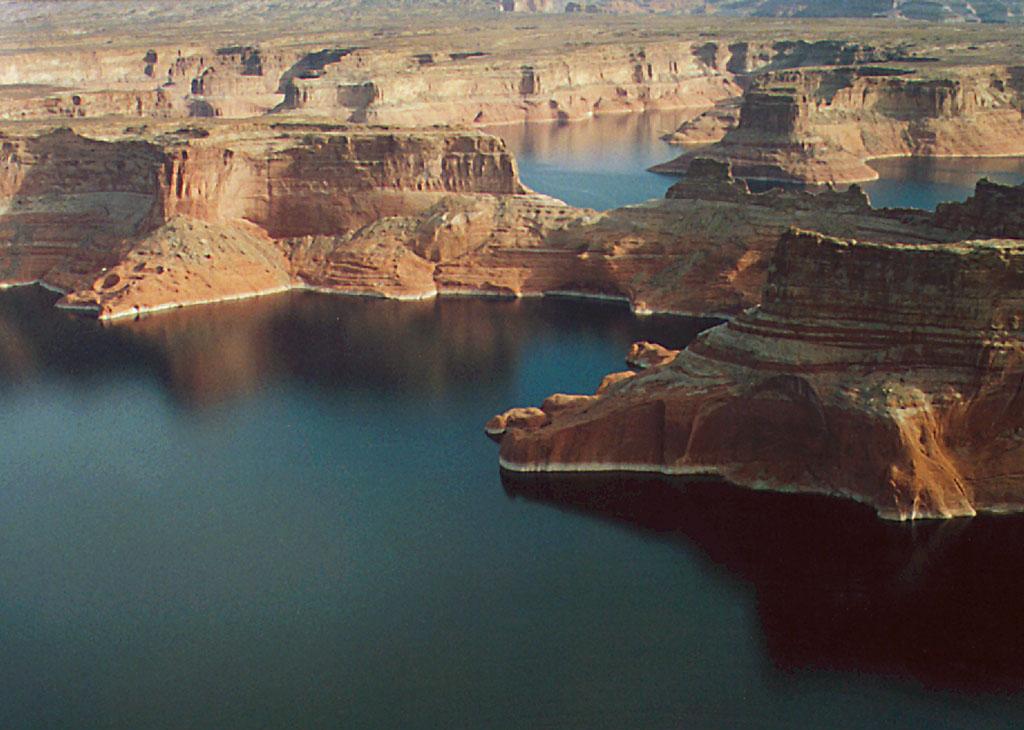
From Wikimedia: Lake Powell from above Wahweap Marina. July 2004, by Dave Jenkins
Lake Powell (Arizona and Utah) provides a good proxy for western slope snowfall, because much of the snow in Wyoming, Colorado, Utah and Northwestern New Mexico drains into the lake via the Colorado, Green and San Juan Rivers. The lake currently contains more than 4.5 trillion gallons of water and is 490 feet deep at the dam.
Between 2000 and 2005, drought conditions (combined with greatly increased water usage in Arizona, California, Nevada and Colorado) caused Lake Powell levels to drop nearly 120 feet. This prompted a considerable consensus of global warming hysteria.
Every scientific study confirms that global warming will cause the amount of water in the Colorado River to decline
But a strange thing happened in 2006 – the lake level stopped declining and instead started increasing rapidly. As you can see in the table below from lakepowell.water-data.com, since 2005 the lake elevation has increased by more than 60 feet above the 2005 low of 3562 ft. As of January 29, at 3622 ft. the lake is within three feet of the January 29 average of 3625 feet elevation. The volume of water in the lake has increased by 65% in the last five years to 4.5 trillion gallons. (At movie theater prices for bottled water, that could almost erase the US National Debt.)
The yearly change in volume is determined by the formula :
delta H = inflow – outflow – evaporation – seepage
Evaporation is relatively constant from year to year as is seepage, so the formula can be written as:
delta H = inflow – outflow – K
Outflow (water usage) has greatly increased over the last few decades due to massive population increases in Phoenix, Las Vegas and Southern California – not to mention the large and ever increasing amount of water being used by the biofuels industry. (It has been estimated by the University of Twente in The Netherlands that the manufacture of one liter of biodiesel requires 14,000 liters of water).
The point being that despite large increases in outflow, the lake level has been rapidly recovering. This could be due to only one explanation – lots and lots of snow in the Rocky Mountains during the last five years.
And an extra bonus from the “weather is not climate” department – January 29, 2010 at 39.9 degrees was ten degrees below normal and the second coldest on record.
Lake Powell (Arizonaand Utah) providesa good proxy for westernslope snowfall,because much of the snow in Wyoming,Colorado,Utah and NorthwesternNew Mexicodrainsinto the lake via the Colorado,Green and San Juan Rivers. The lake currentlycontainsmore than 4.5 trilliongallonsof water and is 490 feet deep at the dam.
Gail, you can have your own opinions, but not your own FACTS. We used to plant a lot more corn than we do now. In fact, as I posted, Corn planting was down 5% just from 2007 to 2009. Corn seeds are more expensive because they are much, much more advanced. Most of the 630 million bushels will be picked this month, and next. Corn doesn’t rot on the stalk.
Gail, field corn is selling for a touch over $0.06. It has NEVER sold for $0.02/lb. It costs between a nickel, and six cents just to grow it.
The price of cattle feed in the U.S. had absolutely nothing to do with the wheat crop in Australia, and Venezuela (drought,) Import/export problems in India, and China (rice,) or *Sweet Corn*/Tortilla prices in Mexico. In fact at the time Mexico had Severe Import Controls on U.S. Corn, and there was absolutely NO connection between the White *Sweet* Corn used in Tortillas, and the Yellow *Field* Corn we feed to cattle, and take the starch from to make ethanol.
Steve Goddard
February 1, 2010 1:08 pm
The solid/gas equilibrium is a balance between freezing and subliming molecules. Some molecules are moving from gas to solid, and others are going the other direction. If more are subliming than freezing, there is a net loss of solid. If more are freezing than subliming, the ice mass increases.
Regardless of the net equilibrium state, my statement “CO2 freezes directly out of the air” is of course correct below the freezing point of 109F. If others want to argue about something else, have at it.
Steve Goddard
February 1, 2010 1:25 pm
Kum,
In summary.
1. Lots of corn is irrigated in Colorado (and Arizona) from surface water.
2. Most of the surface water comes from snow.
3. Large amounts of water are moved from the western slope to the front range for agriculture.
4. A substantial fraction of the corn crop is used for biofuels.
Conclusion:
Biofuels has a significant impact on Colorado River streamflow.
Kum Dollison
February 1, 2010 1:48 pm
NO, I’m not buying it. You Prove to me that water from the Colorado watershed went to corn irrigation in the South Platte River Basin (where the two ethanol refineries are located.)
Your “logic” is not only faulty, it’s nonexistent.
john pattinson
February 1, 2010 2:05 pm
On the same web site as the water data is this graph showing the percentage of the average equivalent waer precipitation for the Upper Colarado http://graphs.water-data.com/ucsnowpack/index.php
Of the three most recent years plus 2010 season so far only 2008 is above average. Is there a good reason for using the January water levels as a better proxy than this graph?
Steve Goddard
February 1, 2010 2:56 pm
john,
You provided a link to a graph for one basin (out of dozens) that feeds Lake Powell.
Kum,
You can’t grow corn in Colorado without irrigation. Large amounts of western slope water are used to grow corn on both sides of the Continental Divide. http://www.greeleytribune.com/article/20070429/BUSINESS/104290117/-1/rss04
Colorado corn acreage is expected to grow by 25 percent this year in response to the high demand for corn-based ethanol, but agricultural economists say fears of resulting higher food prices are largely unfounded.
Ethanol production has been growing at breakneck speed since President Bush announced his goal of decreasing the nation’s dependence on foreign oil through his Advanced Energy Initiative last year. Colorado has a handful of corn ethanol plants producing more than 100 million gallons of ethanol each year. More plants are set to open in the next few years that will easily double that number.
Steve Goddard
February 1, 2010 3:20 pm
john,
I looked closer at your graph and it shows two out of the last three years as above the long term mean. WY 2009 hit 19 inches SWE compared to an average peak of 18 inches. WY 2008 hit 22 inches SWE. 2010 is a little below the mean. Normally El Nino years bring heavy spring snow to Colorado,
After Seven
February 1, 2010 3:37 pm
Why would one use January 29 as some magical date? I’d want to see the data for February 28, March 31, April 30, May 31 & June 30 before drawing any conclusions. If you think about it, most ski resorts open mid- December and close in late March/early April. By taking readings on January 29 you are missing all of the storm data from February March and April and all the spring runoff data for May & June.
Colorado-Big Thompson Project
The Colorado-Big Thompson Project is the largest transmountain water diversion project in Colorado.
Built between 1938 and 1957, the C-BT Project provides supplemental water to 30 cities and towns. The water is used to help irrigate approximately 693,000 acres of northeastern Colorado farmland.
Twelve reservoirs, 35 miles of tunnels, 95 miles of canals and 700 miles of transmission lines comprise the complex collection, distribution and power system. The C-BT system spans 150 miles east to west and 65 from north to south.
West of the Continental Divide, Willow Creek and Shadow Mountain reservoirs, Grand Lake and Lake Granby collect and store the water of the upper Colorado River. The water is pumped into Shadow Mountain Reservoir where it flows by gravity into Grand Lake. From there, the 13.1 mile Alva B. Adams Tunnel transports the water under the divide to the East Slope.
Once the water reaches the East Slope, it is used to generate electricity as it falls almost half a mile through five power plants on its way to Colorado’s Front Range. Carter Lake, Horsetooth Reservoir and Boulder Reservoir store the water. C-BT water is released as needed to supplement native water supplies in the South Platte River basin.
The C-BT Project annually delivers 213,000 acre feet of water to northeastern Colorado for agricultural, municipal and industrial uses.
Steve Goddard
February 1, 2010 3:45 pm
Seven,
Nothing magical about Jan 29, other than the fact that it was the most up to date information. Feel free to try out any date you want – the pattern won’t change. http://lakepowell.water-data.com/
Kum Dollison
February 1, 2010 3:48 pm
Steve, if you had done just a little research, rather than finding a 2007 paper about what someone thought might happen you would have found that Colorado corn production dropped from 1.2 million acres in ’07 to 1.05 million acres in 2009.
Your article wasn’t even accurate for the time period given. As you can see from my above link there are two ethanol plants (both in the South Platte River Basin) with an annual nameplate ability of 40 million gallons, each. As I stated before, ethanol refineries are supported, almost always, and totally, by corn grown within 30 miles.
I sincerely hope your other work is more informed, and better sourced than this has been. However, it won’t matter to me, because I surely won’t be paying any attention to it. I can think of no reason to give you the benefit of the doubt.
Steve,
I am sorry you are questioning my comment. You are wrong! For water, the boiling point is 212 degrees F at one atmosphere. If the pressure dropped, the boiling point temperature would also drop (as people at high altitudes know). Boiling is when the vapor pressure of a liquid exceeds the total surrounding pressure. When water or CO2, or any substance is at a particular temperature, it has a vapor pressure if it is at a liquid or solid state. Solids also have a vapor pressure which is temperature dependent. It turns out that CO2 has a melting point of -72 degrees F at normal pressures. The vapor pressure changes with temperature, and at one atmosphere total pressure and 0.3 torr partial CO2 pressure, CO2 can only exist (in equilibrium) in solid form at below -220 degree F. This is also true if the total gas pressure were 1 torr or 10 atmospheres, as long as the CO2 partial pressure were still 0.3 torr. Look up the vapor pressure variation with temperature, and the freezing temperature of CO2 in a handbook of Physics or Chemistry. Non equilibrium events can be different (it takes a while for a block of dry ice to all evaporate, but it does all evaporate if the temperature of the surrounding is above -220 degrees F and the partial pressure of the CO2 is maintained at 0.3 torr).
Kum Dollison
February 1, 2010 4:01 pm
One last thing, the C-BT project was authorized by FDR in 1937.
That FDR was a prescient fellow, eh? Way back in 1937 he knew those ethanol plants were going to need Co River water. Truly impressive.
Andrew Parker
February 1, 2010 4:12 pm
Pamela Gray (06:10:41) :
I am not sure about the current status, but Fresno State has done considerable study on underground drip irrigation for turf and perennial crops. I do not know what would have to be done to prep such a system for a cold winter, or if ground squirrels and other animals would tear it up.
Steve Goddard (15:40:07) :
There is are also plans for diverting Flaming Gorge Reservoir water (about double that of C-BT, iirc) to the Eastern Slope and from Lake Powell to the St. George area in Utah. I believe that there are still some units (those with the least return) of the Central Utah Project that divert water from the southern slopes of the Uintah Mountains to the Wasatch Front, that.are still pending. Since I am listing grandiose water schemes, I will add the Snake Valley to Las Vegas pipeline, which will devastate the economy and ecosystem of that starkly beautiful desert valley.
Richard Sharpe
February 1, 2010 4:17 pm
Kum Dollison (15:48:32) says:
Steve, if you had done just a little research, rather than finding a 2007 paper about what someone thought might happen you would have found that Colorado corn production dropped from 1.2 million acres in ‘07 to 1.05 million acres in 2009.
Your article wasn’t even accurate for the time period given. As you can see from my above link there are two ethanol plants (both in the South Platte River Basin) with an annual nameplate ability of 40 million gallons, each. As I stated before, ethanol refineries are supported, almost always, and totally, by corn grown within 30 miles.
I sincerely hope your other work is more informed, and better sourced than this has been. However, it won’t matter to me, because I surely won’t be paying any attention to it. I can think of no reason to give you the benefit of the doubt.
Ha ha ha. For someone who says he won’t be paying any attention, you sure have been paying a lot of attention to date.
Leonard,
This conversation is way past due for termination. Let me ask you a simple question to illustrate my point.
If the temperature at Vostok is -128F, are any CO2 molecules changing state from gas to solid (i.e. freezing.)
Of course the answer is yes. There may be just as many sublimating, but plenty are freezing.
Steve Goddard
February 1, 2010 4:28 pm
Kum,
You are wrong, and you know you are. At this point you are just lashing out.
Western slope water is used to grow corn for biofuels, and I have provided you with plenty of documentation showing that. If you aren’t familiar with the geography discussed in the articles, please do a little of your own research.
Phil M
February 1, 2010 4:58 pm
Steve Goddard (16:28:24) :
“Western slope water is used to grow corn for biofuels, and I have provided you with plenty of documentation showing that. If you aren’t familiar with the geography discussed in the articles, please do a little of your own research.”
I believe Steve is correct on this point. A quick Google query turned up a approval of an ethanol plant near Grand Junction in 2008. And one can find all locations of current ethanol plants here: http://www.ethanolrfa.org/industry/locations/
On the other hand, this facility will utilize cellulosic technology and so won’t be as woefully inefficient in energy production as “traditional” ethanol production. In addition, that facility will be designed to convert a variety of feedstocks into biofuel. The decision to locate the facility in western Colorado was no doubt influenced by the proximity of the National Renewable Energy Lab in Golden.
Phil M
February 1, 2010 5:15 pm
@ur momisugly Steve Goddard:
Based on the information your provide here and on the previous post, I’m confused by what I perceive to be conflicting statements. It seemed the point of your previous post was that snowfall had remained stable in the central Rockies for ~100 years. If I recall correctly, you posted a graph demonstrating as much.
Then, on this post you assert that the levels of Lake Powell are “a pretty good proxy for snowfall”; one can see that the Lake Powell (and Lake Mead) varied considerably here in this report, which include data back to 1964 and 1937, respectively: http://www.swhydro.arizona.edu/archive/V4_N2/feature1.pdf
Also on this post, you assert that rising reservoir levels are a result of “lots and lots of snow”, which seems a contradiction to your original analysis, again, purported to show that snow levels had remained constant.
How should one reconcile these contentions?
Kum Dollison
February 1, 2010 5:17 pm
That C-BT project was flowing water a long time before anyone even thought about building an ethanol plant in NE Colorado.
And, I’m not “lashing out.” You’re just trying to defend some sort of preconceived bias in the face of all common sense.
I’ll give you the last word. I’m through with it.
Chris Edwards
February 1, 2010 6:14 pm
It seems to me that Kum is missing the point, ethanol production squanders water and corn, plain stupidity unless hostile foreign actions force it upon you, it is low octane and gives poor fuel economy, the whole car fuel/pollution saga is a can of worms, also I would guess the plants emit water vapor? we know that is actually a “greenhouse “gas.I would say the info Steve gives googles better than Kum’s and he comes over as even! but the spat over what is a moot point is a waste of good people.
ventana
February 1, 2010 7:00 pm
The score
Steven eleven, Kum Squat.
Steve Schaper
February 1, 2010 7:30 pm
Gail,
Corn and soybean farmers don’t plant ‘veggies’. All they can plant are corn and soybeans because that is all that they can drive to the elevator and sell. We used to feed the world. Now the world feeds itself, but we are producing two or three times the corn. We have to or we can’t pay our property taxes (and other taxes). Now, when ethanol was the going thing, there was more corn than soybeans (neither of which are the types eaten by humans), but you aren’t going to see farmers in corn country planting tomatoes – they can’t sell them. Ethanol production is about 6% of the crop. The rest goes directly to feed. Of the 6% that goes to ethanol, much of that is usable afterwards as high-quality feed. Water, by the way, isn’t destroyed. There is this thing called the water cycle. You might have read about it in grade school.
The food riots overseas were about a short rice crop in Australia and environs and had NOTHING to do with ethanol or biodiesel.
Bill Parsons
February 1, 2010 9:18 pm
Your maps might focus a bit further south.
Thanks for your story. I’ve often wondered what Powell’s fluctuations tell us about drought and snowfall. Of some interest (the column missing on the right) is the outflow, I would think.


Gail, you can have your own opinions, but not your own FACTS. We used to plant a lot more corn than we do now. In fact, as I posted, Corn planting was down 5% just from 2007 to 2009. Corn seeds are more expensive because they are much, much more advanced. Most of the 630 million bushels will be picked this month, and next. Corn doesn’t rot on the stalk.
Gail, field corn is selling for a touch over $0.06. It has NEVER sold for $0.02/lb. It costs between a nickel, and six cents just to grow it.
The price of cattle feed in the U.S. had absolutely nothing to do with the wheat crop in Australia, and Venezuela (drought,) Import/export problems in India, and China (rice,) or *Sweet Corn*/Tortilla prices in Mexico. In fact at the time Mexico had Severe Import Controls on U.S. Corn, and there was absolutely NO connection between the White *Sweet* Corn used in Tortillas, and the Yellow *Field* Corn we feed to cattle, and take the starch from to make ethanol.
The solid/gas equilibrium is a balance between freezing and subliming molecules. Some molecules are moving from gas to solid, and others are going the other direction. If more are subliming than freezing, there is a net loss of solid. If more are freezing than subliming, the ice mass increases.
Regardless of the net equilibrium state, my statement “CO2 freezes directly out of the air” is of course correct below the freezing point of 109F. If others want to argue about something else, have at it.
Kum,
In summary.
1. Lots of corn is irrigated in Colorado (and Arizona) from surface water.
2. Most of the surface water comes from snow.
3. Large amounts of water are moved from the western slope to the front range for agriculture.
4. A substantial fraction of the corn crop is used for biofuels.
Conclusion:
Biofuels has a significant impact on Colorado River streamflow.
NO, I’m not buying it. You Prove to me that water from the Colorado watershed went to corn irrigation in the South Platte River Basin (where the two ethanol refineries are located.)
Your “logic” is not only faulty, it’s nonexistent.
On the same web site as the water data is this graph showing the percentage of the average equivalent waer precipitation for the Upper Colarado
http://graphs.water-data.com/ucsnowpack/index.php
Of the three most recent years plus 2010 season so far only 2008 is above average. Is there a good reason for using the January water levels as a better proxy than this graph?
john,
You provided a link to a graph for one basin (out of dozens) that feeds Lake Powell.
Kum,
You can’t grow corn in Colorado without irrigation. Large amounts of western slope water are used to grow corn on both sides of the Continental Divide.
http://www.greeleytribune.com/article/20070429/BUSINESS/104290117/-1/rss04
john,
I looked closer at your graph and it shows two out of the last three years as above the long term mean. WY 2009 hit 19 inches SWE compared to an average peak of 18 inches. WY 2008 hit 22 inches SWE. 2010 is a little below the mean. Normally El Nino years bring heavy spring snow to Colorado,
Why would one use January 29 as some magical date? I’d want to see the data for February 28, March 31, April 30, May 31 & June 30 before drawing any conclusions. If you think about it, most ski resorts open mid- December and close in late March/early April. By taking readings on January 29 you are missing all of the storm data from February March and April and all the spring runoff data for May & June.
More for Kum,
http://www.ncwcd.org/project_features/cbt_main.asp
Seven,
Nothing magical about Jan 29, other than the fact that it was the most up to date information. Feel free to try out any date you want – the pattern won’t change.
http://lakepowell.water-data.com/
Steve, if you had done just a little research, rather than finding a 2007 paper about what someone thought might happen you would have found that Colorado corn production dropped from 1.2 million acres in ’07 to 1.05 million acres in 2009.
Your article wasn’t even accurate for the time period given. As you can see from my above link there are two ethanol plants (both in the South Platte River Basin) with an annual nameplate ability of 40 million gallons, each. As I stated before, ethanol refineries are supported, almost always, and totally, by corn grown within 30 miles.
I sincerely hope your other work is more informed, and better sourced than this has been. However, it won’t matter to me, because I surely won’t be paying any attention to it. I can think of no reason to give you the benefit of the doubt.
Steve,
I am sorry you are questioning my comment. You are wrong! For water, the boiling point is 212 degrees F at one atmosphere. If the pressure dropped, the boiling point temperature would also drop (as people at high altitudes know). Boiling is when the vapor pressure of a liquid exceeds the total surrounding pressure. When water or CO2, or any substance is at a particular temperature, it has a vapor pressure if it is at a liquid or solid state. Solids also have a vapor pressure which is temperature dependent. It turns out that CO2 has a melting point of -72 degrees F at normal pressures. The vapor pressure changes with temperature, and at one atmosphere total pressure and 0.3 torr partial CO2 pressure, CO2 can only exist (in equilibrium) in solid form at below -220 degree F. This is also true if the total gas pressure were 1 torr or 10 atmospheres, as long as the CO2 partial pressure were still 0.3 torr. Look up the vapor pressure variation with temperature, and the freezing temperature of CO2 in a handbook of Physics or Chemistry. Non equilibrium events can be different (it takes a while for a block of dry ice to all evaporate, but it does all evaporate if the temperature of the surrounding is above -220 degrees F and the partial pressure of the CO2 is maintained at 0.3 torr).
One last thing, the C-BT project was authorized by FDR in 1937.
That FDR was a prescient fellow, eh? Way back in 1937 he knew those ethanol plants were going to need Co River water. Truly impressive.
Pamela Gray (06:10:41) :
I am not sure about the current status, but Fresno State has done considerable study on underground drip irrigation for turf and perennial crops. I do not know what would have to be done to prep such a system for a cold winter, or if ground squirrels and other animals would tear it up.
Steve Goddard (15:40:07) :
There is are also plans for diverting Flaming Gorge Reservoir water (about double that of C-BT, iirc) to the Eastern Slope and from Lake Powell to the St. George area in Utah. I believe that there are still some units (those with the least return) of the Central Utah Project that divert water from the southern slopes of the Uintah Mountains to the Wasatch Front, that.are still pending. Since I am listing grandiose water schemes, I will add the Snake Valley to Las Vegas pipeline, which will devastate the economy and ecosystem of that starkly beautiful desert valley.
Kum Dollison (15:48:32) says:
Ha ha ha. For someone who says he won’t be paying any attention, you sure have been paying a lot of attention to date.
Oh, forgot the link for Co Corn Production
http://usda.mannlib.cornell.edu/usda/nass/Acre/2000s/2009/Acre-06-30-2009.pdf
Leonard,
This conversation is way past due for termination. Let me ask you a simple question to illustrate my point.
If the temperature at Vostok is -128F, are any CO2 molecules changing state from gas to solid (i.e. freezing.)
Of course the answer is yes. There may be just as many sublimating, but plenty are freezing.
Kum,
You are wrong, and you know you are. At this point you are just lashing out.
Western slope water is used to grow corn for biofuels, and I have provided you with plenty of documentation showing that. If you aren’t familiar with the geography discussed in the articles, please do a little of your own research.
Steve Goddard (16:28:24) :
“Western slope water is used to grow corn for biofuels, and I have provided you with plenty of documentation showing that. If you aren’t familiar with the geography discussed in the articles, please do a little of your own research.”
I believe Steve is correct on this point. A quick Google query turned up a approval of an ethanol plant near Grand Junction in 2008. And one can find all locations of current ethanol plants here:
http://www.ethanolrfa.org/industry/locations/
On the other hand, this facility will utilize cellulosic technology and so won’t be as woefully inefficient in energy production as “traditional” ethanol production. In addition, that facility will be designed to convert a variety of feedstocks into biofuel. The decision to locate the facility in western Colorado was no doubt influenced by the proximity of the National Renewable Energy Lab in Golden.
@ur momisugly Steve Goddard:
Based on the information your provide here and on the previous post, I’m confused by what I perceive to be conflicting statements. It seemed the point of your previous post was that snowfall had remained stable in the central Rockies for ~100 years. If I recall correctly, you posted a graph demonstrating as much.
Then, on this post you assert that the levels of Lake Powell are “a pretty good proxy for snowfall”; one can see that the Lake Powell (and Lake Mead) varied considerably here in this report, which include data back to 1964 and 1937, respectively:
http://www.swhydro.arizona.edu/archive/V4_N2/feature1.pdf
Also on this post, you assert that rising reservoir levels are a result of “lots and lots of snow”, which seems a contradiction to your original analysis, again, purported to show that snow levels had remained constant.
How should one reconcile these contentions?
That C-BT project was flowing water a long time before anyone even thought about building an ethanol plant in NE Colorado.
And, I’m not “lashing out.” You’re just trying to defend some sort of preconceived bias in the face of all common sense.
I’ll give you the last word. I’m through with it.
It seems to me that Kum is missing the point, ethanol production squanders water and corn, plain stupidity unless hostile foreign actions force it upon you, it is low octane and gives poor fuel economy, the whole car fuel/pollution saga is a can of worms, also I would guess the plants emit water vapor? we know that is actually a “greenhouse “gas.I would say the info Steve gives googles better than Kum’s and he comes over as even! but the spat over what is a moot point is a waste of good people.
The score
Steven eleven, Kum Squat.
Gail,
Corn and soybean farmers don’t plant ‘veggies’. All they can plant are corn and soybeans because that is all that they can drive to the elevator and sell. We used to feed the world. Now the world feeds itself, but we are producing two or three times the corn. We have to or we can’t pay our property taxes (and other taxes). Now, when ethanol was the going thing, there was more corn than soybeans (neither of which are the types eaten by humans), but you aren’t going to see farmers in corn country planting tomatoes – they can’t sell them. Ethanol production is about 6% of the crop. The rest goes directly to feed. Of the 6% that goes to ethanol, much of that is usable afterwards as high-quality feed. Water, by the way, isn’t destroyed. There is this thing called the water cycle. You might have read about it in grade school.
The food riots overseas were about a short rice crop in Australia and environs and had NOTHING to do with ethanol or biodiesel.
Your maps might focus a bit further south.
Thanks for your story. I’ve often wondered what Powell’s fluctuations tell us about drought and snowfall. Of some interest (the column missing on the right) is the outflow, I would think.