In Debunking National Wildlife Federation Claims – Part 2 some commenters claimed that the snow data cited from WRI “was not good enough”. OK then, on to a bigger catchment. Steve Goddard replies in this brief essay.
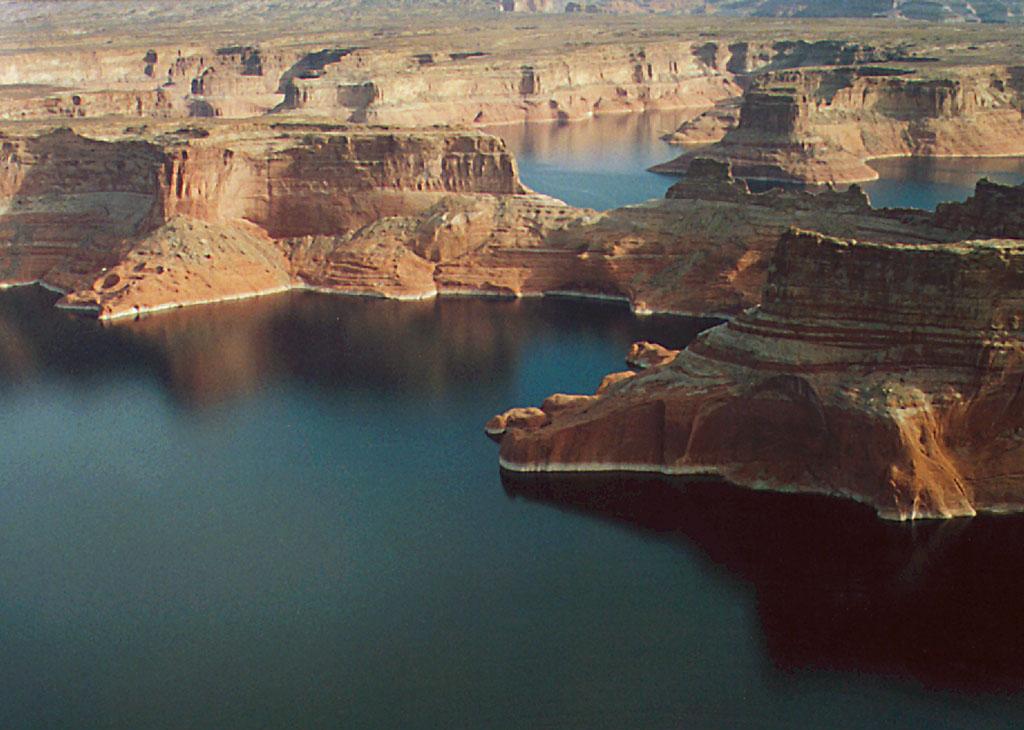
From Wikimedia: Lake Powell from above Wahweap Marina. July 2004, by Dave Jenkins
Lake Powell (Arizona and Utah) provides a good proxy for western slope snowfall, because much of the snow in Wyoming, Colorado, Utah and Northwestern New Mexico drains into the lake via the Colorado, Green and San Juan Rivers. The lake currently contains more than 4.5 trillion gallons of water and is 490 feet deep at the dam.
Between 2000 and 2005, drought conditions (combined with greatly increased water usage in Arizona, California, Nevada and Colorado) caused Lake Powell levels to drop nearly 120 feet. This prompted a considerable consensus of global warming hysteria.
Every scientific study confirms that global warming will cause the amount of water in the Colorado River to decline
But a strange thing happened in 2006 – the lake level stopped declining and instead started increasing rapidly. As you can see in the table below from lakepowell.water-data.com, since 2005 the lake elevation has increased by more than 60 feet above the 2005 low of 3562 ft. As of January 29, at 3622 ft. the lake is within three feet of the January 29 average of 3625 feet elevation. The volume of water in the lake has increased by 65% in the last five years to 4.5 trillion gallons. (At movie theater prices for bottled water, that could almost erase the US National Debt.)
The yearly change in volume is determined by the formula :
delta H = inflow – outflow – evaporation – seepage
Evaporation is relatively constant from year to year as is seepage, so the formula can be written as:
delta H = inflow – outflow – K
Outflow (water usage) has greatly increased over the last few decades due to massive population increases in Phoenix, Las Vegas and Southern California – not to mention the large and ever increasing amount of water being used by the biofuels industry. (It has been estimated by the University of Twente in The Netherlands that the manufacture of one liter of biodiesel requires 14,000 liters of water).
The point being that despite large increases in outflow, the lake level has been rapidly recovering. This could be due to only one explanation – lots and lots of snow in the Rocky Mountains during the last five years.
And an extra bonus from the “weather is not climate” department – January 29, 2010 at 39.9 degrees was ten degrees below normal and the second coldest on record.
Lake Powell (Arizonaand Utah) providesa good proxy for westernslope snowfall,because much of the snow in Wyoming,Colorado,Utah and NorthwesternNew Mexicodrainsinto the lake via the Colorado,Green and San Juan Rivers. The lake currentlycontainsmore than 4.5 trilliongallonsof water and is 490 feet deep at the dam.
The cause or the lake level rise would be all the anecdotal evidence evidence piling up. I knew all the anecdotal evidence would someday manifest itself somewhere on somebodies door step in the form of crow eating.
Kum Dollison
February 1, 2010 12:20 am
Kuhnkat, that “Twent” article was just a silly hit-piece. Many (most?) biodiesel producers don’t even use water in the process anymore.
As for corn: as I said, something like 96% of the corn used for ethanol is Not irrigated. That that is was irrigated long before the local ethanol refinery was built. As for the plants, water usage can run from zero to 4 gal/gal of ethanol, with the average being around 3. Many plants use waste water from the local municipality, or from a local river. They put the water back cleaner than they found it. As I said, a couple have been built with zero-discharge.
You want to look at water? Get a number on how much they use in the typical California oilfield (water injection,) and the typical oil refinery.
Michael
February 1, 2010 12:23 am
Lake Lanier Georgia is full now too. California water wars will be put on hold this summer too. God is good. Thanks for turning down the heat old man.
Jimbo
February 1, 2010 12:23 am
Q. If there were no human extraction of water from the lake since 1992 then what would the likely level be today?
Due to time constraints I have not read all the comments before posting this question.
Who needs biofuel, besides Obama supporters who get government subsidies? From the environmentalist’s point of view, biofuel is as bad as any regular gas or diesel when it burns — but it takes much more natural resources to produce it. From the economist’s point of view, biofuel is waste of taxpayers’ money. Remove ideological pink glasses, and you will see that it is a sheer nonsense designed to raise taxes and grab more political power.
Meanwhile, nobody is running out of oil and natural gas. If we build enough nuclear stations for heating, railways, and heavy industry, Earth’s oil and gas reserves will last for centuries. By that time, surely, safe and portable compact nuclear reactors will be moving every vehicle and every flying machine (even if we won’t come up with something better, like direct mass-to-energy converters).
Biofuel is too expensive, silly, and harmful.
Nigel S
February 1, 2010 1:46 am
Biofuels
The point, surely, is that the crops for biofuels (and the water required) are new uses since we (rich westerners at least) have to eat.
Wouldn’t it be simpler to convert to steam power for cars? Not as efficient perhaps but a lot less water use I would guess. (This is not a serious suggestion but then neither is biofuel, apart from reprocessed cooking oil which seems like a win win since it is otherwise often tipped down the drain). The only downside is the faint smell of fish and chips which makes one a bit hungry at times.
Vincent
February 1, 2010 1:54 am
You would think, that maybe someone among these researchers would have taken a look at the total water budget – how much is being drawn off. Only then, after having examined the obvious explanations, would they be in a position to look for a climate change explanation.
But then, what do I know about science?
Michael
February 1, 2010 2:17 am
Who doesn’t go to Climate Depot for their latest Man-made global warming Smack Down News? I bet the Obama administration does. I bet all the news agencies do. I bet all the AGW alarmists do. It seems that’s the only place to get the real consolidated news on climate science smack down updates. Good on ya Climate Depot http://www.climatedepot.com/
Symon
February 1, 2010 2:48 am
I think Kum has a valid point. You can’t talk about ‘biofuels’ and then quote a statistic about a biofuel which isn’t produced in the area under discussion.
As for advising someone to “research”, it’s a shame you didn’t do that with your infamous CO2-freezing-out-of-the-air-article. In that missive, it was a throwaway comment that created the rumpus, as it seems to be with this essay. Why not stay on subject, and avoid detracting attention from the point you are trying to make?
kadaka
February 1, 2010 4:13 am
@ur momisugly Nigel S (01:46:38) :
Steam power would be very efficient, and be very flexible on fuel supply as what is needed is a simple source of heat, not the precise burning characteristics required for an internal combustion engine. The major problem for people would be a 20-30 minute warm-up time to get the steam pressure up. Sure, people will buy electric cars that need an 8 hour recharge to do a 1 hour daily commute, but won’t give up being able to jump right in and go in an instant.
Oh, about used cooking oil… Back around 2007-8 I was studying online about homebrew biodiesel, checking out sites with all the info needed for DIY. As the fuel prices were skyrocketing, used restaurant oil went from being something discarded that you could have for the asking, to something people were paying for, and then there were outfits gathering it up for commercial processing. In short order it became something that had to be locked up so people wouldn’t steal it, when before they were paying to get rid of it. If it has gone back to throwaway status then fuel prices have dropped so low it’s no longer worth the effort to convert it, or there is a very low concentration of environmental and/or economical people with mechanical skills in that particular area where it’s being discarded.
Another quick biofuel note: They were selling online kits for homebrew ethanol, a thousand bucks or so each, probably still are. The sites said you could mix it with regular gasoline up to 15% without any modifications to the vehicle, recoup your investment pretty quick. About then here in central PA I started noticing new stickers at the gas pumps, “Contains 10% ethanol.” Currently, in what may be a nod to the real state of biofuels, there are stickers saying “May contain up to 10% ethanol.”
Nigel S
February 1, 2010 4:42 am
Biofuel
There was an excellent edition of ‘Top Gear’ in which they drove an unmodified old Volvo on fat straight from a chip shop cut with a little white spirit. The car seemed to run perfectly well.
bikermailman
February 1, 2010 4:51 am
Kum Dollison (23:36:05) :
RE the water being pumped over the mountain: I’m guessing that it’s for the City of Denver. There is in fact a resivoir near the Colorado River Headwaters, on the West side of the Divide, and a pipline going under the mountain. Probably not being used for irrigation in the East part of the state.
Traveling through E Colorado and W Nebraska last fall, there was in fact a prodigious amount of corn being grown, didn’t see a lot of irragation going on. This all being said, having travelled all over the Colorado River watershed, I’ve seen all manner of crops being flood irrigated. To the point that would make a Plains farmer blush. There’s a fair amount of corn crop in these parts (South Plains), almost completely irrigated, but with center pivot or drip. Much more efficient uses of water, IMO, certainly more so than the flood irrigation used even in the desert of South Arizona.
richard verney
February 1, 2010 5:33 am
Whilst I am unsure whether going back to steam is the future, regarding the post on steam cars, many of these were fitted with a flash boiler that warmed up in about 5 minutes. All one would have to do is steam up whilst you pack the car, it would then be ready to drive. Perhaps steam is making a come back since I seem to recall that within the last few months there was a land spped record set by a steam car of about 170 to 200 mph.
Well this certainly sheds new light on the greenies desire to drain the lake. No lake level to indicate that there must have been a lot of snow to result in those increases in lake level in spite of the increased outflow of water, would mean no further evidence that they are wrong!
I live in AZ and the greenies call for draining Lake Powell seem to occur in phases. Now I see what all the fuss was about the last time. They don’t even pretend to care anymore that millions of people depend on that stored water.
@ur momisugly Nigel S (04:42:41) :
There was up to a certain year of certain Volvo diesel engines that could run straight vegetable oil (SVO), about 1986 I think. When using waste vegetable oil (WVO) the major issues are filtering out fine sediments and the oil contains acids, both picked up during the cooking. When using those fuels, outside temperature can be an issue. There can be dual-fuel dual-tank systems, where regular diesel is used at the start until things warm up and then VO is used. There can also be systems using heaters for the tank and engine.
Often with VO and biodiesel there are engine timing issues, older engines with manually adjustable timing are preferred. Sensor-controlled electronic ignition systems will likely have problems, although recently manufactured vehicles are being built for multi-fuel use and can handle biodiesel and perhaps VO.
A major issue with biodiesel is it has more of a solvent character than normal diesel, it is considered corrosive. Thus older vehicles may need the old rubber hoses upgraded, and certain seals and O-rings get upgraded to Viton.
Which brings up something interesting. Diesel is basically #2 heating oil, there may be some additives for cleaner burning and to keep it from “gelling up” in real cold weather. Home heating oil is dyed red for a quick check if truckers are using it to duck paying highway fuel taxes.
Home oil furnaces can, with no exceptions I know of, burn both #2 and #1 heating oils, with #1 otherwise known as kerosene, which is a solvent. After reviewing the expected quality of homebrew biodiesel, I concluded that old-fashioned “dead dinosaur” diesel is best for vehicles, while biodiesel would be best used for home heating. Furnaces are a lot less finicky than vehicles.
Pamela Gray
February 1, 2010 6:10 am
Continuing my comment about irrigation and water conservation. Some plants require root irrigation, while others prefer leaf. And you can get a better crop, or more suited for your intended purpose, by changing the way you provide water. For example, overhead irrigation of alfalfa can lead to a product with too much stem instead of a leafy one. Flood irrigation, done once or twice, can produce a leafy plant, which is what you want. Drip irrigation is a form of root irrigation if the drip occurs along the ground. It is potentially a better way to provide water at the root level but it is damn hard to harvest around the lines, let alone replant the field, even if you don’t replant every year as is the case of alfalfa. There are ways to lay down the flexible lines and pick them back up again but the space between rows has to be pretty wide, decreasing potential yield from a field. These ways of reducing or conserving water while getting a better product are not straightforward decisions.
Ken S
February 1, 2010 6:11 am
“bikermailman (20:35:01) :
For those of you who haven’t seen the Green River, it’s fantastic at both Flaming River Gorge and the confluence with the Colorado, at Canyonlands Park, both on the map.”
I considered purchasing property along Green River just a short ways north of the city of Green River. After finding the property on the sat image of Google Map I decided that living in in a house located approx 15 foot above river surface would not be a good idea if the spring runoffs continue to to increase each year.
Approx 12 acres with 183 foot of Green River River frontage, I would never run out of water, problem might be just too much?
Here is a link to the property listing not meant to be spam, not sure if this posting will even get past the spam filter. http://www.moabproperties.com/listings/l0004.html
There are a couple nice pictures of the area and you can see the river and if the trend contines I guess the entire property will be part of the river as well.
kadaka
February 1, 2010 6:30 am
@ur momisugly Steve Goddard (05:33:37) :
“Biofuels” may need some closer defining. They make these room-sized little furnaces they call “stoves,” that blow out hot air. They run on wood pellets, coal… and there are corn burners. Straight dry feed corn, just pour it in the hopper.
I don’t know what the percentage is of corn grown that goes straight to being bulk fuel, but people may assume that “biofuel” means all that corn is going right to ethanol or similar, and overestimate how much water and other resources are used in the conversion. When there might be no “converting” to speak of.


The cause or the lake level rise would be all the anecdotal evidence evidence piling up. I knew all the anecdotal evidence would someday manifest itself somewhere on somebodies door step in the form of crow eating.
Kuhnkat, that “Twent” article was just a silly hit-piece. Many (most?) biodiesel producers don’t even use water in the process anymore.
As for corn: as I said, something like 96% of the corn used for ethanol is Not irrigated. That that is was irrigated long before the local ethanol refinery was built. As for the plants, water usage can run from zero to 4 gal/gal of ethanol, with the average being around 3. Many plants use waste water from the local municipality, or from a local river. They put the water back cleaner than they found it. As I said, a couple have been built with zero-discharge.
You want to look at water? Get a number on how much they use in the typical California oilfield (water injection,) and the typical oil refinery.
Lake Lanier Georgia is full now too. California water wars will be put on hold this summer too. God is good. Thanks for turning down the heat old man.
Q. If there were no human extraction of water from the lake since 1992 then what would the likely level be today?
Due to time constraints I have not read all the comments before posting this question.
Who needs biofuel, besides Obama supporters who get government subsidies? From the environmentalist’s point of view, biofuel is as bad as any regular gas or diesel when it burns — but it takes much more natural resources to produce it. From the economist’s point of view, biofuel is waste of taxpayers’ money. Remove ideological pink glasses, and you will see that it is a sheer nonsense designed to raise taxes and grab more political power.
Meanwhile, nobody is running out of oil and natural gas. If we build enough nuclear stations for heating, railways, and heavy industry, Earth’s oil and gas reserves will last for centuries. By that time, surely, safe and portable compact nuclear reactors will be moving every vehicle and every flying machine (even if we won’t come up with something better, like direct mass-to-energy converters).
Biofuel is too expensive, silly, and harmful.
Biofuels
The point, surely, is that the crops for biofuels (and the water required) are new uses since we (rich westerners at least) have to eat.
Wouldn’t it be simpler to convert to steam power for cars? Not as efficient perhaps but a lot less water use I would guess. (This is not a serious suggestion but then neither is biofuel, apart from reprocessed cooking oil which seems like a win win since it is otherwise often tipped down the drain). The only downside is the faint smell of fish and chips which makes one a bit hungry at times.
You would think, that maybe someone among these researchers would have taken a look at the total water budget – how much is being drawn off. Only then, after having examined the obvious explanations, would they be in a position to look for a climate change explanation.
But then, what do I know about science?
Who doesn’t go to Climate Depot for their latest Man-made global warming Smack Down News? I bet the Obama administration does. I bet all the news agencies do. I bet all the AGW alarmists do. It seems that’s the only place to get the real consolidated news on climate science smack down updates. Good on ya Climate Depot
http://www.climatedepot.com/
I think Kum has a valid point. You can’t talk about ‘biofuels’ and then quote a statistic about a biofuel which isn’t produced in the area under discussion.
As for advising someone to “research”, it’s a shame you didn’t do that with your infamous CO2-freezing-out-of-the-air-article. In that missive, it was a throwaway comment that created the rumpus, as it seems to be with this essay. Why not stay on subject, and avoid detracting attention from the point you are trying to make?
@ur momisugly Nigel S (01:46:38) :
Steam power would be very efficient, and be very flexible on fuel supply as what is needed is a simple source of heat, not the precise burning characteristics required for an internal combustion engine. The major problem for people would be a 20-30 minute warm-up time to get the steam pressure up. Sure, people will buy electric cars that need an 8 hour recharge to do a 1 hour daily commute, but won’t give up being able to jump right in and go in an instant.
Oh, about used cooking oil… Back around 2007-8 I was studying online about homebrew biodiesel, checking out sites with all the info needed for DIY. As the fuel prices were skyrocketing, used restaurant oil went from being something discarded that you could have for the asking, to something people were paying for, and then there were outfits gathering it up for commercial processing. In short order it became something that had to be locked up so people wouldn’t steal it, when before they were paying to get rid of it. If it has gone back to throwaway status then fuel prices have dropped so low it’s no longer worth the effort to convert it, or there is a very low concentration of environmental and/or economical people with mechanical skills in that particular area where it’s being discarded.
Another quick biofuel note: They were selling online kits for homebrew ethanol, a thousand bucks or so each, probably still are. The sites said you could mix it with regular gasoline up to 15% without any modifications to the vehicle, recoup your investment pretty quick. About then here in central PA I started noticing new stickers at the gas pumps, “Contains 10% ethanol.” Currently, in what may be a nod to the real state of biofuels, there are stickers saying “May contain up to 10% ethanol.”
Biofuel
There was an excellent edition of ‘Top Gear’ in which they drove an unmodified old Volvo on fat straight from a chip shop cut with a little white spirit. The car seemed to run perfectly well.
Kum Dollison (23:36:05) :
RE the water being pumped over the mountain: I’m guessing that it’s for the City of Denver. There is in fact a resivoir near the Colorado River Headwaters, on the West side of the Divide, and a pipline going under the mountain. Probably not being used for irrigation in the East part of the state.
Traveling through E Colorado and W Nebraska last fall, there was in fact a prodigious amount of corn being grown, didn’t see a lot of irragation going on. This all being said, having travelled all over the Colorado River watershed, I’ve seen all manner of crops being flood irrigated. To the point that would make a Plains farmer blush. There’s a fair amount of corn crop in these parts (South Plains), almost completely irrigated, but with center pivot or drip. Much more efficient uses of water, IMO, certainly more so than the flood irrigation used even in the desert of South Arizona.
Whilst I am unsure whether going back to steam is the future, regarding the post on steam cars, many of these were fitted with a flash boiler that warmed up in about 5 minutes. All one would have to do is steam up whilst you pack the car, it would then be ready to drive. Perhaps steam is making a come back since I seem to recall that within the last few months there was a land spped record set by a steam car of about 170 to 200 mph.
Here are some references.
One third to one half of water pumped over from the western slope is used for agriculture.
http://www.allbusiness.com/environment-natural-resources/ecology-environmental/13626685-1.html
Over 90 percent of water consumed through human activities in Colorado occurs in agriculture.
http://www.colorado.edu/law/centers/nrlc/publications/water_and_growth_faq.pdf
Mesa County is the largest water user in the state. It is almost all agricultural and is 99% surface water. Weld County is the largest corn producer and the second largest water user in the state. 80% of the water used in Weld County is surface water.
http://co.water.usgs.gov/infodata/wateruse.html
One third of corn production in the US is for biofuels.
http://www.europeaninstitute.org/May-2008/biofuels-once-seen-as-a-climate-panacea-now-causing-food-headaches-and-transatlantic-second-thoughts.html
Symon,
The freezing point of CO2 is -109 degrees. In Antarctica it gets as cold as -128 degrees.
Good luck trying to grow corn in Colorado or Arizona without irrigation. Most of the corn growing regions receive 15 inches of precipitation or less per annum.
http://www.nationalatlas.gov/printable/images/pdf/precip/pageprecip_co3.pdf
Symon,
How is biofuels water usage off topic? It is a big part of the water equation in the Rocky Mountains.
Well this certainly sheds new light on the greenies desire to drain the lake. No lake level to indicate that there must have been a lot of snow to result in those increases in lake level in spite of the increased outflow of water, would mean no further evidence that they are wrong!
I live in AZ and the greenies call for draining Lake Powell seem to occur in phases. Now I see what all the fuss was about the last time. They don’t even pretend to care anymore that millions of people depend on that stored water.
Biofuel from ‘food-stock’ is so wrong, at so many levels,,, inclusive of the fact that they are at least as carcinogenic for the acetaldehydes and formaldehydes formed and (est.) to result in ~10% higher incidence of asthma, emphysema and other pulmonary diseases.
Perhaps not the point, herein, but at least as relevant~
http://www.highlighthealth.com/eco-friendly/alternative-ethanol-fuel-wont-improve-future-air-quality/
http://woods.stanford.edu/docs/biofuels/BiofuelsCommentary.pdf
richard verney (05:33:05)
New steam car record, yes, these crazy guys
http://www.steamcar.co.uk/lsr_history.html
An American put up the money so thanks for that.
Steve,
Remember this?
http://wattsupwiththat.com/2009/06/13/results-lab-experiment-regarding-co2-snow-in-antarctica-at-113%C2%B0f-80-5%C2%B0c-not-possible/
I guess not.
@ur momisugly Nigel S (04:42:41) :
There was up to a certain year of certain Volvo diesel engines that could run straight vegetable oil (SVO), about 1986 I think. When using waste vegetable oil (WVO) the major issues are filtering out fine sediments and the oil contains acids, both picked up during the cooking. When using those fuels, outside temperature can be an issue. There can be dual-fuel dual-tank systems, where regular diesel is used at the start until things warm up and then VO is used. There can also be systems using heaters for the tank and engine.
Often with VO and biodiesel there are engine timing issues, older engines with manually adjustable timing are preferred. Sensor-controlled electronic ignition systems will likely have problems, although recently manufactured vehicles are being built for multi-fuel use and can handle biodiesel and perhaps VO.
A major issue with biodiesel is it has more of a solvent character than normal diesel, it is considered corrosive. Thus older vehicles may need the old rubber hoses upgraded, and certain seals and O-rings get upgraded to Viton.
Which brings up something interesting. Diesel is basically #2 heating oil, there may be some additives for cleaner burning and to keep it from “gelling up” in real cold weather. Home heating oil is dyed red for a quick check if truckers are using it to duck paying highway fuel taxes.
Home oil furnaces can, with no exceptions I know of, burn both #2 and #1 heating oils, with #1 otherwise known as kerosene, which is a solvent. After reviewing the expected quality of homebrew biodiesel, I concluded that old-fashioned “dead dinosaur” diesel is best for vehicles, while biodiesel would be best used for home heating. Furnaces are a lot less finicky than vehicles.
Continuing my comment about irrigation and water conservation. Some plants require root irrigation, while others prefer leaf. And you can get a better crop, or more suited for your intended purpose, by changing the way you provide water. For example, overhead irrigation of alfalfa can lead to a product with too much stem instead of a leafy one. Flood irrigation, done once or twice, can produce a leafy plant, which is what you want. Drip irrigation is a form of root irrigation if the drip occurs along the ground. It is potentially a better way to provide water at the root level but it is damn hard to harvest around the lines, let alone replant the field, even if you don’t replant every year as is the case of alfalfa. There are ways to lay down the flexible lines and pick them back up again but the space between rows has to be pretty wide, decreasing potential yield from a field. These ways of reducing or conserving water while getting a better product are not straightforward decisions.
“bikermailman (20:35:01) :
For those of you who haven’t seen the Green River, it’s fantastic at both Flaming River Gorge and the confluence with the Colorado, at Canyonlands Park, both on the map.”
I considered purchasing property along Green River just a short ways north of the city of Green River. After finding the property on the sat image of Google Map I decided that living in in a house located approx 15 foot above river surface would not be a good idea if the spring runoffs continue to to increase each year.
Approx 12 acres with 183 foot of Green River River frontage, I would never run out of water, problem might be just too much?
Here is a link to the property listing not meant to be spam, not sure if this posting will even get past the spam filter.
http://www.moabproperties.com/listings/l0004.html
There are a couple nice pictures of the area and you can see the river and if the trend contines I guess the entire property will be part of the river as well.
@ur momisugly Steve Goddard (05:33:37) :
“Biofuels” may need some closer defining. They make these room-sized little furnaces they call “stoves,” that blow out hot air. They run on wood pellets, coal… and there are corn burners. Straight dry feed corn, just pour it in the hopper.
I don’t know what the percentage is of corn grown that goes straight to being bulk fuel, but people may assume that “biofuel” means all that corn is going right to ethanol or similar, and overestimate how much water and other resources are used in the conversion. When there might be no “converting” to speak of.