UPDATE: Easy come, easy go, the sharp decline has popped back up to near normal in the space of a couple days. See the end of the story for update.
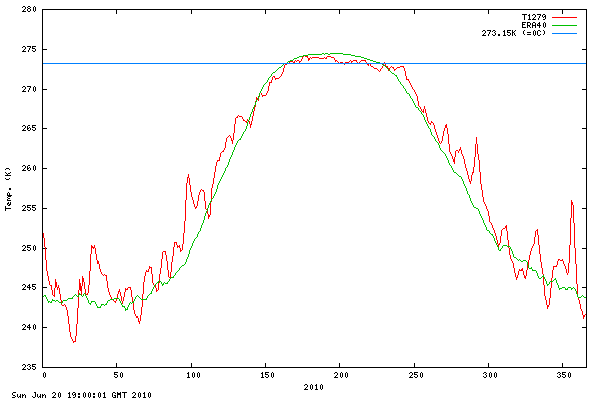
According to the Danish Meteorological Institute, Arctic temperatures are currently below 238K (-35.15 degrees Celsius or -31.27 degrees Fahrenheit)
That is more than five degrees below normal (the green line) and the lowest reading since 2004. The slope of decline has also recently been quite sharp, dropping from 252K on January 1, a drop of 14 degrees in 22 days.

Source: http://ocean.dmi.dk/arctic/plots/meanTarchive/meanT_2010.png
For an interactive view, showing historical data see:
http://ocean.dmi.dk/arctic/meant80n.uk.php
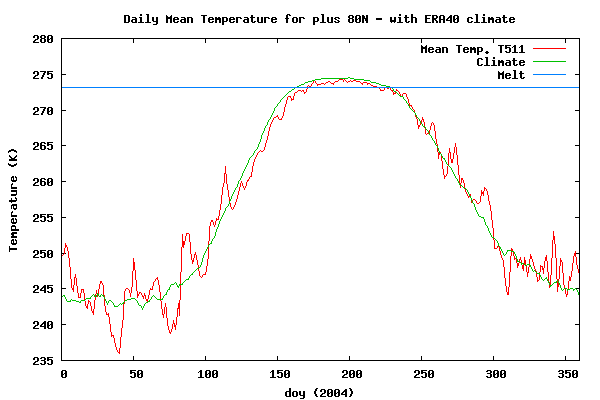
The last time temperatures were this low in the Arctic was in February, 2004, where the 80N temperature reached 236K.

Source: http://ocean.dmi.dk/arctic/plots/meanTarchive/meanT_2004.png
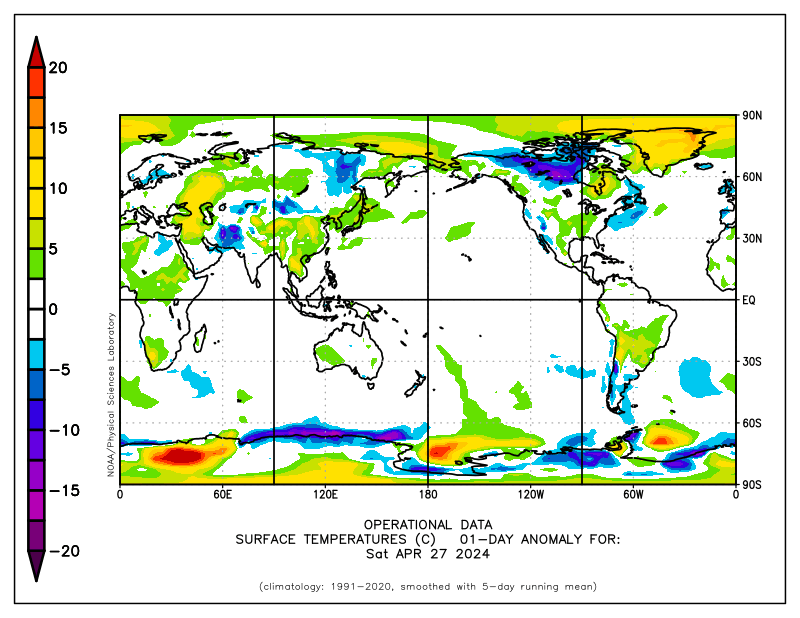
In other news, temperatures in both the Arctic and Antarctic are well below normal.

Source: http://www.esrl.noaa.gov/psd/map/ANIM/sfctmpmer_01a.fnl.30.gif
h/t to Steve Goddard
UPDATE: Quick rebound from the coldest temperature since 2004, will it oscillate back?

OT (maybe).
Has anyone ever challenged Hansen on his being in a position of conflict? I mean the guy adjusts the data, bitches about it yet we’re supposed to think he’s reporting it as a neutral scientist. If this was business he’d be in court defending his manipulating of data for personal gain!
Steve Goddard (09:48:41) :
Phil,
The coldest temperature in six years what this article is about, not “a few days below normal.”
A couple of days at 5ºC below vs. ~100 days at 5ºC above doesn’t seem that worthy of note.
davidmhoffer (11:25:30) :
Phil doth quote:
Actually there’ll be long wave coming in, probably around 100+ W/m^2.
Can you help me understand from where?
Clouds, long wave isn’t solar (no sun there at present).
OK, I found it myself …
http://www.accuweather.com/ukie/bastardi-europe-blog.asp?partner=accuweather
The West might be spared somewhat and the Northern Plains as well but the cold conveyor belt through Winterpeg is forming to deliver a February onlslaught to the East Coast of North America. Good for Chicago Hub Nat Gas prices anyway.
I guess we will get some sealing ice … maybe I’ll leave that topic alone 😀
Phil. (20:49:51) says:
Phil. seems correct. For something like the last 130 days or so Arctic temperatures have been at or below 270K(-3C), but for something like 100 of those days they have been above the average of the recording period by several degrees, perhaps as much as 5K(C).
Phil,
The coldest day in the Arctic out of the last 2,100 days, is definitely worthy of note.
Not really, it’s really no colder than it was 2 years ago.
Another reason for the recent cooling is extra albedo.
The N hemisphere has been covered in snow for four weeks, reflecting all incoming solar energy. Likewise, there have been large saturated anticyclones. Even now, there is low stratus stretching from Bulgaria to France, with 99% reflectivity.
The higher latitudes have been starved of solar radiation for four weeks. That has to reduce the amount of energy reaching the pole.
.
>>Actually there’ll be long wave coming in, probably around 100+ W/m^2.
>>Can you help me understand from where?
>>Clouds, long wave isn’t solar (no sun there at present).
Not sure about that. Clouds reflect (absorb-transmit) back what is coming up from the surface – they are an insulator, not a heat source. The polar surface will be COLD, so will the clouds.
In Europe, the daytime surface temperature is about -5oc. The clouds at 1000ft are about -2oc (slight inversion). There will be precious little LW radiation returned from them (but they will prevent night temperatures dropping to -20oc).
.
Suppressed by the 31-year AO negetivity, the arctic is damned for everything – melting ice, global warming, endangering species and all other that can be, or cannot be named.
Now, the suppressed arctic is in a revolution, and the revolution is all but complete, arctic recharged, bringing back the arctic that was, shockened the arrogant human that believed in global warming, and return everything that the arctic have been damned for.
C’est la lutte finale, groupons-nous, et demain, l’internationale, sera le genre ARCTIQUE.
” The slope of decline has also recently been quite sharp, dropping from 252K on January 1, a drop of 14 degrees in 22 days.”
At the end of December the graph was down at about 244K. The 2009 graph stayed up for several days and when the 2010 graph came up at 252K I wondered what was going on, but graphs are usually quite spiky, so I didn’t pursue it. If you go back through the archived graphs the present temp is not that unusual, except for the most recent years temps at or below the present number are there in the majority of years, usually as spike, but sometimes lasting longer.
Richard M (18:40:46) :
Thanks for pointing that out
Phil,
I superimposed the 2010/2008 plots, and it is more than half a degree colder in 2010 than the coldest in 2008.
rbateman (15:40:54) :
“Dave Andrews (13:13:52) :
They just don’t get it, plain and simple. If you take the Polar Air and blow it down on the temperate zones all winter, it makes for one heck of a climate change. Who cares if the Arctic is above normal in the winter, where nothing can melt and nobody live there, but we sure as heck do care that things are well below normal in the Northern Temperate zone where billions of people live.”
You’ve hit the nail on the head!
The NH is by far the most important part of the world as far as population density is concerned, and a couple of degrees Celsius colder than recent years will have a significant negative impact upon us. However, a few degrees increase in temperature will have many positive benefits for agriculture and reduced energy use.
The whole idea that global average temperature is important is a complete myth.
AndyW (07:16:43) :
The arctic was overly warm with the AO in December and now has swung the other way, then threads were posted on how cold Europe was, now it is how cold the Arctic is since Europe is more normal again.
Stop cherry picking!
It is in the weather not climate forum. The warm Arctic/cold mid NH and cold Arctic/warm mid NH has already been remarked upon. The interesting point is when we have a “warm Arctic/frozen EU/USA” is the earth radiation more energy than normal?
Heh, interesting, now that it is “Cold” it makes the blog, but when it was “warm” for the last 1/3rd of 2009 not a peep.
http://ocean.dmi.dk/arctic/plots/meanTarchive/meanT_2009.png
and imagine that, cold in the Arctic in winter! Shocking.
REPLY: If the temperature had dramatically shot up, we’d be covering it. WUWT has covered a number of “warm” stories recently:
http://wattsupwiththat.com/2010/01/22/warmest-decade-on-record/
http://wattsupwiththat.com/2010/01/08/high-fire-danger-in-south-australia-as-temperatures-soar/
http://wattsupwiththat.com/2010/01/15/uah-satellite-data-has-record-warmest-day-for-january/
Your complaint is nulled. – A
and since the temp just whipped back up to pretty much normal…do we now debate if wuwt does articles on normal? sorry, couldn’t resist.
REPLY: If the temperature had dramatically shot up, we’d be covering it. WUWT has covered a number of “warm” stories recently:
You mean like this…..
http://ocean.dmi.dk/arctic/meant80n.uk.php
REPLY: Thanks for pointing that out, hadn’t checked it today yet. -A
Oh sorry, I was specifically talking about the DMI data Anthony…which seemed relevant given the topic of the post.
So…maybe not nulled?
REPLY: Still nulled, your argument is that I don’t report “warm” things, and I’ve illustrated 3 stories this month on “warm” things, plus an update to the current story. Still doesn’t change the fact that the temperature dip is the lowest since 2004, which is noteworthy. If you don’t want to see these things visit another blog. – A
I’m not sure where the idea came from that temperatures in Europe have moderated. Temperatures across Europe are very cold, and forecast to get even colder. Berlin is forecast to go below 0F this week.
http://wxmaps.org/pix/temp4.html
http://www.wunderground.com/global/stations/10385.html
Average temperatures in the Arctic have ranged this year from a high of -25C to a low of -35C. Currently they are -30C. Anyone who considers these temperatures to be “warm” must be living in an alternate reality. I was in -23C weather a couple of weeks ago and it is painful bone chilling cold.
Ralph (00:26:44) :
>>Actually there’ll be long wave coming in, probably around 100+ W/m^2.
>>Can you help me understand from where?
>>Clouds, long wave isn’t solar (no sun there at present).
Not sure about that. Clouds reflect (absorb-transmit) back what is coming up from the surface – they are an insulator, not a heat source.
We’re talking about the Arctic in winter, the clouds act as black body radiators.
The polar surface will be COLD, so will the clouds.
The Arctic atmosphere in winter is in an almost permanent strong inversion.
Surface temps ~240K, top of inversion ~250-260K, that would amount to ~30% excess of down-welling over up-welling.
In Europe, the daytime surface temperature is about -5oc. The clouds at 1000ft are about -2oc (slight inversion). There will be precious little LW radiation returned from them (but they will prevent night temperatures dropping to -20oc).
We’re not talking about Europe in daylight.
I will forecast also:
The red line is going up to meet the average, which means warm air masses have arrived at the pole which means brutal cold air is replacing them in the more southern regions, and I can vouch for that since in Greece we are getting the first below zero C night measurements of the year.
OOOH! look! cold weather. See global warming isnt real its all a hoax. Oil companies are far more reliable that scientists.
Scientists and engineers at oil companies keep your car running, your house warm, and your store full of food. Without oil companies, society would collapse within a week.
On the other hand, the disappearance of climate science would no impact on your life whatsoever.
Steve Goddard (08:07:37) :
Phil,
I superimposed the 2010/2008 plots, and it is more than half a degree colder in 2010 than the coldest in 2008.
I did the same, maybe 0.5ºC max, however that temperature fluctuates by several degrees/day so not exactly significant!
Even less so now that it’s 2ºC above average.
Perhaps the title should be changed “to arctic-temperatures above 80°n are back above normal”? 😉