August 2009 Global Temperature Update: +0.23 deg. C
Dr. Roy Spencer September 4th, 2009
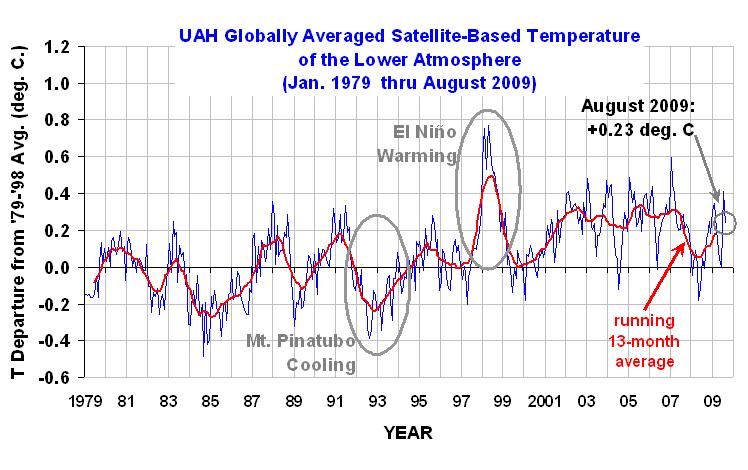
August 2009 saw a modest fall in the global average tropospheric temperature anomaly, from +0.41 deg. C in July to +0.23 deg. C in August. The tropical and Northern Hemispheric troposphere remain quite warm, but the Southern Hemisphere cooled by over 0.4 deg. C in the last month.
YR MON GLOBE NH SH TROPICS
2009 1 +0.304 +0.443 +0.165 -0.036
2009 2 +0.347 +0.678 +0.016 +0.051
2009 3 +0.206 +0.310 +0.103 -0.149
2009 4 +0.090 +0.124 +0.056 -0.014
2009 5 +0.045 +0.046 +0.044 -0.166
2009 6 +0.003 +0.031 -0.025 -0.003
2009 7 +0.412 +0.212 +0.610 +0.427
2009 8 +0.231 +0.284 +0.179 +0.455
NOTE: For those who are monitoring the daily progress of global-average temperatures here, we are still working on switching from NOAA-15 to Aqua AMSU, which will provide more accurate tracking on a daily basis. We will be including both our lower troposphere (LT) and mid-tropospheric (MT) pre-processing of the data. We will also be adding global sea surface temperature anomalies from the AMSR-E instrument on board the NASA Aqua satellite.
Whatever happens it was predicted by the models.
“Forecasts of climate change are about to go seriously out of kilter. One of the world’s top climate modellers said Thursday we could be about to enter “one or even two decades during which temperatures cool.”
http://www.newscientist.com/article/dn17742-worlds-climate-could-cool-first-warm-later.html
Based on AGW theory, July temperature spike should have initiate higher evaporation, which would have caused increased GH effect, which should have warmed oceans and led to more CO2 released, which should have caused temperature increase, which should have increased humidity, which should have… but temperature just fell back.
I would think the relative cooling of the SH basically stems from Antarctic/Southern ocean. While not explainig why they are record high, generally elevated temperatures in Oz is a consequence of the current el Nino.
Cassanders
In Cod we trust
“Frank Mosher (19:26:46) :
Flanagan. What happened?”
Hahaha!! Yes Flanagan where are you? Earlier this year he promised me a super El Nino and we agreed to review temperature data in September 2009…
Way OT, but I am eager to know about the scaling between a Denmark organization and IRAC/JAXA in graphing the arctic ice extent.
For the former, the ordinate starts at “0 million km2”:
http://ocean.dmi.dk/arctic/icecover.uk.php
For the latter, the ordinate starts at ” 2 million km2″:
http://www.ijis.iarc.uaf.edu/seaice/extent/AMSRE_Sea_Ice_Extent.png
However, to my presbyopic eyes, the two graphs look essentially identical.
The origin of the ordinate for the Danish graph should be “2 million Km2” and not “0 million km2”, or?
Could a sea ice expert teach me please?
Oops, typo. On line 1, “scaling between” should read “scaling difference between”.
1. If we get a La Nina on the scale of the 1997/98 el Nino, will temperatures drop down to below pre-1998 levels? What’s that got to do with humans if it happens?
2. How confident are we that the actual data generated isn’t the artefact of pre-chosen statistics?
3. If we accept a step shift up of 0.2 degrees post 2000, with no discernible upward trend currently to worry about, is that going to melt the entire icesheet of Greenland?
Seems to me that the data says: the Earth may exist in a variety of states, but there’s nothing in the past 50 years which says we’re going into a meltdown situation……..
OT: Kaufmann graphics that speaks for them selves:
http://www.klimadebat.dk/forum/vedhaeftninger/kaufmannf.gif
http://www.klimadebat.dk/forum/vedhaeftninger/kaufmann1.gif
http://www.klimadebat.dk/forum/vedhaeftninger/kaufmannd.gif
Kaufman added a graph with today 0,6K higher than 1940. GISS said that 1940 was at the same level as today:
http://www.junkscience.com/MSU_Temps/Arctic1880-2004_1.gif
Why this difference? Does it seem objective for Kaufmann to apply the 0,6K-graph?
Josh (22:04:05) :
Yup. Last weekend we were up in the Sylvan Lake area. Leaves on both aspen and brush beginning their change. Somewhat cool and autumn like.
http://parks.state.co.us/parks/sylvanlake
Sea temperatures where cold this august and september in the SH.
re Ozzie winter … tad warmer north of a latitude line north of about Woolongong, south of this line however has been cold (Ski season has been awesome and it’s powering on with some great snowfalls due to hit early in the new week) and central, western and southern states have been cold. It’s all about where the winds/ jet streams have been blowing from and towards. Meanwhile the planet continues to cool.
Anyone else caught this? Concessions in a recent report that solar activity and ENSO conditions are major climate drivers. This is nothing new of course and the report still panders to the usual AGW BS. Noteworthy though is the evidence based reference to these and other natural drivers of climate and indeed the website itself posting this report as showing a willingness to be a little more open minded. Worth a look. Follow link here. http://www.spaceweather.com/
“If this is what it takes to get the AGW monkey off our backs, well, that’s what it takes.”
Sorry cold winter just weather. Hot weekend climate change.
“Floods remain as downpour ends”
http://news.bbc.co.uk/1/hi/scotland/8239074.stm
Moray SNP MP Angus Robertson—-“The hard lessons learnt from this latest devastation include the need for local agencies to redouble their efforts to get flood prevention measures into place and to recognise that climate change will only lead to more flooding in the future.”
Bryn:
http://www.osdpd.noaa.gov/ml/ocean/sst/anomaly.html
SH is mostly water, and there’s lots of cold water.
Gene Nemetz (00:35:19) :
You’re probably thinking of the Old Farmer’s Almanac. They haven’t made their annual announcement of publication yet, but they do have the 2010 weather data up.
They also redid their web site. Some regional forecasts sound a lot like this year, the PDO continues. From http://www.almanac.com/weather (click on “Long-Range weather forecast” for details, but that doesn’t include the regional name.
Northeast:
Winter will be colder than normal, on average, primarily due to persistent cold temperatures in January, with only brief thaws. Other cold periods will occur in mid-December and mid-February. Precipitation and snowfall will be below normal. Watch for a snowstorm around Thanksgiving, with other snowy periods in mid- and late December and mid- and late January.
April and May will be slightly cooler than normal, with below-normal precipitation continuing and raising concern of summer drought.
Summer will be cooler than normal, with slightly below normal rainfall. The hottest periods will be in early and mid-June, late July, and early to mid-August.
September and October will be slightly drier than normal, with near-normal temperatures.
Upper midwest:
Winter will be much colder than normal, with temperatures 3 degrees below normal, on average, in the east and 6 degrees below in the west. The coldest periods will occur in mid-December, early and mid- to late January, and early and mid- to late February. Precipitation and snowfall will be below normal in the east and above normal in the west. The snowiest periods will occur in mid- to late November, mid-December, early January, mid- to late February, and early to mid- and mid- to late March.
April and May will be warmer than normal in the east but cooler in the west. Precipitation will be above normal, with widespread snow in mid-April.
Summer will be cooler than normal, with below-normal rainfall in the east and near-normal rainfall in the west. The hottest periods will occur in mid-July and early August.
September and October will be slightly cooler than normal, with near-normal precipitation.
Texas/Oklahoma:
Winter will be colder than normal, on average, from the Metroplex north and westward, with near-normal temperatures elsewhere. The coldest periods will occur in the second week of December, early to mid-January, and early to mid-February. Precipitation and snowfall will be near or slightly below normal. The most significant snow and ice will occur in mid-December, early January, and early and mid-February.
April and May will be warmer then normal, with near-normal rainfall.
Summer will be hotter and drier than normal, with the hottest periods from late June through the first half of July and in early to mid-August. The likelihood of a major hurricane is below normal.
September and October will bring near-normal temperatures, on average, with slightly below normal rainfall.
Desert Southwest:
Winter will be colder than normal, on average, especially in the west, with the coldest periods in early to mid-December, mid-January, and early to mid-February. Precipitation and snowfall will be near normal, with the snowiest periods in mid-December, early January, and mid-February.
April and May will be cooler than normal, with above-normal rainfall in the west.
Summer will be cooler and drier than normal, with the hottest temperatures in early and late July and early August.
September and October will be cooler and drier than normal.
Oh yeah?
We had snow in the mountains outside Kabul into mid August (last year it was all gone in early June). Our temps have already plunged below 32°C almost a month early. In fact we didn’t break 32°C the last week and a half of August. Plus we got treated to two big gully washers last week (very unusual for August). Nights are already around 10°C.
The birds here are already starting their migrations too. The swallows moved out a week ago.
Yep, methinks we too are in for a VERY cold one.
On the plus side, the bad guys go to ground when the weather is bad. Here’s hoping they freeze their nibblets off in their caves!
Bryn
did you actually read what he said, rather than what the reporter thought he said.
““There’s a lot of natural variability but you’ve got a climate change signal on top of that.””
“Harry Eagar (20:06:48) :
I do not believe anybody knows the global temperature to a ten-thousandth of a degree.
I don’t even believe anybody knows it to a full degree, but we might debate that.”
You are right, of course. But this time the fault lies with WUWT and their chosen title.
Please notice what they call it in the graph, and that the “UAH” at the beginning is almost like a disclaimer.
Part of looking at such numbers is wondering what they means.
(A very similar problem is that the IQ is called IQ)
The lesson I am drawing about gloal temperature changes from the recent La Nina and the current mild El Nino conditions concerns the responsiveness of the global air circulation systems to changes in tropical ocean SSTs.
All the more significant for the coming few years is the current relative coolness of the southern hemispere SSTs which is likely to filter across to the northern hemisphere over time and be compounded by the rapid heat loss of the northern continents in winter.
Whilst the La Nina was present the air circulations were well equatorward of normal and now with El Nino they have returned poleward towards normal but are still not as poleward as during the 1975 to 2000 warming period.
The past two UK summers were worse than the present one but even this summer the relative warmth has been limited mostly to the south east quadrant of the UK. The Met Office summer forecast could only ever have come right if the oceans had been significantly warmer or warm for significantly longer.
The latitudinal positions of the air circulation systems really do seem to ebb and flow poleward and equatorward along with changes in ocean SSTs with consequent regional climate changes over time.
On multidecadal time scales the current phase of the oceans seems to be the primary climate driver and as we have seen over the past few years that driver swamps any anthropogenic influence. Until the experts get the balance right their forecasts cannot improve but to get it right they have to take the current ‘weighting’ for CO2 effects out of the equation and replace it with a far lower number and possibly remove it altogether.
On the basis of the last few years the rapid responses in the air to ocean changes are persuading me and should persuade others that the short term ocean and air behaviour is far more powerful than previously acknowledged. Even ENSO variability is clearly seen reflected in air circulation changes let alone the multidecadal phase shifts.
There is no reason why ocean variability need be limited to interannual ENSO and multidecadal PDO shifts either. There could be longer term ocean variability not yet identified but I do not rely on that at this point.
Longer term background trends are more likely to be solar induced than CO2 induced because solar trends affect ocean energy content whereas CO2 only affects the temperature of the air and so is swiftly dealt with by minor adjustments in the air.
Ocean surface water variability causes surface air temperature anomalies then the air circulation shifts to neutralise them. The entire air circulation system and the hydrological cycle are involved.
I don’t think there is any evidence that any ‘equilibrium’ temperature has ever actually changed from changes in the air alone. That is merely an extrapolation from the ideas of Tyndall and others combined with the current absence of any serious attempt to find a mechanism that could neutralise such an effect.
To achieve such a change in any equilibrium temperature one has to change the energy content of the oceans beyond the changes attributable to solar and oceanic variability. To date we don’t even have a grip on the solar effects let alone other influences.
It is true that changes in the composition of the air will change the thermal characteristics of the air but that has no effect on equilibrium unless it can be transmitted to the oceans and all the evidence is that that cannot happen on any timescale less than millennia and even then it would be unmeasurable from our puny influence.
Instead all that happens is a miniscule shift in the air circulation systems and a miniscule change in the speed of the hydrological cycle transferring energy faster to space. I have proposed that as the mechanism countering any changes in equilibrium from changes in the air alone and await any serious attempt at countering it.
Extra energy from the oceans (often a huge amount) is disposed of in exactly the same way with no tipping point in sight but with air circulation shifts of hundreds of miles latitudinally. There mght be a latitudinal shift of less than a mile from anything that humans could achieve. Wholly insignificant against natural variability.
tokyoboy (01:27:47) :
Way OT, but I am eager to know about the scaling between a Denmark organization and IRAC/JAXA in graphing the arctic ice extent.
The main difference between these two graphs is that JAXA defines sea ice extent as the area where sea ice concentration exceeds 15%. The explanation’s a few paragraphs below the graph here:
http://www.ijis.iarc.uaf.edu/en/home/seaice_extent.htm
DMI uses >30% (your link showed the explanation at the top left). Thus their area is lower and a different scale is appropriate.
By the way, NSIDC and NANSEN use 15% as their threshold.
http://nsidc.org/data/seaice_index/daily.html
http://arctic-roos.org/observations/satellite-data/sea-ice/ice-area-and-extent-in-arctic
JLKreuger
Re: your temperatures. Should those numbers be Fahrenheit?
http://www.woodfortrees.org/plot/hadsst2sh/from:1948/to:2010/plot/hadcrut3gl/from:1948/to:2010/plot/hadsst2sh/from:1948/to:2010/trend/plot/hadcrut3gl/from:1948/to:2010/trend
The hemispheric SST are not out yet , but if the global Southern Hemisphere temperature anomaly is down by 0.4 C, then the Southern Hemisphere SST will also be down the second month in a row . I have found that the Southern Hemisphere SST best correlates with global surface temperature anomaly [hadcrut3] and lead Northern hemisphere SST changes and global surface temperature changes by as much as 5-8 months . This can be clearly seen in the period 2006 to 2008 ,1963-1965 and 1900-1902. These were all periods that led to cooler subsequent global periods
If we see a steady decline in Southern Hemisphere SST, cooler global temperatures could begin to manifest 5-8 months later together with a strong La Nina . My best guess for this is 2010.[perhaps the latter part]
““There’s a lot of natural variability but you’ve got a climate change signal on top of that.””
Check out the AGW terminology employed in that statement, which is essentially a redefinition of words in an attempt to dictate Reality: natural variability does not produce “climate change”. Only Man produces “climate change”. But now tell me just who it is that actually denies climate change, unless it’s Man-made?
And the AGWers think no one will notice their word-games and thus not draw the appropriate conclusion that their whole operation is a massive Propaganda Op.?
Gene Nemetz (00:35:19) :
CPT. Charles (20:30:44) : PS—The Farmer’s Almanac sez: Bitter Winter for most the US.
“They are usually right”.
Yes, last year Joseph D’Aleo (icecap.us) made their forecast which showed a perfect match with what happened in the real world.
Who did the job this year I don’t know.
““There’s a lot of natural variability but you’ve got a climate change signal on top of that.””
A totaly meaningless statement unless you can quantify natural variability