
 From WOOD-TV, Grand Rapids, MI
 Chief Meteorologist Bill Steffen has been a familiar face in West Michigan since 1975.
MSNBC needs to read Bill’s Blog

 MSNBC is running a four-part series entitled Future Earth. On their website they say you can “find out why Earth’s climate machine — the North Pole — is melting alarmingly fast. Learn about our planet’s future, and how you can stop its decline.”
First, the North Pole is not “Earth’s Climate Machine”. There is far more heat and area in the Tropics than at the North Pole.
Second, YOU can’t stop it’s decline (assuming it’s declining)! Nature is big – you personally are insignificant compared to nature. Don’t you wish you had the power to control icecaps! If you don’t mind some profanity, check out George Carlin’s take on “Saving the Planet”.
Third, MSNBC does not know “our planet’s future”. The scenario they portray in this piece is about as remote a possibility in the near future (and more than likely the very far future) as the Lions going 16-0 next season. The Antarctic icecap (which is much bigger than the Arctic icecap) has been growing. In Sept. 1979 (first year of satellite data) the Antarctic icecap was 18.4 million sq. km. In Sept. 2008, the Antarctic icecap was at 19.2 million sq. km. That’s a 30-year trend.
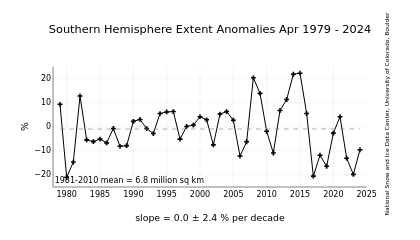
By comparison, Michigan is 151,586 sq. km, so that’s an increase in icecover of over five times the area of Michigan. MSNBC could instead be doing a story on the trend of cooling in Antarctica and possible falling sea levels due to ice accumulation in Antarctica. Keep in mind that if the Polar icecap (without Greenland) melted…it would hardly cause sea level to rise, because the icecap is currently displacing water in the Arctic Ocean. The Antarctic icecap is over a land continent, not floating over an ocean. Significant ice accumulation over the land of Antarctica would cause sea level to fall. The Arctic icecap did decrease significantly (yes, very significantly) from 1979 to 2007. To do a fair piece on Arctic ice…MSNBC or anyone would have to note this. However, to also be fair…they should also tell what’s been going on in the Arctic since 2007.
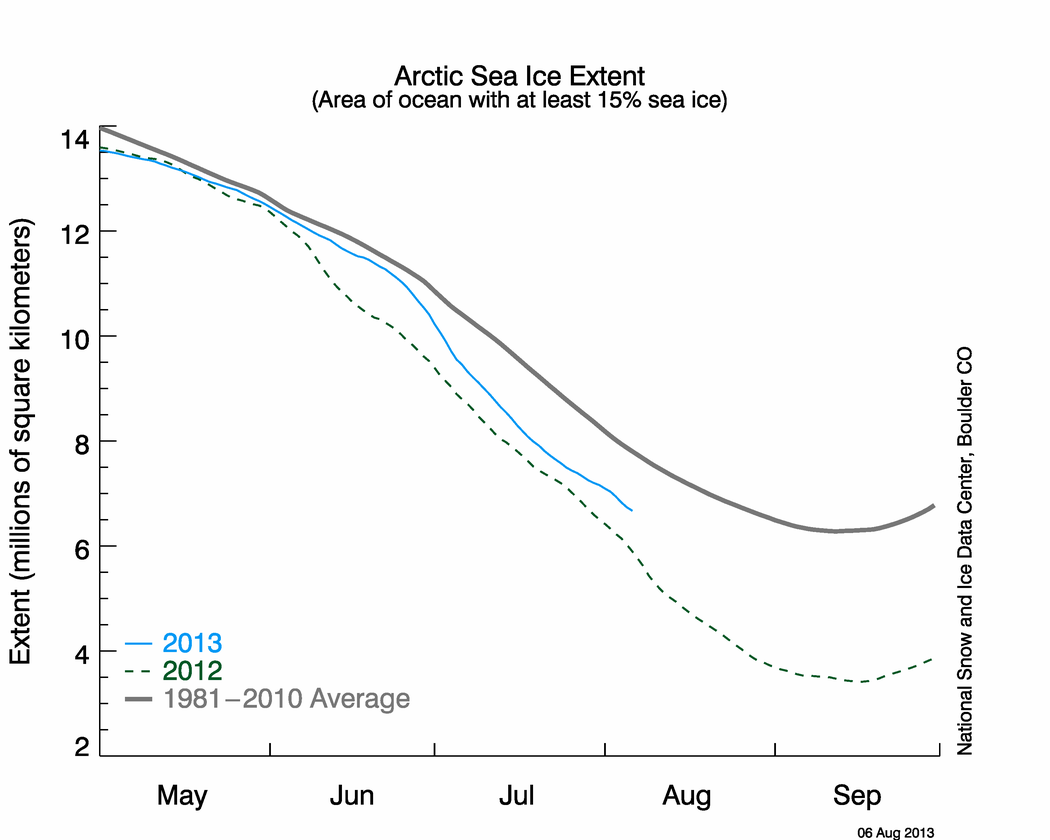
Please, CHECK OUT THIS GRAPH from the National Snow and Ice Data Center. Note that the current icecap has grown significantly and is now much closer to the 1979-2000 average than it is to the low level of 2007. There are meteorological reasons for this increase (PDO – Pacific Decadal Oscillation going negative, etc.) that have nothing to do with CO2. Some scientists predicted there would be no icecap this summer. It’ll actually be bigger than last summer. Al Gore predicted last year that “the icecap will be gone in five years!”. I would be willing to not only bet Al Gore but also give him 100 to one odds that there will still be a polar ice cap in 2013. One last point, MSNBC is owned by General Electric. GE is already making money off the issue with their Carbon Credit Master Card (link from “Treehugger”, no less).
Here’s CNN’s story on the new credit card. Interesting note: In the fourth quarter of 2008 as GE/NBC stock fell 30 percent, GE spent $4.26 million on lobbying — that’s $46,304 each day, including weekends, Thanksgiving and Christmas. In 2008, the company spent a grand total of $18.66 million on lobbying.” Reviewing their lobbying filings, GE’s specific lobbying issues included the “Climate Stewardship Act,” “Electric Utility Cap and Trade Act,” “Global Warming Reduction Act,” “Federal Government Greenhouse Gas Registry Act,” “Low Carbon Economy Act,” and “Lieberman-Warner Climate Security Act.” Do you think this “big business” is just concerned about the environment?
Well, check out this column from the Politico, which says: “Several of the companies would gain a commercial advantage after a cap and trade was established. General Electric has an “ecoimagination” line of green appliances and equipment. Robert Stavins, a professor of business and government at Harvard University, said a cap and trade program would be fantastic for GE and other companies that sell products that consume power. He said that if energy costs go up as a result of the regulation — something he believes is likely — a wide array of products from appliances to power plants would become prematurely obsolete and need to be replaced with greener models.” That would mean big money for GE (parent company of NBC and MSNBC). Take a moment and read my previous post on polar ice…check out the graphs and charts…they speak for themselves.
ONE LAST ADD: Check out this website with pictures of submarines in open water at the North Pole. Also: The Weather Channel is now owned by NBC, so they will have a similar policy.
Graeme Rodaughan (23:53:47) :
GE is the new Dupont, with CO2 tag teaming Freon.
……………..
The match up between GE and Duponts tactics (see Ref) is pretty much spot on. Use the legal system to outlaw your competition, achieve monopoly prices, sh@f#t the end consumer, and lock in mega-profits for a generation.
Don’t you just love the naive environmentalists who just don’t get it.
——————————————-
Not just GE.
It does amuse me when AGW types go for the “Big Oil Shill” AH attack.
“Big Oil” stands to profit from this through the indefinite extension of their business model. This is obvious if you think about it. The addition of ethanol simply extends the oil model and distribution network profitability, pushing back the “peak oil” watershed.
Big government, big oil and big industry all stand to profit from this scare.
The irony is remarkable.
“Also, as the sea warms around the continent, especially in the most northerly parts of the continent (Antarctic Peninsula) large ice shelves are eroded from beneath . . . . This melting of buttressing ice shelves unplugs the land-based glaciers, and they begin to flow into the sea more rapidly. As such, there is a large net loss of ice from the western half of the continent, and a slight gain in the eastern half. More sea ice builds up around the continent because as the surface waters warm, the ocean becomes more stratified (it ‘turns over’ less readily).”
I’m also having trouble with the internal contradictions and non-sequiturs in this explanation. How does more sea ice “build up” if the ocean has warmed? I can understand how warming temperatures at the surface would reduce the heat flux moving vertically upwards due to the reduced temperature gradient, but how exacly can this be seen as a cooling effect at the surface produced by an initial warming at the surface, to therefore explain more sea ice around the continent?
Why exactly does the break-up of an ice shelf on one part of the continent explain the build up of ice on the other? Does the ice uphill get “cold feet” and say “Uh, uh – I’m not going that direction” after seeing the fate of its distant kinsman down below? If a land-based glacier extends outwardly into the surrounding ocean, how exactly is it in a “plugged state” that will unplug once the ice in the sea disintegrates? My understanding of a glacier (which could be wrong) is that the flow of ice is caused by the growth in ice above which, due to the massive weight of the ice, pushes the downwards portion of the glacier outwardly. This dynamic should not change depending on whether the galcier terminates in land or in the ocean. Certainly the seawater can’t be holding the glacier back, and I can’t think of any reason why merely cutting off the tail end of a solid glacier has an effect on the flow of the ice immediately above it, which is a function of the weight of the ice above that, etc.
If the terminus of the glaciers start to crumble into the ocean at a faster rate, wouldn’t this tend to put a brake on the rate at which the waters surrounding the continent warm? This, of course depends on the cause of the ocean warming. If it’s due to radiation from added CO2, then you should have a strong negative feedback here provided by the melting ice. If, on the other hand, the surrounding ocean is warming from changing ocean currents, then you have a different story, but I guess this would mean we have another “bait and switch” argument as the cause of the ocean warming isn’t from increased CO2 but some other phenomenon that provides a steady input of warm water to replace the water chilled by the melting ice.
Doe anybody know whether these processes are occurring as described, or is this mere speculation?
http://www.catlinarcticsurvey.com/latestfromtheice
Looks to me like they can soon pack it up. (Note the website has dropped the vital readings for the three trekkers).
Check this:Global ice +1.158 two days ago (recorded on this post), no visibly change on graph SH or NH since then but today 0.7!
http://arctic.atmos.uiuc.edu/cryosphere/iphone/iphone.anom.global.html
this is why files need to be saved!
Talking about people becoming inconvenient: The patron saint of all things green (no, not Kermit), James Lovelock, wrote a scathing rant against wind power in the (UK) Guardian.
(Apologies if this has been posted before)
O/T Spaceweather suggests there is a sunspot struggling to emerge. Look at the SOHO linked on WUWT, it is possibly a sunspeck. Look at the magnetogram, and there is possibly another as well. Two sunspecks? Two cycle 23 sunspecks?
The last one last week didn’t last more than 12 hours.
The record table attached seems to me doubtful. I found another, better documented at http://omniclimate.wordpress.com/2009/02/23/world-temperature-records/ with more recent records.
Slightly OT, but relevant, I hope. The BBC reported acidification of the oceans thanks (of course) to CO2 increases in the atmosphere. Their ‘science’ reporter Roger Harrabin did a piece a few weeks ago about the coral dissolving (!) but my rusty chemistry says that if the ocean releases CO2 when it warms up, it must be contain as much CO2 as it will hold already.
Can someone here confirm this? It seems absurd to me to suggest that a few ppm change in the air could acidify the oceans!
Sorry – should have included this link:
http://news.bbc.co.uk/1/hi/sci/tech/8021459.stm
James P
This is what I found on Wikipedia. 50 times more than in the atmosphere.
“There is about 50 times as much carbon dissolved in the oceans in the form of CO2 and carbonic acid, bicarbonate and carbonate ions as exists in the atmosphere. The oceans act as an enormous carbon sink, having “absorbed about one-third of all human-generated CO2 emissions to date.”[25] Gas solubility decreases as the temperature of water increases and therefore the rate of uptake from the atmosphere decreases as ocean temperatures rise.”
It seems unlikely that human’s burning of fossil fuel will alter the oceans CO2 content anytime soon.
Maybe some, near the surface in warm waters.
But, of course that will not stop the AGW people from pushing this scare in the same way as with global warming.
http://www.newscientist.com/article/mg17924042.800-were-off-the-hook-over-el-nino.html
Interesting little paper. Abstract has been pulled. Wonder where Kim Cobb is now
If we get more water vapour then the water producing it was cooled somewhere in the region of 80 calories per gram of water lost. Once that water vapour condences it realeases that 80 calories of heat into the atmosphere. That drives those towering cumulus clouds. Those same clouds shield the surface from incoming radiation as well as absorbing a lot of the backscatter radiation of the just released heat.
The way I see it more water vapour means a cooler planet. Can a resident scientist clarify please.
Uncivil Servant (02:04:55) : Thank you for the article from James Lovelock. He is half right – comments inserted in this excerpt, in CAPS.
Global warming is real and deadly and we have to do our best to counter it FALSE but we must not be led astray by the special pleading of an industry made rich by over-generous subsidies paid for by your taxes and one that is bound to fail to deliver TRUE.
Sean (21:55:10) : And thank you Sean for some excellent points. Excerpt:
I don’t think Mr. Steffen’s comments about the benefits of cap and trade legislation to GE’s bottom line go nearly far enough. Considering that a 1 GW coal fired plant would have to be replaced with 4 GW of wind turbines (to account for the different load factors) TRUE – ABOUT 5 IN GERMANY and would also have to be backed up with another GW of gas turbines for when the wind dies TRUE, plus load variation would have to be managed through a smart grid, there is a lot of hardware to be sold TRUE. AND SUDDEN VARIATIONS IN WINDPOWER CAN CRASH THE GRID – JUST WAIT UNTIL THIS HAPPENS IN WINTER.
SEE E.On Netz excellent Wind Report 2005 at
http://www.eon-netz.com/Ressources/downloads/EON_Netz_Windreport2005_eng.pdf
Excerpt:
FIGURE 5 shows the annual curve of wind
power feed-in in the E.ON control area for 2004,
from which it is possible to derive the wind power
feed-in during the past year:
1. The highest wind power feed-in in the E.ON grid
was just above 6,000MW for a brief period, or
put another way the feed-in was around 85% of
the installed wind power capacity at the time.
2. The average feed-in over the year was 1,295MW,
around one fifth of the average installed wind
power capacity over the year.
3. Over half of the year, the wind power feed-in
was less than 14% of the average installed wind
power capacity over the year.
The feed-in capacity can change frequently
within a few hours. This is shown in FIGURE 6,
which reproduces the course of wind power feedin
during the Christmas week from 20 to 26
December 2004.
Whilst wind power feed-in at 9.15am on
Christmas Eve reached its maximum for the year
at 6,024MW, it fell to below 2,000MW within only
10 hours, a difference of over 4,000MW. This corresponds
to the capacity of 8 x 500MW coal fired
power station blocks. On Boxing Day, wind power
feed-in in the E.ON grid fell to below 40MW.
Handling such significant differences in feed-in
levels poses a major challenge to grid operators.
In order to also guarantee reliable electricity
supplies when wind farms produce little or no
power, e.g. during periods of calm or storm-related
shutdowns, traditional power station capacities
must be available as a reserve. This means that
wind farms can only replace traditional power
station capacities to a limited degree.
An objective measure of the extent to which
wind farms are able to replace traditional power
stations, is the contribution towards guaranteed
capacity which they make within an existing
power station portfolio. Approximately this capacity
may be dispensed within a traditional power
station portfolio, without thereby prejudicing the
level of supply reliability.
In 2004 two major German studies investigated
the size of contribution that wind farms make
towards guaranteed capacity. Both studies
separately came to virtually identical conclusions,
that wind energy currently contributes to the
secure production capacity of the system, by
providing 8% of its installed capacity.
As wind power capacity rises, the lower availability
of the wind farms determines the reliability
of the system as a whole to an ever increasing
extent. Consequently the greater reliability of
traditional power stations becomes increasingly
eclipsed.
As a result, the relative contribution of wind
power to the guaranteed capacity of our supply
system up to the year 2020 will fall continuously
to around 4% (FIGURE 7).
In concrete terms, this means that in 2020,
with a forecast wind power capacity of over
48,000MW (Source: dena grid study), 2,000MW of
traditional power production can be replaced by
these wind farms.
THAT’S 2% SUBSTITUTION CAPACITY, OR 98% CONVENTIONAL BACKUP.
AT TIME OF WRITING WIND POWER 2005, E.ON NETZ WAS THE LARGEST WIND POWER GENERATOR IN THE WORLD. THE E.ON REPORT IS HONEST AND RELIABLE – BUT WILL YOUNG BARACK EVER READ IT?
A FURTHER IRONY IS THAT DURING THE RECENT EXTREME COLD WEATHER IN THE UK, THERE WAS NO WIND AND NO WIND POWER – APPARENTLY ALSO COMMON DURING EXTREME SUMMER WARMTH – SO WIND POWER IS NOT THERE WHEN IT IS MOST NEEDED. MORE SUBSIDIES AND HIGHER POWER RATES FOR CONSUMERS ARE NOT THE SOLUTION.
GE SHOULD MAKE A PUBLIC STATEMENT NOW ABOUT THE LIMITATIONS OF WIND POWER, TO PROTECT ITSELF AGAINST BEING SUED INTO OBLIVION IN THE COMING YEARS. AMERICANS ARE VERY LITIGIOUS, AND WIND POWER IS BEING OVERSOLD AS A PANACEA THAT DOES NOT WORK – SOLID GROUNDS FOR A HUGE CLASS-ACTION LAWSUIT.
PERHAPS CLASS-ACTION LAWSUITS WILL ALSO BE BROUGHT AGAINST ALL THE WARMIST SUPPORTERS AND THEIR ORGANIZATIONS, AS THE ENORMOUS WASTE OF MONEY ON A NON-PROBLEM BECOMES APPARENT – IMAGINE ALL THE LITIGATORS IN THE USA LINING UP TO GET IN ON THAT ACTION.
OT New York sized (Wilkins) ice shelf collapses.
http://www.independent.co.uk/environment/climate-change/new-yorksized-ice-shelf-collapses-off-antarctica-1675400.html
kmye
I think you are wrong that Bill’s post is not helping. This article was re-posted from Bill’s own blog, which is operated very informally as a place where locals can chat about the weather with their favorite expert. It was not meant as some sort of scientific treatise. His post makes the issue accessible to people who may not have an understanding of the science. They may only have a gut feeling that what they are hearing in the media doesn’t quite jive. This is a great indication that the grassroots movement is growing. 🙂
MSNBC is among the worst of the lying, corrupt, doctrinaire so called “news services.” They would be astonishing if we didn’t also have CNN, BBC et al.
Way to go BILL!! He’s one of our guys! Nice to see a local good guy speaking out.
“KMYE,
…I dunno; maybe I’m just being too touchy, but it feels to me a little like taking part in an AGW thread on digg.com, or I’m sure elsewhere, when someone jumps in and says something like “More CO2 doesn’t warm the atmosphere [at all],” when you just want to say: “You’re not helping.”
I disagree, the more that each and every person speaks up about the lunacy of AGW, the better it is for all. Most meteorologists know that AGW is a lie, and more are talking about it. That is a good thing.
WSI who?
…-
“WSI Issues 2009 Hurricane Season Update
Weather Authority’s Tropical Forecast Calls for Less Active Season than Last Year
Andover, MA, April 20, 2009 — WSI Corporation’s updated 2009 hurricane season forecast now calls for 11 named storms, 6 hurricanes, and 2 intense hurricanes (category 3 or greater).
These forecast numbers are lower than those from the WSI forecast issued in December (13 named storms, 7 hurricanes, and 3 intense hurricanes) due to a continuation of relatively cool tropical Atlantic Ocean temperatures and a waning of the recent La Nina event. The 2009 forecast numbers are quite close to the long-term (1950-2008) average of 9.8 named storms, 6.0 hurricanes, and 2.5 intense hurricanes).
The 2009 WSI tropical forecast comes on the heels of a very successful 2008 forecast. The WSI December forecast values of 14 named storms, 7 hurricanes, and 3 intense hurricanes were slightly smaller than the final observed 2008 values of 16/8/5. The subsequent updates improved the forecast further, as the April 2008 updated forecast values of 14 named storms, 8 hurricanes, and 4 intense hurricanes were the most accurate amongst the publicly-available forecasts issued last spring.
“Ocean temperatures in the tropical Atlantic are cooler, relative to normal, than at any time since 1994,” said WSI seasonal forecaster Dr. Todd Crawford. “Further, the recent La Nina event has now ended, and we expect normal or even slightly above-normal wind shear in the tropical Atlantic this season. Neither the cooler tropical Atlantic nor the neutral wind shear conditions are enabling for tropical activity this year. We have reduced our forecast numbers to adapt to the latest information, and future changes to our forecast are more likely to be towards smaller numbers than larger numbers.””
http://www.wsi.com/corporate/news/releases/useg042009_tropcoutlook.asp
There is about 50 times as much carbon dissolved in the oceans in the form of CO2 and carbonic acid, bicarbonate and carbonate ions as exists in the atmosphere.
Thank you, Per. One thing I forgot to mention is that ‘acidification’ is a misnomer as well, implying as it does that the water is becoming acidic. Even the BBC admits that the sea is alkaline (pH 8.2) and the reduction in alkalinity due to CO2 is nowhere near enough even to make it neutral (pH 7) although of course they don’t phrase it like that.
What I would like to know is how gaseous CO2 reacts in the atmosphere and in the oceans to produce the various compounds, some of which (e.g. bicarbonate) are alkaline! I don’t mind looking it up (and will do so) but I’m sure someone here will know and be able to put it into context properly.
TIA
Important Message:
The german Alfred-Wegner-Institut finished an expedition today:
The Ice in the arctic is two times thicker than expected: 4m instead of 2m
http://www.radiobremen.de/wissen/nachrichten/wissenawipolararktis100.html
kmye (00:16:40) wrote in part: …is it necessarily a good thing to draw attention to pieces like the above just because the author happens to be a respected(?) weather “personality?”
I would argue that even if not “a good thing” it is indeed a “necessary thing”, Kmye. We humans are a diverse lot and operate at many levels. Some of us are reached by sober science, some by cries of wolf. Some of us respond more readily to a name or a face or a personality.
All of us (have a right to) vote.
p.s. They are talking flu, here, but it could as well be AGW:
“…what we really need . . . is a tremendous outbreak of calm.”
Precisely why I don’t watch MSNBC and I don’t buy GE products!
That snarky comment about the Lions hurt. :^(
Especially since the Lions are more likely to go 16-0 this year than we are to see any AGW predictions come true.
:^)
Nice article, from San Francisco of all places, ripping into the Goracle’s testimony last week.
http://www.examiner.com/x-9111-SF-Environmental-Policy-Examiner~y2009m4d27-Al-Gore-global-warming-and-truth