A guest post by Steven Goddard
One of the most widely discussed climate feedbacks is the albedo effect of polar sea ice loss. Ice has a relatively high albedo (reflectance) so a reduction in polar ice area has the effect of causing more shortwave radiation (sunlight) to be absorbed by the oceans, warming the water. Likewise, an increase in polar sea ice area causes more sunlight to be reflected, decreasing the warming of the ocean. The earths radiative balance is shown in the image below. It is believed that about 30% of the sunlight reaching the earth’s atmosphere is directly reflected – 20% by clouds, 6% by other components of the atmosphere, and 4% by the earth’s surface.

We all have heard many times that summer sea ice minimums have declined in the northern hemisphere over the last 30 years. As mentioned above, this causes more sunlight to reach the dark ocean water, and results in a warming of the water. What is not so widely discussed is that southern hemisphere sea ice has been increasing, causing a net cooling effect. This article explains why the cooling effect of excess Antarctic ice is significantly greater than the warming effect of missing Arctic ice.
Over the last 30 years Antarctic sea ice has been steadily increasing, as shown below.

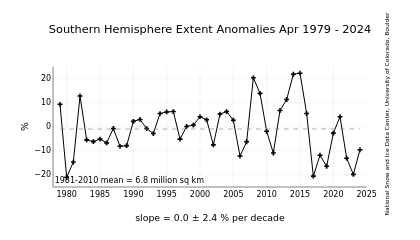
December is the month when the Antarctic sun is highest in the sky, and when the most sunlight reaches the surface. Thus an excess of ice in December has the maximum impact on the southern hemisphere’s radiative balance. In the Antarctic, the most important months are mid-October through mid-February, because those are months when the sun is closest to the zenith. The rest of the year there is almost no shortwave radiation to reflect, so the excess ice has little effect on the shortwave radiative (SW) balance.
This has been discussed in detail by Roger Pielke Sr. and others in several papers.
So how does this work? Below are the details of this article’s thesis.


1. As mentioned above, the Antarctic ice excess occurs near the December solstice when the sun is highest above the horizon. By contrast, the Arctic ice deficiency appears near the equinox – when the sun is low above the horizon. Note in the graph below, that Arctic ice reaches it’s minimum in mid-September – just when the sun is setting for the winter at the North Pole. While the September, 2008 ice minimum maps were dramatic, what they did not show is that there was little sunlight reaching the water that time of year. The deviation from normal did not begin in earnest until mid-August, so there were only a couple of weeks where the northern hemisphere SW radiative balance was significantly impacted. Thus the water in most of the ice-deficient areas did not warm significantly, allowing for the fast freeze-up we saw during the autumn.
The 2008 peak Arctic ice anomaly occurred near the equinox, when it had the minimum heating effect on the ocean.

By contrast, the peak Antarctic ice anomaly occurred at the December solstice, when it had a maximum cooling effect, as shown below.
2. The next factor to consider is the latitude of the ice, which has a strong effect on the amount of solar insolation received. Arctic sea ice is closer to the pole than Antarctic sea ice. This is because of the geography of the two regions, and can be seen in the NSIDC images below.
Antarctic sea ice forms at latitudes of about 55-75 degrees, whereas most Arctic ice forms closer to the pole at latitudes of 70-90 degrees. Because Antarctic ice is closer to the tropics than Arctic ice, and the sun there reaches a higher angle above the horizon, Antarctic sea ice receives significantly more solar radiation in summer than Arctic sea ice does in its’ summer. Thus the presence or absence of Antarctic ice has a larger impact on the SW radiative balance than does the presence or absence of Arctic ice.
At a latitude of -65 degrees, the sun is about 40 degrees below the zenith on the day of the solstice. Compare that to early September negative anomaly peak in the Arctic at a latitude of 80 degrees, when the sun is more than 70 degrees below the zenith. The amount of solar radiation hitting the ice surface at those maxima is approximately 2.2 times greater in the the Antarctic than it is in the Arctic = cos(70) / cos(40) .
The point being again, that due to the latitude and date, areas of excess Antarctic ice reflect a lot of SW radiation back out into space, whereas deficient Arctic ice areas allow a much smaller quantity of SW radiation to reach the dark surface of water. Furthermore, in September the angle of incidence of the sun above the water is below the critical angle, so little sunlight penetrates the surface, further compounding the effect. Thus the Antarctic positive anomaly has a significantly larger effect on the earth’s SW balance than does the Arctic negative anomaly.
3. The next point is an extension of 2. By definition, excess ice is further from the pole than missing ice. Thus a 10% positive anomaly has more impact on the earth’s SW balance than does a 10% negative anomaly.
4. Due to eccentricity of the earth’s orbit, the earth is 3% closer to the sun near the December solstice, than it is during the June solstice. This further compounds the importance of Antarctic ice excess relative to Arctic ice deficiency.
All of these points work together to support the idea that so far, polar ice albedo feedback has been opposite of what the models have predicted. To date, the effect of polar albedo change has most likely been negative, whereas all the models predicted it to be positive. There appears to be a tendency in the climate community to discount the importance of the Antarctic sea ice increase, and this may not be appropriate.
What do you make of this story from Science Daily:
“Scientists Refute Argument Of Climate Skeptics”
http://www.sciencedaily.com/releases/2009/01/090109115047.htm
It would be interesting to see if the trend in Antarctic sea ice follows one of the components of the Milankovitch cycles. EG. more / less daylight hours per year at the poles.
Just some more cycles governed by our fellow planets.
The case made in the Science Daily article seems a fatuous attack on a straw man even if the statistics are correct which seems dubious.
I have never heard any credible argument that the climate is random. Obviously there are drivers – the scientific disputes are over identifying and quantifying them.
The study seems to prove absolutely nothing, except perhaps that the most vaguely tenuous link to AGW will get you funding and a publication.
So in the Antarctic we have land surrounded by sea ice, and in the Arctic we have sea ice surrounded by land.
No wonder I get polar bears and penguins confused.
Art (21:49:29) :
What do you make of this story from Science Daily:
“Scientists Refute Argument Of Climate Skeptics”
———————-
Infantile
It is correct to say that reflectivity increases dramatically with increased angle of incidence, however, as I understand it there is no critical angle for light travelling through air being reflected off water because the ratio of refractive indices is >1.
I would be curious to see the graph of reflectivity w.r.t. latitude and season used by the GCMs, it must be tremendously complex……. or maybe they just don’t bother with such things.
Art (21:49:29) :
A quick read of the article reveals the following:
“The GKSS Research Centre asks: is it an accident that the warmest 13 years were observed after 1990, or does this increased frequency indicate an external influence?”
“…it is extremely unlikely that the frequency of warm record years after 1990 could be an accident and concluded that it is rather influenced by a external driver.”
We are supposed to assume that the driver is CO2, I guess. But the article does not name the driver as CO2 because it is just a statistical model. Therefore, the title of the article is hogwash. They have refuted nothing. All they have succeeded in doing was proving that something changed and caused the temperature to rise. Must that something be CO2? No, it could be a number of things.
Perhaps the oceans. Maybe the sun. Or lack of large eruptions spewing earth cooling particles into the upper atmosphere. Maybe something else we know nothing about.
Art,
The study is meaningless because it presumes that climate would have been stable without some ‘external driver’. It also presumes that the measurements of temperature after 1990 do not have any warming bias when compared to measurements before 1990.
Just another example of biased media spinning a story in a way that is not supported by the facts.
How about the “Big 6” oceanic -atmospheric cycle flipping from cold phase to warm, one by one, from 1976 to 2001? Eh?
And now the PDO has gone cold.
Anyone notice a pattern, here?
Interesting. Much is made of loss of Arctic ice as proof of GW, but the gain in Antarctic ice is studiously ignored.
There are 2 issues here.
1, is the gain and/or loss of ice evidence for GW? ie an effect of climate change.
2, is the gain and/or loss of ice as a primary driver of climate? ie a cause of climate change.
The media and warming proponents focus almost exclusively on 1, while we should be worrying about 2.
There is good evidence that even during the current interglacial, Antarctica has continued to acummulate ice (Antarctic ice sheet, not sea ice).
If this is true, and it can be hard to navigate through the myths and outright disinformation put out by the Warmers, it means we are not in a relatively stable cycle of glacial/interglacial phases. Rather, Earth passed a cooling tipping point a few hundred thousand years ago and we a sliding (pun intended) toward an icerink Earth.
I think another factor in Arctic heat balance is that although sea water has an albedo of almost zero, when the azimuth angle is high, the albedo approaches 0.80, compared to 0.82 for ice under some conditions. (~above, re critical angle) Note, too, that the emissivity of sea water is approximately 1 minus the the albedo (1 minus zero). That is, open sea water essentially radiates to the winter (night) sky as a black body. Ice would act as an insulator under these conditions. The tendency to restore Arctic ice in winter is very high, no matter what happens in the summer. Sell that kayak!
This quote from link by Art (21:49:29):
For some reason Antarctica has been ice covered for 12-14 million years, long before the Arctic was ice covered. There has been ice at the North pole for only about the last 2 million years or so. Off hand, I would say that the South pole is more important a factor in maintaining Earth’s overall balance of temperature than the North pole is. If we had a large land mass at the North pole, even something the size of Greenland, Earth would probably be a *lot* colder than it is now.
We probably depend on the Arctic ocean absorbing what heat it does in order to provide a climate that is habitable in places like North America and Europe.
“Scientists Refute Argument Of Climate Skeptics”
Desperate nonsense.
No reasonably intelligent “Denier” ever said there wasn’t a warming trend.
We just said that CO2 wasn’t responsible for ALL the warming.
I find all these articles more and more worrying. It seems that everything the IPCC and the AGW alarmists have been telling us has been wrong and that all the indications are that the feedbacks are currently negative and that we are in for a hell of a cooling. No more talk of volcanoes as well please.
Art (21:49:29) :
What do you make of this story from Science Daily:
“Scientists Refute Argument Of Climate Skeptics”
The chart shows Hadley temps from 1850 to present. So the farther we get away from the end of the LIA, the warmer it gets. Except for weather variations, of course.
“Dutch take to skates as cold snap freezes canals”
“… Anticipation is growing for the “Elfstedentocht” or “11 Cities Tour,” a national event where speed skaters race along a 200-km (120-mile) course beginning and ending in the northern city of Leeuwarden.
This year marks the 100th year since the race began and if held, the tour would be the first in over a decade. …”
evanjones
PDO has entered its cool phase, ENSO is neutral and there are no sunspots. The pattern we can expect is 20 years where there will be more La Ninas than El Ninos. It will be damp and cool in Australia.
During this period icebergs in the southern ocean will increase in number and move further north, as they have done over eons of time. It will all become patently clear within a few years that the AGW faithful have fallen for their own propaganda.
This is off topic but I just couldn’t resist.
Fox News has a story about Google searches causing global warming. http://www.foxnews.com/story/0,2933,479127,00.html
I would laugh if the global warming crowd had no power or influence in our world, or impact on our policies. That’s how ridiculous all of this has become. But unfortunately they are driving energy policy, and driving our living standards into the ground.
It’s chilly this winter so I’m thinking of leaving my computer on all night running a macro which submits random searches to Google from a dictionary, one per second. Think that will help? 😉
Good points Coaldust….. I’ll add another reason… A change due to interpretation of the data by climate “scientists”.
That could account for their conclusions derived from HadCrut data… After all Anthony Watts is showing that the sites for gathering Climate data are not complying to the standards set down for them, many sites across the globe have shut down, and the record was never meant to determine 100ths of a degree ….
… I wonder if they had just used satellite data, whether or not they would get the same results???
An excellent exposition full of insights. Many thanks for a superbly provocative thought-provoking discussion.
I trust that if for some reason at the height/depth of the PDO phase we have just entered that arctic ice is very high and antarctic ice very low that discussions will return to this, as that scenario might be a significant contributor/trigger to potential warming………
As for the Antarctic, all anybody hears is that the Ice shelves are cascading into the sea and breaking away, to go spinning off into climate chaos, that the Antarctic pennisular is melting… etc… blah, blah
One never hears that the sea ice is at historic highs…. Or that the temperature over the Antarctic land mass is showing cooling.
Very clean and clinical, but how do you adjust for the dirty soot factor?
http://www.climate-skeptic.com/2008/06/polar-bears-and.html
The SH sea ice anomaly has been steadily trending down since Mar 2008 and appears to much closer to 0 here than shown in above:
http://arctic.atmos.uiuc.edu/cryosphere/IMAGES/current.365.south.jpg
The Cryosphere Today also state that observed N. Hemisphere sea ice area is almost one million sq. km below values seen in late 1979 and S. Hemisphere sea ice area is about 0.5 million sq. km above that seen in late 1979, PARTLY offsetting the N. Hemisphere reduction (not a “significantly greater” cooling effect).
Re coaldust (23:00:23) :
quote it could be a number of things.
Perhaps the oceans. Maybe the sun. Or lack of large eruptions spewing earth cooling particles into the upper atmosphere. Maybe something else we know nothing about. unquote
It could be dust spread on the ice. It could be smoothed, surfactant and oil-spill polluted water not producing as many clouds as usual. It could be smoothed water having reduced albedo during insolation. It could be smoothed water having less emissivity during darkness. It could be plankton blooms lowering albedo…
So, five things it might be. Add in your sun and eruptions (oceans is a bit general), that’s seven things it might be. Surely there must be more? Oh, yes. CO2. Eight.
JF
as another spin on the “Arctic Ice is Disappearing” roulette wheel, Pen hadow is off to measure the actual thickness of the Arctic ice.
http://www.catlinarcticsurvey.com/
“The Catlin Arctic Survey
The Catlin Arctic Survey is an international collaboration between polar explorers and some of the world’s foremost scientific bodies. It seeks to resolve one of the most important environmental questions of our time:
How long will the Arctic Ocean’s sea ice cover remain a permanent feature of our planet?”
Not quite a completely loaded question, but at least they’re doing some science on the way and no 600 tonne ship ploughing after them!