
From the European Space Agency (ESA):
New ice thickness map of the Arctic unveiled
The first map of sea-ice thickness from ESA’s CryoSat mission was revealed today at the Paris Air and Space Show. This new information is set to change our understanding of the complex relationship between ice and climate.
From an altitude of just over 700 km and reaching unprecedented latitudes of 88º, CryoSat has spent the last seven months delivering precise measurements to study changes in the thickness of Earth’s ice.
Satellites have already shown that the extent of sea ice in the Arctic is diminishing. In fact, spring 2011 is the third lowest extent recorded by satellite.
However, to understand fully how climate change is affecting the fragile polar regions, there is a need to determine exactly how the thickness of the ice is changing.
To answer this question, a group of scientists together with Prof. Duncan Wingham from University College London proposed the CryoSat mission to ESA in 1998. The loss of the original CryoSat satellite in 2005 as a result of a launch failure has unfortunately made this a longer than normal wait.

Nevertheless, the launch of the replacement satellite in April 2010 has resulted in these first maps of ice thickness. They clearly demonstrate that CryoSat is a mission of excellence and will greatly advance polar science.

The results were presented at the Le Bourget air and space show by Volker Liebig, ESA’s Director of Earth Observation Programmes, Duncan Wingham and René Forsberg from the National Space Institute at the Technical University of Denmark.
Prof. Wingham said, “A new mission is always risky. There’s quite a long wait and then everyone gets to see if it really can deliver.
“What’s really nice about these results is that they show not only that the hardware is really excellent – which we already knew – but that it can deliver the geophysical information we need too.
“It’s a credit to the teams at ESA and UCL who have worked really hard and I’m very happy with these new results.”
CryoSat measures the height of the sea ice above the water line, known as the freeboard, to calculate the thickness. The measurements used to generate this first map of the Arctic were from January and February 2011, as the ice approaches its annual maximum.

Download: HI-RES JPEG (Size: 498 kb)
The data are exceptionally detailed and considerably better than the mission’s specification. They even show lineations in the central Arctic that reflect the ice’s response to wind stress.
Prof. Liebig said, “This major result comes just one year after launch. It is another important step towards achieving one of the primary objectives of the mission; namely, to determine how much the sea ice in the Arctic is thinning in response to a changing climate.”
A new map of Antarctica has also been created showing the height of the ice sheet. This is more preliminary because more data are needed here to see what CryoSat can do.
Even so, the extra coverage CryoSat offers near the poles can be demonstrated: parts of Antarctica can now be seen for the first time from space.

Download: HI-RES MP4 (Size: 5 779 kb)
In addition, detail of edges of the ice sheet where it meets the ocean can now closely monitored thanks to CryoSat’s sophisticated radar techniques. This is important because this is where changes are occuring.
“It is very satisfying to see these exciting results,” said ESA’s Richard Francis, who was the CryoSat-2 Project Manager during its development.
“It has taken about ten years to convert the initial proposal into a flying mission: ten years of hard work and dedication from a core team of less than a hundred people, ably assisted with crucial expertise from a few hundred more.”
ESA’s CryoSat Mission Manager, Tommaso Parrinello, added, “These first results are very exciting as we begin to see the mission’s potential realised.
“The coming months will be dedicated to completing the picture to gain better insight into how polar ice is changing.”
================================================================
Steve Goddard points out that there is good agreement with the Navy PIPS map:
For the past two years I have been getting constant flak from alarmists for using Navy PIPS2 maps. Turns out PIPS2 is very accurate. However, they seem to have been taken offline as of May 23.
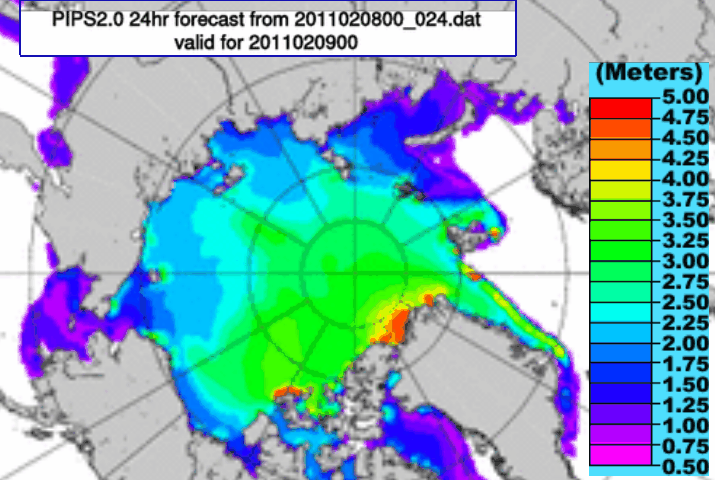
NSIDC’s Dr. Walt Meier wrote about PIPS in a guest post last year on WUWT
Discover more from Watts Up With That?
Subscribe to get the latest posts sent to your email.

Oddly enough, I’ve heard many places in the world, even some local to me, described as fragile and yet I can’t recall anybody describing one as robust. Curious that isn’t it.
I often wonder how life ever survived on this planet in all these fragile environments.
Oh no, no more ice treks to keep us in stitches!
Slightly odd that thick ice shows up as red, thin ice as dark blue…
Individual species or creatures may be “fragile” to some degree, but life is very robust. If certain species aren’t able to adapt, other species take their place.
TerryS says: June 21, 2011 at 8:58 am “I often wonder how life ever survived on this planet in all these fragile environments.”
It has always been a battle of words, Terry. Much of the alarmist’s propaganda is based on simple techniques to brainwash children and ignorant adults. And it works.
We will have reached a certain level of saneness when the phrase “climate change” is replaced by “climate variability” except where the first actually makes sense. Not holding my breath.
Arctic ice? It grows and diminishes? Surprise! Exactly as it has since man first ventured into the Arctic region. Maybe these headlines can help.
1881: “This past Winter, both inside and outside the Arctic circle, appears to have been unusually mild. The ice is very light and rapidly melting …”
• 1932: “NEXT GREAT DELUGE FORECAST BY SCIENCE; Melting Polar Ice Caps to Raise the Level of Seas and Flood the Continents”
• 1934: “New Evidence Supports Geology’s View That the Arctic Is Growing Warmer”
• 1937: “Continued warm weather at the Pole, melting snow and ice.”
How about: The calendar says summer starts tomorrow in the Northern Hemisphere. The snow falling in the mountains of Colorado tells a different story.
A storm that has prompted a tornado watch across Nebraska and Kansas today also left 2 to 4 inches of snow in the Rocky Mountains, said Joe Ramey, a weather service meteorologist in Grand Junction, Colorado.
And here in Norther Alberta I’m experience overnight frost for the first time in my 35 years – Five night in a row – never experienced that until this year.
Unfortunately we cannot really believe any of this (ice caps melting), they have been saying for years that the poles are melting. I ain’t seen anything yet has anyone here?
http://ocean.dmi.dk/arctic/icecover.uk.php
Each year since 2007 has been above. Antarctica has been mostly above anomaly for past 6 years so? Please explain nonsense
Sorry. Each of those headlines were supposed to have a URl from the NYT but none of them showed up for some reason.
Hey Terry! I was watching an adventure show on PBS following two men crossing a section of Denali National Park in Alaska. The narrator kept referring to the ‘delicate’ and ‘fragile’ ecosystem while dodging grizzly bears. I never knew the great grizz’s to be dainty.
What remains is when refreeze starts, we are at summer, now but it is a short oh 11 weeks or so until freeze
up begins anew. Also what the article says it that this is the:”Third lowest extent since Satellite measurment
began.” Thirty years ago-hmmm…
Not enough time to get a solid trend and, the fact that now that measurements are better, you get more
”unprecedented ” , ”worse than we thought” results…
There’s nothing quite like a scientist approaching a topic with a pre-determined conclusion. What, I wonder, will he think if arctic ice is not thinning? Likely come up with some half-assed excuse as to how thickening ice “is consistent” with CAWG
theoryhypothesisconjecture.I believe I see a ‘ridge’ in the first image, extending from the NE corner of Greenland towards the Laptev Sea that coincides almost *perfectly* with the Gakkel Ridge.
“Cryosat produces its first Arctic ice thickness map”
And it’s the thinnest it’s ever recorded…
The fact that the large tongue of sea ice along the east coast of Greenland is composed almost entirely of the thickest and oldest ice tends to support the notion put forward in Rigor and Wallace 2004 that the prime driver of the Arctic sea ice decline was a paradigm shift in the surface circulation patterns of the Arctic
http://iabp.apl.washington.edu/research_seaiceageextent.html
“This animation of the age of sea ice shows:
1.) A large Beaufort Gyre which covers most of the Arctic Ocean during the 1980s, and a transpolar drift stream shifted towards the Eurasian Arctic. Older, thicker sea ice (white ice) covers about 80% of the Arctic Ocean up to 1988. The date is shown in the upper left corner.
2.) With the step to high-AO conditions in 1989, the Beaufort Gyre shrinks and is confined to the corner between Alaska and Canada. The Transpolar Drift Stream now sweeps across most of the Arctic Ocean, carrying most of the older, thicker sea ice out of the Arctic Ocean through Fram Strait (lower right). By 1990, only about 30% of the Arctic Ocean is covered by older thicker sea ice.
3.) During the high-AO years that follow (1991 and on), this younger thinner sea ice is shown to recirculated back to the Alaskan coast where extensive open water has been observed during summer.
The age of sea ice drifting towards the coast explains over 50% of the variance in summer sea ice extent (compared to less than 15% of the variance explained by the seasonal redistribution of sea ice, and advection of heat by summer winds).”
Here is an updated animation that Rigor made about a year and a half ago. The inclusion of the buoy drift tracks makes it fairly easy to see the dramatic change in the BG and the TPD in the late 80s. I have seen no reasonable argument that these circulation pattern changes are in any way related to anthropogenic CO2 emissions.
As the climate grew colder, the northern(‘western’) colony became less viable, and at the same time the Black Death hit Iceland, freeing up homesteads that Greenlendings had legal claim to, so many moved back to Iceland at that time. Fishermen out of Bristol England, when they didn’t get a good catch on the Grand Banks, would then sail to the “East” Colony to take slaves. The Greenlendings told them that the West colony reverted to paganism (there is no evidence of this) so the fishermen/slavers were sent up there, where no one lived anymore. The last Greenland Norse appear to have passed away around 1453, not that long before Columbus.
The 1362 expedition was in response to the rumor that the West Colony had reverted to paganism, but of course they weren’t there anymore. It appears that they then sailed into Hudson’s Bay (consider a magnetic compass and and translators with the Algonquian speaking of large bodies of water to the south and a great river) seeking a way home, avoiding the ice.
It is curious that the Norse who converted many Dorset and intermarried with them, did not adopt any of their cultural artifacts for dealing with the ice. Norse trade goods are found in the remains of Dorest camps throughout Baffin Island and other eastern parts of northern Canada. However, the lure of better farmland in Iceland, and the blood-thirstiness of the newly arriving Inuit may have simply made returning to Iceland a much more attractive prospect. You mustn’t think of the Norse in the fourteenth and fifteenth centuries as Vikings. They were very much medieval Europeans at this point in time.
The Kensington Runestone has been shown to be written in the Bohuslansk dialect of the period, and the weathering of the inscription is not remotely consistant with a nineteenth century forgery. The forgery theory is old and has been disproven, however the idea of Europeans in America that far back is not PC.
It -is- impossible to separate religion from culture. Privilaging materialistic ontology and epistemology to those not limited by naturalism is simply the logical fallacy of special pleading.
NASA: Arctic Ocean Could be Mostly Ice Free in 2013
[youtube http://www.youtube.com/watch?v=ztz3ZdPbdKo?rel=0&w=425&h=349%5D
Excellent!
Now all we have to do, is wait 30 years for the first climate data point. And 60 years for the next. Then we can make an alarming extrapolation.
Wil says:
June 21, 2011 at 9:26 am
> Sorry. Each of those headlines were supposed to have a URl from the NYT but none of them showed up for some reason.
Just put in the URL without any HTML decoration. or angle brackets.
Or just send them to http://www.mrc.org/bmi/uploads/pdf/FireandIce.pdf
As I’ve suggested for several years, quite the pile up against the Canadian Shield craton. Winds and currents result in immense lateral stress, which translates into both strain and outright stacking of individual pieces of ice. I wonder what THIS does to “the models?”
Now, give us as many per year of these as they can manage. It’s not clear from the above whether it takes a full two months to do one, but that seems to be the outside limit (January & February it said, but that would also be true if the did it on Jan 31 and Feb 1!).
How does it look vs PIOMAS?
Help me out here; is that thickness map indicating the Canadian Archipelago is ice free? Is the Northwest passage really open already in June?
(Before setting sail, I recommend you check another source, because it just isn’t so.)
I guess I’m curious why the cryosat can’t or doesn’t measure ice thickness in that particular area. In fact, it seems to have trouble measuring ice thickness anywhere the sea is adjacent to land, except in the eastern hemisphere. Doesn’t seem to be as much of a problem along the Siberian coast.
This is great because we now appear to have reliable ice thickness data (and they say they will be able to continually update the map from now on).
It certainly shows there is much thicker sea ice in the Arctic than other estimates showed and the PIOMAS model, for example, had (and I note they just brought in a new version that increased the volume – the older and newer versions are both off by a significant amount, however, because the math just does not work).
TerryS, the only ecosystem that are robust are the kudzu that covers the South and the roaches in New York City, but any story that mentioned them would just say “climate scientists predict that only cockroaches and kudzu will survive the coming climate apocalypse.”
What’s the over under for when they declare it worse than we thought?