Guest post by E.M.Smith
Temperature Inversion
The Event
We’ve recently had some very cold days in International Falls.
This posting:
http://wattsupwiththat.com/2011/01/21/new-record-cold-tempertures-in-minnesota/
has a nice write up of the -46 F new record cold. ( That’s -43.33 C – still damn cold.) This is not just another “oh a record” posting. I’m asking “what does this mean about the magnitude and time scale of CO2 action?” and finding it means “not much” and “very short term”. But first, the data:
RECORD EVENT REPORT
NATIONAL WEATHER SERVICE DULUTH MN
518 PM CST FRI JAN 21 2011
…RECORD LOW TEMPERATURE SET AT INTERNATIONAL FALLS MN…
A RECORD LOW TEMPERATURE OF -46 DEGREES WAS SET AT INTERNATIONAL
FALLS MN TODAY. THIS BREAKS THE OLD RECORD OF -41 SET IN 1954.
Last night set a “daily record” too, but not a new “all time record”.
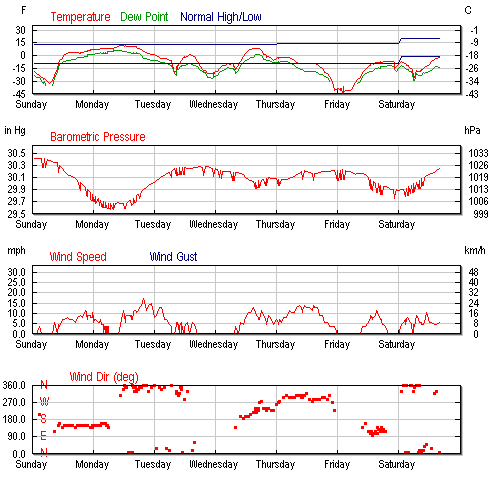
Here is a monthly chart so you can see if anything “interesting” happens on that scale:
And here is a ‘close up’ on that week in particular:
International Falls week ending 22 January 2011
The Meaning
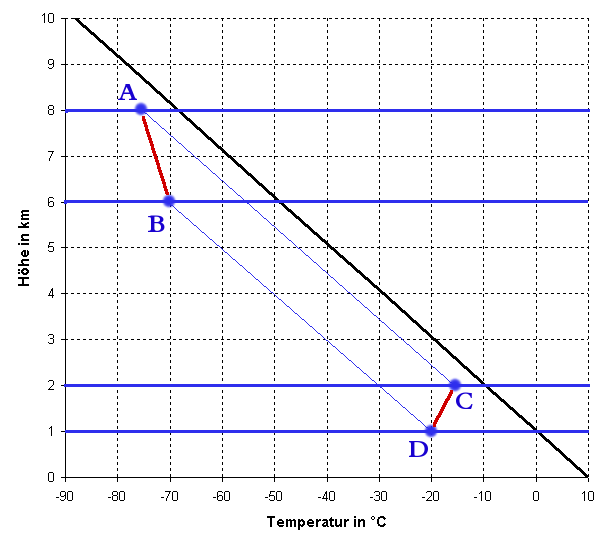
OK, so what does this mean? Typically it means that there was a temperature inversion on a cold clear night. (I was watching The Weather Channel when they reminded me of this with a brief coverage of how this particular cold record happened). Normally, temperature decreases with altitude, during an inversion the temperature is coldest at the surface and warmer at altitude. (The “D-C” segment in the diagram up top. It is showing how air from the ‘normal’ “A-B” segment, if descended, would result in an inversion).
Under certain conditions, the normal vertical temperature gradient is inverted such that the air is colder near the surface of the Earth. This can occur when, for example, a warmer, less dense air mass moves over a cooler, denser air mass. This type of inversion occurs in the vicinity of warm fronts, and also in areas of oceanic upwelling such as along the California coast. With sufficient humidity in the cooler layer, fog is typically present below the inversion cap. An inversion is also produced whenever radiation from the surface of the earth exceeds the amount of radiation received from the sun, which commonly occurs at night, or during the winter when the angle of the sun is very low in the sky. This effect is virtually confined to land regions as the ocean retains heat far longer. In the polar regions during winter, inversions are nearly always present over land.
That bit about relative IR rates is the key bit, from my point of view.
The Weather Channel also pointed out that the conditions needed were:
1) Clear sky. (i.e. no cloud layer blocking IR).
2) Still air. (i.e. no turbulent processes mixing the air and a lack of convective processes).
3) Dry air. (i.e. the water vapor content had to be taken out of the air for the IR to be free to leave).
So what does that LEAVE in the air? CO2.
Now think about this for a minute. If you have ANY of: Convection, barometric driven mixing, clouds, water vapor, water droplets; then IR does not dominate. With them all removed, and with the CO2 left in place, we have the full “CO2 Forcing” in effect (but unobscured by other drivers).
And what did we get? A New All Time Record Low.
I’d like to turn this into a whole lot more, but to me it’s clear and done at this point and any “more” is “less” clear.
CO2 is completely swamped by ANY of [ convection, wind, water vapor, clouds / water drops ] and when seen acting on its own can do nothing to prevent record lows from IR radiation from the surface.
There are sidebars and sidelights, but the crux of it is just that. CO2 is a wimp, and can be ignored. Water kicks sand in its face and clouds pee in its beer while the wind gives it a wedgie.
Sidebar on timing:
Look at the daily cycles. The IR cooling process happens in less than a day. From the 20th to the 21st things plunge. Why did it not happen on the 12th to 13th? Because IR was busy being beat up by the other processes. And when they are out of the way? Overnight a plunge to “way cold” that leaves CO2 “speechless”.
This means that the IR process is measured in HOURS, not days, weeks, months, and certainly not “30 year trends”. It’s over and done in HOURS. Trying to measure it with an annual average is folly of the worst sort. Trying to do so when there is clear evidence that it is irrelevant in the context of water and wind is lunacy. Doing it while completely ignoring clouds, humidity, and winds, as the “Annual Global Average Temperature” does is a bastard cross of folly with lunacy. “Just say no.”
Sidebar on Water and Wind
The Weather Channel put up two graphics. I don’t know if they were “typical” or actual data from the location, and I can only describe them here (i.e. I don’t have links… yet…)
One showed ‘normal conditions’ with it -40 F at altitude and something like -8 F at the surface, the other showed the inversion with it being -43 F at the surface (last night) and something like -15 F at 5000 feet. They then went into the above referenced discussion of the importance of ‘still air’ and low humidity to allow radiative cooling of the surface.
This made one thing very clear to me: Much of the “surface temperature” we measure is in fact measuring how much “vertical mixing” has happened (or not). We can get 30 F range based on how much vertical mix is going on? And nobody is taking that into account in the “Global Average Temperature”?
Where are the data on vertical mixing rates globally? Do we even have a clue how they change over time? Over 60 year PDO cycles? We’ve got 3 orders of magnitude “more there there” in the vertical mixing range than in the 1/100 C variations they are panicked over in “Global Warming” and it is being ignored?
Now look at that daily data again. Yes, there is wind moving things down from Canada, but it’s not the lateral displacement that is dominant here, it’s the vertical displacement. The lateral is taking several days to work, the vertical is much faster. There are “microbursts” that can down an airliner (over 2000 fpm downdrafts) and the distance we are talking about is 5000 feet. I make that 2.5 minutes time scale.
I’ve noted for a couple of years now that ever since the sun went quiet, the vertical atmospheric ‘thickness’ got compressed to thinner, and the PDO flipped: that the winds were more “bursty” and with more “vertical component” (in comments on various threads, many at WUWT). Now I think we have “why it matters”. Just ask the folks in Frostbite Falls…
Now, as that thinner colder layer gets colder (as has happened up North) we get more water vapor turned into ice crystals (all that snow on the ground as well as the ice in noctilucent clouds) and with more GCR (cosmic rays) making more condensation, if it’s more COLD condensation as ice, we get that “clear cold dry” air.
Conclusion
So, in the end, it’s all about what happens to the water, what happens to the wind, and what drives the clouds.
And even just ONE clear, dry, cold night with CO2 doing all it can but resulting in a record low EVER for that location pretty much says there is not a thing of importance being done by CO2. That even just one day away is drastically different says that the CO2 is not the “driver” here, it isn’t even in the passenger seat…
When I’m in a casual conversation with a “luke-warmer” I try to explain the difference
between a night in the desert and in the tropics.
The the CO2 blanket -in the the dry desert- not worth a thing. You freeze.
90% humidity in the tropics are balmy day’n night.
“That bit about relative IR rates is the key bit, from my point of view.”
Actually, it simply says “radiation” — which would include visible radiation. If that is your “key bit”, then you clearly missed a big chunk of the energy balance involved here.
“CO2 is a wimp, and can be ignored.”
Just because an effect is small does not necessarily mean it can be ignored. How about you pay me just 0.1% interest on my money each day? Heck, even 0.01% per day would be better than I can get at any bank right now. Similarly, CO2 provides only a small part of the total back radiation. But a small change in that 300+W/m^2 IR would lead to noticeable changes in climate.
Clearly CO2 has SOME effect on climate. And even 1 or 2 W/m^2 has a noticeble effect on global temperature.
“This means that the IR process is measured in HOURS, not days, weeks, months, and certainly not “30 year trends”. It’s over and done in HOURS. ”
Couldn’t you just as easily say” IR affects things in just hours. If you change CO2 and change IR balance, the effects would be SEEN in just hours.
“CO2 is completely swamped by ANY of [ convection, wind, water vapor, clouds / water drops ]”
Yep, weather is much more affected by any of those in the short term. But overall, those affects will average out to produce climate. And even a small change in any of them will change climate.
The warnest temperatures always occur where there is the least amount of green house gases. That is arid regions.
Also we should be more interested in the heat content of the atmosphere as apposed to temperature..
Mick says: January 23, 2011 at 9:41 pm
I’ve lived and worked many years in desert countries and can confirm it gets cold very quickly after sunset. In those days, during the 1970s, I wasn’t aware of AGW and accepted the nightly temperature drop as unremarkable. In Namibia I was startled many times at night by rocks cracking off pieces as the outer shell cooled faster than the inner.
We need some current real time reports from a few desert countries that will show there is no “CO2 signature” in the so called greenhouse effect.
After this, I think I cannot disassociate in my mind the IPCC with Boris and Natacha.
The obvious reply from a warmist would be, “Just think how cold it would have been without all of that CO2!”
You can’t argue with a tautology. No matter what occurs it is “consistent” with their theory.
It is obvious to anyone that CO2 forcing is inconsequential. Any effect it may have on climate or weather is so minor, that it should relegate its proponents to the status. of hysterical charlatans. This hoax has gone beyond its usefulness to both politicians and grant vampires.
I suspect that the next villains will be soot, methane (man’s contribution is so negligeble that it would be hard to define), metals, or even flush toilets. The nut cases will never stop. The problem with soot, of course, is that it is almost entirely produced in the Third World. And the enemy is the First World economies. This should be interesting.
It’s that wee eensie weensie little bit of mythical CO2 “forcing” they’re trying us on with EA Smith. You know the ‘SIGNAL’ amongst the “noise”.
Excellent logical observations like yours just knock the whole CO2 theory on the head, but the computer says naaaa.
“CO2 is completely swamped by ANY of [ convection, wind, water vapor, clouds / water drops ] and when seen acting on its own can do nothing to prevent record lows from IR radiation from the surface.”
I’d be surprised if there are there any climate boffins who would contend that convection et al do not have the potential to effect local/regional weather to a much greater degree than CO2. That seems like a given in any informed discussion of the subject that should go without saying.
The problem is we’re still left with the fact CO2 is still there and it still adds a surface forcing. So the record cold would have been a bit colder had anthropogenic CO2 been absent. That also should go without saying.
I don’t see how this changes the debate at all.
Sure, weather isn’t climate.
I get that. But minus 46 degrees Fahrenheit, by five degrees a record, does suggest there isn’t a warming trend this Winter for the North American continent.
Back to the drawing board for AGW.
The warmists will come out of the box, again, with some explanation — they always do. But everytime AGW’s do, it gets harder to rationalize their previous erroneous prognostications.
Time is running out on the warmists!
David J. Ameling says:
January 23, 2011 at 9:58 pm
“The warnest temperatures always occur where there is the least amount of green house gases. That is arid regions.”
Yes but that’s also true for the coldest temperatures. Clear dry air allows the surface to heat faster during the day and cool faster at night.
You cannot fight religion with logic. It will only put you on the Black-List.
The feminists at the University of Oslo wanted to ban logic. Logic was too troublesome.
An additional point is that the CO2 IR response is 80% masked by water vapour, so over most of the world it is even more insignificant. When it is dry air and the CO2 is the main GHG like deserts and ice-fields it still can’t step up to the plate.
Oh come on, you are talking about a weather event, and CO2 is all about climate, at least in their minds. Weather is not climate, thus this should not have been posted.
Tim Folkerts says:
January 23, 2011 at 9:58 pm
I’ll be happy to give you 0.1% on your money (CO2), heck, I’ll be happy to give you 1%. But just remember, there will be fees and charges ( water, wind, clouds).
The most important paragraph in E Ms excellent essay is..
Trying to attain high rates of interest when the related fees and charges will rob you blind is lunacy. Claiming 0.1% per day is substantial over a term of a year (or 5 or 10 or 30) while completely ignoring fees and charges is a bastard cross of folly with lunacy. “Just say no.”
Mick says:
January 23, 2011 at 9:41 pm
“The the CO2 blanket -in the the dry desert- not worth a thing. You freeze.
90% humidity in the tropics are balmy day’n night.”
Of course you tested your hypothesis by removing the CO2 from the dry desert air and noting there was no difference.
Oh wait… maybe you didn’t.
Dave Springer says:
January 23, 2011 at 10:39 pm (Edit)
I don’t see how this changes the debate at all.
#######
it doesn’t, dave!
EM. The AGW argument amounts to this.
Existing Atmosphere = effective radiating altitude of X.
Existing Atmosphere + More C02 = effective radiating altitude of X+e
That is, when you add more C02 to the existing atmosphere the it becomes more opaque THAN IT WOULD BE WITHOUT THAT C02. That raises the altitude at which
the atmosphere becomes transparent. which raises the altitude at which energy escapes via radiation.
its about the delta in temp, not the temperature. So that -46 would have been colder with less C02. Warmer with more ;colder with less. Note the absence of any absolute number. C02 doesnt make it warm. it makes it warmer than it would have been with out it.
When you raise the effective radiating altitude the heat takes longer to escape. That gives you a surface warmer than it would have been otherwise. not warm, warmer than it would have been otherwise.
here is A bad metaphor. my blanket is colder than my skin, but it makes me warmer by delaying the transport of energy. warmer than I would be without it. A thicker blanket keeps me warmer. A nice shiny super thin space blanket keeps me very warm because it reradiates 80% of my IR back to me. But eventually, of course, i freeze.
the question is how much warmer?
Doesn’t it have to be daytime for CO2 to do its full magic?
Co2’s a good conductor, also in radiation throughput (can’t hold on to it). Need someone in spectometry or possibly quantum mechanics for details for it has to do with whether the molecule has a permanent magnetic moment or not. H20 does and co2 doesn’t I believe it is. Bottom line, as E.M. showed, h2o’s the big mama of warmth in this typeof situation. Co2 might even speed the loss, have read that somewhere.
So far the change due to CO2 is not measurable. Yes, there would be a measurable change between NO CO2 and todays’ level but most of the impact from CO2 is already realized. Any additional is just not going to make any measurable difference. The impact from CO2 is logarithmic. So imagine rather than paying you a percentage in interest, I pay you in a fixed amount. The first 10ppm has some impact. The next 10ppm has less impact. The next 10ppm has even less impact. Each 10ppm I add has less impact than the 10ppm I added before.
Water vapor is a much greater impacting greenhouse gas. The earth’s atmosphere is already nearly opaque to the frequencies absorbed by CO2 because water vapor absorbs those same frequencies and there is much more of it. Imagine you have very thick black drapes across a window. Now draw a very light shear curtain across in front of those drapes. It isn’t going to make any measurable amount of difference. Yes, in theory it will make a difference but you will not be able to measure it.
I’m sorry but I don’t accept your argument.
If you apply a small, steady, worldwide, forcing to natural variability you will (over time) get a small averaged temperature increase – no matter how much the natural phenomena individually dominate the forcing. I’m afraid this is a straw man.
Hmmm. What if it is the glitch in the GPS that sends you down that dead-end road?
CO2 is a factor in the IR budget. As Steve Mosher above says – it is warmer with CO2 than it would be without it. It is just that there is disagreement to the extent of its contribution.
I’m no subscriber to the AGW theory, but I feel this is a poor contribution to the sceptics’ cause.
There’s a fatal flaw in your logic. CO2 is the global warming gas, it likes warm, so when it saw the cold coming it scuttled off somewhere else, simples;)
pat says:
January 23, 2011 at 10:22 pm
I suspect that the next villains will be soot […] The problem with soot, of course, is that it is almost entirely produced in the Third World. And the enemy is the First World economies. This should be interesting.
I am sure soot is a major player on sunlit snow. This is why NH springtime snow cover is diminishing while it is pretty stable otherwise. Also, if soot forcing (and of course UHI) is taken into account (its efficacy is high), there’s not much room left for CO2 sensitivity.
And there’s an even more serious problem with soot: it is completely removed from the atmosphere in a week or two by precipitation, so as soon as soot emissions are stopped, nothing is left in the “pipeline”. Also, it is not prohibitively expensive to decrease soot emissions, one just needs more perfect combustion & proper filters. It is a proven technology. To make a long story short, stop burning biomass, especially dung for cooking, use natural gas instead. Burn coal in power plants (with proper handling of smoke), not at home. Reap grass. Collect dead wood in forests and burn it in a controlled manner. Do not use small diesel engines, install filters on large ones.
There’s also a collateral advantage in decreasing soot emissions. Soot in air (unlike carbon dioxide) is dangerous to human health.
Here we go on radiation again and Steven Mosher, I see the point of what AGW proponents point out on increased opacity and the raising of the height at which unimpeded passage to space occurs. But there is an equal (or close) effect that makes co2 be the molecule that increases loss of heat that is already within the atmosphere. The more co2 the faster the atmosphere will lose it’s heat.
It goes like this. If the atmosphere is warmer than it should at a moment, in other words the conditions are right for the atmosphere to lose heat, it can only do that quickly if it’s heat (in N2 & O2) is passed to a molecule which can radiate. Reverse thermalization.
From everything physicists have said and I have read says this is always occurring. If the conditions say the atmosphere should get warmer, that is a hot ground and cool air, the thermalization will be occurring as AGW science tells us every day. If the ground is cold and the air is warmer the opposite is occurring, reverse thermalization. Warm n2 & o2 can’t get rid of their heat alone easily and excite the vibration mode of h2o or co2 and they will radiate. But from I have read h2o has a permanent magnetic moment (maybe it was electronic moment) and h2o hangs on to its excitation much tighter where co2 doesn’t have such permanent moment and must very instantly radiate. Only ~½ goes to space but still the more co2 you have the faster co2 can help the atmosphere cool to space.
Aren’t you well aware of this opposite aspect? This is not exactly what Dr. Vonk was speaking of month’s ago but very related.