By David R. Legates
Science does show us that more carbon dioxide leads to a little bit of warming and that both that little warming and the fertilizing effect of the carbon dioxide are likely to be beneficial. Carbon dioxide will not, however, become an existential threat to the planet. (below)
“Mister Legates, I am a big fan of the Cornwall Alliance. However, you, sir, are merely a stooge for the climate alarmist Left, which has an obvious agenda to destroy our economy with its NetZero and its ban on natural gas appliances and its electric vehicle mandates. Anyone who has even a rudimentary understanding of science would clearly know that ….”
Okay, so, nobody really sent that first paragraph to me. But the gist accurately combines views that various people have said.
Background
Over the years, even before I joined the Cornwall Alliance, I received numerous complaints from people sending me emails—who, I believe, are well-meaning—that take issue with my position on carbon dioxide as a greenhouse gas, as a pollutant, and as the single most existential threat to the planet as a whole.
First, let me state for the record, that I do not believe that carbon dioxide, methane, and nitrous oxide are existential threats to the planet. Nor are they reasonable threats of any kind.
Second, let me also state for the record that I do not believe carbon dioxide is a pollutant. In fact, if all life on Earth ceased to exist, our atmosphere would lose all its oxygen content, and the proportion of carbon dioxide in our atmosphere would increase above ninety-five percent.
So what?
Well, according to most reputable scientists, there is no life on Mars or Venus, and the atmospheres of our two closest planets are largely carbon dioxide—that of Mars, about 96 percent carbon dioxide, 2 percent argon, and 2 percent nitrogen, and that of Venus about 96.5 percent carbon dioxide and only 3.5 percent nitrogen. Thus, technically speaking, oxygen in our atmosphere is a pollutant created by life on Earth, most notably by plant life. (No, I don’t seriously think oxygen is a pollutant. You’ve heard of irony, right?)
An Apparent Controversy
Here is something I recently wrote for—well, I won’t tell you where it comes from, to protect the organization. The question was posed to me, “Is carbon dioxide a greenhouse gas?” My response was (trigger alert for some): Yes, certainly. And this is a good thing, because without gases like carbon dioxide creating a greenhouse effect, life on planet Earth wouldn’t exist. Earth’s surface is warmer than it would be in the absence of an atmosphere—by about 54 degrees Fahrenheit, or 30 degrees Celsius. Without it, most of us would freeze to death!
I received a response, and let me say that I have received numerous comments like this over the years, so I am not singling out this one person, but this response was, in essence:
Thanks for your efforts at <Name of Organization Redacted>, but CO2 does nothing to cause warming of the atmosphere. The climate alarmist “greenhouse effect” does not exist and the whole anthropogenic greenhouse gas warming story is a lie from the beginning.
Now, I don’t disagree with everything said here. I believe the concept of anthropogenic warming as an existential threat to the planet was a lie from the moment the first person attached the phrase “existential threat” to anthropogenic warming. But I take issue with the argument that carbon dioxide does not warm the atmosphere and that the so-called “greenhouse effect” does not exist.
Yes, I acknowledge that the greenhouse effect is a misnomer. A greenhouse warms primarily because of the lack of a transfer of latent and sensible heat. In particular, the glass in the greenhouse prevents convection and transport of water vapor—processes that are very important in the surface energy balance—from moving energy away from the greenhouse.
However, the people who have written to me about this issue do not refer to the greenhouse effect as a misnomer; rather, they mean that no gas, including carbon dioxide, can ever warm the atmosphere.
These critics provide reasons why they feel I am placating climate alarmists by admitting the greenhouse effect exists. So, let me briefly discuss some of their reasons and indicate why I think they are misinformed about physics or about what I believe.
Many of the complaints note that “carbon dioxide is a colorless, tasteless and harmless gas that facilitates photosynthesis so we can live on this planet.” Well, I wholeheartedly agree.
Others complain that I should realize hurricanes, tornadoes, heat waves, wildfires, and other weather-related events are not increasing as a result of increasing carbon dioxide. Yes, I have said that many times as well.
So, what IS their argument against the greenhouse effect?
Four Groups
I tend put people into four camps, and I am sure you can name adherents to each group.
There are the climate alarmists, for whom carbon dioxide is an evil gas that will adversely affect our climate and whose production must be stopped at all costs. For them, no solution is too draconian, and both geoengineering and carbon sequestration are requisite actions.
Then there are the climate apologists, for whom carbon dioxide is an evil gas, but who feel there is little we can do about it because moving off fossil fuels will gut our economy and destroy our current way of life. They see geoengineering and carbon sequestration as necessary, but adaptation to the calamities brought by an overabundance of carbon dioxide is their primary course of action.
Then there are the climate realists, for whom carbon dioxide is a minor player in climate change and a warmer world will, in fact, be a better world. I put myself in that category.
For all three of those views, the greenhouse effect is real. The only difference is the last group—climate realists, my group—argue that carbon dioxide is not likely to create a runaway effect that destroys the planet.
Then, finally, there are those (searching for a name) for whom carbon dioxide plays no role whatsoever in Earth’s radiation balance. Eradicate carbon dioxide or flood the atmosphere with it—Earth’s temperature will remain unaffected.
These are the ones who usually take umbrage with my mere mention of the existence of a “greenhouse effect.” They believe we are the victims of a conspiracy to elevate carbon dioxide to evil gas status when, in fact, it has no effect whatsoever on Earth’s climate.
GHG Hoax?
According to them, the hoax apparently began back in 1845 when physicist James Prescott Joule, for whom the unit of energy is named, produced a false definition of energy that has since corrupted the field of physics. Other big-name physicists have been in on this hoax, most notably Niels Bohr, Max Planck, Gottfried Liebniz, Johann Bernoulli, Gaspard-Gustave Coriolis, Lord Kelvin, and William Rankine, just to name a few.
Even Einstein was in on the conspiracy. Somehow, they all knew climate change would become a major scientific issue some 150 years later, so they made sure carbon dioxide’s being an evil gas was cooked into the immutable laws of physics. Humm….
Some of the arguments made to me have focused on specific aspects of physics. One person noted that when a photon of energy is absorbed by an object (or a gas), it has five femtoseconds, that is five times ten to the minus fifteenth power, to emit that energy. I have no idea from where that magic number arises. The argument is that no object, including a gas, can store energy (Reassure yourself of that next time you pick up a blazing-hot cast-iron skillet and forget the hot pad!), and thus the idea of carbon dioxide heating the atmosphere is a fraud. I am not sure how that person defines the temperature of an object, however.
Another person noted to me that the Ideal Gas Law proves that so-called greenhouse gases cannot warm the atmosphere. The Ideal Gas Law states that pressure times volume equals the number of molecules in the gas, times the ideal gas constant, times the temperature. Therefore, temperature is related only to a change in pressure and/or volume of the gas and thus, according to the argument, as long as the pressure and volume of the gas remain constant, no gas can change its temperature in any other way. The concentration of carbon dioxide is not needed in this equation, and therefore carbon dioxide has no influence. And we don’t need to know the concentration of carbon dioxide to calculate the adiabatic lapse rate, either.
Another person reasoned that if I believe the greenhouse effect keeps Earth warmer by about 30 degrees Celsius and carbon dioxide concentrations have doubled since the Industrial Revolution, then air temperatures should have risen by 30 degrees Celsius since then, too—and they haven’t. So, see, the greenhouse effect MUST be a fraud! They miss two important facts: first, that water vapor is the most important greenhouse gas, and it doesn’t increase in lock step with carbon dioxide; and second, the impact of each added molecule of carbon dioxide has a diminishing effect with increasing concentrations.
Someone else argued that it is inappropriate to use math to represent the complexities of physics because too much is left out of mathematical equations. Besides, they argue, math is not science. I don’t know what to say about that except—good luck doing any scientific calculations.
Conclusion
As I said earlier, I believe most of these people are well-meaning. That is, they recognize that the Earth is not becoming a planet of horrors and that carbon dioxide is indeed the life-affirming gas that it is. But we have to be rooted in truth and hold fast to what is good. Science does show us that more carbon dioxide leads to a little bit of warming and that both that little warming and the fertilizing effect of the carbon dioxide are likely to be beneficial. Carbon dioxide will not, however, become an existential threat to the planet.
Of course, I have been called a “science denier” and labelled as someone who “denies the basics of climate” so many times it is becoming trite. At least it is refreshing to see that I am also being criticized for adhering to the physics.
Maybe someday I will be labelled derisively as a science lover. I can’t wait!
————————-
David R. Legates, Ph,D. (Climatology), Director of Research and Education for the Cornwall Alliance for the Stewardship of Creation, is a retired Professor of Climatology at the University of Delaware and the co-editor of Climate and Energy: The Case for Realism (Regnery, 2024).
Then there are real world observations.
https://www.winterparkresort.com/the-mountain/mountain-cams
Thanks for that link!
So…… It snows?
Yes, it still snows.
But Greta said no.
We must listen to her; she can actually see the CO2 molecules in the atmosphere.
Scissor,
I think I recall that you were going to try for some late season skiing?
If so, how late were you able to go this year, and how does that compare to previous years?
Thanks for asking. I’m somewhat passionate about skiing and don’t mind sharing about it.
It was a good year just because I was free to ski more often and have more flexibility to take off days with fresh snow, so it’s difficult to make an objective comparison per se. I’m thinking of heading to Winter Park tomorrow as they close this weekend, and looking up to the Continental Divide, I can see what appears to be a snowstorm up there. I probably will head to A Basin one or two more times.
In general, though, skiing in Colorado is better than it was decades ago simply because of artificial snowmaking. I would attribute this to there being greater variability in precipitation than temperature. There were some bad years before snowmaking. Not so much anymore.
As far as the length of the ski season is concerned, resorts tend to close because of lack of traffic more so than lack of snow. So, the real key to season length is on the front end. There is competition to be the first area to open and there is traffic because people are excited to get back to the slopes. My memory says that some resorts opened in early October years ago and openings now tend to be in late October.
All that said, ski areas use “climate change” as a way to generate income, and organizations like “Save Our Snow” are ignorant and pretty much sell snake oil for donations.
I lot of us backcountry, telmarking skiers try to ski every month of the year in Colorado…..
A few tenths of a degree increase is not likely to end snow.
Thank you for a well-organized, thoughtful article. A good summary of where we are.
Why all the hysteria, wasted wealth, ignoring better places to support common well-being?
Thank you again.
Go Blue Hens. ( I think)
Add to this well though out piece, the hijacking and redefining terminology with the probable intent to misdirect, confuse, and or deceive.
It’s a long list and I will spare all of you.
Need to clarify the thesis – is the author the hijacker, or is the assumed opponent?
The only response you should give two of those groups is”There is no climate crisis.” drop that mic and walk away. No amount of reality or facts will penetrate their mentally damaged “beliefs” and trying to is a waste of your valuable time.
From the article:”…carbon dioxide is not likely to create a runaway effect…”
Your “not likely” is the hole alarmists run trucks through. Why not say can’t, will never, absolutely no way, etc.
Joule’s experiment said the internal energy of a gas is a function of temperature only. u = u(T)
Obviously it cannot, because if it could, it already would have eons ago. It hasn’t, so it obviously can’t.
Exactly!
There has been a lot more CO2 in the air in the ancient past and no run-a-way overheating event occurred.
So, it’s not going to happen at current levels of CO2, or even at levels humans could possibly produce. Humans will barely be able to double the amount of CO2 in the air if we burn all the fossil fuels available. So, 900ppm of CO2 in the near futue, verses 7,000ppm in the ancient past.
There is no good reason to worry about CO2.
That is not what he said. His words are “not likely”. If it is obvious to you why is it not obvious to him?
I can’t answer that
That is the point. It is obvious but he can’t bring himself to any farther than “not likely”. At some level he thinks it could.
The FUD factor at work. (Fear, Uncertainty and Doubt.)
Slightly off topic, but I just watched Soylent Green last night (followed by Logan’s Run).
I think you need a 5th category. I believe radiative gases do drive the temperature of the atmosphere to a higher level than an atmosphere without them. The wrongly named greenhouse effect is real. However, the effect on Earth has reached its maximum strength. Adding more CO2 will not cause any additional warming.
The evidence shows up in Miskolczi’s analysis of NOAA radiosonde data (2010, 2023) as well as a couple of recent analyses of NASA CERES data (Nikolov/Zeller 2024 and Eschenbach 2025 [greenhouse efficiency]).
https://tallbloke.wordpress.com/wp-content/uploads/2024/08/geomatics-04-00017-with-cover.pdf
https://wattsupwiththat.com/2025/01/22/greenhouse-efficiency-2/
It is true that more CO2 will absorb more surface IR due to pressure broadening, however, the same CO2 drives increased evaporation which leads to decreases in high altitude water vapor as described by Dr. Willian Gray.
https://tropical.atmos.colostate.edu/Includes/Documents/Publications/gray2012.pdf
You and I must have been typing our “5th category” comments at the same time. 🙂
Does this make you and Richard an AGW “fifth column” in the eyes of those who claim CO2 has no warming effect whatsoever?
I think the position you describe fits into his definition of Realist.
Agreed, because the realists look at all that is known about atmospheric CO2, and known *empirically.* And NOT *only* the parts the alarmists like.
I think the position you describe fits into the author’s definition of Realist.
We’re all a tiny bit different, the categories are a convenience.
As far as I can tell, the ‘CO2 can’t heat the atmosphere’ camp seems to ignore the fact, absolute observable fact, that certain gases will warm up when IR is shined through them.
Although they don’t actually ‘heat the atmosphere’ (technically this is true), they slow down IR radiation by absorbing photons and either re-transmitting them in a random direction, or by collisions with other molecules. Either way, IR radiation from the surface to space is slowed.
“Although they don’t actually ‘heat the atmosphere’ (technically this is true), . . .”
Well, scientifically it is not true.
LWIR-excited GHGs actually do “heat the atmosphere” via their collisional transfer of vibrational and rotational kinetic bond energy (“heat”) to LWIR-transparent N2 and O2 molecules that comprise 99% of atmospheric gases.
Saying “GHGs actually do “heat the atmosphere” implies that gasses are a source of heat. It’s radiation that warms the gases.
The fraud continues because people imagine that Greenhouses and blankets and thermostats are sources of heat.
The science is scrambled.
Why do we never discuss how much conduction and convection warm the atmosphere?
Well, that only applies to IR-active gases that absorb (temporarily) LWIR radiated by Earth’s surfaces and atmosphere. It is the subsequent collisional exchange of kinetic energy (NOT radiation) between an energized GHG molecule and a lower energy non-GHG molecule (99% likely to be either N2 or O2) that is the dominant mechanism that distributes thermal (heat) energy across the atmosphere.
BTW, convective heat exchange in Earth’s hydrodynamic cycle (energy transfer from warmer gases to cooler gases) is driven overwhelming by molecule-molecule collisions, NOT by radiation and not by conduction.
VS
These are quite obviously two different things, and are often conflated. Therein lies the misunderstanding.
Although technically, the ‘thermal heat energy’ you describe is really kinetic energy. Its unfortunate naming being the same as Infrared Radiation is probably the cause of most confusion in this field.
I think you missed my point. In the extreme, think of a hurricane. All that energy is transported primarily by conduction, convection and evaporation /condensation. Are the radiative effects between the surface and atmosphere at all significant?
No, I did not miss your point. In you post above you stated:
“Saying “GHGs actually do “heat the atmosphere” implies that gasses are a source of heat . . . The fraud continues . . .”
If you really want to play the semantics game, there are several sources of heat to be considered:
— solar energy absorbed by Earth (overwhelming dominate)
— energy developed within Earth’s interior as the result of decay of radioactive elements
— energy developed within Earth’s interior as a result of movement of tectonic plates
— energy developed within Earth and within the atmosphere as a result of differential tidal accelerations from the Moon and Sun
— an almost insignificant amount (on average) of heat due to comets, asteroids, and cosmic dust entering Earth’s atmosphere, and
— an almost insignificant amount of incoming radiation from starlight and the CMB radiation.
I never asserted that conduction and convection, as well as phase change, were not mechanisms for heat exchange . . . they are. I was just pointing out that collisional exchange of kinetic energy between atmospheric molecules is the predominate means (i.e., excluding exceptional “limit case” conditions) of energy exchange in Earth’s atmosphere, which indeed says nothing about the source(s) of said energy.
A lot of the “can’t cause any warming” camp take the view that if something can’t be measured than it doesn’t exist.
Thanks to improving technology, there are a lot of things that can be measured today that couldn’t be measured 100 years ago.
Much respect for Dr. Legates. There is a fifth category, in which I find myself.
I too accept that the static radiative effect of incremental CO2 in the atmosphere is based on valid considerations. And I also accept that the order of magnitude of the end result after dynamic processing in the general circulation is vanishingly weak. Negligible. Indistinguishable from zero by any means we have available to us.
How so? Energy conversion.
[kinetic energy] –> [internal energy + potential energy] (positive values in W/m^2)
[internal energy + potential energy] –> [kinetic energy] (negative values in W/m^2)
Lorenz described it. ERA5 computes it as the hourly “vertical integral of energy conversion” parameter. That is why I keep posting a link to this time-lapse video. There is a Readme text description with references, which I will also post here in a reply,.
https://youtu.be/hDurP-4gVrY
Thank you for your patience.
### From the description text at that video.###
Readme: Are CO2 emissions a risk to the climate? No. The static “warming” effect of incremental CO2 (~4 W/m^2 for 2XCO2) disappears as kinetic energy (wind) is converted to/from internal energy (including temperature) + potential energy (altitude).
This time lapse video shows the daily minimum, median, and maximum values of the computed “vertical integral of energy conversion” hourly parameter from the ERA5 reanalysis for 2022. Values for each 1/4 degree longitude gridpoint at 45N latitude are given. The vertical scale is from -10,000 to +10,000 W/m^2. The minor incremental radiative absorbing power of non-condensing GHGs such as CO2, CH4, and N2O vanishes on the vertical scale as the rapidly changing energy conversion in both directions is tens to thousands of times greater.
So what? The assumed GHG “forcings” cannot be isolated for reliable attribution of reported surface warming. And with all the circulation and energy conversion throughout the depth of the troposphere, heat energy need not be expected to accumulate on land and in the oceans to harmful effect from incremental non-condensing GHGs. The GHGs add no energy to the land + ocean + atmosphere system. Therefore the radiative properties of CO2, CH4, and N2O, and other molecules of similar nature, should not be assumed to produce a perturbing climate “forcing.” The concept of energy conversion helps us understand the self-regulating delivery of energy to high altitude for just enough longwave radiation to be emitted to space.
References:
The ERA5 reanalysis model is a product of ECMWF, the European Centre for Medium-Range Weather Forecasts. The computed parameters “vertical integral of potential + internal energy” and “vertical integral of energy conversion” are described at these links.
https://codes.ecmwf.int/grib/param-db/?id=162061
https://codes.ecmwf.int/grib/param-db/?id=162064
Further comment:
This is for just one latitude band at 45N. Similar results were observed for 45S, 10N/S, 23.5N/S, and 66N/S.
More Background:
From Edward N. Lorenz (1960) “Energy and Numerical Weather Prediction”
https://doi.org/10.3402/tellusa.v12i4.9420
“2. Energy, available potential energy, and
gross static stability
Of the various forms of energy present in
the atmosphere, kinetic energy has often
received the most attention. Often the total
kinetic energy of a weather system is regarded
as a measure of its intensity. The only other
forms of atmospheric energy which appear
to play a major role in the kinetic energy
budget of the troposphere and lower stratosphere
are potential energy, internal energy, and the
latent energy of water vapor. Potential and
internal energy may be transformed directly
into kinetic energy, while latent energy may
be transformed directly into internal energy,
which is then transformed into kinetic energy.
It is easily shown by means of the hydrostatic
approximation that the changes of the
potential energy P and the internal energy l of
the whole atmosphere are approximately proportional,
so that it is convenient to regard
potential and internal energy as constituting
a single form of energy. This form has been
called total potential energy by Margules (1903).
…
In the long run, there must be a net depletion
of kinetic energy by dissipative processes. It
follows that there must be an equal net
generation of kinetic energy by reversible
adiabatic processes; this generation must occur
at the expense of total potential energy. It
follows in turn that there must be an equal net
generation of total potential energy by heating
of all kinds. These three steps comprise the
basic energy cycle of the atmosphere. The
rate at which these steps proceed is a fundamental
characteristic of the general circulation.”
And that’s the crux of the issue, that the ‘end result after dynamic processing in the general circulation’, CO2’s effect is ‘vanishingly weak, negligible, indistinguishable from zero’. I.e. there is no basis to claim man’s CO2 can have any measurable effect on the atmosphere’s temperature. This is the trap Legates unwittingly falls into. Saying it ‘can’ have an effect, however ‘vanishingly weak, negligible, indistinguishable from zero‘ it is, even if scientifically (but unmeasurably) correct, is interpreted by climate alarmists as it has a threatening effect. As it’s said, ‘give them an inch and they’ll take a mile’.
“a minor player”
sounds not too different to me than
“vanishingly weak, negligible”
“Saying it ‘can’ have an effect, however ‘vanishingly weak, negligible, indistinguishable from zero‘ it is, even if scientifically (but unmeasurably) correct, is interpreted by climate alarmists as it has a threatening effect.”
Good point.
Author: “Then there are the climate realists, for whom carbon dioxide is a minor player in climate change … “
My aim is to demonstrate from known physics that conceding *any* contribution of incremental CO2 to the reported warming goes too far in the debate. But I hold “climate realists” in respect for standing against the unwarranted alarm.
“I too accept that the static radiative effect of incremental CO2 in the atmosphere is based on valid considerations. And I also accept that the order of magnitude of the end result after dynamic processing in the general circulation is vanishingly weak. Negligible. Indistinguishable from zero by any means we have available to us.”
That is my take on it, too.
Dr. Happer says the ECS is about 1.5C for a doubling of CO2. But, he says, that number is *before* feedbacks are figured in. And, from all indications, the feedbacks have made CO2 warming undetectable.
The only thing climate alarmist have in the way of “evidence” of CO2 causing warming is that CO2 increases correlate with the Hockey Stick global temperature increases.
The problem I have with that is the Hockey Stick chart is a figment of the imagination of dishonest climate alarmists and does not represent reality. There is no Hockey Stick chart “hotter and hotter and hotter” temperature profile in the written temperature records. The Hockey Stick chart creators had no other data to use than the written records, which show no Hockey Stick profile, so one has to question how they got a scary Hockey Stick chart profile out of written data that has no scary Hockey Stick chart profile. The truth is these dishonest climate alarmist computer jockeys made the Hockey Stick up out of whole cloth to create a correlation between temperatures and CO2 levels.
Reality is represented by the original, written, regional temperature records from all around the world which shows a cyclical movement of the Earth’s climate where it warms for a few decades and then cools for a few decades and then repeats the process with the warmest periods and the coolest periods staying within about a 2.0C boundary, at least since the end of the Little Ice Age, and CO2 is not correlated with this cyclical movement. CO2 increases while temperatures cool for decades in the Real World. No correlation.
Another key principle of Climate Realists is that even though man’s CO2 probably has added some tiny amount of warming, it is neither measurable, nor is it in the slightest bit important. It is a giant red herring.
In my quest to learn whether an actual herring could be giant I learned:
“There is no fish species called “red herring”, rather it is a name given to a particularly strong kipper, made from fish (typically herring) strongly cured in brine or heavily smoked.”
So no snarky technical correction for BC, just a thanks for inciting learning.
There is no tropical, water vapor “Hot Spot” in the atmosphere, so CO2 isn’t doing what the climate alarmists claim it should be doing, which is creating large amounts of water vapor, and the water vapor is supposed to initiate a run-a-way overheating effect..
No Tropical Hot Spot = No Existential Threat from CO2. It’s not there, much to the chagrin of the Climate Alarmists. Yet, they still preach “gloom and doom” about CO2.
I don’t know how much warmth a given amount of CO2 might add to the atmosphere (I’ve seen the “estimates”), but it can’t be much, because it can’t be measured in the real world of our climate, even after 50 years of trying to measure it.
We can’t name one thing in our climate that is affected by CO2. Temperatures? The correlation between recent temperatures and CO2 could just be a coincidence, especially as the temperatures increased by the same amount as today, in the recent past, when there was less CO2 in the air. No correlation with temperatures and CO2 in the 1930’s. And it was more like an anti-correlation, after the 1930’s, when temperatures dropped by about 2.0C down through the 1970’s, while at the same time, CO2 was increasing. CO2 was increasing from 1940 to 1980, yet the temperature cooled by 2.0C. Where’s the correlation?
And there is no connection between CO2 and any specific weather event on the planet, despite the Climate Alarmists best efforts to connect them. The historic weather facts dispute all the Climate Alarmist claims of a connection between CO2 and the Earth’s weather. They are presenting unsubstantiated assumptions as established facts. This is science fraud.
The “theory” says the tropical tropospheric hotspot must exist because of water vapor amplification, which causes the “catastrophe” of catastrophic anthropogenic global warming. All climate general circulation models except the Russians predict it.
Since it cannot be found anywhere in the Tropical Troposphere using different measurement techniques, that alone falsifies the “theory” and the worry.
CAGW is therefore a notion that cannot be verified. If you want to believe in it, be my guest, but then stop with the “science denier” bullshit too. Hypocrites, all of them.
“Since it cannot be found anywhere in the Tropical Troposphere using different measurement techniques, that alone falsifies the “theory” and the worry.”
That would be my opinion, too. 🙂
That hasn’t slowed the Climate Alarmists down, though. They carry on like the Hot Spot is there. I would call that delusional.
Sure, but just because CO2 isn’t any kind of threat to life as we know it, doesn’t mean we shouldn’t use its existence to tax and borrow our way to everlasting prosperity.
That’s what “sin taxes” are for after all, so that our betters can ensure that humanity in general suffers remorse for its existence.
Stated by author David Legates in the above article:
“One person noted that when a photon of energy is absorbed by an object (or a gas), it has five femtoseconds, that is five times ten to the minus fifteenth power, to emit that energy. I have no idea from where that magic number arises.”
That assertion comes directly from two facts:
a) The mean collision frequency of gas molecules at STP (that is, basically the altitude range where GHG molecules absorb 90+% of Earth surface LWIR radiation) is about 7e9 per second, equivalent to there being about 7 nanoseconds average time before any given atmospheric GHG molecule collides with another atmospheric molecule, with a 99+% probability that that collision will be with a non-LWIR-excited molecule having lower energy. If you heard that assertion correctly, the claim is about 6 orders-of-magnitude too fast; however, a time constant on the order of a nanosecond is still about a million to a billion times faster than a LWIR-excited GHG molecule can emit an IR or lower energy photon via spontaneous self-relaxation (at STP conditions, requiring on the order of 0.001 to 1 second). William Happer has discussed this comparison extensively in several talks that are available on YouTube.
b) With an LWIR-excited (i.e., higher energy) GHG molecule colliding with a non-excited molecule (GHG or LWIR-transparent, at lower energy), there will be a transfer of energy that occurs via excitation of the vibrational and rotational modes of kinetic energy in the lower energy molecule (most likely N2 or O2) according to the equipartition-of-energy principle for molecule-on-molecule collisions.
In other words, the physics of the situation demand that LWIR-energized GHG molecules such as water vapor, CO2 and methane distribute their absorbed LWIR energy with the rest of the atmosphere in a time very much faster than they can emit a photo of energy to return to a lower energy state via statistical quantum mechanics.
This “thermal equilibration” of LWIR energy across all constituents of Earth’s atmosphere explains why water vapor, CO2 and methane on average are never found to be appreciably hotter than N2 and O2 and Ar at any altitude level within Earth’s troposphere.
Plus one for good physics, but the technical terms describe the process of incoming photons transferring energy to atmospheric gasses. The rate at which the transfer process happens. seems secondary.
Answer’s article’s “I have no idea from where that magic number arises.“, but neither supports nor contradicts the idea that heating is a problem.
For those of us who ride the short bus, can you tell me if FfNoVA’s comment below is sustantially the same as yours? If so, his is much more readable (at least to me).
FfNoVA is on the right track but I disagree with these statements:
” . . . but via conversion of thermal radiation to sensible heat that is then convected aloft to where it excites GHGs that can then freely radiate IR to space.”
1) There is no “convected aloft” process because the time constant for an LWIR-excited GHG molecule to collide with a colder, non-excited molecule (99% probability of being a N2 or O2 molecule) and to transfer some of its energy in the process is on the order of microseconds to nanoseconds, far too short for any significant convection to occur.
2) “Sensible heat” (that is, the kinetic energy associated with a given molecule’s translational velocity and its molecular degrees-of-freedom in vibrational and rotational modes) applies to both IR-active molecules (GHGs) and IR-inactive molecules (N2, O2, Ar). As such, either one can transfer heat to the other during collisions depending of each’s relative energy level, in accordance with the Boltzmann law of equipartition of energy in a mixture of gases seeking thermal equilibrium.
3) All atmospheric gases (not just GHGs) radiate energy isotropically because they are at a temperature above absolute zero, per the Stefan-Boltzmann law. However, all gases, including GHG’s do not necessarily “freely” radiate IR photons—let alone lower energy photons—to space . . . for most of Earth’s atmosphere the so-called “atmospheric window” for radiation directly to space is over a severely limited range of frequency and outside of that there is typically a layer of atmosphere that the radiation from lower levels must pass through (with possible absorption) before reaching “space”.
Thanks, and thanks for taking the time for a detailed response.
You are welcome . . . and despite your self-deprecation, your comments here and in response to other WUWT articles are conclusive evidence that you don’t “ride on the short bus”. 🙂
Excellent comments, TYS. A great explanation of the process.
This is the reason I come to WUWT: Lots of experts on lots of things.
David Legates is a genuine hero, who has paid a heavy price professionally for standing up against the CAGW madness from its inception.
To his list, above, I would only respectfully ask that he add a fifth category of persons to include those of us who fully understand that CO2, H2O and other trace species of IR-active gases absorb and emit photons at specific IR wavelengths, but that the spontaneous emission of photons by these gases in the lower troposphere is dramatically curtailed by collisions with non-IR active gas species like N2 and O2.
In other words, so-called GHGs do warm the air around us, but via conversion of thermal radiation to sensible heat that is then convected aloft to where it excites GHGs that can then freely radiate IR to space.
This mechanism differs from the ‘mainstream’ assumption of radiative transfer throughout the troposphere in that the latter will always result in increased warming with increased CO2, which is nowhere in evidence in the Earth’s geological history.
“…a fifth category…” Exactly. This is important.
Just saw your post, above. Great minds (at least in your case0 do think alike.
Never say never . . . never say “always”.
Your statement ignores the known fact that, like most processes in nature, there are asymptotic limits associated with the extent to which a given “absorber” concentration can continue to result in increased absorption over a give path length (ref: Beer–Bouguer–Lambert [BBL] extinction law; https://en.wikipedia.org/wiki/Beer–Lambert_law ).
Happer and van Wijngaarden have presented science-based papers arguing that Earth’s atmosphere has already reached its “saturation limit” for increasing atmospheric CO2 levels causing any significant increase in absorption of LWIR from Earth’s surfaces or its atmosphere.
“asympototic” is a lovely word / concept, imho …
… that is way underused (ignored) compared to ‘exponential’ / ‘singular’ and the like.
This returned to mind recently, as we suffered thru a popular [sic?] gift-book —
‘Scale: the universal laws of [just about anything]‘* —
Dozens of cleverly presented diagrams (mostly semi-logarithmic graphs, in format) …
… only to arrive at a most elegant Fig. 78 (p. 417!), in a chapter modestly titled
“The Vision of a Grand Unified Theory of Sustainability” [maybe GUT-o’-Sust?],
this climax captioned by such unintelligible mathematical jargon …
All to avoid the obvious interpretation that he’s arrived ~ empirically ~ at a ho-hum sum of ‘logistic‘ functions, these neatly bounded asymptotic forms considered nowhere in the book.
———
*Source: by Geoffrey West (2017), proclaimed as a Distinguished Professor, theoretical physicist; cover-blurbed by ‘If there was [sic] a Nobel Prize for trans-disciplinary science, G. W. would have won it for … Scale.’
Another opinion (inscribed therein): Truly, this man is lost.
I don’t think I’ve ignored any facts, specifically, the one that if you increase the ‘radiative forcing’ in a radiative transfer model, you’ll get warming.
I agree wholeheartedly with Happer and van Wijngaarden that, assuming radiant transfer models are applicable within the lower troposphere, their application of Schwarzschild’s equations, as opposed to the alarmo-sphere’s use of garbage GCMs, will result in only a modicum of warming.
Unfortunately, their approach apparently ignores the fact that IR-excited GHGs near the Earth’s surface are overwhelming ‘thermalized’ by collisions with non-GHGs, meaning that radiative transfer models are not applicable to the lower troposphere.
Given that there is no evidence from the geological past that CO2 is the ‘control knob’ of the Earth’s climate, it’s well past time to start questioning the alarmist’s application of radiative transfer models to the lower troposphere. Otherwise, we’re going to continue running up hill on a playing field of their choosing.
I not sure that Happer and van Wijngaarden ignore what you say. If anything the thermalization of GHG-absorbed LWIR energy with N2 and O2 atmospheric gases only enables those GHG molecules to be more effective at absorbing more LWIR over a given path length near Earth’s surface. I do believe the MODTRAN computer model, which is the basis for much of Happer and van Wijngaarden’s work, takes into account the collisional exchange of energy between IR-active and IR-transparent molecules alone a given path length (i.e., path-toward-ToA) in its calculations.
The attached screen grab shows what Google’s AI has to say on the subject:
‘If anything the thermalization of GHG-absorbed LWIR energy with N2 and O2 atmospheric gases only enables those GHG molecules to be more effective at absorbing more LWIR over a given path length near Earth’s surface.’
Yes, thermalization leads to the availability of more ‘ground states’, which means more absorbtion and more thermalization, etc. Thermalization converts thermal radiation to sensible heat, which enhances convective heat transfer, and in the lower troposphere doesn’t just delay the re-emission of photons, it effectively prevents it from happening.
While Google AI may believe that MODTRAN fully accounts for all the implications of a convecting lower troposphere that absorbs, but does not emit, photons in the wavelengths that are pertinent to IR-active GHGs, those conditions don’t seem conducive to ‘radiant transfer’ to me.
Also, I looked briefly again at vW&H’s ‘Atmosphere and Greenhouse Gas Primer’ and didn’t find any mention of ‘MODTRAN’, so perhaps they used their own codes. In any event, the assumption of radiant transfer makes these type of calculations infinitely easier than, say, having to numerically ‘solve’ the intractable Navier-Stokes equations, not to mention that the results from adding ‘forcings’ to these models plays very well into the hands of parties who might see CAGW as an opportunity to advance their causes.
Well, on that point you may be correct. Happer and van Wijngaarden are stated to have used HITRAN:
“Dr. William Wijngaarden and Dr. Will Happer examine the likely influence of these greenhouse gases using the HITRAN line-by-line molecular transmission and absorption database maintained at Harvard University (Wijngaarden & Happer, 2020). We discuss Wijngaarden and Happer’s important paper in this post and refer to it as W&H. HITRAN stands for high-resolution transmission molecular absorption. The database compiles spectroscopic parameters that computer programmers can use to model the transmission and emission of light in the atmosphere. W&H use the database to model a hypothetical mid-latitude temperature and GHG atmospheric profile to derive a representative climate sensitivity to doubling the gases.”
(source https://clintel.org/the-greenhouse-effect-summary-of-the-happer-and-van-wijngaarden-paper/ )
Moreover, both directly admit to using HITRAN in their joint paper Relative Potency of Greenhouse Molecules, January 2021 (pdf download at https://wvanwijngaarden.info.yorku.ca/files/2021/03/WPotency.pdf?x45936 ).
However, HITRAN is just a compilation of molecular spectroscopic parameters used by various computer codes to simulate the transmission and emission of light in gaseous media, particularly in terrestrial and planetary atmospheres. MODTRAN is a computer program that uses these parameters, along with other information, to model atmospheric radiation propagation. In summary, HITRAN is the data source, and MODTRAN is a tool that uses that data to make calculations.
I assume that Happer and van Wijngaarden used MODTRAN to facilitate their use of the HITRAN database, but I may be mistaken on this, and indeed they may have used their own codes which, in turn used the HITRAN data.
Nice summaries of HITRAN and MODTRAN, and, yes, the former is indeed cited in the above mentioned primer. My take is that HITRAN, analogous to the periodic table of the elements, contains a lot of information about the ‘pieces’, but doesn’t convey a lot of info re. the nearly infinite combinations of those pieces. So unless their radiant transfer model (or MODTRAN) is effectively able to do this, I’m skeptical that they’ve taken the most important impact of ‘thermalization’ into account, namely that it decouples thermal radiation at the surface where we live from the TOA radiation that satellites in space can actually see.
BTW, most of what I’m saying on this subject is derived from a presentation by Tom Shula and Marcus Ott, which was well summarized on Andy May’s site, here:
https://andymaypetrophysicist.com/wp-content/uploads/2025/01/Shula_Ott_Collaboration_Rev_5_Multipart_For_Wuwt_16jul2024.pdf
Is CO2 a greenhouse gas?
The opinions are out on that….but if yes, how strong is it?
Love to hear your comments.
An evaluation of the greenhouse effect by carbon dioxide (2) | Bread on the water
It is medium strong.
Hmmm . . . based on received down-votes, perhaps I should have said it is minimum strong?
/sarc
From his Wikipedia page:
Legates has spent much of his career casting doubt on the severity of climate change and the human causes of warming.[5][7] He is affiliated with the Heartland Institute, a think tank that promotes climate change denial.[5]
Note Hartland’s “climate change denial” and Legates’ “casting doubt”.
Wikipedia’s treatment of people and organizations regarding the topic of anthropogenic global warming (AGW) is reason enough to question the information on the entire site. And reason enough that I cannot support the site when asked periodically by founder Jimmy Wales.
+1 for researching offsite instead of adding opinion on top of opinion.
How much more evidence do you need to conclude that
(i) this is a war of ideas, a sustained attack of highly motivated alarmists against reason; that
(ii) there is no safe middle ground upon which to stand; and that
(iii) language (terminology) is a tool or weapon of every such war?
Never speak the words of your opponents, as they have reduced terms to their propaganda value.
Never concede that there is a ‘global climate’ (etc.), rather than the ‘climes’ as they have been understood and classified properly for ages.
Never concede any point, even something as innocuous as “CO2 is a gas” can be problematic.*
Even the use of such innocuous sounding phrases as “Science shows …” or “… unlikely to result in …” will be used against you.
Their whole edifice is rotten, corrupt to the core, despite how mighty it appears. There is no room for compromise. It has to be razed to the ground, then its earth salted, to end for our times its Molloch-feeding abominations.
Seriously and respectfully, Dr Legates, (retired) ‘Professor of Climatology’, please give us something better than this.
——————
*Hint, it is better regarded as a condensing vapor, since time-immemorial, hence ‘carbonic-acid vapor’ in every language. ]
Freeman Dyson, no stranger to this temptation, showed one way to cut through the fog & speak clearly about this, already in the mid-1980s, four decades ago!
Nice article!
I just wanted to point out that I do not think that this statement is correct:
>> Others complain that I should realize hurricanes, tornadoes, heat waves, wildfires, and other weather-related events are not increasing as a result of increasing carbon dioxide.
There was a post about Chris Wright and he was criticized to make a similar statement, according to a web article (right, I know), he said
“that the Intergovernmental Panel on Climate Change says there has been no increase in the frequency or intensity of hurricanes, tornadoes, floods, or droughts”
Which let me to a little game with ChatPG (basically me insisting to see what IPCC says about hurricanes instead of “major hurricanes” and such)
I turns out that me and ChatPG cna only agree on
“that the IPCC does not claim an increase in the frequency or intensity of hurricanes, tornadoes, floods, or droughts”
or in other words not you, me, ChatPG, IPCC or whoever can really prove anything one way or the other with the current uncertain data, so any claim stating certainty (like the first two above) are wrong. Like the IPCC you can then mask your lacking knowledge and insert fill words like “likely” and similar, but that is just unscientific babble..
ChatPG?
lol.. you cna see my expertise.. I never even learned the name right..
https://openai.com/index/chatgpt/
(if you google “chatpg” you end up using openai’s chatgpt)
Just for fun I also tried gogole’s Gemini (I might know little, but I keep trying and learning)
This one would have none of it!
According to it because the climate alarming experts used words like “likely” and so on, they did claim various catastrophes in the IPCC6 report chapter 11!
(It is a worthwhile read what they actually say there about hurricanes, tornadoes, floods and draught – the four topics Wright made his statement on)
and I ended up getting lectures on how a “likely” statement is a populistic claim even after I asked it to use the strictest linguistic interpretation in it’s evaluation.
It seems indeed catastrophic..
Sorry

No you’re not.
I don’t understand what the Eastern USA plus Atlantic Ocean map is supposed to say. Also how about a key that decodes the color scale?
Irene ==> What are you telling us with that image?
You will see tonight. I am passing this on as a warning. Sorry.
https://www.blitzortung.org/en/historical_maps.php?map=30
Whatever it is, it’s off topic.
My guess: The poster is trying to say “big storm” happen. Never happened before! Watch – big proof of AGW. Big. Plenty Yuge storm.
Having been born, raised, and lived east of the Big Muddy, I can say rapid rain, hail, tornadoes, lighting, and hurricanes are in my DNA. These are not new and not caused by CO2.
So far, so good. My area of Oklahoma has been getting plenty of rain, and the strong storms are forming up just east of us. People east of us should be on the lookout for severe weather.
Usually, around here, we get April and May showers and then it gets dry all summer. The amount of dryness varies. Sometimes we get well-timed rains in the summer, and sometimes we don’t, and when we don’t, it can get real dry. So, I’m always hoping for lots of rain through May and as far into summer as we can get.
___________________________________________________________________________
That’s right:
Venus with 96% CO2 is hot enough to melt lead.
Mars with 96% CO2 is cold enough to snow dry ice.
Earth with 0.04% CO2 is . . . .
One of the main difference between those two, proximity to the sun.
Venus, like Earth, emits as much long-wave (LW) radiation to space as it absorbs short-wave radiation (SW) from the Sun, and notwithstanding its closer ‘proximity to the sun’, absorbs significantly less SW radiation from the Sun than Earth due to its much higher albedo.
Any material at thermal equilibrium absorbs and emits the same energy. I prefer the thermal equilibrium of my surroundings to occur at about 77F so I can wear short sleeves.
If it’s 70F in my house, my wife laments that it’s way too hot.
I always say that my wife’s comfort zone is 2 degrees. If it’s 68°F, she’s too cold and on comes the heat. if it’s 70°F it’s too hot and on comes the A/C.
Are you saying proximity to the sun isn’t relevant?
No, just saying there are other factors involved, as well. For example, the Earth and the Moon have about the same proximity from the Sun, but no-one would ever mistake surface conditions on one for the other.
The second is atmospheric mass / depth.
Every day, with some exceptions, a place on Earth warms after the Sun peeps over the horizon, then cools as sunset approaches. This includes the oceans and the land, which is in harmony with them and follows a similar rise and fall.
This has happened, to the best of our knowledge, forever since Earth was formed. In the absence of people, Nature set the temperatures and their patterns. It continues to contribute.
Every day, more or less, there is a little effect on the warmth of the atmosphere from the presence of gases like water vapour and CO2. The day still warms after sunrise and cools before sunset. The question that has not yet been answered to the satisfaction of scientists and people in general is “What tells the system to stop the the temperature at a particular level each night?” Is the lowest temperature decline each night set by the solar system alone, or with some help from those wrongly-labelled greenhouse gases? There are physical processes that prevent runaway cooling BEFORE the next sunrise. Do greenhouse gases play a part? Do greenhouse gases and their extra heat wipe their slate clean each night, or does a little heat accumulate beyond each day?
This is quite a complicated series of questions. Some complicated mechanisms have been postulated. I do not know the correct answers, so I do not shoot my mouth off by adopting the favourite theory among many from people who have attempted answers.
Nature will continue its tasks without human popularity polls. Geoff S
All else remaining equal. Only it never does
Dr. Legates ==> Very well said — and, as if it means anything, I fully agree.
“Science does show us that more carbon dioxide leads to a little bit of warming…”
The issue here is what to accept about CO2 and the global temperature increase.
Does nature and man-made measurements overrule CO2 lab experiments and absorption curves?
While it is popular to claim ‘human CO2 emissions trapped heat’ gets sequestered in the ocean, the warmth of the upper ocean is actually from the sunshine it absorbs, modulated by clouds.
So while CO2 doesn’t warm the ocean, it might warm the atmosphere a little bit. Let’s see.
Assuming reliable trends in the image below for SST and T2m, the excess warming by 2024 since 1980 in the atmosphere (T2m) over the SST is only 0.0176°C =(0.0019-0.0015)*(2024-1980).
This 0.0176°C [also =0.0836°C – 0.066°C)] might be from the GHG effect, if not from fewer clouds.
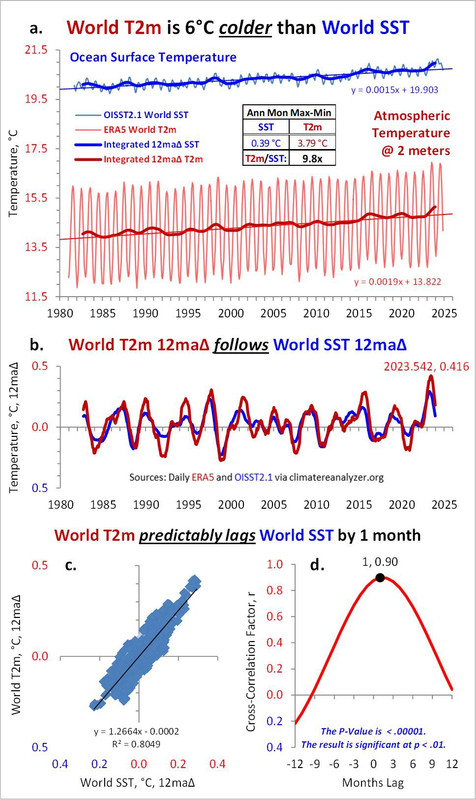
Since water vapor is about 3x more powerful a GHG than CO2, the CO2 increase since 1980 of 85.85ppm might have induced 0.0044°C of the total excess from the T2m-SST trends, =0.0001°C/yr, or 0.001°C/decade, also =0.00005°C/ppm – well below noise and measurement uncertainty.
And then there’s the issue of CO2 anomalies lagging the climate, ie, not leading climate changes:
There is certainly room to say CO2 warming is so minor it can be neglected in real climate models.
Correction: I incorrectly used 44 years instead of 528 months in some of my math before, sorry.
(0.0019°C/mo – 0.0015°C/mo) x 528 months / 4 = 0.0528°C from CO2 = (1.0032°C-0.792°C)/4
For 44 years at 0.0012°C/yr, 0.012°C/decade; and 0.0006°C/ppm. I was off by a factor of twelve.
This is still a compelling argument for not including CO2 ‘warming’ in climate models.
I sit very firmly in the Singer and Happer camp. CO2 will cause modest warming, from what I have digested of Happer & Wijngarden recently the theoretical warming for 2*CO2 might be 0.7 degC. Of course in the complex real world it could be somewhat smaller or greater depending on other factors but it is almost certainly a modest and largely benign affect.
And of course I wholeheartedly agree that without CO2 there is no life on earth.
Where I do depart slightly from the author of the article is the common assertion that GHG warm the earth by 30 degC or so versus absence of GHG. This is based on assumptions about a “dry” world etc which I think exaggerates the case. Some other attempts at estimating this suggest it is much smaller, maybe about 15 degC or so.
Its a minor point about an otherwise well written article.
It is likely much, much smaller, perhaps .1C, due to negative feedbacks. Too small to measure, not to mention, matter.
I’m guessing you’re referring to CO2 doubling, and not GHGs in general.
Or maybe even less.
Dr Markus Ott explains ‘greenhouse’ theory, why it is garbage and presents a more plausible explanation of the planet’s temperature profile in 2 short videos:
https://www.youtube.com/watch?v=Bj6ORbRBZ2s
I agree with pretty much everything you’ve said. The above quote is certainly true, but it is not a complete description of the GHE. The glass in a greenhouse is nearly transparent to short wave high energy incoming solar radiation, but nearly opaque to out going long wave radiation from the interior. Since the out going LWIR is absorbed by the glass it is much warmer the the night sky or even surrounding objects when the outdoors is colder than the greenhouse interior. Thus, the rate of heat loss from the inside of the greenhouse is far slower than it would be if the interior had a a view of the sky or colder surroundings that it would have if the glass fully transmitted all wave lengths. This is, I believe, the “greenhouse effect” that the effect of greenhouse gases is being compared too.
That said, the miniscule concentration of CO2 and the small portion of that concentration contributed by combustion of fossil fuels is obviously very weak and not a significant concern.
The quote wasn’t a description of the GHE at all, but of how an actual greenhouse works.
What distinguishes a greenhouse from other buildings is that its walls and roof are made of glass. It is heat transfer by radiation that warms a greenhouse and the slowing of heat loss by radiation that keeps it warm enough for plants. Any suitable wall and roof construction other than glass will reduce sensible and latent heat transfer, but they will fully block incoming solar and outgoing LWIR radiation. That is the what makes a greenhouse different that other types of buildings. Of course many other types of buildings use glass as a means of providing passive solar heating and, in cases where visibility is wanted but heating isn’t glass types and coatings can block incoming UV as well as outgoing IR. There’s also Low-E glass coated to reflect outbound IR which slows heat loss by radiation significantly more than ordinary glass. The greenhouse effect is properly described in terms of radiant energy transfer, not convection or conduction.
Very nice, well said.