News Brief by Kip Hansen — 15 November 2024
“In 2022, Congress passed the Global Catastrophic Risk Management Act (GCRMA). The GCRMA requires the Secretary of Homeland Security and the administrator of the Federal Emergency Management Agency (FEMA) to coordinate an assessment of global catastrophic and existential risk in the next 30 years.”

Now, the Homeland Security Operational Analysis Center (HSOAC) has produced this assessment. In reality, the report is produced by a unit of the RAND Corporation: “RAND’s Homeland Security Research Division (HSRD) operates the Homeland Security Operational Analysis Center (HSOAC)”.
The report, titled simply “Global Catastrophic Risk Assessment”, focuses on risk associated with six topics:
1) artificial intelligence, 2) asteroid and comet impacts, 3) nuclear war, 4) rapid and severe climate change, 5) severe pandemics, and 6) supervolcanoes.
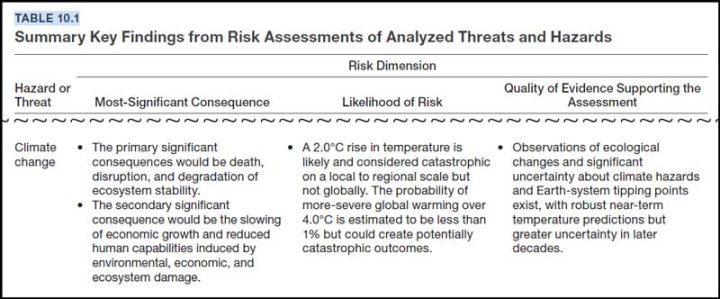
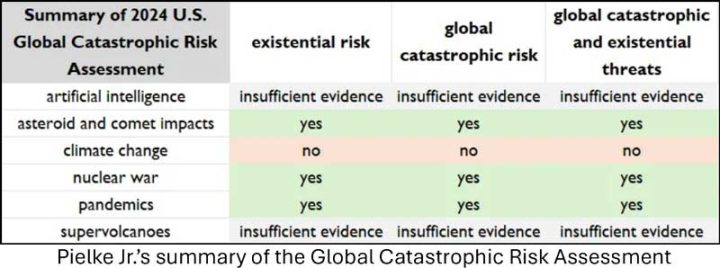
Dr. Roger Pielke Jr. writes about the governmental report on his substack under his title “Global Existential Risks”. Pielke Jr.’s piece is well worth reading in its entirety, but is summarized, for readers here, in one excerpted chart from the full RAND-produced report followed by Pielke’s summary chart.
Read Pielke’s whole piece here.
# # # # #
Author’s Comment:
I mostly agree with Pielke Jr. And, yes, this section is longer than the main post.
AI will not become “sentient” and threaten mankind – it may cause havoc if allowed to direct or control anything whatever : AI is neither intelligent nor rational, it cannot tell truth from error, fact from fiction, and, like your five-year old, is perfectly happy just making things up and passing them off as reality.
Supervolcanoes are geological – they could and might also cause vast destruction but will not represent existential or globally catastrophic risk.
It is commonly believed that comet or asteroid strikes have occurred in the past and are a possibility – the risk depending on the size. And, nuclear (atomic) weapons have been used and could be again. A widespread all-out nuclear war would have the potential to be globally catastrophic and even existential.
Intentionally or accidentally super-lethalized disease agents could wipe out humanity – or enough of humanity to force us back into the stone age. It wouldn’t take too much of a reduction in population for us to lose our advanced technological abilities. Even the smartest of us could not start from step zero and produce computer chips or cell phone services or manufacture vaccines.
So, what risks should our governments and think tanks be focused on?
Hint: not climate change.
Thanks for reading.
# # # # #
Table 10.1
A 2.0°c rise in temperature is likely and considered
catastrophic on a local to regional scale but not globally.
_____________________________________________
The big lie right there.
The Big Lie is a lie so colossal that nobody would believe that someone
could have the impudence to distort the truth so infamously
Steve ==> Hmm….it is likely as with the current system of determining Global Average Surface Temperature (as if there was such a thing) show we are almost there and likely to get there.
If some region was to get a lot more warm, say parts of Pakistan already far too hot for people to live comfortably, then it could be “locally catastrophic (as in uninhabitable)….yes, it is a stretch.
It is possible that this is based on “projected sea level rise” for the SIDS…. island nations. I’d have to dig into the report.
I think Willis was the first to show that the vast majority of the SIDS were keeping up with sea level rise at its current rate. And, at least so far, there has been no increase in that rate.
No atolls have diminished. Of 709 islands looked at over about thirty years 86% have got bigger or stayed the same. Including Tuvalu
“… say parts of Pakistan already far too hot for people to live comfortably…”
If there’s a good reason to live in a particular location, say to mine opals (Australia), then folks go underground. Our local “guided mine tour” (silver) goes down to 100 feet below the surface. It’s 65°F year round.
“A 2.0°c rise in temperature is likely and considered catastrophic“…
Over a CENTURY!
That’s 0.2°c per decade. Imperceptible without modern instrumentation.
We don’t have a century. The peak of the millennial cycle will occur in about 75 years, then it’s on to a cold period which bottoms around 2500 — if the next glacial period doesn’t start. In the shorter term, I’m predicting slight cooling for another decade or two. This cooling period started around 2016, but was interrupted by the HT volcano. Peak temperatures in 2100 will be about the same as the Roman Warm Period. Nothing catastrophic is going to happen.
De-industrialization of the west will be catastrophic.
A study by astronomers showed that the optimum planetary temperature for life is 5 degrees C warmer than Earth.
Provided the rate of change was similar to the past 100 years, I doubt if even a 4 degree rise would be even slightly catastrophic. Apart from anything else, most of the warming would appear as milder nights and winters, a welcome change for a large part of the planet.
The idea that a small warming could be catastrophic for the world is completely barking mad. Trouble is, the fear is very profitable for lots of people. Until Trump becomes the sitting president, that is.
Chris
Indeed. As many others have noted, repeatedly: daily changes in temperature are more than 2 degrees C.
That is about the difference from my feet on the floor to my head where I am sitting now. If I open the window behind me it will instantly drop by 4-5 degrees…
Well, the Toba super volcano eruption that happened 74’000 years ago wiped out almost
all of humanity, leaving only 3-10K people left on the planet. If Yellowstone went off, who
knows what the global impact would really be ? Especially when the U.N. is trying to phase
our use of fossil fuels. It could be a winter that lasts years.
Yellowstone would be a global catastrophe on a scale not seen since the last ice age.
Probably no crops anywhere in the N hemisphere for many years
Leo ==> Yes, the Hollywood version of a Yellowstone Supervolcano Eruption would do just that. But Hollywood is not the real world. What evidence do we have that points to that type of event?
There is evidence that there could be a volcanic event in/around Yellowstone….but a SUPER event?
Wait, can we get a volcano to erupt in Hollywood?
dk_ ==> Hopefully ? ! ?
Import John Oliver, the failed British stand up comedian, he’s suitably deranged.
https://ashfall.unl.edu/
There is evidence that super volcanoes have erupted and destroyed life at great distance.
mkelly ==> Yes, in the distant past — which is why it is possible …. but there is no evidence that it is imminent (next 30 years) or that it would be global.
Imminent no. You are correct. It has been noted that both pole switching ends and Yellowstone volcanic eruptions are on a roughly 700,000 yr period with both over due.
Polar switching is a magnetic event. You would need a compass to notice any change at all..
No one would be snapping selfies at Old Faithful.
Ice age? We are in an ice age and have been for millions of years. You probably mean “glacial age” which have occurred about every 100,000 years for the past million years. We are currently in a warm interval between glacial ages when ice coverage of Earth is much reduced. For the 2 million years before that such intervals occurred about every 40,000 years. We are currently about 6,000 years into our current interglacial which will end perhaps tomorrow, or in a hundred years or a thousand, but it will begin. That is the “climate change” to worry about when all of Canada, the top half of the US and most of Europe will be covered once more with a mile or two of ice. To me, that is the climate change we should be studying, not this CO2 nonsense.
I believe you mean occurring about every 10,000 years, then lasting for around 100,000 years.
The Neanderthals thrived during the Ice Age as did Homo Erectus…
Besides there are people living on Greenland and in Shara to this day…
Eric ==> Quite speculative, but it is possible that a huge huge huge supervolcano, like the entirety of the Yellowstone field, could create catastrophic effects.
There is just not much evidence that it could/would/might happen on that scale.
wiped out almost all of humanity
Reading the Wikipedia entry carefully suggests this “all” is unsupported.
74000 years ago – humanity did not have access to fossil fuels, technology beyond stone age tools and were not spread all over the planet.
The Global Catastrophic Risk Assessment
And how to tackle it:
UK must treat Trump like a ‘best mate’ who needs correcting, says Sadiq Khan
Mayor of London backtracks on previous criticism of President-elect as he stresses importance of special relationship
https://www.telegraph.co.uk/politics/2024/11/15/uk-treat-trump-like-best-mate-correcting-sadiq-khan/
Make the weasel squirm.
And , more farmer unrest ….
NEWS TIP
https://www.reuters.com/world/europe/french-farmers-stage-protests-against-mercosur-deal-next-week-2024-11-13/
With slurry…
https://www.express.co.uk/news/politics/1976366/Farmers-welsh-labour-conference-protest
It will always be the thing you never thought of that gets you.
It’s not what you KNOW you don’t know that gets you. It’s what you DON’T KNOW you don’t know.
Tipping Points — AHHH, RUN AWAY!
Correct! Except maybe for the implied insult to 5-year-olds, and the “happy” part-‘It doesn’t get happy, it doesn’t get mad, it just runs programs.” Anything else is salesmanship.
The aforesaid child is a good gage, though: we should adopt the principle of not letting an AI computer system “run” anything that can’t be entrusted to a 5-year-old.
IMO, you could substitute government for AI in the previous sentence, or the quoted one, above.
dk__ ==> “we should adopt the principle of not letting an AI computer system “run” anything that can’t be entrusted to a 5-year-old.”
Very good! Like it.
I suspect you know quite a bit about the disaster of Hurricane Katrina, as in why it was such a large disaster. I bet you could come up with at least a dozen other large disasters that have happened since for the same reason:
politicians serving their own and other particular interests rather than the general interests, even when the risks have been well documented and the mitigation requirements are mostly well known.
Does this knowledge put any weight on whether said politicians or a dispassionate AI would be likely to do a better job? Sure, an AI would not be able to force the use of resources and activities but maybe provisions could be put in place such that the AI’s conclusions about such things could be kept in front of the people regardless of politicians wishes.
You probably also know that the beliefs expressed by many people here, that an AI program is simple a computer program turning inputs into predetermined outputs much in the way of a spreadsheet, is a gross misunderstanding.
AI (as the misnomered software is called) is great at data collection and sorting, and pattern recognition as it operates on a weighted decision tree, which is not common.
The concern is to not allow AI to make decisions or have unconstrained control. Any AI computer needs a manual/mechanical “kill switch.”
AI is not so much misnomed as it is incorrectly defined. The correct definition is Automated Idiocy.
AI isn’t new, but has been around at least since the works of Claude Shannon, Marvin Minsky, and Alan Turing. Practical AI programming and design techniques have been in use since at least the 1950s, and many of the systems and programs we encounter daily using computers, phones, and the internet use various components of AI.
IMO the current publicity of AI are collective a marketing push by big tech, are designed both to obtain investment and capture government regulation as a means to dominate market and eliminate competition, as well as to deceive the gullible.
This is not at all to say that there aren’t useful, practical designs, methods, and systems that use artificial intelligence techniques or paradigms as a base, but that they are just softare and hardware systems, and just as fallible as you say.
AI is another red herring as you say. There is no computer program that has ever shown any actual intelligence and it is nothing like even a simple animal brain. AI is a name to amuse the public. When a computer invents something completely new and gets a patent for it we may be getting somewhere. I thought of something patentable this morning while out for a walk!
I offer DAVE’s climate change risk assessment here for free:
Plenty of observational and computational evidence exists to conclude there is negligible risk to the climate system or to any climate-related trend – temperature, precipitation, storm intensity, etc. – from the static radiative effect of incremental CO2, CH4, N2O, or of any other non-condensing gas known to absorb and emit in the IR spectrum.
I certify that I have received no funding from any source to have performed this assessment.
Well, Thank you Dave. (free too!)
I would be concerned about Dave’s Syndrome, however…
https://blackbooks.fandom.com/wiki/Dave%27s_syndrome
https://youtu.be/36aisbtnS4U
How we “react” to climate change poses a great risk to humanity. This can be combined with AI, nuclear war and pandemics under the heading “Politicians”, which is the primary risk to humanity.
“Politicians”, which is the primary risk to humanity.”
_________________________________________
Death by Government – R.J. Rummel
O/T – It’s a shame The Guardian Editor, Katherine Viner, cannot offer her small readership some free counselling.
unbanned
3 hours ago
Thanks for this George. [Monbiot]
I’m pretty devoid of hope for the future, but what can we do?
allanbabb
unbanned
Or you could take out the thing that’s doing the damage: the economy.
https://www.theguardian.com/commentisfree/2024/nov/15/dying-earth-cop29-azerbaijan-species#comments
Story tip.
https://www.newscientist.com/article/2455922-worlds-largest-coral-is-300-years-old-and-was-discovered-by-accident/
Yet more, er, settled science.
Yet more, er, settled science.
Is there an echo in here?
in here?
Apparently…
What happened to the bigger ones? Must have been climate Change.
Thanks Kip.
Regarding “super volcanoes”, most folks are not well informed. Try this:
Bruneau-Jarbidge volcanic field – Wikipedia
John ==> Thanks for the link.
In the UK things just get… well, more and more bonkers by the day…
Reeves has come under heavy fire after she was caught ‘lying’ on her CV about her true work history as an economist.
In October the Guido Fawkes website revealed that while she claimed she worked as an “economist” at the Bank of Scotland between 2006 and 2009, she in fact had a more mundane job working in a support unit managing administration, IT and planning matters.
https://www.express.co.uk/news/politics/1976516/rachel-reeves-CV-economy-correction
And…
RACHEL REEVES’ “BRITISH CHESS CHAMPION” MYTH BUSTED
https://order-order.com/2024/10/15/investigation-rachel-reeves-british-chess-champion-myth-busted/
Oh well.
Shall we add another to the list? Ben Davidson at Suspicious Observers presents evidence to suggest that the Sun is overdue for a periodic micro-nova. These have caused major extinctions and yet some humans have always survived.
It would be catastrophic and, as has happened in the past at regular 6000 +/- 500 years; the last being over 6000 years ago. He has a web site which has a much more complete description.
Old George ==> Do you think the evidence is credible?
“So, what risks should our governments and think tanks be focused on?”
Cleaning up our research system. Coming from many different sources, even of necessity a very open, scientific magazine had a rare article on a problem with “publish or perish,” this on “chesnut blight.” (Wooden Boat, 2024, no. 300, 50th anniversary issue.)
This seems to be one of the best brief summaries from a previous president of Sigma Xi, which started and still claiming to be a Research Honor Society, now too much devoted to policy impacts from such research. Journals are almost universally using “Impact Factors” based on numerical citations rather than content and too much requiring money for publishing. This has not completely knocked out good research but I suspect the impact has been significant as shown here. It is at least ‘serious abscesses’ but to what degree worse is unclear to me.
https://www.sigmaxi.org/news/keyed-in/post/keyed-in/2024/04/11/passing-the-torch
“But today’s highly competitive landscape has culminated in the creation of a new kind of scientist: the accomplished technician who seemingly publishes a new paper every 37 hours. Such successes—or maybe we should call them abscesses—indicate not so much that certain individuals have mastered the publish-or-perish game, but rather that the standard that society has set for scientists is no longer tenable.”
hd ==> And here I that I was the only one here at WUWT that subscribes and reads Wooden Boat.
My youngest son is and employee and volunteer at The Wooden Boat School at the Hudson River Maritime Museum
That makes two of us, well almost two I read WoodenBoat but can no longer afford the subscription, but I do have a subscription to Small Craft Adviser. I also muck about designing small boats.
STORY TIP: Some comment appeared on this topic on November 14 about the probability of an eruption in Yellowstone. It was in the Idaho Capital Sun by the Yellowstone Volcanic Observatory. Best guess: 0.0001% in any one year.
Regarding artificial intelligence: the LLMs we see today are not intelligent. What they are, are trainable heuristic machines with a good grasp of grammar for input and output.
They don’t learn at all, they are literally no more than a very Rube Goldberg “monkey see, monkey do” algorithm combined with intellectual piracy of a truly global scale.
And their problems are only going to get worse, not better. So called AI summaries – with large and measurable degrees of error – are already propagating back into the intellectual piracy part and making results even worse. Someone ought to measure the accuracy entropy of this feedback loop – I would not be surprised if the point of no return (i.e. more garbage out than quality) is an actual tipping point … and is not that far away.
c1ue ==> See the recent studies on Model Collapse:
https://www.nature.com/articles/s41586-024-07566-y
https://en.wikipedia.org/wiki/Model_collapse
Nick Bostrom’s 2008 book “Global Catastrophic Risks” adds
supernovae, gamma-ray bursts, solar flares and nanotechnology to the above list.
But as someone below mentioned, the most likely catastrophe is the current policy response to the
supposed “existential climate crisis”.
cata·stroph·ic
[ˌkatəˈstrɒfɪk]
adjective
involving or causing sudden great damage or suffering:“a catastrophic earthquake”Here I disagree with Pielke Jr., a 2C increase in temperature will not be “catastrophic” to local or regional areas by any stretch of the imagination. A 4C change may just be a little uncomfortable.