h/t Roy W. Spencer
March is a peak month for auroras, and this should be a good one in the coming days.
A strong X-class solar flare lasting 5 hours has erupted on the sun, lifting a coronal mass ejection (CME) with an Earth-directed component. Play the right-hand video in the link, 1st comment, to see the CME near the end of the clip.
… the flare was unusual in that it involved two widely-separated sunspots than became magnetically connected during the flare.
https://www.swpc.noaa.gov/products/lasco-coronagraph
NOAA SWPC writes:
R3 (Strong) levels were reached on 22 March, 2024. The flare activity began from Region 3614 (to the north), and was still in progress when another flare erupted from Region 3615 (to the south). It’s tough to say with certainty at this point which flare was the source of R3 level
Carrington Time? NO, only TV and internet disruption? Is it safe to work on my suntan?
The 774 solar event may have been ten times as powerful as the 1859 event. If the equivalent happened today the result would be catastrophic damage to electronics of all kinds, and widespread loss of life. It would be one of the most consequential events in human history.
When does it arrive here?
Sometime March 25th or March 26th according to SpaceWeather.com This X-class event lasted for more than 5 hours, plenty of time to lift a CME out of the sun’s atmosphere. Indeed, SOHO coronagraphs have detected a bright halo CME heading directly for Earth. This is going to cause a geomagnetic storm when it arrives, probably on March 25th.
CMEs aimed at Earth are called “halo events” because of the way they look in coronagraph images. As the expanding cloud of an Earth-directed CME looms larger and larger it appears to envelop the Sun, forming a halo around our star.
Potential Impacts: Radiation – Passengers and crew in high latitude, high
altitude flights may experience small, increased radiation exposures.
Spacecraft – Infrequent single-event upsets to satellites are possible.
Radio – Small effects on polar HF (high frequency) propagation resulting in fades
at lower frequencies.
What about weather events and earthquakes ?
If March is a peak month for Auroras: —is March also a peak month for CMEs? If March is a peak month for CMEs, what are the external causes leading up to the CMEs?
Your CO2 emissions.
Would like to know how many GW of energy is going to be dumped into the atmosphere.
And since it is stopped up there, how long before it is radiated out.
A Layman’s guess.
The Northern Hemisphere is entering spring. The Earth’s axis in the NH is shifting to point more at the Sun. We had a winter where it didn’t so ozone levels would be at their lowest.
Again, just “A Layman’s guess”.
A question. What is the Southern Hemisphere’s equivalent of “Aurora Borealis” called?
Aurora Australis
In ’62, in high school, I participated in an aurora logging project in Northern Minnesota. We were told that auroras occurred every several days at those latitudes. However, half the time it would be cloudy, and another half would be daylight, so we could expect to see them only every couple of weeks, and that’s if we stayed up all night. We learned that we mostly saw them in the winter, not because that they were the most common then, that’s when it was the most dark. I’m not so sure why March would be higher. It may be because people are taking advantage of the warmer weather and spend more time outside.
NOAA/SWPC edited out the LASCO C2 and C3 video frames between 0008 UTC and 0442 UTC for some reason. They apparently had to adjust down the contrast gain with this CME in frames after 0442 UTC. Still the first frames in C3 images at 0442 UTC and following are impressive.
A full halo, asymmetric fast moving CME will hit 1 AU sometime around 0000 UTC 25 March, that is around 8pm EDT / 5 PM PDT Sunday night. A near full moon will hinder what would otherwise be an impressive aurora event (cloud cover permitting) and will reach well down into CONUS US mid latitudes.
Who had “Carrington Event” on their 2024 Bingo card?
The filament structure lifting off the NH active region 13614 was unusual and quite large. Even though this was “just” a X1.1 flare event, the amount of plasma lifted off the photosphere, super-heated by the corona magnetic flux release, and then ejected is quite large.
(see image attached. Image is the SDO 94 angstrom taken at 0544 UTC, a full 4 1/2 hours after the initial filament rupture event began.)
Think of pushing on a light-weight door versus a very heavy steel door. It takes a lot more effort to push the heavy door to get the same closing velocity as the light door, which you can easily slam fast. The extra effort is an indication of the much higher mass being flung which must be accelerated. This will be a major solar storm event for Earth on Sunday night into Monday morning.
The Earth geomagnetic environment today is already disturbed by a high speed proton flux (that is, above the 10 MeV SWPC warning threshold for HF impacts, LEO satellites, and high-lat high alt commercial air traffic), likely from the Coronal Hole 1207 transiting the Earth-facing solar meridian. Folks in the high latitudes above 65N/S are getting treated to an active aurorae show right now. This is a G1 event, at Kp index ~5, on NOAAs scale of geomagnetic storms. The K index is a logarithmic scale.
The geomagnetic storm for Sunday night into Monday from this 0100-0600 UTC CME will likely be at least at G3 (Kp ~7, maybe higher to 8). G5 conditions, Kp to 9 is NOT expected from this CME.
But keep in mind the Southern Hemisphere active region 13615 is just now rotating to central Earth facing meridian, and it is FKC (that is, very large area complex magnetic structure, and compact), and classified “beta-gamma-delta”, the worst of all possible combinations. Cross your fingers that it doesn’t pop in the next 48 hours.
As of noon 12 CDT, proton flux has the solar radiation warning level at S2, moderate level, effects:
Biological: Passengers and crew in high-flying aircraft at high latitudes may be exposed to elevated radiation risk.
Satellite operations: Infrequent single-event upsets possible.
Other systems: Small effects on HF propagation through the polar regions and navigation at polar cap locations possibly affected.
The arrival of the CME proton flux on Sunday night from this latest long-duration solar flare will be worth watching to see how high this goes. Being on ISS during an S4 or S5 would not be good for long term health. Protected areas of the ISS include the orbiter’s middeck and the aft ends of the space station’s U.S. Destiny laboratory and Russian-built Zvezda service module. NASA may have to initiate radiation protection protocols for ISS on Sunday.
In 2000, a severe solar radiation storm prompted NASA to order astronauts/cosmonauts aboard the International Space Station to take shelter in a more heavily shielded Russian-built section of the orbiting outpost.
The three crewmen remained in the aft end of the Zvezda module for about 12 hours before the warning was lifted.
During that time, Russian scientists estimated, the crew received the equivalent of a week’s normal radiation exposure.
“It wasn’t life-threatening, and they weren’t projected to receive any exposures that would put them even close to their limits,” said Michael Golightly, chief of space science at the Johnson Space Center in Houston. “But we don’t like them to get any extra exposure if we can help it.”
Of note, a Jan 23, 2012 long duration flare/CME (AR 11402) during SC24 was quite large but only had a glancing blow on Earth as the region had transited past the Earth meridian 2 days earlier-. A direct hit from one that size would have triggered radiation alert protocols again on the ISS.
It will bypass the Earth. The next explosion from spot 3615 may hit the Earth directly.


The SWPC plasma density model is merely a predicted forecast (a simulation) for midnight Sunday, early AM Monday morning (0600 UTC), based on limited, initial CME structure information. SWPC fmodels teams will be rerunning these models again over the 24 hours to better estimate predicted impacts. The actual CME won’t hit SOHO/SDO, orbiting at their L1 points, less than an hour before its arrival at Earth.
For now temperature of the thermosphere is increasing.
A weak geomagnetic storm is underway.
Very strong fluctuation of magnetometers in the north.

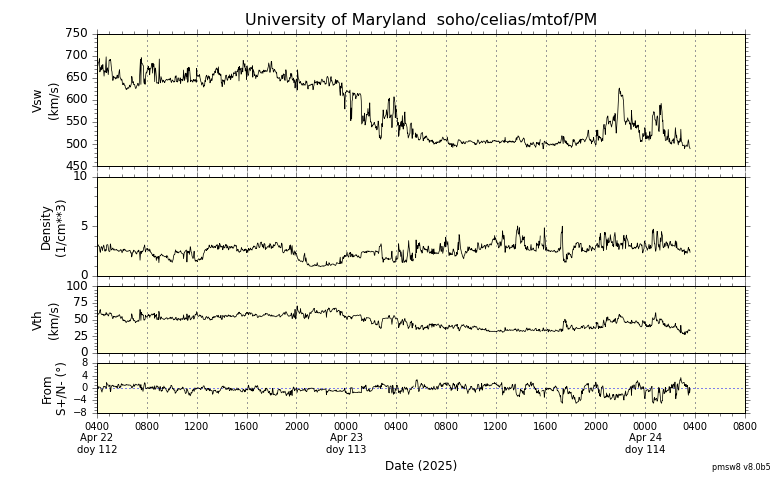
A sharp jump in solar wind speed.
