Guest post by Paul Dorian

Overview
The sun continues to be very quiet and it has been without sunspots this year 70% of the time as we approach what is likely to be one of the deepest solar minimums in a long, long time. In fact, all indications are that the upcoming solar minimum may be even quieter than the last one which was the deepest in nearly a century. In addition, there are now forecasts that the next solar cycle, #25, will be the weakest in more than 200 years. Even weak solar cycles, however, can produce significant solar storms. In fact, it was this same time of year back in 1859 when a super solar storm – now known as the “Carrington Event” – took place during another weak solar cycle (#10). The event has been named for the British astronomer, Richard Carrington, as he observed from his own private observatory the largest solar flare which caused a major coronal mass ejection (CME) to travel directly toward Earth. Fortunately, solar storms of this magnitude are quite rare as it would very likely have a much more damaging impact on today’s world than it did in the 19th century.

The solar storm of September 1, 1859
This past weekend saw the strongest geomagnetic storm of the year with northern lights visible all the way down into the northern US, but it was nothing in comparison to what took place 160 years ago. From August 28, 1859 to September 1, 1859 numerous sunspots and solar flares were observed on the sun and auroras were being observed in different parts of the world. Just before noon on the cloudless morning of Thursday, September 1, 1859, 33-year-old astronomer Richard Carrington – widely acknowledged at the time to be England’s best – was in his own private observatory and, as he usually did on sunny days, he used his telescope to project an 11-inch wide image of the sun on a screen and carefully drew the sunspots that he saw. Suddenly, two brilliant beads of blinding white light appeared over the sunspots, intensified rapidly, and became kidney-shaped. He realized that he was witnessing something unprecedented and left for about one minute to find another witness. On returning within 60 seconds, he and his witness found that much had already subsided in that short time.

The next morning, Friday, September 2nd, 1859, when the CME arrived, it crashed into Earth’s magnetic field, causing the global bubble of magnetism that surrounds our planet to shake and quiver. The CME reached the Earth some 17.6 hours after the eruption which is much quicker than the normal journey time of 3 or 4 days as an earlier CME actually cleared the way of the ambient solar plasma for the second blast to move so quickly. Rapidly moving fields induced enormous electric currents that surged through telegraph lines and disrupted communications. In fact, telegraph systems all over Europe and North America went haywire and, in some cases, telegraph operators were literally shocked as sparks were flying and telegraph paper was often set on fire. Some systems actually continued to work despite being disconnected from their power supplies as aurora-induced electric currents still allowed messages to be transmitted. Skies all over Earth erupted in red, green and purple auroras – even in tropical locations like Cuba, Jamaica, El Salvador, the Bahamas and Hawaii. The auroras were so bright over the Rocky Mountains that their glow awoke gold miners who began preparing breakfast because they thought it was morning. People in the northeastern US could read a newspaper by the aurora’s light.

31 Aug 1859, – The Cadiz Sentinel at Newspapers.com
On Saturday, September 3, 1859, the Baltimore American and Commercial Advertiser reported, “Those who happened to be out late on Thursday night had an opportunity of witnessing another magnificent display of the auroral lights. The phenomenon was very similar to the display on Sunday night, though at times the light was, if possible, more brilliant, and the prismatic hues more varied and gorgeous. The light appeared to cover the whole firmament, apparently like a luminous cloud, through which the stars of the larger magnitude indistinctly shone. The light was greater than that of the moon at its full, but had an indescribable softness and delicacy that seemed to envelop everything upon which it rested. Between 12 and 1 o’clock, when the display was at its full brilliancy, the quiet streets of the city resting under this strange light, presented a beautiful as well as singular appearance.”
Today’s view of “The Carrington Event”
Back in the 19th century there were no X-ray satellites or radio telescopes and no one knew solar flares existed until that September morning. “What Carrington saw was a white-light solar flare—a magnetic explosion on the sun,” explains David Hathaway, solar physics team lead at NASA’s Marshall Space Flight Center in Huntsville, Alabama. “It’s rare that one can actually see the brightening of the solar surface,” says Hathaway. “It takes a lot of energy to heat up the surface of the sun!” The explosion witnessed by Carrington produced not only a surge of visible light, but also a mammoth cloud of charged particles and detached magnetic loops—a “CME”—and hurled that cloud directly toward Earth. “In the 160-year record of geomagnetic storms, the Carrington event is the biggest”, says Hathaway. In fact, going back farther in time by examining Arctic ice (energetic particles leave a record in nitrates in ice cores), it is estimated that this event may have been the biggest in 500 years and nearly twice as big as the runner-up.
Impact on today’s world
Today we know that solar flares happen frequently, especially during solar sunspot maximums. In today’s world, electronic technologies have become embedded into everyday life and are, of course, quite vulnerable to solar activity. Power lines, long-distance telephone cables, radar, cell phones, GPS, and satellites – all could be significantly affected by an event like this one. In other words, the world’s high-tech infrastructure could grind to a halt disrupting daily activities from purchasing a gallon gas to using the Internet.
Of particular concern is the fear about what this kind of solar storm could do to the electrical grid since power surges caused by solar particles can blow out giant transformers. If numerous transformers happened to be destroyed at once, it would likely take a painfully long time to replace them. The eastern US is especially vulnerable since the power infrastructure is highly interconnected so that failures in one location could cause failures in other regions. One long-term solution to this vulnerability would be to rebuild the aging power grid to be less susceptible to solar disruptions.
Final thoughts
On the positive side, there is comfort in the fact that observations of the sun in today’s world are a constant with a fleet of spacecraft in position to monitor the sun and gather data on solar flares. Also, there is better forecasting in today’s world and solar scientists could give some sort of warning as to when solar flares might appear and whether a given storm is pointed at Earth. Improved forecasting can allow for mitigating actions to be taken since the most damaging emissions travel slowly enough to be detected by satellites well before the particles strike the Earth. For example, power companies could protect valuable transformers by taking them offline before a solar storm strikes. Finally, statistics suggest that “Carrington-type” flares are perhaps once in a half-millennium events. The statistics are far from solid, however, and Hathaway (NASA) cautions that we don’t understand flares well enough to rule out a repeat in our lifetime.
Meteorologist Paul Dorian
Perspecta, Inc.
perspectaweather.com
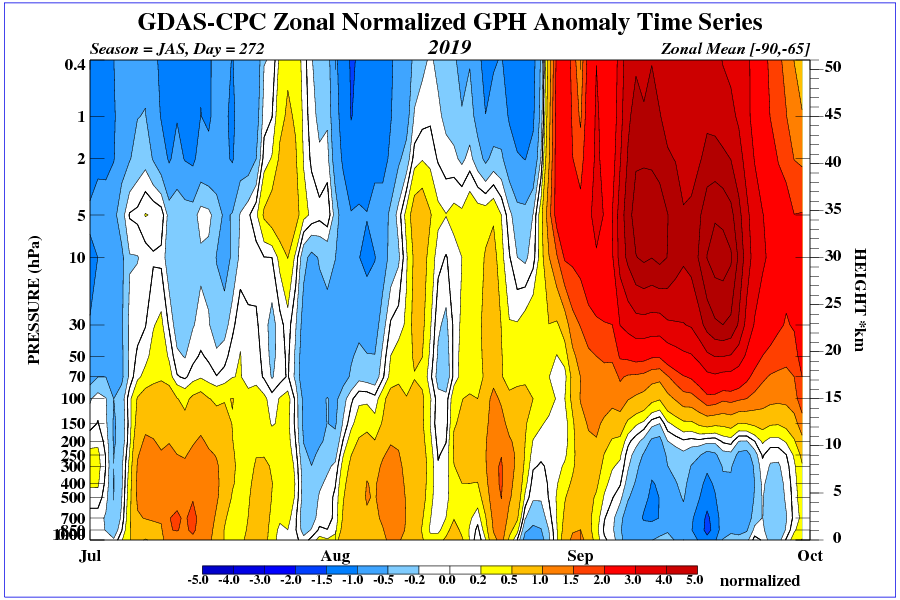
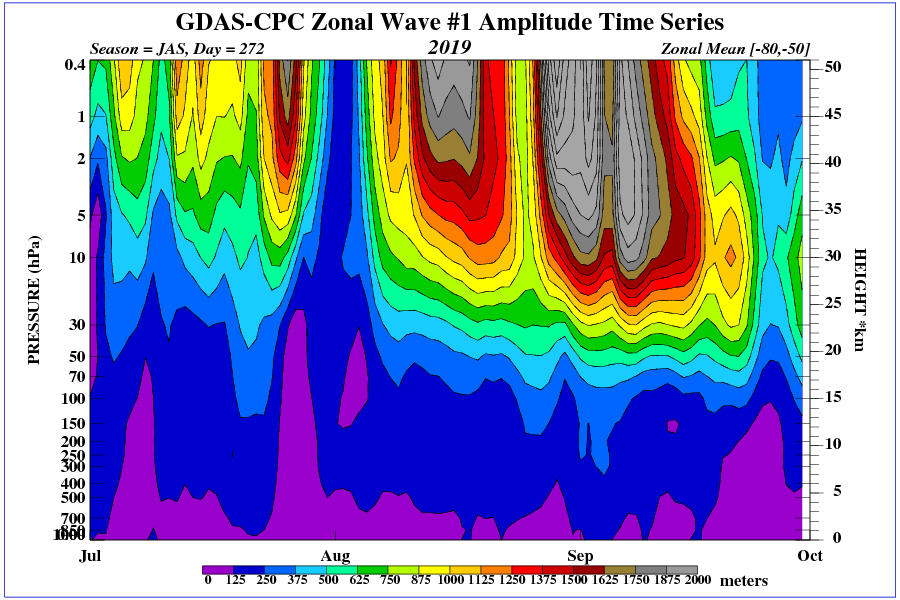
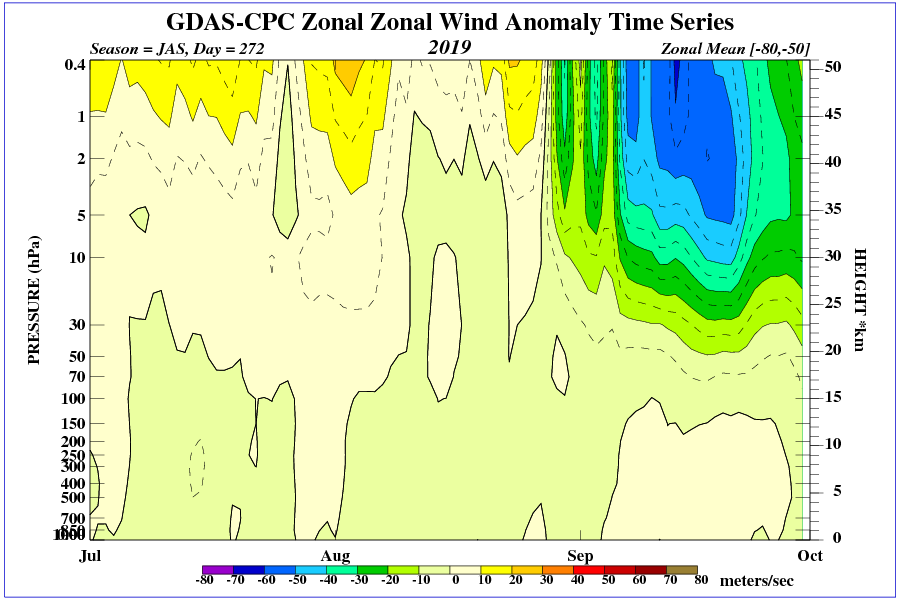
Anomalies of the winter southern polar vortex.
The biggest effect of a very large CME would be on the electricity Transmission grids if they were not properly fused or didn’t manage in time to dump the surge before it fried the transformers. And probably only ones north or south of the equator 40 degrees latitude. This is why the March 13, 1989 geomagnetic storm caused Hydro Quebec a temporary 9 hour shutdown, but further south in CONUSA, there was little effect.
I am not sure if there is any difference to a DC HVDC line vs. say a 500 KVA AC line or if DC is more resilient to such a high surge? HVDC requires less conductor per unit distance than an AC line, (2 conductor) as there is no need to support three phases and there is no skin effect. Plus there is no frequency in the DC line since that is reestablished at the end of the line where the inverter equipment crank out whatever frequency you require making them good at operations between grids of different AC frequency. But the HVDC lines are usually a lot longer than AC, albeit less conductor wire so not sure how HVDC would hold up under an intense CME. Perhaps worse because of more exotic solid state controls, thyristors and inverters?
If the circuit breakers can protect the transformers from lightning striked (they can), then they would have no trouble protecting from a Carrington event which is hundreds of times slower.
Apples and oranges. Lightning strikes are millisecond events, and circuit breakers/fuses do protect for the most part from a lightning strike. Lightning on a transmission line is seeking the shortest and quickest route to ground, and if it is provided with a route to ground, it does so instantly with no harm. A CME is a much different event, inducing high currents into a long run of wire over a much longer period of time. I don’t know that a standardized circuit breaker or a fuse does the same job with a CME when it is circulating induction currents in the transformer copper windings that does the damage to the transformer when it melts/fuses. But we should be able to design something that does open the circuit and initiate a complete shutdown of the grid which is probably what is required, which is to allow the CME event to pass without harm. Of course, a planned soft shutdown of the grid is preferred, so it may still be a human call to do so in advance of a known CME event approaching. We have so little real world experience with this.
All electricity seeks the shortest path to ground. It’s what electricity does.
When it comes to protection from over voltage fast is a problem, slow less so.
A Carrington event is orders of magnitude easier to handle than is a lightning strike.
I would suspect EMP damage to electronic devices and the indirect damage caused by the electronic device failure would be the problem.
If the EMP pulse destroys the electronics that controls the grid circuit breakers there maybe damage as electrical grids require controlled shutdown to avoid damage.
There are high power electronic switches that are used for DC power lines may be damaged by the EMP pulse. DC power lines require control equipment to be shutdown safely.
The problem is there is a large amount of energy stored in magnetic fields about the wires in a large electric grid so instant shut-off can damage the grid. A possible mitigating plan would be to shutdown the entire grid.
A key issue to determine affect on our country would be the time required to get the electrical grid back up. Without electricity large cities become chaotic. Loss of power for a year or so would be a problem.
The delivery time for large power transformers is roughly a year.
There is no EMP (adding pulse to that is redundant.)
The problem with stored energy in the EM field has been known by electrical engineers for a hundred years.
In January, sudden stratospheric warming is possible in the north, in the conditions of La Niña.
http://www.bom.gov.au/climate/model-summary/archive/20190903.nino_summary_6.png
For those more inclined to review an audio-visual review of GIC (Ground Induced Currents due to magnetic storm) related subjects: “Effect of geomagnetically induced currents (GIC) on power transformers and power systems” by ABB Customer World
(First posted on April 29, 2014 at 6:25 am https://wattsupwiththat.wordpress.com/2014/04/29/climate-craziness-of-the-week-un-climate-change-to-effect-computers-communications-prepare-now/#comment-1624405 )
https://youtu.be/-8OKmlyVeKQ
These level of solar storm may be more common than thought. Lucky for us we missed by one week orbit time the last Carrington level event
https://science.nasa.gov/science-news/science-at-nasa/2014/23jul_superstorm/
Peter Taylor wrote a very good post above. People here seem to be scoffing about the effects but they are very real and much more serious than AGW.
The UK Govt set up a dept to examine the problems another Carrington event would bring. ThHe report is here
https://assets.publishing.service.gov.uk/government/uploads/system/uploads/attachment_data/file/449593/BIS-15-457-space-weather-preparedness-strategy.pdf
tonyb
Currently, the sun is extremely quiet.
http://www.solen.info/solar/images/AR_CH_20190910_hres.png
Only when the coronal hole is at the solar equator can a geomagnetic storm be expected. The G2 storm is not dangerous.
These warnings are fine and all, but they start to sound like Y2K predictions or “Iraqi oilfields will be burning for 30 years” or, I don’t know, CAGW!
Extraordinary claims require extraordinary evidence.
Live Skeptically…
“Humans have long been shaping Earth’s landscape, but now scientists know we can shape our near-space environment as well. A certain type of communications — very low frequency, or VLF, radio communications — have been found to interact with particles in space, affecting how and where they move. At times, these interactions can create a barrier around Earth against natural high energy particle radiation in space. These results, part of a comprehensive paper on human-induced space weather, were recently published in Space Science Reviews.
With further study, VLF transmissions may serve as a way to remove excess radiation from the near-Earth environment. Plans are already underway to test VLF transmissions in the upper atmosphere to see if they could remove excess charged particles — which can appear during periods of intense space weather, such as when the sun erupts with giant clouds of particles and energy.”
https://www.nasa.gov/feature/goddard/2017/nasas-van-allen-probes-spot-man-made-barrier-shrouding-earth
Nobody has mentioned what would happen to nuclear power plants. You don’t just shut those down with a five-minute warning. Or even a whole day warning.
Actually, you can shut those things down in just a couple of minutes.
What you then have to do is provide power for the pumps for the next week or two.
If the grid isn’t available, they have generators and plenty of fuel for them.
Maybe this is what Ezekiel saw… There’s a link to a free PDF on “Z-Pinch Aurorae”.
https://stickmanonstone.com/product/high-current-z-pinch-aurora-1/
This is a nothingburger aside from a few grid transformers that are this minute on the verge of failure. There is however the real risk that such an event might escalate into a cascading grid failure (from the simultaneity of arcs from faulty component failures, not from the flare itself). And there might be some areas that remain dark because of insufficient supply side planning and delays in transformer manufacturing… so I’d put irreparable damage at slim to none. So the real question is, are we prepared to black-start the grid after such an event? All we have to go on in most places are drills and simulations.
Antenna-like conductors spanning hundreds of miles on poles astride railroad tracks, such as the straight unshielded telegraph wires that demonstrated Carrington Event effects: none in popular use, no critical infrastructure. We went microwave then fiber years ago. Paths are not long or straight or above ground.