While the sun is completely blank today, and has been for 8 days, some new things are happening in space in the electromagnetic relationship between the sun and the Earth – cracks are forming in Earth’s magnetic field that are allowing solar wind particles into Earth’s upper atmosphere.

The sunspot number keeps decreasing, as would be expected at the end of solar cycle 24:

The vernal equinox is less than 10 days away. That means one thing: Cracks are opening in Earth’s magnetic field. Researchers have long known that during weeks around equinoxes fissures form in Earth’s magnetosphere. Solar wind can pour through the gaps to fuel bright displays of Arctic lights.
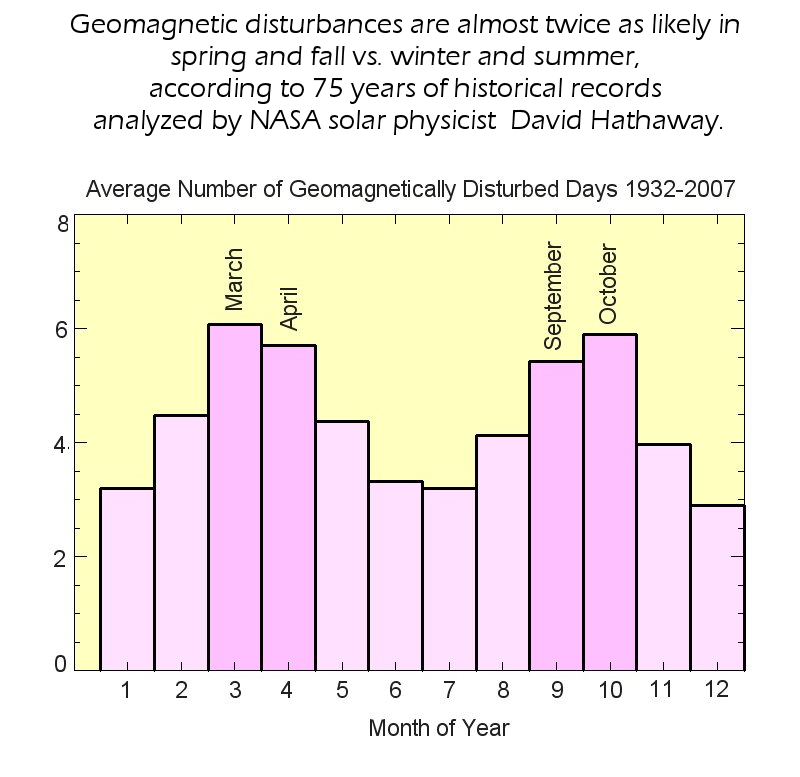
This is called the the “Russell-McPherron effect,” named after the researchers who first explained it. The cracks are opened by the solar wind itself. South-pointing magnetic fields inside the solar wind oppose Earth’s north-pointing magnetic field. The two, N vs. S, partially cancel one another, weakening our planet’s magnetic defenses. This cancellation can happen at any time of year, but it happens with greatest effect around the equinoxes. Indeed, a 75-year study shows that March is the most geomagnetically active month of the year, followed closely by September-October–a direct result of “equinox cracks.”
NASA and European spacecraft have been detecting these cracks for years. Small ones are about the size of California, and many are wider than the entire planet. While the cracks are open, magnetic fields on Earth are connected to those on the sun. Theoretically, it would be possible to pick a magnetic field line on terra firma and follow it all the way back to the solar surface. There’s no danger to people on Earth, however, because our atmosphere protects us, intercepting the rain of particles. The afterglow of this shielding action is called the “aurora borealis.”
One such episode occurred on March 9th. “The sky exploded with auroras,” reports Kristin Berg, who sends this picture from Tromsø, Norway:

During the display, a stream of solar wind was barely grazing Earth’s magnetic field. At this time of year, that’s all it takes. Even a gentle gust of solar wind can breach our planet’s magnetic defenses.
Via NASA Spaceweather
Leif, I will definitely give you credit for getting me to see Maxwell’s equations from a TOTALLY different perspective.
I was always clear that Gauss’s Law of Magnetism says there are no sources or sinks (i.e., monopoles) for magnetic fields, but I never ever interpreted that as saying magnetic fields are neither created or destroyed, with the bizarre implication that they always were and always will be.
So magnetic fields are conserved.
BUT … as Feynman pointed out, conservation of energy does not mean “energy” exists, but rather, energy is merely an abstract accounting term.
Hmmm … might the same not be true for “magnetic fields”.
What makes the compass needle point north must surely exist. What keeps stuff stuck to your fridge door must surely exist. What helps homing pigeons to find their way must surely exist…
Ask people in Hiroshima [that ere left] if the energy in E=mc^2 is merely an abstract accounting term…
A south magnetic pole orientation makes the compass needle point to the geo-north …. LOL.
And anthro-added CO2 causes not one naught of warming…
and Leif,
I’m reckoning (after 3 beers) that a magnetic monopole discovery (hiding in plain sight in our Sun) will earn you a Nobel. They answer to that problem is why CP asymmetry exists and how to cancel it.
http://adsabs.harvard.edu/abs/1972CoASP…4..141W
You have to copy and paste the whole thing:
http://adsabs.harvard.edu/abs/1972CoASP…4..141W
WordPress screws up the link, so here is a better link:
https://www.elif.org/research/Wilcox-Monopole.pdf
WordPress screws up the link, so here is a better link:
https://www.leif.org/research/Wilcox-Monopole.pdf
It is getting late here…
You were publishing before I was born. I’m thanking you for telling me something new to me, and linking to it after a few tries.
Leif. Read the short paper on the ‘monopole’ solar magnetic field during solar minima in 1954 and 1965. Have there been any new developments in this seemingly impossible phenomenon? Was the field simply ‘outward’ (It’s difficult to even make a sensible question) in every direction – not just in the ecliptic plain? Is there a limitation on the distance ‘outward’? Could there be a period of some Universal (or intergalactic, or interstellar) ‘resonance’ for lack of a clearer term where the ‘other pole’ is at some great distance? I’m thinking a flea on a reindeer would think the North Magnetic Pole to be a monopole.
The solar magnetograph measurements turned out to be inaccurate. The interplanetary magnetic field undergoes what is called the Rosenberg-Coleman effect which explains the ‘monopole’-like behavior at sunspot minima. so, the sun is not a monopole. John Wilcox was never afraid of asking ‘big’ questions, but in this case he was a bit too far off.
I recall how much time (years) it took before the definition of energy I learned in Thermodynamics in Chem E school made any sense: “the capacity to do work”. Talk about abstract.
And even work is carefully defined. you can exhaust yourself pushing all day on a boulder that doesn’t move and end up having done no work!
How doomed can we be?
We are all going to die.
Eventually, of something…
But that’s just part of the condition of being alive.
” Many people view the polar aurora (“northern lights”) as a rare phenomenon. It is indeed rare at most centers of population, but in Alaska, for instance, or in much of Canada, the aurora is quite common. Its greenish arcs, often consisting of many parallel rays (picture above), may stretch quietly across the sky, with the rays constantly fading as new ones appear. At other times the arcs may be agitated, move rapidly, expand or fade, as if manipulated by an unseen hand.
What is the aurora? Where does its light come from, and what causes it? In the 1800s it was already evident that the Earth’s magnetic field was involved: auroral rays seemed to follow the Earth’s magnetic field lines, and the frequency with which aurora was observed depended on the distance from the magnetic pole, not from the geographic one. The typical height of the aurora turned out to be about 100 km or 60 miles, placing it in the upper fringes of the atmosphere.
In the late 1800s scientists experimented with electric phenomena in glass containers from which most of the air had been pumped out, and produced there beams of what seemed to be negatively charged particles, later named electrons. When electrons hit an obstacle, they can produce light (television screens and computer monitors operate that way), leading to the idea that perhaps the aurora was produced like that, too, when beams of electrons from outer space entered the atmosphere.
The idea gained support when Kristian Birkeland in Norway, around 1895, aimed an electron beam at a spherical magnet and found it was guided towards the magnetic poles of the sphere. Instrumented rockets and satellites later confirmed the existence of such electron beams in the aurora, measured their energies and even photographed from above the world-wide distribution of aurora. But we are still learning about how this happens and where the aurora’s energy comes from.”
https://www-spof.gsfc.nasa.gov/Education/Ielect.html
We flew west across the Canadian prairies on Saturday night. I had the window seat and enjoyed a stunning display of aurora the whole way. Great article and explanation – thank you.
I prefer to call the whole thing ‘electric-magnetic-electromagnetic’, ie ‘electric weather’, after the electrically charged solar and atmospheric particles, with their magnetic field, behaving electro-dynamically making their electromagnetic dance of light and fury, driving earth’s electric, magnetic, and geomagnetic fields. ?dl=0
?dl=0
Several years ago it was getting beyond old trying to find all the latest data throughout the day, so I made an application to produce an image every 5 minutes with the latest data. 84,351 images later and counting…
Here’s the very first public look at them:
I’m just too busy today working on my other solar work to get involved in responding today, sorry… Save your questions for later.
It’ll be available and we can talk about solar effects in depth after the Sun-Climate Symposium.
‘Electric Weather’ is a misnomer. Electric currents are generated [and shorted out] locally at the Earth by the interaction with the electrically neutral and magnetic [but not electric] solar wind and the magnetic [but not electric] Earth.
Very nice summary!
Why can you no longer rate a story?
Leif, thanks for all of your above responses to my questions.
You are welcome.
Take care or you might lose you pseudonym as the “Donald Trump of solar science”.
Make the Sun Great Again!
There you go. Electrical effects being called “magnetic effects”…