
Extreme space weather has a global footprint and the potential to damage critical infrastructure on the ground and in space. A new report from the European Commission’s Joint Research Centre (JRC) calls for bridging knowledge gaps and for better coordination at EU level to reduce the potential impact of space weather events.
The sun shapes the space environment around the Earth. This so-called space weather can affect space assets but also critical infrastructure on the ground, potentially causing service disruptions or infrastructure failures. Numerous space weather events affecting the power grid, aviation, communication, and navigation systems have already been documented.
The impact of severe space weather can cross national borders, which means that a crisis in one country can affect the infrastructure in the neighbouring countries. This raises concerns due to the increasing reliance of society on the services that these infrastructures provide.
New report identifies knowledge gaps
The JRC has investigated the impacts of space weather on critical infrastructure in the EU. A new report identifies the gaps in reducing risks linked to space weather and makes recommendations for policy, industry and science on how to close these gaps.
The report summarises the results of a summit organised in partnership with the Swedish Civil Contingencies Agency and the UK Met Office, with the support of the US National Oceanic and Atmospheric Administration (NOAA) in November 2016. Representatives from European infrastructure operators, insurance, academia, ESA, and European and US government agencies attended the event.
Interdependencies and crisis response
The potential failure of critical infrastructures during extreme space weather can lead to cascading effects impacting other sectors.
New methodologies and tools, as well as a multi-risk governance approach are needed to assess these interdependencies and to enable the coordination of the many different actors that often manage risks in isolation from one other.
A pan-European vulnerability assessment of the power grid should be carried out to identify critical issues and transboundary effects in case of extreme space weather. Infrastructure operators should also assess whether their systems could be indirectly vulnerable to space weather, for instance due to dependencies on timing and positioning information provided by the Global Navigation Satellite System (GNSS).
Better communication between science and industry is also needed to provide relevant and reliable information to operators for decision making.
Space weather forecasting
Early warning and preparedness are essential for limiting the effects of space-weather impacts.
In Europe and the USA, 24/7 space-weather forecasting capabilities are available to support the early warning of government and industry. However, it is important that the consistency of forecasts from different service providers are ensured.
There is a need to enhance forecasting capabilities for regional or local forecasts on the severity and duration of extreme space weather to ensure appropriate response from local operators.
Currently, geomagnetic storm forecasting is hampered by the limited understanding of the magnetic field orientation of Coronal Mass Ejections (CME) before they hit the Earth, and there are still significant knowledge gaps in physical and impact modelling, which affect the early-warning capabilities and preparedness in industry.
The role of the EU
In the EU, the European Programme on Critical Infrastructure Protection provides a policy background for critical infrastructure protection, while the EU disaster risk management policy covers prevention, preparedness and response for all types of disasters.
The Union Civil Protection Mechanism requires EU Member States to prepare a national risk assessment and list the priority risks they are facing. Six countries have included space weather in their risk assessment.
The participants of the summit indicated that there is a need for for improving coordination between the different space weather actors and recommended the establishment of a strategic European decision-making capability to coordinate space-weather risk mitigation and response at pan-European level.
They also advised that the roles and responsibilities of the key players in Europe should be better defined and suggested that coordinated strategic investments for improving the scientific know-how in this area could be explored.
Background
Different types of solar activity can impact the operations of critical infrastructures: Solar flares trigger radio blackouts and affect radar, ground- and space-based communications, as well as the GPS network. Solar radiation storms are a threat to satellite operations, aviation and space flights. Geomagnetic storms, caused by the ejection of magnetised solar plasma which interacts with Earth’s magnetosphere, affect satellite, GPS, aviation, rail transport and power-grid operations.
###
JRC Report: http://publications.jrc.ec.europa.eu/repository/bitstream/JRC104231/space_weather_cover%2breport_final.pdf
Rather than just react, we need to take action to control space weather so that problems never happen. First we need to figure out how we can control the Sun’s activities and prevent it from causing any problems. I want a government grant to study the problem. I cannot promise that we will come up with any tangable results but we will in one way or another spend the money that is givern us.
“Rather than just react, we need to take action to control space weather so that problems never happen. First we need to figure out how we can control the Sun’s activities and prevent it from causing any problems.”
Sounds expensive. I guess that’s the idea. We need lots of grants to study this problem. 🙂
It is expensive but I could use the money.
We absolutely MUST find the control button for the sun!
We are a very tiny target. Remember you can be a climate guy without even knowing how to use Excel. Any flares shooting out a small amount above or below the sun’s equator will miss earth. Any place the same small distance along the sun’s equator in both direction from the shortest distance point between sun and earth will miss the earth. What are the chances of hitting the earth, assuming flares can exit from anywhere on the surface of the sun?
=(area of the ‘disc’ of the earth)÷(area of the sun) =125E06/6E12 ~ one chance in 48,000 flares. How many carrington events are there among 48,000 flares. The last to hit earth was1859. Maybe when we are replacing transformers and building néw lines, we could put them in Faraday cages, or stick in large lightning rods near them. First thing to prepare for it is a no brainer-get rid of all the dinky windmills. Their dynamos would be burnt out and would be fire hazards.
Any flares shooting out a small amount above or below the sun’s equator will miss earth.
No, a CME is pretty wide in angular extent, like 40-120 degrees:
http://www.leif.org/research/CME-Widths.png
Thanks Leif, as always, I found your other posting (up thread) and this one educational. I’m a mining engineer and geologist so am an interested neophyte on solar stuff. I have a clue or two on climate, though having studied paleoclimate ~60yrs ago and having done some work on the glacial maximum and glacial Lake Agassiz. I’m getting to be a specialist in alarmist psychology in these modern fearful days, too.
Exactly…these things are not bullets, or even a shotgun blast…they are very by the time they reach our neck of the woods.
Of course, we do not have to worry about the ones that miss Earth, but then again, it only takes one that does.
Somehow I am unreassured by the dismissals of those who say we have little to worry about. We will not know that until it happens and it is manageable.
Not a complete list…not meant to be, but some things we know for sure are that these events do happen, that there are no replacement transformers on hand for all that might be wrecked, that it would take a very long time to replace them, that without electricity and transportation supply lines it will take a lot longer than that, that blackouts can quickly lead to widespread chaos and rioting, that our financial and communications and oil refining and transportation and manufacturing networks all depend on electric power…and perhaps most importantly, that experts are often wrong about things that have happened before and more so for things which have not.
This seems to be a permanent replacement for the Y2K problem and also provides work past AGW.
I suspect that the reasonable precautions taken on the grid and electronics already are enough, although the Japanese thought that 11m sea walls were enough! :-((
This is OT but may be worth attention
Solar powered trains with the batteries included ?
http://feeds.thetimes.co.uk/web/imageserver/imageserver/image/methode%2Ftimes%2Fprod%2Fweb%2Fbin%2F9b28b550-10b0-11e7-ba25-b39dfd977d66.jpg?
“!Electrification of Britain’s railway lines should be scaled back in favour of cheaper alternatives such as battery-powered trains, the boss of Network Rail has said.” (as reported by the Times)
Vuk, Having traveled the rail line from New castle to London not many years ago, I think. they better rebuild the road bed first. I marvelled at the balancing skill of the young lady who poured the coffee which was a challenge for me to keep in the cup and to drink. I predicted a derailment any day at the time but haven’t heard of such happening.
cnn telling the world
Kiev, Ukraine (CNN)A former Russian lawmaker and Kremlin critic who fled to Ukraine last year was shot dead Thursday in Kiev — a killing that Ukraine’s President called a “Russian state terrorist act.
Since Ukraine’s ‘President’ is Ready president made by Makhthaberin Merkel; neither one commanding the money lacking for paying the gas bill for 10 years – Ukraine let open.
Putin only can hope Ukraine people over time will pay back.
What’s Putins gain if one of them is shot.
Time and CCN will tell.
Little known is former Vice Pres Biden’s son is is on the board of a Ukrainian Gas company and has other interests there and also that the previous US admin payed a Ukrainian ‘official’ to remove an anti American gov minister and replace him with one of their own choosing. I think the US House Sec Com should widen their investigation.
The problem is CO2 diverts all the resources away from legitimate research. It is the biggest non-war waste in recent history. So much good could be done and real research performed, but instead it is all wasted on a nonsensical misguided political agenda.
Just How Much Does 1 Degree C Cost?
https://co2islife.wordpress.com/2017/01/25/just-how-much-does-1-degree-c-cost/
Climate “Science” on Trial; How Does Ice Melt In Sub-Zero Temperatures?
https://co2islife.wordpress.com/2017/03/05/climate-science-on-trial-how-does-ice-melt-in-sub-zero-temperatures/
Climate “Science” on Trial; Did Cosmic Rays End the CA Drought?
https://co2islife.wordpress.com/2017/03/22/climate-science-on-trial-only-one-side-can-win/?iframe=true&theme_preview=true
+10. The opportunity costs of CO2 obsession and cliamte extremism is vast.
“The problem is CO2 diverts all the resources away from legitimate research.”
It does have one advantage I can think of: it keeps a lot of true-believing wanna-be scientists busy and prevents them from screwing up other fields of research. And, at least so far, it has kept their version of the Scientific Method (i.e., conjecture –> computer model –> proven theory) from infecting the real sciences. It would be great if we could find a cheaper less invasive way of keeping them busy (e.g., sucking their thumbs and playing ‘switch’) so the resources you mention can be dedicated to legitimate research.
I would like to see them printing license plates in striped suits.
Seeing some of these people in handcuffs doing the perp walk will be a heartwarming sight, and that day will be a fine day indeed.
Any report from the EU or UN is bogus. After blowing countless billions on CO2 control, now we must prevent the Sun from going nova.
If I were a betting man, I would put the odds greatly in favor of a man-made nuclear EMP detonated at the right height above Chicago over the odds of the Sun zapping us.
Sadly, you are probably correct.
The difference is, for the EMP, someone has to make it happen…lots of someones really…and other someones can potentially prevent it from occurring. Nothing will prevent a repeat of the Carrington Event, and it is just a matter of time, really.
As inevitable as the next direct hit by a cat 5 hurricane, or the next city wrecking earthquake in California…just a matter of time.
From the article: “Currently, geomagnetic storm forecasting is hampered by the limited understanding of the magnetic field orientation of Coronal Mass Ejections (CME) before they hit the Earth,”
I would like to hear more about this aspect.
CME has magnetic polarity. If the CME hits the Earth with a leading edge that is polarized north, it opens a breach in the Earth’s magnetic shield and loads the magnetosphere with plasma starting a geomagnetic storm.
The opposite is true for the CME with leading edge that is polarized south.
Polarity can be detected only when one of the solar monitoring satellites is hit, but NASA could be devising methods for earlier detection.
If the CME hits the Earth with a leading edge that is polarized north, it opens a breach in the Earth’s magnetic shield and loads the magnetosphere with plasma starting a geomagnetic storm.
Not true. If the field is pointing south the filed connects better with the Earth’s field and feeds energy into the geomagnetic tail, from where it is later released and causing the storm. The Earth’s field is always open to the solar wind.
Perhaps you should have a word with the NASA’s people and sort out your differences.
“For reasons not fully understood, CMEs in even-numbered solar cycles (like 24) tend to hit Earth with a leading edge that is magnetized north. Such a CME should open a breach and load the magnetosphere with plasma just before the storm gets underway. It’s the perfect sequence for a really big event.”
https://science.nasa.gov/science-news/science-at-nasa/2008/16dec_giantbreach
as they say, they don’t understand it. Partly because it is wrong.
http://www.swpc.noaa.gov/phenomena/geomagnetic-storms
“The solar wind conditions that are effective for creating geomagnetic storms are sustained (for several to many hours) periods of high-speed solar wind, and most importantly, a southward directed solar wind magnetic field (opposite the direction of Earth’s field) at the dayside of the magnetosphere. This condition is effective for transferring energy from the solar wind into Earth’s magnetosphere.”
And as I showed half a century ago, the magnetosphere is always open to the solar wind. No ‘breach’ nonsense.
And this has nothing to do with even/odd cycles.
You should not believe everything you just pick up from the internet.
Better listen carefully to what I tell you and learn.
Even Wikipedia has it right: https://en.wikipedia.org/wiki/Geomagnetic_storm:
“The solar wind also carries with it the Sun’s magnetic field. This field will have either a North or South orientation. If the solar wind has energetic bursts, contracting and expanding the magnetosphere, or if the solar wind takes a southward polarization, geomagnetic storms can be expected. “
Hi doc
My quote is from NASA
Your quote is from NOAA
When it comes to the matters solar I’ll would go with NASA rather than NOAA if there is a conflict.
After all NASA landed man on the moon, while the NOAA’s man landed at the bottom of the Boulder dam. /sarc
You just misunderstand a garbled press release. Listen to me and learn. There is no conflict between NOAA and NASA on this.
https://www.nasa.gov/mission_pages/sunearth/news/News041211-geostorm.html
“What is a geomagnetic storm?
The Earth’s magnetosphere is created by our magnetic field and protects us from most of the particles the sun emits. When a CME or high-speed stream arrives at Earth it buffets the magnetosphere. If the arriving solar magnetic field is directed southward it interacts strongly with the oppositely oriented magnetic field of the Earth.”
Ah, down to Wikipedia now, is it?
As you said “You should not believe everything you just pick up from the internet.”
In this case Wikipedia has it right. Take it from me.
Vuk, anybody who follows spaceweather knows that when the IMF points south, auroras are more likely. Isn’t this all about the fact that magnetic opposites attract, or am I being too simple here?
Vuk wouldn’t know, but you are right, it is a bit more complex. When two magnetic fields of opposite directions are pressed together they can change their topology at their interface. That change is called ‘reconnection’ and is the cause of electric fields that can created currents and accelerate charged particles.
Here is more on this process: http://www.leif.org/EOS/yamada10rmp.pdf
Dr S, thanks for your link, as always.
NASA’s five THEMIS spacecraft mission is to:
1. Establish when and where substorms begin
2. Determine how the individual components of the substorm interact
3. Determine how substorms power the aurora, and
4. Identify how local current disruption mechanisms couple to the more global substorm phenomena.
Here is more from NASA article I quoted above:
“At first I didn’t believe it,” says THEMIS project scientist David Sibeck of the Goddard Space Flight Center. “This finding fundamentally alters our understanding of the solar wind-magnetosphere interaction.”
…..
“The circumstances were even more surprising. Space physicists have long believed that holes in Earth’s magnetosphere open only in response to solar magnetic fields that point south. The great breach of June 2007, however, opened in response to a solar magnetic field that pointed north.”
Here is more from NASA article I quoted above:
“At first I didn’t believe it,” says THEMIS project scientist David Sibeck of the Goddard Space Flight Center. “This finding fundamentally alters our understanding of the solar wind-magnetosphere interaction.”
And you should still not believe it, as it is simply not true.
“The circumstances were even more surprising. Space physicists have long believed that holes in Earth’s magnetosphere open only in response to solar magnetic fields that point south. The great breach of June 2007, however, opened in response to a solar magnetic field that pointed north.”
Perhaps Sibeck believed that, but the idea about ‘opening a breach’ is nonsense. The magnetosphere is always open to the solar wind as I showed half a century ago. Now, the magnetosphere is large and it can easily happen that the direction of the field fluctuates over the surface so that the satellite not always measures the overall effective direction. So, a single storm can easily be abnormal in that sense.
A more realistic picture is that there is enough fluctuation of the field direction over the ‘nose’ of the magnetosphere that reconnection always takes place somewhere [namely in the patches where the field is southward]. Sibecj may be right in saying that the simple-minded idea that the direction is the same over the whole node is not right. So people who believe in simple-minded ideas [including you] may be wrong.
Bottom line: there are no ‘breaches’ and the solar wind ‘does not pour in’.
Doc, I can tell whitewash when I see one; one summer in my student days I earned pocket money by whitewashing second hand furniture.
I can tell whitewash when I see one
But you are easy prey for breathless press-release hype of the kind of ‘not even wrong’.
Plus, you have a severe case of learning-deficiency.
Geomagnetic activity is a good global measure of the effect of the direction of the interplanetary [and CME] magnetic field. Analysis of more than a quarter million hours of data [ http://www.leif.org/research/Coupling-Function-AMS93.pdf ] shows that on average geomagnetic activity is twice as strong for southward fields [cos alpha < 0] than for northwards fields:
http://www.leif.org/research/am-index-and-field-direction.png
This is well-understood and well-established. The Figure shows activity as a function of the field strength B and the direction [cos alpha].
vukcevic March 25, 2017 at 11:18 am
“For reasons not fully understood, CMEs in even-numbered solar cycles (like 24) tend to hit Earth with a leading edge that is magnetized north. Such a CME should open a breach and load the magnetosphere with plasma just before the storm gets underway. It’s the perfect sequence for a really big event.”
If this were true geomagnetic storms in even cycles should be stronger than in odd cycles. But, in fact there is absolutely no difference:
http://www.leif.org/research/Storms-Even-Odd-No-Difference.png
Shows the Dst-index [a measure of the storms size] as a function of time from impact for more than 800 storms since 1905. The storms start with a compression of the magnetosphere [Dst goes up] followed by a depression [Dst goes down] due to the currents generated by the charged particles that have entered to magnetosphere. It then takes several days for that effect to die down as the particles [in the Van Allen belts] are gradually lost by collisions and various wave interactions.
“Polarity can be detected only when one of the solar monitoring satellites is hit, but NASA could be devising methods for earlier detection.”
That answered the question I had, vukcevic. Thank you.
This is, in fact, one of the pressing research areas, but so far we have not succeeded.
Off topic: everyone turn on your lights tonight. Earth Hour, in honor of man’s dominion over nature.
Ironic, but flashlights and batteries were on special discounts the past few days where I shop.
Earth only gets an hour?
We wouldn’t be talking about space weather if Earth didn’t produce it’s own ELECTRIC currents from the outer core ( the Geodynamo ) . Electromagnetism protects use from the suns solar wind and allows life as we know it to evolve.
“Our planet’s magnetic field is believed to be generated deep down in the Earth’s core.
Nobody has ever taken the mythical journey to the centre of the Earth, but by studying the way shockwaves from earthquakes travel through the planet, physicists have been able to work out its likely structure.
Right at the heart of the Earth is a solid inner core, two thirds of the size of the Moon and composed primarily of iron. At a hellish 5,700°C, this iron is as hot as the Sun’s surface, but the crushing pressure caused by gravity prevents it from becoming liquid.
Surrounding this is the outer core, a 2,000 km thick layer of iron, nickel, and small quantities of other metals. Lower pressure than the inner core means the metal here is fluid.
Differences in temperature, pressure and composition within the outer core cause convection currents in the molten metal as cool, dense matter sinks whilst warm, less dense matter rises. The Coriolis force, resulting from the Earth’s spin, also causes swirling whirlpools.
This flow of liquid iron generates electric currents, which in turn produce magnetic fields. Charged metals passing through these fields go on to create electric currents of their own, and so the cycle continues. This self-sustaining loop is known as the geodynamo.
The spiralling caused by the Coriolis force means that separate magnetic fields created are roughly aligned in the same direction, their combined effect adding up to produce one vast magnetic field engulfing the planet.”
http://www.physics.org/article-questions.asp?id=64
Almost correct description except for this
Charged metals passing through these fields
There are no charges running around. What they mean is conducting metals …
Lief, “Charged metals passing through these fields”
Ok Replace “charged metals” with currents of conducting metals.
“For a time electric currents seemed so different from electric charges at rest that the two were studied separately. It seemed as if there were four kinds of electricity: positive and negative electrostatic charges, and positive and negative moving charges in currents. Now scientists know better. There are just two kinds, positive and negative, exerting the same kind of forces whether they were ‘electrostatic charges from friction’ or ‘moving charges from power supplies’. ”
http://practicalphysics.org/electric-charge-and-current-short-history.html
What is electricity
“Electricity figures everywhere in our lives. Electricity lights up our homes, cooks our food, powers our computers, television sets, and other electronic devices. Electricity from batteries keeps our cars running and makes our flashlights shine in the dark.”
http://www.energyquest.ca.gov/story/chapter02.html
“The Earth’s magnetic field is believed to be generated by electric currents in the conductive material of its core, created by convection currents due to heat escaping from the core. However the process is complex, and computer models that reproduce some of its features have only been developed in the last few decades.”
https://en.wikipedia.org/wiki/Earth%27s_magnetic_field
“In physics and materials science, the Curie temperature (TC), or Curie point, is the temperature at which certain materials lose their permanent magnetic properties, to be replaced by induced magnetism. The Curie temperature is named after Pierre Curie, who showed that magnetism was lost at a critical temperature.”
https://en.wikipedia.org/wiki/Curie_temperature
Ok Replace “charged metals” with currents of conducting metals.
Even that can confuse people. Better to replace ‘currents’ with ‘flows’ or ‘movements’ so people do not think the currents are electric currents.
Lief New discoveries about the ELECTRICAL nature of inner Earth.
3 October 2016
“Oceans might not be thought of as magnetic, but they make a tiny contribution to our planet’s protective magnetic shield. Remarkably, ESA’s Swarm satellites have not only measured this extremely faint field, but have also led to new discoveries about the electrical nature of inner Earth.”
http://www.esa.int/Our_Activities/Observing_the_Earth/Swarm/Magnetic_oceans_and_electric_Earth
It has been known for more than 150 years that the interior of the Earth was an electrical conductor and that electrical currents were flowing down there. The more detailed mapping of the conductivity adds detal but not new knowledge about the nature of the electrical currents/
There is no absolute certainty that any of the dynamo models, and there are few, is accurate. What we know is that the geomagnetic field is in a continuous ‘flux’. Current (the 12th Generation) IGRF model shows that the rate of increasing intensity in the S. Indian Ocean is gaining in intensity is matched by decrease in the N. American continent
http://www.geomag.bgs.ac.uk/images/dFcolourful.jpg
Map of predicted annual rate of change of total intensity for 2015.0-2020.0. Credit BGS
What we know is that the geomagnetic field is in a continuous ‘flux’.
Somewhat disingenuous. We do know a lot and our knowledge is steadily improving, but the basics remains rock solid.
With due respect, neither the earth’s magnetic field or the science of its generation is rock solid.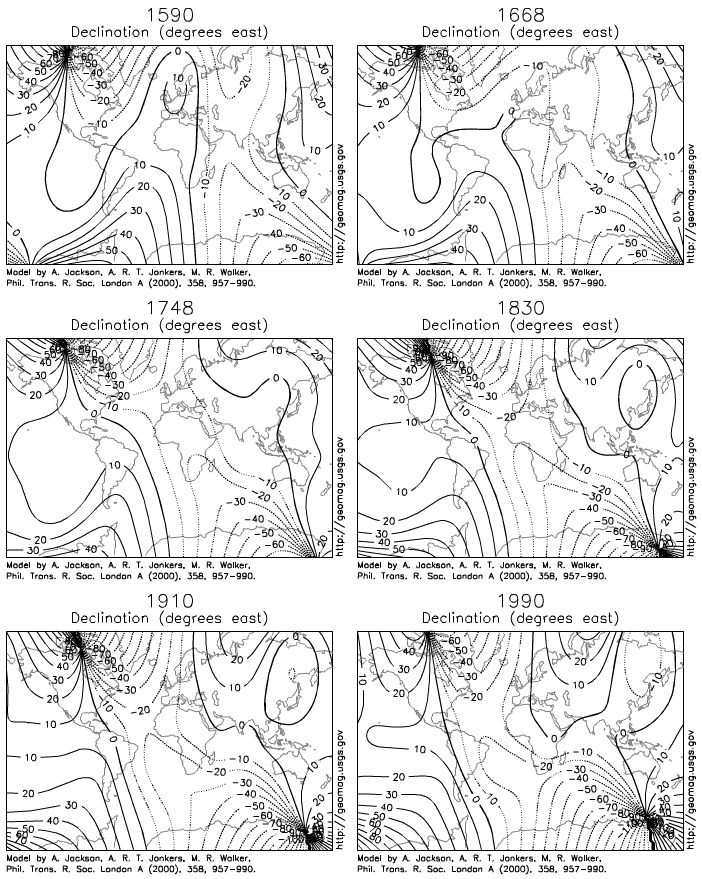
The knowledge of its generation by a dynamo and its description by high-order spherical harmonics are ‘rock solid’. The rest are details [that are steadily improving]. Your attempts to sow uncertainty and doubt fall flat.
I feel in some way that the space weather scare is promoted as a fall back solution if the CO2/climate scare fails to work. The only problem is that you can hardly blame mankind for the threat.
Kp=4+ geomagnetic activity during last 48h and the last night’s aurora satellite view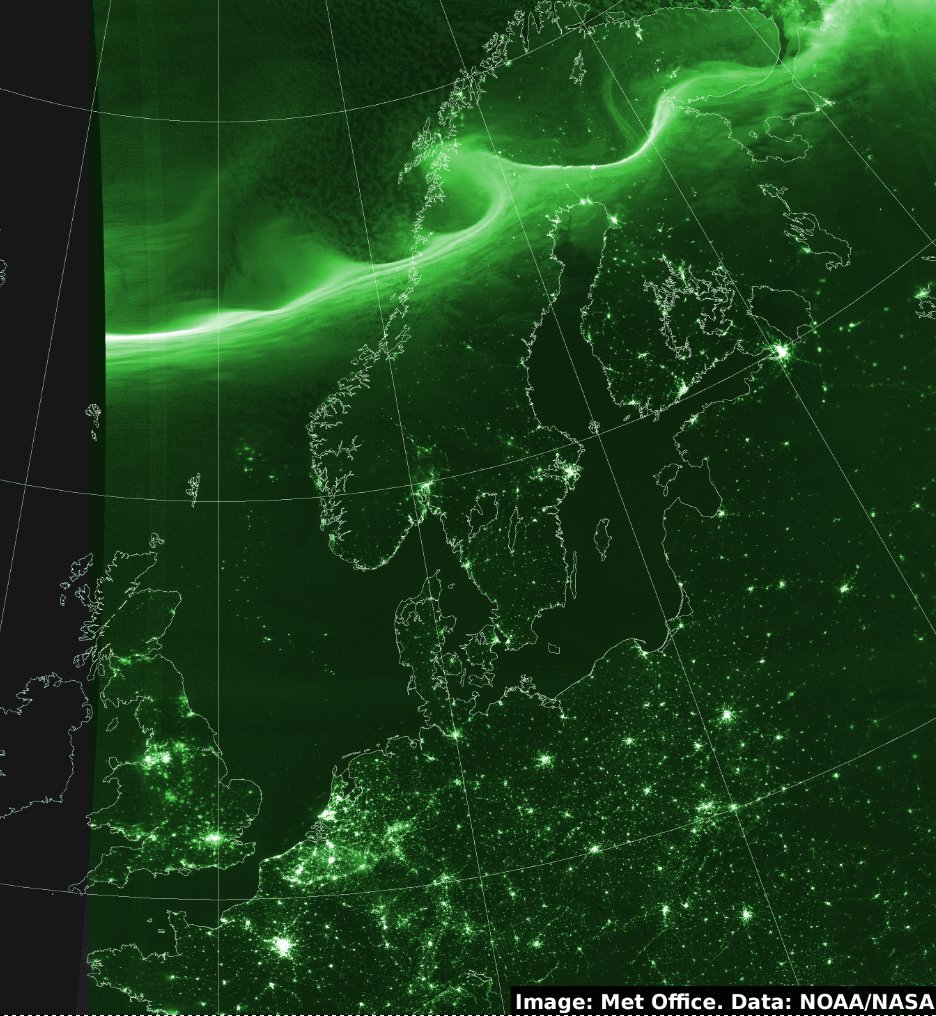
Some new stuff from the Big Bear Solar Observatory (BBSO)
Igniting a solar flare in the corona with lower-atmosphere
March 28, 2017
The Ulyses project and it’s consequences, turning human induced global warming into a dead horse…?
https://www.youtube.com/channel/UCKE0qdPuLg2l0IWnSfgsBSg