Guest Post by Werner Brozek, Edited by Just The Facts:


The above are plots of what the slopes NOAA’s surface temperature anomalies look like for the three intervals 1975 to 2000; 1950 to 2000; and 2000 to 2015. The top one is before adjustments and the bottom one is after adjustments, seemingly in an attempt to get rid of the hiatus. The given slopes are in degrees C/century.
Karl Popper said: “For it is always possible to find some way of evading falsification, for example by introducing ad hoc an auxiliary hypothesis, or by changing ad hoc a definition.”
So exactly what is the definition of a hiatus? NOAA defines a “hiatus” as a slowdown in warming and not a complete stop, so we are NOT talking about a pause with a very slight negative slope when talking about whether or not we are in fact experiencing an “hiatus”. However by talking about a “slowdown”, at least three different elements need to be defined so we can all be clear whether of not a hiatus has indeed occurred.
We need to know how long the recent period is that we are comparing things to. Then we need to know how long the previous period can be that we are using for a comparison. Then we need to know how much higher the previous period needs to be in order for us to have a hiatus. For example, does the previous slope need to be at least 10% or 20% or 30% higher than the most recent slope in order to claim that we have a hiatus?
Let me illustrate why the above are important with an analogy. Suppose Bob is born with a height of 20 inches at birth. Then Bob grows to be 5 feet when his 12th birthday is reached. Then Bob undergoes a huge growth spurt and reaches 6 feet on his 13th birthday. Then his growth rate slows down and he only gains another 4 inches by his 14th birthday. Now the question is: “Did his growth rate slow down?” Probably 97% of people would say the growth rate slowed. But 3%, all climate scientists, would say there never was a change in growth rate. They would say Bob grew 52 inches or 4 inches per year in the first 13 years. And since he grew 4 inches between ages 13 and 14, there was no slowdown. Would you agree?
If I were to define a hiatus, I would say the most recent period must be at least 15 years. And the period preceding it must also be at least 15 years, but not more than 25 years. And the slope of the preceding period must be at least 30% more than the latest slope. By this definition, even NOAA shows a hiatus since the recent ratio for 1975 to 2000 versus 2000 to 2015 is 1.717/1.143 or 1.50 so the preceding period has a slope that is 50% more than the latest slope. Would you agree? Of course, comparing 2000 to 2015 with 1950 to 2000 gives a completely different picture as can be seen on the above diagrams.
Before the revisions, the ratio for the slopes for (1950 to 2000)/(2000 to 2015) was 1.48, so the 50 year period had a slope that was 48% larger. But afterwards, the latest 15 year period actually had the larger slope. In all fairness to Thomas Karl, I am not aware of a precise definition of a hiatus so no one can accuse him of changing definitions. However I do believe it is ingenious of him to compare the recent 15 years with 50 years before that, especially since virtually nothing happened for the first 25 of those 50 years.
The following is from their report: “In summary, newly corrected and updated global surface temperature data from NOAA’s NCEI do not support the notion of a global warming ‘hiatus.’ Our new analysis now shows the trend over the period 1950-1999, a time widely agreed as having significant anthropogenic global warming (1), is 0.113°C dec−1, which is virtually indistinguishable with the trend over the period 2000-2014 (0.116°C dec−1).”
The above statement perplexes me. They appear to be satisfied that they have proven to themselves and hopefully others that no hiatus occurred. But in doing so, they have, in my mind, proven that there is no catastrophic warming occurring either. A warming rate of 1.16 C/century will not reach 2 C by 2100.
In the sections below, as in previous posts, we will present you with the latest facts. The information will be presented in three sections and an appendix. The first section will show for how long there has been no warming on some data sets. At the moment, only the satellite data have flat periods of longer than a year. The second section will show for how long there has been no statistically significant warming on several data sets. The third section will show how 2015 so far compares with 2014 and the warmest years and months on record so far. For three of the data sets, 2014 also happens to be the warmest year. The appendix will illustrate sections 1 and 2 in a different way. Graphs and a table will be used to illustrate the data.
Section 1
This analysis uses the latest month for which data is available on WoodForTrees.com (WFT). All of the data on WFT is also available at the specific sources as outlined below. We start with the present date and go to the furthest month in the past where the slope is a least slightly negative on at least one calculation. So if the slope from September is 4 x 10^-4 but it is – 4 x 10^-4 from October, we give the time from October so no one can accuse us of being less than honest if we say the slope is flat from a certain month.
1. For GISS, the slope is not flat for any period that is worth mentioning.
2. For Hadcrut4, the slope is not flat for any period that is worth mentioning.
3. For Hadsst3, the slope is not flat for any period that is worth mentioning.
4. For UAH, the slope is flat since February 1997 or 18 years and 4 months. (goes to May using version 6.0)
5. For RSS, the slope is flat since December 1996 or 18 years and 6 months. (goes to May)
The next graph shows just the lines to illustrate the above. Think of it as a sideways bar graph where the lengths of the lines indicate the relative times where the slope is 0. In addition, the upward sloping blue line at the top indicates that CO2 has steadily increased over this period.

When two things are plotted as I have done, the left only shows a temperature anomaly.
The actual numbers are meaningless since the two slopes are essentially zero. No numbers are given for CO2. Some have asked that the log of the concentration of CO2 be plotted. However WFT does not give this option. The upward sloping CO2 line only shows that while CO2 has been going up over the last 18 years, the temperatures have been flat for varying periods on the two sets.
Section 2
For this analysis, data was retrieved from Nick Stokes’ Trendviewer available on his website. This analysis indicates for how long there has not been statistically significant warming according to Nick’s criteria. Data go to their latest update for each set. In every case, note that the lower error bar is negative so a slope of 0 cannot be ruled out from the month indicated.
On several different data sets, there has been no statistically significant warming for between 14 and 22 years according to Nick’s criteria. Cl stands for the confidence limits at the 95% level.
The details for several sets are below.
For UAH6.0: Since October 1992: Cl from -0.026 to 1.731
This is 22 years and 8 months.
For RSS: Since January 1993: Cl from -0.013 to 1.672
This is 22 years and 5 months.
For Hadcrut4.3: Since July 2000: Cl from -0.017 to 1.371
This is 14 years and 10 months.
For Hadsst3: Since June 1995: Cl from -0.003 to 1.739
This is an even 20 years.
For GISS: Since November 2000: Cl from -0.018 to 1.336
This is 14 years and 7 months.
Section 3
This section shows data about 2015 and other information in the form of a table. The table shows the five data sources along the top and other places so they should be visible at all times. The sources are UAH, RSS, Hadcrut4, Hadsst3, and GISS.
Down the column, are the following:
1. 14ra: This is the final ranking for 2014 on each data set.
2. 14a: Here I give the average anomaly for 2014.
3. year: This indicates the warmest year on record so far for that particular data set. Note that the satellite data sets have 1998 as the warmest year and the others have 2014 as the warmest year.
4. ano: This is the average of the monthly anomalies of the warmest year just above.
5. mon: This is the month where that particular data set showed the highest anomaly. The months are identified by the first three letters of the month and the last two numbers of the year.
6. ano: This is the anomaly of the month just above.
7. y/m: This is the longest period of time where the slope is not positive given in years/months. So 16/2 means that for 16 years and 2 months the slope is essentially 0. Periods of under a year are not counted and are shown as “0”.
8. sig: This the first month for which warming is not statistically significant according to Nick’s criteria. The first three letters of the month are followed by the last two numbers of the year.
9. sy/m: This is the years and months for row 8. Depending on when the update was last done, the months may be off by one month.
10. Jan: This is the January 2015 anomaly for that particular data set.
11. Feb: This is the February 2015 anomaly for that particular data set, etc.
15. ave: This is the average anomaly of all months to date taken by adding all numbers and dividing by the number of months.
16. rnk: This is the rank that each particular data set would have for 2015 without regards to error bars and assuming no changes. Think of it as an update 25 minutes into a game.
| Source | UAH | RSS | Had4 | Sst3 | GISS |
|---|---|---|---|---|---|
| 1.14ra | 6th | 6th | 1st | 1st | 1st |
| 2.14a | 0.170 | 0.255 | 0.564 | 0.479 | 0.68 |
| 3.year | 1998 | 1998 | 2014 | 2014 | 2014 |
| 4.ano | 0.483 | 0.55 | 0.564 | 0.479 | 0.68 |
| 5.mon | Apr98 | Apr98 | Jan07 | Aug14 | Jan07 |
| 6.ano | 0.742 | 0.857 | 0.835 | 0.644 | 0.93 |
| 7.y/m | 18/4 | 18/6 | 0 | 0 | 0 |
| 8.sig | Oct92 | Jan93 | Jul00 | Jun95 | Nov00 |
| 9.sy/m | 22/8 | 22/5 | 14/10 | 20/0 | 14/7 |
| Source | UAH | RSS | Had4 | Sst3 | GISS |
| 10.Jan | 0.261 | 0.367 | 0.690 | 0.440 | 0.75 |
| 11.Feb | 0.156 | 0.327 | 0.660 | 0.406 | 0.82 |
| 12.Mar | 0.139 | 0.255 | 0.680 | 0.424 | 0.84 |
| 13.Apr | 0.065 | 0.175 | 0.657 | 0.557 | 0.71 |
| 14.May | 0.272 | 0.310 | 0.694 | 0.593 | 0.71 |
| Source | UAH | RSS | Had4 | Sst3 | GISS |
| 15.ave | 0.179 | 0.287 | 0.676 | 0.484 | 0.77 |
| 16.rnk | 6th | 6th | 1st | 1st | 1st |
If you wish to verify all of the latest anomalies, go to the following:
For UAH, version 6.0 was used. Note that WFT uses version 5.6. So to verify the length of the pause on version 6.0, you need to use Nick’s program.
http://vortex.nsstc.uah.edu/data/msu/v6.0beta/tlt/tltglhmam_6.0beta2
For RSS, see: ftp://ftp.ssmi.com/msu/monthly_time_series/rss_monthly_msu_amsu_channel_tlt_anomalies_land_and_ocean_v03_3.txt
For Hadcrut4, see: http://www.metoffice.gov.uk/hadobs/hadcrut4/data/current/time_series/HadCRUT.4.3.0.0.monthly_ns_avg.txt
For Hadsst3, see: http://www.cru.uea.ac.uk/cru/data/temperature/HadSST3-gl.dat
For GISS, see:
http://data.giss.nasa.gov/gistemp/tabledata_v3/GLB.Ts+dSST.txt
To see all points since January 2015 in the form of a graph, see the WFT graph below. Note that UAH version 5.6 is shown. WFT does not show version 6.0 yet.

As you can see, all lines have been offset so they all start at the same place in January 2015. This makes it easy to compare January 2015 with the latest anomaly.
Appendix
In this part, we are summarizing data for each set separately.
RSS
The slope is flat since December, 1996 or 18 years, 6 months. (goes to May)
For RSS: There is no statistically significant warming since January 1993: Cl from -0.013 to 1.672.
The RSS average anomaly so far for 2015 is 0.287. This would rank it as 6th place. 1998 was the warmest at 0.55. The highest ever monthly anomaly was in April of 1998 when it reached 0.857. The anomaly in 2014 was 0.255 and it was ranked 6th.
UAH6.0
The slope is flat since February 1997 or 18 years and 4 months. (goes to May using version 6.0)
For UAH: There is no statistically significant warming since October 1992: Cl from -0.026 to 1.731. (This is using version 6.0 according to Nick’s program.)
The UAH average anomaly so far for 2015 is 0.179. This would rank it as 6th place. 1998 was the warmest at 0.483. The highest ever monthly anomaly was in April of 1998 when it reached 0.742. The anomaly in 2014 was 0.170 and it was ranked 6th.
Hadcrut4.3
The slope is not flat for any period that is worth mentioning.
For Hadcrut4: There is no statistically significant warming since July 2000: Cl from -0.017 to 1.371.
The Hadcrut4 average anomaly so far for 2015 is 0.676. This would set a new record if it stayed this way. The highest ever monthly anomaly was in January of 2007 when it reached 0.835. The anomaly in 2014 was 0.564 and this set a new record.
Hadsst3
For Hadsst3, the slope is not flat for any period that is worth mentioning. For Hadsst3: There is no statistically significant warming since June 1995: Cl from -0.003 to 1.739.
The Hadsst3 average anomaly so far for 2015 is 0.484. This would set a new record if it stayed this way. The highest ever monthly anomaly was in August of 2014 when it reached 0.644. The anomaly in 2014 was 0.479 and this set a new record.
GISS
The slope is not flat for any period that is worth mentioning.
For GISS: There is no statistically significant warming since November 2000: Cl from -0.018 to 1.336.
The GISS average anomaly so far for 2015 is 0.77. This would set a new record if it stayed this way. The highest ever monthly anomaly was in January of 2007 when it reached 0.93. The anomaly in 2014 was 0.68 and it set a new record.
Conclusion
It appears as if we need to have a precise definition as to exactly what is required to officially have a hiatus. Until we do, any one can use whatever criteria they wish and declare the hiatus over, or to have never occurred, according to their definition. This is one illustration as to how much more climate science needs to mature.
Discover more from Watts Up With That?
Subscribe to get the latest posts sent to your email.
For as long as I’ve been talking about the pause it has been the discrepancy between predicted and actual warming. The lowest predicted warming in 2001 was 0.14C/decade, so I suggest actual (not fabricated) warming of more than 0.07 or perhaps for simplicity 0.05C/decade could be called warming. Changes between +0.05 and -0.05 should be “pause” or no change and less than 0.05C/decade should be considered cooling.
Here are the numbers for 5 data sets.
RSS
Temperature Anomaly trend
Jan 2001 to May 2015
Rate: -0.390°C/Century;
UAH
Temperature Anomaly trend
Jan 2001 to May 2015
Rate: -0.150°C/Century;
NOAA
Temperature Anomaly trend
Jan 2001 to May 2015
Rate: 0.972°C/Century;
GISS
Temperature Anomaly trend
Jan 2001 to May 2015
Rate: 0.535°C/Century;
Hadcrut
Temperature Anomaly trend
Jan 2001 to May 2015
Rate: 0.431°C/Century;
So by your criteria
, GISS and NOAA do not show a pause but the other three do. What do we do now, go by the majority or take an average?
Werner.. just a mathematically point.
Since the satellite data is well short of 100 years long, you should not be stating it as a rate per century.
You are extrapolating well beyond the data points.
You could however, state all trends as decadal or quarter century trends.
I understand your point, but that is how Nick chose to express it on his site. Of course it can easily be converted to a per year basis.
In the same way, you can say you are going 60 miles per hour in your car, but that does not mean you have to be travelling for an hour.
The pause started around 1880 if you use the right graph: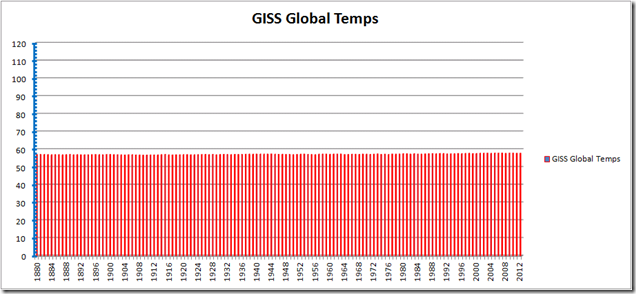 ?w=636&h=294
Maybe the pause even started before 1880.
It’s completely pointless showing graphs like that. The vertical scale must be such that the variations are visible, as we learn in school.
Imagine going to you doctor with a fever, and he plots your temperature on such a graph for the whole of your life, with a baseline at absolute zero. He’d show you the door, and tell you to stop wasting his time.
Once upon a time when climate central would talk about global warming, it was about how hot it was in the US. Then when it was pointed out that there was a cooling trend, well the US was only 2 % of the earth. And the difference between climate and weather was used interchangeable in the course of any debate, hotter was climate and colder is weather. It seems that 5 western states are now responsible for global warming again. Never mind that here in Colorado we’ve hit a new milestone, the coldest high for this date… for the first time ever the heat was turned on in July. Is Colorado thought of as a western state?
Also, there is something similar going on with the polar ice data. There has been a big pause in showing data from almost all the main data sets and I’m sure there is going to be an ‘adjustment’ downward for both poles. Even NOAA knows that something has to be done about expanding polar ice if you are going to eliminate the pause. JAXA, Nansen, Cryosphere Today have all been up to something funny. When they all come back with their new data, gee, we will then be equipped to do our next estimates of the ice extent (lower) minimums and everyone will be happy. Look for the new ice extent plummet not too long before the minimum in late September – fresh for the Paris Summit. They did this when sea-level was letting them down and made an adjustment that no longer represents actual sea level, represents nebulous ocean bottom rebounds. They’ve stopped updating World Glacier observations since many of these have begun to advance again…..
Cowtan and Way used arctic amplification to adjust global temperatures upwards (followed by Hadcrut) and look at what is actually happening to the amplification – it has been de-amplifying since 2006 and the temperature is declining:
ftp://ftp.ssmi.com/msu/graphics/tlt/plots/rss_ts_channel_tlt_northern%20polar_land_and_sea_v03_3.png
Is NOAA going to adjust the temperature back down since 2006? You can bet not.
And Cowtan and Way happily forgot about the other pole when they proposed this adjustment of temp upwards. Temperature 60-70S is dropping like a stone since 1979 and ice has been expanding.
ftp://ftp.ssmi.com/msu/graphics/tlt/plots/rss_ts_channel_tlt_southern%20polar_land_and_sea_v03_3.png
What is the betting on how long they are going to put up with this strong evidence of cooling for all to see?
Werner, I suggested Monckton do a similar ‘hiatus’ analysis for these two graphs. How about you giving it a try? At least it will force them to do something drastic to these two uncooperative graphs.
My graphing skills along with the slope calculations were limited to what WFT gives, and now Nick’s has been added. However Walter Dnes could do what you suggest. When you see an article by him in the near future, ask him about it.
The Global Temperature Anomalies of land-ocean data, satellite data, and computer modeling all give different answers to what might actually be or will be happening. The paper at http://gsjournal.net/Science-Journals/Research%20Papers-Climate%20Studies/Download/6128 reconciles their differences based on CO2.
I do not see how land-ocean data and satellite data can be reconciled after 1998, regardless what CO2 may be doing.
Sorry Joel, but computer modelling with unvalidated climate models DOES NOT give any indication of anything !!
The point was NOT to validate the CIMP5 computer model(s), but to put everything at some common reference point (the 1979-1995 period) at which there is not a lot of disagreement and where the models presumably stated with NOAA GTA that were different than the ones now in the NOAA file, and to show how they differ in recent years (1995-2015) and beyond, if all are set to the same reference point. The CIMP5 climate model average does not mimic the measured data after that period. This would indicate the model(s) need to be adjusted. I presume you are indicating that those models have not been validated. Whether true or not, they are the “validation” to the alarmists that the earth will “burn” when we get to 2C. Computer generated. Are you suggesting that I am doing modeling?
This whole article is mute. It took me a whole 3 seconds to notice that the trend starts in a strong La Nina year and ends in a strong El Nino year.
I assume you are talking about 2000 to 2015. But despite this fact, look at the huge difference in slope from before (0.706) to after (1.143).
My thought in looking at the graphs displayed is “What is the justification for using the year 2000 as a start or end point?”. If that point is shifted either way by several years, then a very different picture is displayed which negates NOAA,s outlook. So what is the purpose of the exercise.
In NOAA’s original report, the last three times were 1998 to 2012, 1998 to 2014, and 2000 to 2014. So it seems as if the final period needed to be at least 15 years. While different combinations give slightly different slopes, it is clear to me that there is still a hiatus. Had I ended and started in January 1998 for example, the 1998 to 2015 would have been smaller, but 1975 to 1998 would also have been smaller. But then I would have been accused of cherry picking. Right?
The ratio for 1975 to 1998/1998 to 2015 is 1.589/0.972 = 1.63, so the earlier slope was 63% larger.
“A warming rate of 1.16C per century will not reach 2C by 2100” actually it will, because when the warmists talk about 2C now you will notice it is “2C above pre industrial levels”. Give it another year and it will be “2(F( with the F not mentioned) above pre industrial levels” that they mean, or no change.
1.16 C/century x 0.85 century = 0.99 C. So adding 0.8 C that has already happened, I get 1.8 C.
I’ll give you a definition: “That graph, in which you have jiggered the data to support your cause, is good for 15 years in Federal penitentiary. The next one will add 10 years to the sentence.”
As to “data adjustments”- if “time of observation” is the factor that counts, as we hear from whats-his-face (can’t even recall his name, but you know who I mean), why, once it was taken into consideration, is it ever again an issue? The very first adjustment which accounted for it should have negated it for future consideration, no? Otherwise, there’s no end to “TOBS”.
I agree that the very odd adjustment may be legitimate. But when things change every year or sooner, it makes you suspicious as to what is going on.
I think going from 1950 is an obvious attempt to water down the actual magnitude of the warming slowdown.
I would have compared the slopes for Jan 1975-Dec, 1999 and Jan 2000-Now, 1015.
The justification for using 2000 as a breakpoint is you’re away from the 1998 episodic event. Having large excursions right the edge of a range is never a good thing for least-squares-fit trend (which weights the points near the edge the heaviest).
Different combinations give slightly different values for the ratios, so starting sooner and ending sooner (but at the same place as the previous start) may affect both numbers in the same direction.
But going back to only 1975, I do not believe you will find any combination where the previous rate of warming is less than 30% more than the present rate.
Conclusion
It appears as if we need to have a precise definition as to exactly what is required to officially have a hiatus. Until we do, any one can use whatever criteria they wish and declare the hiatus over, or to have never occurred, according to their definition. This is one illustration as to how much more climate science needs to mature.
_______
Sorry, but a record of 20 years, or even 50 years, is not even close to an indication of actual ‘climate’ change. It’s just a record of cyclic weather variability, and is incapable of eliciting climate trends in isolation. Climate trends show up unambiguously in data sources that are considerably longer than 250 years.
500 years is what I would call the minimum needed to unambiguously detect actual planetary and regional climate changes.
All of the talk of the satellite record or a subset of it is really a discussion weather cycles and the noise within them. That’s not a climate change signal.
So are we merely playing into the AGW lobby’s hands, via pretending that an alleged ‘climate change’ can be unambiguously measured via such a means?
Yes.
And as the acorn data keep revealing, the instrumental data trend prior is hardly credible either.
So shouldn’t we be asking, why on earth are we doing this, and falling into their defining of what unambiguous climate change is, and what is required to measure, and clearly unambiguously detect it?
Surely I can’t be the only one who is troubled by all this nitty gritty weather data being couched in terms of measuring a climate change ‘hiatus’?
Look, the cAGW kooks defined the hockey stick as a short-term sharp change. Well the first time I saw their cAGW hockey stick, I said to myself, “Nope, that isn’t correct, because I know climate can not be unambiguously detected on such a short timescale.”
The implication and insinuation of the Hockey Stick graph was that it was portraying sure evidence of a sharp short and therefore assuredly anthropogenic (industrial) origins of such a cAGW fingerprint.
Well the both the Hockey Stick and cAGW have now been thoroughly discredited and debunked.
So why the hell are we still looking for climate change on such a short time scale?
Hey, that’s my take on it.
I suggest we snap out of this and re-focus on actual climate change data, that we can unambiguously detect and measure, and let the weather cycles remain weather cycles and not pretend they are climate data.
Or is that too unmentionable?
2 cents worth
You raise excellent points. Think of it this way: We are in a chess game with NOAA and they make a move. It is now up to us to make a counter move so no one thinks we are checkmated by their move.
Thank you Werner,
I estimate it’s becoming time to pin them down and point this out clearly, and refocus them and others on the discussion of the scientific agenda as opposed to this unfortunate tangent that has been wasting everyone’s time and career.
These serial spats are not why we do this, surely?
NOAAs got internal factors to take care of (which the may not), if they’ve likewise lost sight of why we’re actually doing this amid all of the skin, hair and hot air flying about the inter-planet. No good waiting for them to refocus on the science, or they’d have already realized it and done it already. Who led us here? We didn’t come this way by choice, so let’s choose the field of battle for ourselves. Bit rhetorical, but you see what I mean.
We should consider how this will appear in retrospect, in 25 or 50 years if we don’t take the adult and refocused initiative now to put climate back on-topic, and in its proper context.
Respect for you all.
Hopefully things will change after the next election in the states. Then we may only have to wait two years to get things into the proper context. It is unfortunate that there is only one major global data set outside the states.
Every 6 hours NCEP takes the earths Temperature. This is the result of what the model computes as the global temperature given its finer grid and advanced inputs ( satellites, surface data, etc) So the question is why isnt this the gold standard. For if the ncep output is wrong, then should they not be trying to “adjust” to what Big Brother ( NOAA) is saying? The last 30 years show the rise we saw when the PDO flipped warm but why would it see what appears to be the fall since the PDO flip ( like the late 50s, it went back to the warm stage for 2-3 years, and it is now) and is this El Nino Spike going to be followed by an even greater drop off like the last 2, 06-07,09-10, which is what I believe.
79-88 http://models.weatherbell.com/climate/cfsr_t2m_1979.png
88-2005: http://models.weatherbell.com/climate/cfsr_t2m_1988.png
since 2005 http://models.weatherbell.com/climate/cfsr_t2m_2005.png
Dr Ryan Maue has developed a super site on Weatherbell.com for instant measuring of temps. Now here is something Curious, and the CFSV2 sees it too.. The “cooling” now taking place globally in the face of the evolving enso
http://models.weatherbell.com/climate/cdas_v2_hemisphere_2015.png
Thank you for your comments. But I got “access forbidden” for each of the three links.
“It appears as if we need to have a precise definition as to exactly what is required to officially have a hiatus.”
The definition of the IPCCs hiatus is in the IPCC AR5 report.
It is not a thing as such, it was just the term used by the IPCC to describe an apparent slowdown in global average temperature change during a particular period of time, compared to previous periods.
It makes sense why the IPCC highlighted this period – it was of interest if the temperature change had increased, decreased or was not changing.
That is just my point, namely that this definition is so vague that two different people can easily come to opposite conclusions as to whether or not we are in a hiatus right now.
For example “ apparent slowdown” should be quantified. And “a particular period of time” needs to be either specified or given a narrow range. As well “previous periods” also needs to be either specified or given a narrow range. At least that is my opinion.
Werner Brozek.
It is not vague. It was defined and coined in the IPCC AR5 report. There is only one definition.
Then please answer the following question with a “yes” or “no”.
Does the adjusted NOAA data set show a hiatus?
Werner Brozek.
It was defined and coined in the IPCC AR5 report. There is only one definition.
Thank you for your response. I knew you could not answer with a “yes” or “no” since that one definition was too vague. By that definition, NOAA says there was no hiatus, but by that same definition, I can prove there still is a hiatus as I have done in the introduction.
harrytwinotter and Werner Brozek:
I think you should have checked what the IPCC AR5 actually said about the misnamed ‘Pause’ because it is NOT as harrytwinotter claims
NO! Comparisons of trends between different time periods are not involved.
Box 9.2 on page 769 of Chapter 9 of IPCC the AR5 Working Group 1 (i.e. the most recent IPCC so-called science report) is here and says
GMST trend is global mean surface temperature trend.
A “hiatus” is a stop.
However, the ‘stop’ is exhibited as being a “difference between simulated and observed trends”; i.e. a period of more than 15-years duration where the measured global mean surface temperature (i.e. GMST) trend is less than the great majority of projections of GMST provided by computer models of climate.
Richard
Thank you!
In that case, it is sad that Thomas Karl and the others do not know what a hiatus is since they say:
“In summary, newly corrected and updated global surface temperature data from NOAA’s NCEI do not support the notion of a global warming “hiatus”.”
I say this because their new 0.116 C/decade is still way below projections and not at all alarming.
(My article was premised on NOAA’s apparent definition of a hiatus.)
Werner Brozek:
You say:
Yes, and I remind that the thread has been deflected by harrytwinotter’s falsehood about the IPCC definition.
This thread is about NLOAA’s calculations and NOAA’s definition of the “hiatus”. This was provided by NOAA in its 2008 Assessment that can be read here and says
This differs from what you claim (in your above essay) is NOAA’s definition; i.e. you say
But I consider “observed absence of warming” to be a trend that cannot be distinguished from zero with 95% confidence.
In summation, the NOAA definition predates the IPCC definition and they differ.
Richard
Thank you!
Their whole recent article about “Possible artifacts of data biases in the recent global surface warming hiatus” supports my claim as to their present apparent definition. From my article:
They are clearly comparing two periods to come to their conclusion.
As for the other part about the 95% and 15 years, I do not know what the numbers were before the adjustment, but for the last 15 years, Nick’s site now gives:
Temperature Anomaly trend
Jun 2000 to May 2015
Rate: 1.246°C/Century;
CI from 0.597 to 1.894;
And the first time the lower end of Cl is negative is:
Temperature Anomaly trend
Feb 2009 to May 2015
Rate: 2.372°C/Century;
CI from -0.030 to 4.774;
This is long after the other data sets from section 2 of this article. I was really surprised at this!
Werner Brozek:
I write to provide a caution.
You say of NOAA
Sorry, but that is not at all clear.
They have adjusted the data so it now shows “the trend over the period 2000-2014 (0.116°C dec−1).” That trend indicates no ‘Pause’ or ‘Hiatus’ according to the NOAA 2008 definition although there is still a ‘Hiatus’ according to the IPCC AR5 definition.
Please note that prior to NOAA making the adjustments the IPCC AR5 does NOT report the NOAA GMST trend was then significantly more than zero.
The startling thing is that the adjustments are so great that – as their comparison of two periods shows – their revised assessment removes the ‘Hiatus’ completely by creating a trend since 2000 “which is virtually indistinguishable with the trend over” the previous 50 years.
So-called climate ‘scientists’ like to move goal posts post hoc and it seems such a change is being conducted by NOAA on its GMST data. Hence, my warning is that whatever you find, the data will change to prevent you having a firm conclusion as e.g. happened in this case.
Richard
Thank you!
And besides different definitions for “hiatus” from different sources, NOAA threw a new curve ball at us with their latest report. Namely they were using a 0.10 significance level for all new trends. As far as I knew, it was always 0.05 for climate science.
I think the authors second point which was that by choosing 1950-2000 as the first period they are tacitly admitting that the lower rate of warming is expected. Whether or not a hiatus has happened or the definition is irrelevant. The fact is that the warming rate of 0.113 means 1C per century not 2, 3, 4, 5, or 6C per century as they have speculated. Further since it is obvious that the rate is declining in recent decades and we know scientifically that the effect of CO2 decreases logarithmically it is almost impossible for the rate to increase. So, 1C is an UPPER BOUND and it is likely much less.
I have a blog at https://logiclogiclogic.wordpress.com/2015/04/10/temperature-rise-by-end-of-century-cannot-be-significant/ that shows by multiple methods additional temperature change by 2100 can be no more than 0.3C. This is scientific fact based on the actual data not computer models. We have gotten so much heating since 1945 from the amount of CO2 we have put into the atmosphere. Knowing that CO2 is logarithmic it is easy to compute the remaining effect from additional CO2. This includes whatever “feedbacks” as it is based on the real data of nearly 70 years. Based on this it is really indisputable that the total additional temperature change by 2100 is around 0.3C.
Whether there is a haitus or not the total additional temperature change by 2100 is not 1C, 2C, 3C, 4C, 5C or 6C. It is 0.3C. That’s indisputable scientific fact which I find impossible to argue without employing essentially religious or faith based arguments. We have sufficient data to clearly make the calculation (even using their adjusted data which may be twice the change actually happened) and even attributing all of the change to CO2 (even though there is overwhelming evidence that other factors are contributing to the warming) that the total change cannot be more than 0.3C more by 2100 from CO2 – at most. (Also assuming a total CO2 level of 550-600 by 2100 which is a good average assumption.
We need to clean house at NOAA and start over with people who won’t “adjust” data to fit their political leanings.
Werner, why did you detrend the UAH trend in the WFT graph? Haven’t you simply removed the trend in order to say there is none?
You detrended because WFT links to UAH v5.6 and you want to plot v6.0, perhaps? I would have gone with the former until 6.0 has been fully established. Not sure why you detrended CO2, but it doesn’t injure your point.
BTW, UAH had some missing data for June when they first posted earlier month. Now updated, it’s slightly warmer as a result. The average 2015 anomaly so far, according to Spencer’s blog (v6.0), is 0.20C.
http://www.drroyspencer.com/2015/07/revised-uah-global-temperature-update-for-june-2015-0-33-deg-c/