 Letter to the Editor Watts Up With That?
31st October 2014
For decades green extremists have been spreading doomsday forecasts of global warming.
But where do we find the greatest abundance of life on land? Follow the equator around the globe – the Amazon, the Congo, Kenya, Indonesia and New Guinea – all places where it is warm and wet.
And where is life such a struggle that few species live there? Go towards the poles – Siberia and the cold deserts of Antarctica and Greenland.
Where do most tourists go in winter? Few go to Alaska or Iceland – most head towards the warmth of the Mediterranean, the Caribbean, the Black Sea and Bali.
Which season is most welcomed? It is not the first frost, nor the first snowstorm, but the first cherry blossoms, the first robins, and the welcome green shoots of new spring pasture.
Land life multiplies in summer – many mammals hibernate or die in winter.
Every nurseryman knows that plants grow best in a warm greenhouse with added carbon dioxide. Global warmth speeds up the life-supporting water and carbon cycles – warming oceans expel the gases of life (carbon dioxide and water vapour) producing more clouds, more precipitation and more plant growth.
This is why the warm eras of the past are remembered as periods of plenty – the cold eras are times of hunger, migrations and war.
Life on Earth has never been threatened by greenhouse warming. It is the sudden plunge into an ice age that we need to fear.
Green alarmists should venture from their cosy offices and coffee shops and celebrate the welcome warmth of our global greenhouse while it lasts.
Warmth is good.
Viv Forbes,
Rosewood Qld Australia
For those who would like to read more:
Warmer temperatures do more good than harm:
http://www.spectator.co.uk/features/9057151/carry-on-warming/
I think the “Precautionary Principle” is demonstrated here aptly! ALL the logic & reason says warming is benign & beneficial to Humanity & the Planet, yet invoke the PP, & you have disasters in abundance!!!! Isn’t it just brilliant, if you’re a lawyer of course!
Viv,
It is a well known phenomenon called: “latitudinal diversity gradient” (LDG)
I am not sure what you are saying. Are you saying that the Earth has warmed slightly since the end of the “Little Ice Age” from the cold that helped to cause crop failures, starvation, plague and war.
Anymore when I see the acronym WWF, I instead see WTF.
Sort of the same mental response I get to the name petey grace.
Maybe petey is actually lew in disguise?
Otter,
It seems that you get a Grace response more often than anyone else….
Maybe you should ask him where he goes for vacation…
In Matt Ridley’s article he used the word Brobdingnagian. Can any of our Brit/AUS/NZ folks help out on that one? Never saw it before.
Thanks,
PBH
[Classic literature! Your high school and college classes didn’t include Gulliver’s Travels? “Brobdingnag is a fictional land in Jonathan Swift’s satirical novel Gulliver’s Travels occupied by giants. Lemuel Gulliver visits the land after the ship on which he is travelling is blown off course and he is separated from a party exploring the unknown land.” .mod]
Next up, the origin of the word ‘Gargantuan’! 😉
One of Swift’s satires on hubris – the AGW crowd need to understand them, and Orwell. Some hope! Brett
a lot of nonsense about how insects will not be able to adapt to hotter temps. Looks like they have and in an extreme envirnoment –
Urban areas are several degrees hotter than average-
“http://www.theguardian.com/com…
“But surprisingly, the industry has discovered that bees kept in urban areas are healthier and produce better honey”
damn- environment
Speaking of Perth, here is an interesting article from The Daily News (Perth) dated Thursday 2nd November, 1922:
October Heat
HUGE WATER CONSUMPTION
The effect of the October heat wave was reflected in the huge increase in the water consumption on Sunday, Monday and Tuesday. From a consumption of 4,834,000 gallons on the 22nd, the figures jumped to 8,853,000 gallons on Sunday, 11,121,000 on Monday, and 10,533,000 gallons yesterday. The maximum for any one day was established during the heat wave of last summer, when 12,393,000 gallons was reached.
I wonder what the summer of 1921 in Perth was like?
@BruceC
October 31, 2014 at 6:41 am: 40C is not uncommon, in my experience. Brett
I have a huge amount of respect for Matt Ridley, but I am puzzled by one thing. He appears to believe that the IPCC computer predictions to the end of this century are basically correct. As he says, based on this assumption, global warming will be a net benefit until 2080.
However, if there’s any certainty in this debate, it’s that the IPCC predictions are hopelessly wrong. In this century CO2 has increased by around 10 per cent and yet there has been zero global warming. By the admission of several top climate scientists (e.g. Trenberth, Jones) this outcome has invalidated the climate models. Also, the trend of sensitivity assessments has been falling, a recent one gave just 0.4C warming for a CO2 doubling.
It seems almost certain, therefore, that if there is any 21st century global warming, it will be very small. It is also becoming more likely that this century will be dominated by global cooling.
Why Matt continues to think there will be several degrees of warming is beyond me….
Chris
Warming is a pleasant walk in the park. It is the cold that mankind has battled since we left the forest canopy. The slight modern warming has relieved some of our suffering but we must not take our eyes off of the true enemy of ALL life. GK
Pretty much from the start of the year Anthony and his excellent blog have been warning us that the warmists are becoming increasingly worried about the continuation of the pause and would become increasingly desperate in their attempts to claim it was over. Anthony and contributors predicted that this would take the form of a claim that 2014 is the hottest year on record or evah! As usual Anthony is on the money. The Daily Telegraph is just the latest in trumpeting today that the year is the hottest on record so far. It doesn’t provide us with a source for it’s contention but I don’t think a guessing game on that issue would last long. I expect Christopher Booker is sharpening his knife as we speak!
Jimbo, what if Petey’s last four holiday destinations were to ski resorts?
What does that prove?
Viv nailed it with
I guess it’s time to we started pushing BAGW (i.e., Beneficial Anthropogenic Global Warming) and watch the rats scurry for cover.
Joe Crawford,
Your comment triggered the following thought.
If the myopic theory of significant AGW from fossil fuels continues to be exposed as an intentional exaggeration to create alarm, one wonders if there will be a counter reaction movement that creates an AGWSL (Anthropogenic Global Warming Saves Lives) campaign by opportunistic start-up NGOs.
John
Stephen Rasey, I would then ask him did he FLY! Bear with me Stephen, it’s a patient game. He did not answer so there you have it.
But the planet isn’t warming. It has warmed from about AD 1700. but that trend is presently in abeyance, as has often happened over the past 300 years. The next multidecadal temperature move is more likely down than up. The long-term trend of the past ~3300 years has been down, which will resume sooner or later regardless of what humans do.
Warmth is not good if you like Maine Shrimp…
Gulf Of Maine Is Warming Faster Than Most Of World’s Oceans
Researchers studying the Gulf of Maine say its waters are warming faster than 99 percent of the world’s oceans, and worry the rising temperatures will hit New England commercial fisheries hard.
“The decline of the shrimp fishery, I think that’s another one that has a very strong finger-print of warming,” he says.
http://nhpr.org/post/gulf-maine-warming-faster-most-worlds-oceans
Another Maine shrimp season at risk
A technical committee that advises federal regulators is strongly recommending the extension of a moratorium on the fishery that began earlier this year. A draft of the committee’s report to the Atlantic States Marine Fisheries Commission, which regulates the fishery, says “long term trends in environmental conditions” are unfavorable for the shrimp.
The draft report pins the decline of the cold-water shrimp on rising ocean temperatures. The Northern Shrimp Technical Committee’s report advises regulators that “the depleted condition of the resource and poor prospects for the near future” warrant extending the moratorium into next year.
The Atlantic States Marine Fisheries Commission’s Northern Shrimp Section had closed this year’s shrimp season for the first time in more than 30 years and is set to vote on next year’s season on Nov. 5.
The fishery’s estimated population has fallen by a factor of 14, regulators have said.
“Not having a shrimp fishery will just be another blow to Maine fishermen,” said Ben Martens, executive director of the Maine Coast Fishermen’s Association.
Read more: http://www.wmur.com/news/another-maine-shrimp-season-at-risk/29420808#ixzz3HkkktpSr
@Martin
October 31, 2014 at 12:37 pm : The NAO etc. are about to fix that. For crying out loud, those of us who actually do these things have seen it before. Brett
You’ll have to switch to Maine lobster, then.
http://www.nytimes.com/2012/07/29/us/in-maine-fishermen-struggle-with-glut-of-lobsters.html?_r=1&
Martin,
If you’re interested, Bob addressed this topic when it surfaced a little bit ago.
http://wattsupwiththat.com/2014/09/03/baseless-alarmism-global-warmings-impact-on-gulf-of-maine-driving-away-lobsters-and-fish/
Maine shrimp also suffered from OVER FISHING. Warm waters oof Maine are just that. Warm waters. They have happened before and will happen again. Co2 is not to blame. As for lobster it has been a boom.
Thanks to abundant vegetation, the largest land animals lived in the warmest intervals of geologic history, ie the Jurassic & Cretaceous Periods of the Mesozoic Era (especially the middle of the Cretaceous) & first two epochs of the Cenozoic.
This is very simplistic. You don’t have to go to the poles to find an environment where it is warm yet life struggles. The arid latitudes that ring the planet north and south of the equator are warm and in many places, statistically lifeless. Temperature alone does not guarantee a region will be teaming with life. This article isn’t wrong, just badly incomplete. That is enough for it to be held up an an example of sloppy science by science teachers preconditioned by mandate to hold the flag of Climageddon high. Skeptics can’t use the same shoddy methods as the alarmists because it presents an easy path for them to take down the entire article. We know that alarmists extend no such effort to debunk nonsense from their own ranks such as “An Inconvenient Truth”, but that is a reality we need to correct with our votes, not our science.
You show that you do not know boolean logic. Life is diverse where there are nutrients AND water AND warmth.
We are, and indeed all life is fortunate to be living during a warmer period during our interglacial period, the Holocene. And who knows, perhaps it will rival the MWP eventually, even though Mann and the ippcc tried to disappear it. With luck, it might even rival the mid-Holocene warm period, or Climatic Optimum, some 5,000-7,000 years ago. I doubt it though. For the short term anyway, cooling seems to be in the cards.
Of course, we can’t affect warming or cooling, but the thing we do have the ability to do is adapt. One thing we shouldn’t be doing is shooting ourselves in the foot by making energy more expensive and less reliable.
Cooling is in the cards both for the short term & the long term. With the shifts in the PDO & AMO, the planet should cool over the next few decades, then probably warm again. But longer term, the trend remains down as it has been since at least the Minoan Warm Period, c 3300 years ago, if not indeed since the warmest part of the Holocene Climate Optimum.
PETM: The confirmation bias argument for folks who have nothing better.
Pete, from you PDF.
•PETM –Paleocene-Eocene Thermal Maximum
•56 m.y. ago, lasted 150 k.y., the time for CO2to re-equilibrate.
•Massive carbon release (>4 trillion tons) during 20 kyof early Eocene. Source unknown. Documented by carbon isotope patterns known as CIE, or Carbon Isotope Excursion.
•Oceans acidified as shown by absence of planktonic shells in ocean sediments.
•Oceans warmed by 5oC or 9oF. Air temps were even higher.
Poorly researched to get “Source Unknown”
From my post on Jimbo’s WUWT
Some 56 million years ago, a massive pulse of carbon dioxide into the atmosphere sent global temperatures soaring. In the oceans, carbonate sediments dissolved, some organisms went extinct and others evolved.
Might be the old case of wrong cause / wronge case. A quick search on lava flows 56 million years ago pops up.
The North Atlantic Igneous Province (NAIP) is one of the largest such on earth and extends from Baffin Island and Greenland northwards into the Arctic, east across to Norway and southwards down to Denmark, Scotland and Northern Ireland.
Outpourings of its magma created the Scottish islands of Skye, Rhum, Eigg, Canna and the basalt columns of the Giant’s Causeway and Fingle’s Cave.
Flood basalts from this time are still widely exposed on the Faroe Islands, Greenland and Baffin Island whilst Iceland remains a volcanically active ‘hot spot’ to this day.
It is known that the NAIP was particularly active at two periods in the deep past; the first phase was between 62 – 58 million years ago, with a second phase at the time of the PETM, between 56 – 54 million years ago when the area began to be uplifted; the continental plate split apart and emitted large volumes of magma.
https://sites.google.com/site/thepaleoceneeocenethermalmaxim/5-molten-magma-the-north-atlantic-igneous-province
Or
During the birth of Mount McKinley 56 million years ago when molten magma solidified deep beneath central Alaska, volcanic activity (eruptions at the surface) was also occurring in the park, and produced red, yellow and brown basalts, rhyolites, and other volcanic rocks.
http://vulcan.wr.usgs.gov/LivingWith/VolcanicPast/Places/volcanic_past_alaska.html
Still have no answer to my question – How many tons of lava at 1500 F does it take to cover the north Atlantic and would this tend to heat things up to a greater or lesser extent than CO2?
Enjoy it while it lasts.
http://www.iceagenow.com/GISP2%20Ice%20Core.jpg
See how there was a cooling trend in that graph above.
This graph below shows the spike in temps up to 2010. Wonder how much higher that spike will get…
http://s29.postimg.org/zagke7rzb/gisp2.jpg
Why don’t you show us where it went over the past four years, instead of ending at 2010.
Martin October 31, 2014 at 5:57 pm
LOL. Your huge “spike in temps up to 2010”, looks suspiciously like ‘adjustments’. First the alarmist tried to convince us the MWP and LIA were figments of our imaginations (remember the hokey shtick?). After failing to rewrite history, they started adjusting the historic temperature records and fudging the current temps. Do actually think 2014 is the hottest year on record? Fudging and lying have consequences.
Here’s a thought experiment for you. During the MWP, the Vikings colonized southeastern Greenland, had dairy farms and grew hay and barley for about 300 years. The tithes they paid to the church at Gardar are a matter of record in the Vatican Library, which you could look up and report back to us as a research project. You can not now raise dairy cows anywhere in Greenland nor grow barley. Goats are about all that can survive. If, as in your extension of the GISP2 ice core, temperatures are now higher than they were during the MWP, why can’t cows survive and barley grow? Conversely, if you think they can, why don’t you buy a dairy herd, move to Greenland and keep us posted about your successful dairy operation. I’m sure we’d all love to hear about it.
Martin October 31, 2014 at 5:57 pm
BTW, the extension to 2010 in the graph you provided is very suspicious. It looks an awful lot like a simple extrapolation from where Lappi’s graph ends, not actual data read from the ice core. Anyone knowledgeable about the mechanics of ice core drilling and interpretation interested in clarifying this? Thanks
Martin October 31, 2014 at 5:57 pm
Also, there were at least two cycles of warming and cooling during the 20th century. If in fact the GISP2 ice core data could actually be ascertained to 2010, then those warming and cooling periods would show up. Since they do not, that makes me about 99 and 44/100ths percent sure your spike to 2010 is a simple straight-line extrapolation based on no data.
Plenty of farming going on today in Greenland, and cows too!
http://www.reuters.com/article/2013/03/26/us-greenland-climate-agriculture-idUSBRE92P0EX20130326
Here’s an interesting article…
“Fortunately, a team of scientists led by Jason Box has a new paper that reports the surface temperatures in the center of the Greenland ice sheet — more or less the same area where GISP2 was drilled — from 1840 to 2011. From that, we can see that temperatures there have risen approximately 1.3 C from 1855 to 2011.”
http://www.isthmus.com/forum/viewtopic.php?f=37&t=56942&start=45
Martin,
The produce was grown in a greenhouse. So, are you saying that the Greenlanders had greenhouses?
Your comparison is invalid.
Concerning your second reference, it takes us to a blog called Isthmus beer & cheese fest.
Tell us Martin, what are you all about?
Martin,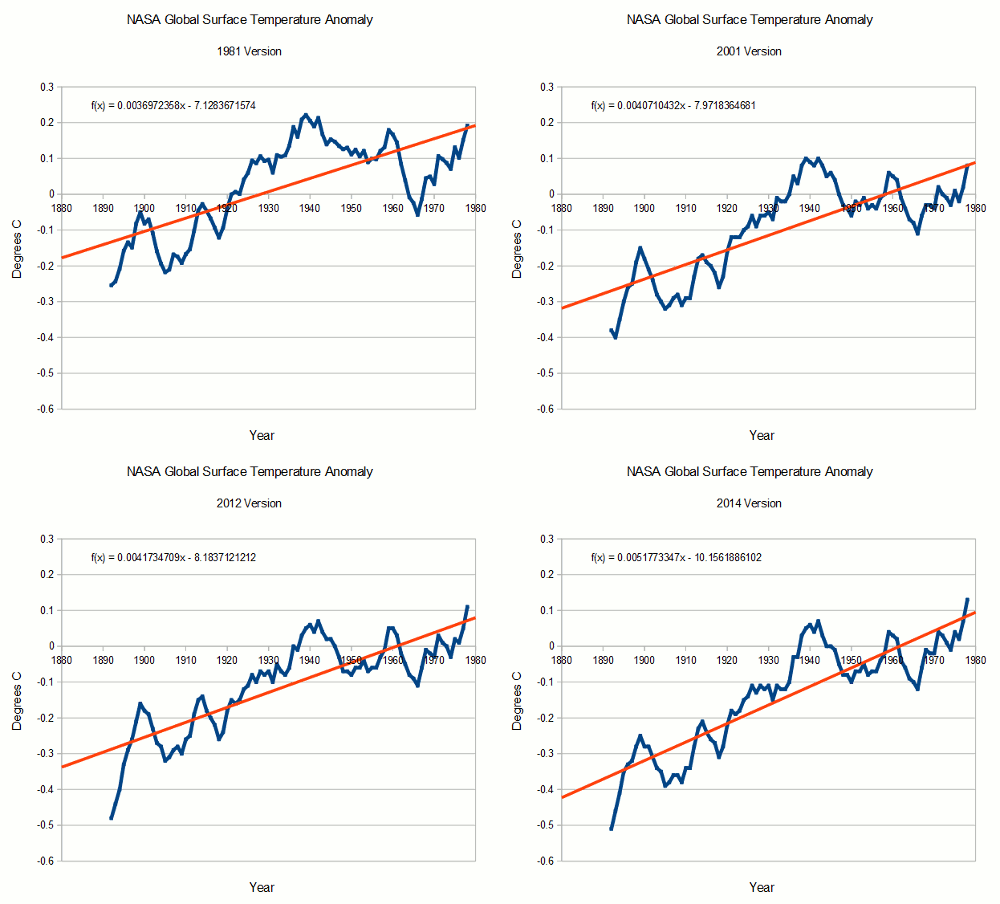
Observe the GISS “adjustments” [note the changing year in the charts]:
http://stevengoddard.files.wordpress.com/2013/12/gissustampering1999-20132.gif
http://stevengoddard.files.wordpress.com/2010/10/1998changesannotated.gif?w=500&h=355
http://stevengoddard.files.wordpress.com/2014/09/altyerationstonasaglobalsince1999.gif?w=640
http://stevengoddard.files.wordpress.com/2012/11/giss1999-2012changes.gif?w=640
And finally, notice all the “hockey sticks” [Click to embiggen]. I count at least twenty:
http://i.snag.gy/BztF1.jpg
Martin
October 31, 2014 at 5:57 pm
“See how there was a cooling trend in that graph above.
This graph below shows the spike in temps up to 2010. Wonder how much higher that spike will get…”
Your spike is drawn thicker than the rest and it’s drawn with a ruler. The guy who forged the chart probably also did Obama’s birth certificate. Hire a better one.
Martin picks ONE YEAR and one season! It’s called the weather and there is nothing unusual here.
http://wattsupwiththat.com/2011/11/10/new-study-shows-temperature-in-greenland-significantly-warmer-than-present-several-times-in-the-last-4000-years/
http://wattsupwiththat.com/2013/06/17/remember-that-unprecedented-greenland-ice-sheet-surface-melt-that-was-allegedly-caused-by-global-warming-never-mind/
The year that I take a holiday in Antarctica will be the same year that Hell freezes over.
I’m going there in February.
To Hell?
It is the potentially eminent release of methane and methane hydrates that are the big risk of catastrophe.
if this happens mass extinction of most all marine life will occur.
this is the man induced methane and co2 release that can cause a feedforwatd into earth methane sinks turning them into methane sources.
look at the summer delta of methane over the northern hemisphere each summer and its exponential increase over the last decades relative to past centuries.
Relax; pop a cool one and release some CO2! We’ve been there and done methane:
http://wattsupwiththat.com/2013/05/15/arctic-methane-emergency-called-off/
http://wattsupwiththat.com/2013/12/13/defusing-the-arctic-methane-time-bomb/
http://wattsupwiththat.com/2014/04/08/permafrost-fear/
http://wattsupwiththat.com/2014/04/11/methane-the-irrelevant-greenhouse-gas/
http://wattsupwiththat.com/2014/08/25/the-atlantic-is-leaking-methane-but-researchers-say-theres-no-cause-for-alarm/
http://wattsupwiththat.com/2014/05/15/more-hype-on-methane-as-climate-boogeyman/
http://wattsupwiththat.com/2014/09/12/methane-damned-if-you-do-dammed-if-you-dont/
http://wattsupwiththat.com/2014/10/11/the-methane-hotspot-identified-in-the-four-corners-area-of-the-u-s-southwest-can-be-fixed-with-some-preventative-maintenence/
http://wattsupwiththat.com/2014/10/15/another-ipcc-modeling-failure-so-thats-where-the-atmospheric-methane-went/
@Ron davison
October 31, 2014 at 5:12 pm: Happen I researched that a few years ago, and found the possible human influence on methane release is less than the natural variation. That is, insignificant. Brett
ron davison,
What ’eminent’ release of methane and methane hydrates are you talking about? Who gave you this scary information? Was it Gavin Schmidt of NASA Giss? It’s a sad day when those on your side have to shoot your own nonsense down. Research the Arctic during the Holocene Hypsithermal. I have done it for you
‘ice-free’ Arctic ocean ~8,000 years ago. No major methane excursion detected. Even if there were we are here today and back in 1979 the Arctic sea ice was at record extent. Stop worrying.
The LiveScience article link is below
http://www.livescience.com/38473-arctic-methane-warming-debate.html
Ron Davidson:
You must not let the alarmists frighten you. That is their purpose. The whole of their science is directed toward that end.
ron davison, please also take a look at these. If natural climate changes could cause this, then why can’t it do it now? There was a correlation with co2 back then too, then the correlation broke down. Why?
Finally, I hope, on methane……….
Methane eating bacteria in the Arctic tundra
http://sciencenordic.com/bacteria-eat-greenhouse-gases
http://ijs.sgmjournals.org/content/56/1/109.short
I don’t like to sweat, therefore… oh, never mind…