

Image Credit: Marathon Nation – Soft Pixel
By WUWT regular “Just The Facts”
There have been a number of statements made recently about “Global Warming Deniers”, e.g. “White House: Global Warming Deniers Wrong to Reference Polar Vortex” US News, “Watch The Daily Show mock Trump and other global warming deniers” The Week and “Global warming denier Jim Inhofe: ‘Fewer and fewer’ senators believe in climate change ‘hoax’”. The Raw Story
Given the apparent prevalence of “Global Warming Deniers”, it seems prudent to take a look at the data so that everyone is clear when Global Warming began and what is undeniable. As such, from the following EPICA Dome C Ice Core record from Vostok, Antarctica, over the last 450,000 years Earth has experienced numerous Glacials, commonly referred to as Ice Ages, and Interglacials, like the Holocene Interglacial we are experiencing today:

“The Last Glacial Maximum (LGM) refers to a period in the Earth’s climate history when ice sheets were at their maximum extension, between 26,500 and 19,000–20,000 years ago, marking the peak of the last glacial period.” As such, one could argue that Global Warming began about “19,000–20,000 years ago”.
However, there was “the Late Glacial Maximum (ca. 13,000-10,000 years ago), or Tardiglacial (“Late Glacial”)” which was “defined primarily by climates in the northern hemisphere warming substantially, causing a process of accelerated deglaciation following the Last Glacial Maximum (ca. 25,000-13,000 years ago)”. “As such, one could also argue that Global Warming began about “13,000-10,000 years ago”.
Now looking at the GISP2 Ice Core record from Greenland, over the last 10,700 years, you can see the rapid warming that occurred at the end of last Glacial and that the current Holocene Interglacial reached it’s maximum peak between 8000 – 7500 years ago:

Since the peak of the Holocene Intreglacial, Earth has experienced several additional descending peaks, including the Minoan Warm Period between 3500 – 3000 years ago, the Roman Warm Period between 2250 – 1500 years ago and the Medieval Warm Period between 1250 – 750 years ago. The Medieval Warm Period and subsequent Little Ice Age can be seen clearly on the following temperature reconstruction based upon Alexandre, 1987 and Lamb, 1988, found Page 250, Figure 7.1 of IPCC Assessment Report 1:

The Little Ice Age “has been conventionally defined as a period extending from the sixteenth to the nineteenth centuries, or alternatively, from about 1350 to about 1850, though climatologists and historians working with local records no longer expect to agree on either the start or end dates of this period, which varied according to local conditions. NASA defines the term as a cold period between AD 1550 and 1850 and notes three particularly cold intervals: one beginning about 1650, another about 1770, and the last in 1850, each separated by intervals of slight warming.” As such, one could argue that Global Warming began in “about 1850”.
However, generally when referring to “Global Warming Deniers” there is an implication that the “Global Warming” that’s being denied is caused by anthropogenic carbon dioxide emissions. Anthropogenic CO2 emissions were de minimis in 1850. In fact, anthropogenic CO2 Emissions from Fossil-Fuels did not become potentially consequential until approximately 1950:

This is why the IPCC only claims to be;
“95% certain that humans are the “dominant cause” of global warming since the 1950s” BBC
As such, one could argue the Global Warming began in “the 1950s”.
However, if you look at the Met Office – Hadley Center HadCRUT4 Global Surface Temperature record for the last 163 years you can see that temperatures didn’t warm during the 1950s, nor the 60s:

In fact it was not until approximately 1975 that temperatures began to rise. As such, one could argue that Global Warming began in approximately 1975.
However, in 2010 Phil Jones was asked by the BBC, “Do you agree that according to the global temperature record used by the IPCC, the rates of global warming from 1860-1880, 1910-1940 and 1975-1998 were identical?” Phil Jones responded that,”Temperature data for the period 1860-1880 are more uncertain, because of sparser coverage, than for later periods in the 20th Century. The 1860-1880 period is also only 21 years in length. As for the two periods 1910-40 and 1975-1998 the warming rates are not statistically significantly different. I have also included the trend over the period 1975 to 2009, which has a very similar trend to the period 1975-1998. So, in answer to the question, the warming rates for all 4 periods are similar and not statistically significantly different from each other.”
The warming during the periods of “1860-1880” and “1910-1940”, before anthropogenic carbon dioxide emissions became potentially consequential, is “not statistically significantly different” from the warming during the periods “1975-1998” and “1975 to 2009”. Thus there is no indication that the warming between “1975-1998” and “1975 to 2009” is unnatural, unusual and/or caused by anthropogenic carbon dioxide emissions. Global Warming may have started in 1975, but there is no observable evidence [of] anthropogenic CO2 emission based Global Warming began in 1975. As such, one could argue that anthropogenic CO2 emission based Global Warming began sometime [after] 1975.
However, if you look at following UAH Satellite Lower Atmosphere graph for the last 34 years;

and this NASA GISS Mean Monthly Surface Temperature Anomaly graph for the last 17 years;
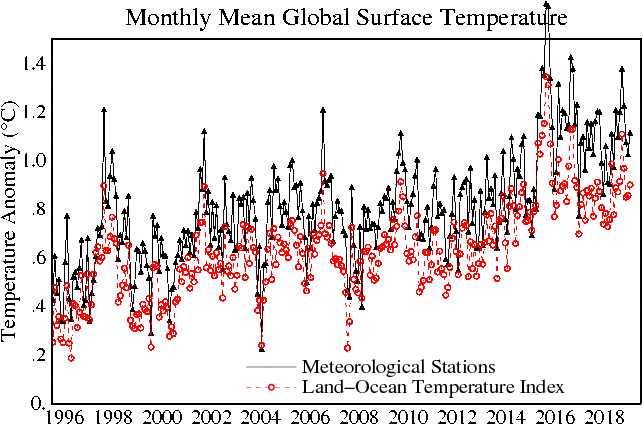
you can see that Global Warming stopped in the late 1990s or early 2000s, which has been referred to as “The Pause” in Earth’s temperature. In fact, looking at the Werner Brozek’s recent article, the Pause in each major temperature data set is as follows:
For GISS, the slope is flat since July 2001 or 12 years, 6 months.
For Hadcrut3, the slope is flat since July 1997 or 16 years, 6 months.
For Hadcrut4, the slope is flat since December 2000 or 13 years, 1 month.
For Hadsst3, the slope is flat since December 2000 or 13 years, 1 month.
For UAH, the slope is flat since October 2004 or 9 years, 3 months. (goes to December using version 5.5)
For RSS, the slope is flat since September 1996 or 17 years, 4 months.”
Shown graphically, that looks like this:

As such, one could argue that for the last 17 – 9 years Global Warming hasn’t been occurring, and thus Global Warming began in 1975 and ended between 1996 and 2004.
However, this would not resolve the question of when the “Global Warming” that’s being caused by anthropogenic Carbon Dioxide emissions began. If you look at Global CO2 Emissions from Fossil-Fuels and;

and Cumulative Anthropogenic CO2 Emissions from Fossil-Fuels, you can see that emissions have been growing rapidly in the last few decades:

In fact the Economist noted in 2013 that “The world added roughly 100 billion tonnes of carbon to the atmosphere between 2000 and 2010. That is about a quarter of all the CO₂ put there by humanity since 1750. And yet, as James Hansen, the head of NASA’s Goddard Institute for Space Studies, observes, ‘the five-year mean global temperature has been flat for a decade.'”
Thus, while anthropogenic CO2 emissions are the highest they’ve ever been, and growing rapidly, Earth’s temperature has been in a 9 – 17 year Pause. And the only period of warming that anthropogenic CO2 emissions could have had a significant influence on, 1975 – 1998, is “similar and not statistically significantly different from” the periods of 1860-1880 and 1910-1940 when there is no evidence of anthropogenic CO2 emission influence. As such one could argue that “Global Warming” due to anthropogenic Carbon Dioxide emissions may not have begun, that Earth’s sensitivity to CO2 may be low, that natural processes may be large enough to outweigh the effects of anthropogenic CO2 emissions, and/or that preparing for a period of rapid and catastrophic Global Warming, when there is no observational evidence that it is in fact occurring, may be a historic folly.
Anyway, what do you think, when did Global Warming begin?
Global Warming began Dec 13, 2000, the day Al Gore realized that not only didn’t his own home state of Tennessee not support him for president, but he wasn’t going to be able steal Florida either.
January 25, 2014 at 5:59 pm | Eric Simpson says:
————–
Is this statement made on the basis of the dwell time of CO2 in the atmosphere ? In which case, I’d suggest that you have an uphill struggle ahead of you. Salby, for one, would not agree with you as, I am sure, would a lot of sceptics. The entire premise of the global warmista theory hinges on +CO2 => +warming +water vapour => runaway +warming due to +water vapour. (Natural) Warming clearly precedes +CO2 and the +water vapour aka ‘the human finger print’, has not been observed in the upper atmosphere. Conclusion must follow that the global warmista theory cannot be upheld and therefore dismissed.
jorgekafkazar says: January 25, 2014 at 8:49 pm
A couple more typos, imho:
“Anthropogenic CO2 emissions where de minimis in 1850.”
“Global Warming may have started in 1975, but there is no observable evidence that anthropogenic CO2 emission based Global Warming starting in 1975.”
Both corrected. I also corrected the following sentence to say 1975.
“As such, one could argue that for the last 17 – 9 years Global Warming hasn’t been occurring, and thus Global Warming began in 1976 and ended between 1996 and 2004.”
Thank you, any other recomendations on how I can improve this article are most welcome.
They often call us the “D” word. What would our detractors call the following people?
My very first reaction on seeing the headline to this post” When did global warming begin?” was that it all began in the boreal late autumn in Madrid in 1995 when Ben Santer changed the entire meaning of the science section of the IPCC’s AR2 with a short sentence change in the final draft, a change which was never approved by the assembled climate scientists at Madrid.
From Berniels account of Madrid 1995
http://enthusiasmscepticismscience.wordpress.com/2012/04/21/madrid-1995-was-this-the-tipping-point-in-the-corruption-of-climate-science/
[ other posts on Madrid 1995 in the RH column ;ie;
Madrid 1995: The Last Day of Climate Science (Part II)
Madrid 1995: Was this the Tipping Point in the Corruption of Climate Science?
Alas, by the early autumn of 1995 the signs were not good. Although a draft leaked in September managed to say that the warming is unlikely to be entirely due to natural causes, this was hardly in dispute, and this was not exactly announcing imminent catastrophe. Moreover, there remained extraordinary strong caveats, especially in Chapter 8, to every positive conclusion. The draft that was circulated to the participants at the Madrid conference, and the only one available when the Report was finally ‘accepted’ by the meeting (see explanation in a following post), also stated in its introduction that results of recent studies point towards a human influence. This was the strongest statement yet, but the body of the document and the concluding summary were not so confident. Some of the boldest retractions were as follows:
Of Studies of Changes in Global Mean Variables (8.4.1): ‘While none of these studies has specifically considered the attribution issue, they often draw some attribution conclusions, for which there is little justification.’
Of the greenhouse signal in studies of modelled and observed spatial and temporal patterns of change (8.4.2.1): ‘none of the studies cited above has shown clear evidence that we can attribute the observed changes to the specific cause of increases in greenhouse gases.’
Of pattern studies ‘fingerprinting’ the global warming (see discussion in later post): While some of the pattern-base studies discussed have claimed detection of a significant climate change, no study to date has positively attributed all or part [of the climate change observed] to [anthropogenic ] causes. Nor has any study quantified the magnitude of a greenhouse gas effect or aerosol effect in the observed data—an issue of primary relevance to policy makers.
Of the overall level of uncertainty: Any claims of positive detection and attribution of significant climate change are likely to remain controversial until uncertainties in the total natural variability of the climate system are reduced.
Of the question: When will an anthropogenic effect on climate be identified? (8.6): It is not surprising that the best answer to this question is, `We do not know.’
[A copy of the 9Oct95 draft of Ch 8 has not been obtained. UPDATE 29June12: 9Oct draft obtained and changes have been verified]
As the Global Climate Coalition pointed out when they broke the scandal, these statements were removed from the final draft of the Working Group 1 Assessment that appear in May 1996 (and that, despite their protests, was subsequently published in June). Moreover, these inconclusive conclusions were not inserted elsewhere, while more positive statements were substituted, strengthened or added. Nature’s first editorial response to the scandal was all about not disrupting the political message before the US election. Yet it conceded that the complaints about the changes to Chapter 8 ‘are not entirely groundless.’
IPCC officials claim that the sole reason for the revisions was to tidy up the text, and in particular to ensure that it conformed to a ‘policymakers’ summary’ of the full report that was tortuously agreed by government delegates at the Madrid meeting. But there is some evidence that the revision process did result in a subtle shift in the relative weight given to different types of arguments, and that – not surprisingly – this shift tended to favour arguments that aligned with the report’s broad conclusions. Conversely, some phrases that might have been (mis)interpreted as undermining these conclusions, particularly if, as IPCC officials feared, they were taken out of context, have disappeared. [13Jun96]
Nature’s editorial response to the Chapter 8 Controversy appeared in the 13 June 1996 edition, the day after Seitz’s Wall Street Journal op-ed launched news of the changes beyond the scientific community. Nature; vol 381, # 6583, p.539
.
As one can easily see from my above quotes global climateers have been aware of the temperature hiatus from 2005 up to this January. They know what the surface temperature standstill is. They know the Mona Loa co2 graph looks like. They know they may have been badly mistaken but will never admit to it because they were shoe horned into their positions by certain entities and kept there by an endless stream of Climastrology funding.
http://wattsupwiththat.com/2014/01/25/when-did-global-warming-begin/#comment-1549801
The reality today is that both have held each other captive.
FUNDING >>>> PAPERS >>>>> POLICIES >>>>> TAXES / LAWS / POWER >>>>> GOVERNMENT REVENUE >>>>> FUNDING……………………………..
Maybe a better question would be:
In answer to the first question: global warming began when you want it to begin. Take your choice from the end of the last glaciation, end of the Little Ice Age, 1910, 1975, 1988.
The answer to the my second question is more difficult. See 1910 to 1940 warming and co2 and the current temperature standstill and co2 for ideas. Refer to Santer’s 17 year minimum and you should be able to see the problems the climateers are facing now.
Strictly speaking, global warming on earth started 4.54 billion yeas ago, that is when it was formed, you know, because space is freaking cold.
AGW never began. There is no Start Date.
I rarely comment on climate blogs anymore as I’m patiently waiting for the next big scare story, but I enjoyed this article enough to applaud it. Informative and incisive.
Very faith strengthening, thank you Prof. Facts.
Could you do an article on what arguments we can use to prove ‘rapid and statistically significant cooling’ when the temperatures start going up again?
“Village Idiot says:
January 26, 2014 at 12:35 am”
Yes, it’s called daytime which follows night with “significant cooling”.
So – when did Global Warming begin?
Also, when did atmospheric CO2 begin increasing?
Apparently they both started increasing about 6,500 years ago. But global warming peaked about 1.2 deg C higher than present ~3,300 years ago, peaked again a little less than one deg C higher than present ~2,000 years ago, peaked next ~1,000 years ago about half a degree C higher than present, and appears to have risen from a low plateau about 200-250 years ago to a slightly higher plateau in the new millenium, whereas atmospheric CO2 has risen from ~260 ppm 6,500 years ago to ~280 ppm ~200 years ago and to ~350 ppm currently:
http://www.climate4you.com/images/GISP2%20TemperatureSince10700%20BP%20with%20CO2%20from%20EPICA%20DomeC.gif
My take from all this is that the overall correlation between total atmospheric CO2 and global warming is negative from 3,300 years ago to present, because the global temperature trend from 3,300 years ago to present is decidedly negative, while the atmospheric CO2 trend for the same period is decidedly positive:
Stephen Wilde on January 25, 2014 at 4:13 pm says:
“I think an adjustable global air circulation driven by a variable rate of convection provides the necessary negative system response aided by the phase changes of water.”
____________________
What drives the rate of convection and how, in relation to increased atmospheric CO2?
Just curious about your ideas on this as i’m trying to find the same connection. See:
http://wattsupwiththat.com/2014/01/17/nasa-revises-earths-radiation-budget-diminishing-some-of-trenberths-claims-in-the-process/#comment-1540077
http://wattsupwiththat.com/2014/01/17/nasa-revises-earths-radiation-budget-diminishing-some-of-trenberths-claims-in-the-process/#comment-1540289
Okay, so it seems this thread says Global warming started in 1975, and lasted to about…2000.
But it was enough to create the unit 1 Mong(stad).
1 Mong equals about 1 billion dollars, which was the approximate cost of the Mongstad project.
RoHa says:
January 25, 2014 at 9:09 pm
“I don’t know who said that, but the Industrial Revolution was well under way by 1850.”
Yes it was underway by then.
Economic historian Gregory Clark: ” … there is no sign of any improvement in material conditions for settled agrarian societies as we approach 1800. There was no gain between 1800 BC and AD 1800 – a period of 3,600 years. Indeed the wages for east and south Asia and southern Europe for 1800 stand out by their low level compared to those for ancient Babylonia, ancient Greece, or Roman Egypt. … ”
The growth is said to have started around 1800 and reached the commoner around 1850. I doubt there is one date you can pick for the “start” that can’t be argued with.
Economist Dr. Gary North: ” … By 1889, these post-1800 inventions had arrived: gas lighting, electric lighting (arc light), the steam powered ship, the tin can, the macadamized road, photography, the railroad, portland cement, the reaper, anesthesia, the typewriter, the sewing machine, the Colt revolver, the telegraph, the wrench, the safety pin, mass-produced newspapers, pasteurization, vulcanized rubber, barbed wire, petroleum-based industry, dynamite, the telephone, Carnegie’s steel mills, the skyscraper, the internal combustion engine, the automobile, and commercial electricity. … ”
I think 1850 is a good date to pick to say the industrial revolution had began in earnest, but one can argue for 1800 just as well. 1750? I don’t think so, as the one invention did not change society all that much.
Regards, Mark
Nice essay JTF, thanks.
J. Philip Peterson – Have a look at the short video explaining the case for CO2 rises lagging behind temperature rise (not the other way round) – now look back ~800 years in thee charts above and there it is – the Medieval Warm Period.
Patrick wrote –
““Village Idiot says:
January 26, 2014 at 12:35 am”
Yes, it’s called daytime which follows night with “significant cooling”.”
First things first .Hydrocarbon assets are extremely valuable so a rise in prices would send more money into the coffers of what many Western countries already consider banana republics so all these stealth ‘carbon’ taxes really circumvent a direct rise in oil prices and prevent money going to nations that are either unstable or have aggressive interests against Western consumerist society. Were the Western Governments to call for a 7 year hiatus into funding the present mode of research and simultaneously stall any hikes in ‘carbon taxes’ under the assumption that there is enough voluntary interest in climate research by passionate people to return to a clear perspective in 7 years or so, how far do you think that proposal would gain traction from either the political side or the pseudo-scientific side ?. The word ‘voluntarily’ is what would terrify researchers but as they are secure within the education system with their salaries and pensions they barely register websites like this regardless of how readers here may believe how important they are.
What is today called ‘climate research’ is really assertion warfare hence it isn’t a real view of global climate and what has made this planet habitable for many millions of years. I would consider it a miracle were I to find an individual who could dwell on the significant daily cooling long enough to ascertain its cause as their location swings into and out of solar radiation each day but unfortunately observers today are still addicted to late 17th century assertions which tried to model the daily and orbital motions of the Earth using timekeeping averages.
The story of how we arrived in this juncture in history where there is no stable narrative whatsoever,not even the cause of the daily temperature rising and falling, is a thrilling story for those willing to give up their hero worship of historical celebrities who were every bit as vindictive and small-minded as present day practitioners in modeling. It is the mob that drives the celebrity culture and not the other way around insofar as figureheads have always served a purpose within the vicious strain of empiricism.
I think you are asking the wrong question. The correct question is has it already or when will the next period of global cooling going to begin. The Minoan, Roman, Medieval and Modern warm periods all correspond with the growth in civilization and human happiness. The intervening cold periods all correspond with the retreat of civilization and a rise in human misery.
For and extreme example what do you think will happen at the start of the next glacial period. You know when Russia, Scandinavia, Canada become tundra and glaciers. Do you think that they are going to just peacefully die or ar they going to do what the Vandals and Huns did in the Migration period (the period between the Roman and Medieval warm periods.
Where I live, warming sustained warming started from 1988, driven by more positive NAO/AO conditions:
http://www.metoffice.gov.uk/climate/uk/actualmonthly/17/Tmean/UK.gif
http://snag.gy/kXxZ2.jpg
Johnron says:
“The Minoan, Roman, Medieval and Modern warm periods all correspond with the growth in civilization and human happiness.”
What they note as the Minoan warm period on the GISP graph at 3300-3200 BP was a horribly cold period in the mid latitudes that caused the fall of many civilisations including the Minoans. The Minoans expanded from about 4700 BP, at the same time as all the other classic cultures of the epoch did, where the GISP data shows it cold in Greenland, and which is fairly equivalent to the modern epoch.
Just The Facts:
Thankyou for a very fine article.
Your article considers temperature data sets to address the question of when global warming began. And – as your article clearly shows – the answer to the question depends on the considered time scale. But that is a consideration of global warming as a physical effect.
Global warming is also a political issue which from its start was independent of physical reality. And the start of the political issue of global warming was in early 1980 when Margaret Thatcher began her campaign to create the political issue. I explain this here .
Please note that the political global warming issue is induced to grow if all reference to science is removed from the influence diagrams in that article.
Richard
J. Philip Peterson:
At January 25, 2014 at 4:52 pm you ask
I answer:
It is called the Medieval Warm Period (MWP).
The MWP was previously called the Medieval Climate Optimum (MCO) so you may want to check that in your research of the matter. Climate alarmists changed the name from MCO to MWP because ‘warmer being better’ was an implication they did not like.
The Roman Warm Period (RWP) was warm. The Dark Age Cool Period (DACP) was cool. The MWP was warm. The Little Ice Age (LIA) was cool. And the Present Warm Period (PWP) is warm. It is possible to see a pattern in this.
Richard
J. Philip Peterson:
At January 25, 2014 at 5:40 pm you ask
Nobody knows although some people like to think they know.
The atmospheric CO2 increase may be entirely natural, entirely anthropogenic, or a result of some combination of natural and anthropogenic causes. Determination of which of these possibilities is true cannot be achieved because sufficient data does not exist.
(ref. Rorsch A, Courtney RS & Thoenes D, ‘The Interaction of Climate Change and the Carbon Dioxide Cycle’ E&E v16no2 (2005) )
Richard