Guest Post by Willis Eschenbach
I grew up on a remote cattle ranch surrounded by miles of forest, far from street lights. The nights were large and silent and very dark when there was no moon. But when the moon was full, the forest at night was full of life. It was clear that the moon had a huge effect on the animal life. The farmers in the area often planted by the moon. Whether that did any good I don’t know. I do know that the moon rules the ocean, though. When I fished commercially for anchovies off of Cannery Row in California, we’d take a week off during each full moon. You couldn’t catch the anchovies during that time, they were too skittish. And the difference between night diving with and without the moon is startling.
 When I was younger, I read in several places that the moonlight doesn’t influence the weather. What the sources said was that it was just too weak to affect the temperature. Heck, you can find people making that claim today. There was no scientific evidence for a detectable effect of moonlight on temperature until 1995, when an article in Science magazine called “Influence of Lunar Phase on Daily Global Temperatures” (paywalled, as usual) said that their comparison with lower tropospheric temperatures showed a temperature difference between full moon and new moon of 0.02°C.
What does that have to do with the moon wind? And what is a “moon wind” when it is at home, anyhow? Well, when I was younger, I once sailed across the Pacific as the first mate on a fifty foot (15m) gaff-rigged staysail schooner. The skipper and I split the navigation duties. This was well before GPS, so the navigation was all done with a sextant and a chronometer.
The skipper took the noon shots, the ones that firmly establish the latitude (north-south). I took the star shots at dawn and at dusk. The navigation wasn’t done while someone else ran the boat. In the morning watch, I was usually the only one awake. I’d set the sails to where the ship would self-steer, and then take the sextant shots. In the evening, the other three guys would usually all be up, but the drill was the same. Self-steer, and sextant.
Sailboats are sloooow, a typical day we would make maybe a hundred miles, less when there’s no wind, and the Pacific is very wide. As a result, I got to watch lots of sunrises and sunsets, plus taking in a lot of late-night skies sitting on deck talking story with the boys.
Including the obligatory breakdowns, we were four months at sea. As day followed day, I became more and more attuned to the cycles of the weather. One of the things that I noticed was what I later found out was called a “terminator wind”. Great name, it sounds ominous. I didn’t know that at the time, so I just called them the “dusk wind” and the “dawn wind”.
A “terminator wind” is a wind that blows across the “terminator”, the moving line on the earth that divides day from night. The sun heats the air on the day side of the terminator line. The heated air rises, and cold dense air from the night side of the terminator flows in to replace the rising heated air on the day side. As a result, the terminator wind always blows from night to day. This leads to a morning/night difference. In the morning the dawn breeze blows from the dark areas further to the west of my location, and towards the sunlit areas east of my location where the sun has already risen. In other words, the dawn breeze is always and forever a west wind.
In the evening, on the other hand, the sun has set in areas to the east of my location. So an east wind blows from the nighttime there, towards the west, where the sun still warms the earth. As a result, the dusk breeze is always and forever an east wind.
The opposite direction of these two winds leads to a curious phenomenon. This is that for relatively steady overall winds, the dawn and dusk winds will alternately oppose the underlying wind, or it will increase the underlying wind. This is most visible when there is a light constant east wind. At the dawn breeze is a west wind, so it opposes the light east wind and leads to a short period of calm around dawn. At dusk, on the other hand, the terminator wind blows from the east, so the dusk breeze reinforces the underlying east wind and leads to a brief gusty period around dusk … and if there is a light underlying west wind, the opposite is true.
Now, here is where the moon came in. After I’d spent enough nights at sea, watching the comings and goings of the moon, I noticed that the moon has a terminator wind just like the sun. I started calling it the “moon wind”, I didn’t know from terminators, I was on a boat in the middle of the sea, I made up a name. I first noticed the moon wind in the doldrums, where the air is often quite calm, with no wind of any kind. In those peaceful conditions, with the boat not moving at all, the terminator wind from the moon is quite apparent … at least it is to sailors hoping for any kind of wind in the doldrums. It obeys the same rule as the dusk and dawn wind in that it always blows from areas with no moon to areas with the moon. Of course, it is much weaker, and only detectable on calm nights. On a calm night it is a sliver of a breeze, just enough to send small wavelets shimmering in the emerging moonlight.
During the time before the full moon, when the moon is waxing, we have only moonsets at night. As a result, before the full moon, the moon wind is always an east wind. After full moon, we only have moonrises at night, so during that time the moon wind is a west wind.
Since that time, I’ve occasionally noted the moon wind on land as well. You need near full moon, preferably a large flat open area, and fairly calm conditions to be able to detect it. It helps to know what you are looking for. In light east wind conditions after the full moon, for example, the west wind at moonrise opposes the underlying east wind, and is seen as a brief period of calm around the time of moonrise. But if the underlying wind is from the west, the wind at moonrise will reinforce that west wind and lead to a brief gusty period around moonrise.
I bring all of this up for several reasons. One is to point out that the earth responds to a very slight change in conditions. We routinely overestimate the strength of the light coming from the moon. The light from the moon is about a million times weaker than the light from the sun (with a full-moon peak at about 0.006 W/m2). The infrared from the moon’s surface is stronger than that, it’s somewhere around 0.03 W/m2. The sum of the two is only a bit above 0.03 W/m2, that’s thirty milliwatts per square metre, a very tiny amount in terms of the global energy budget.
And yet despite that energy being so small, you can still feel the moon wind at the moon’s terminator line, a wind that arises from that tiny energetic addition. What an astounding system. It is so stable that the global temperature hasn’t varied more than ± 0.5% in the last millennium, and despite that amazing stability, it is also so delicately balanced that thirty milliwatts of energy are enough to make the moon wind come up and shiver the silvery ocean with its breeze …
I also bring this up to point out that there is still a whole lot that we don’t understand about how the weather and the climate work. Let me quote the conclusion of the 1995 Science article:
The existence of an identifiable relation between lunar phase and global temperature begs the question as to its fundamental cause. Presumably the causal factor is lunar, but, as pointed out by researchers examining the relation between precipitation and lunar phase (3, 4), this cannot be demonstrated by statistical analyses alone. Other scientists who have examined the lunar influence on various climatic variables have suggested several causative linkages.
For example, increased thunderstorm activity near the time of the full moon may be related to lunar distortions of Earth’s magnetic tail (5). Another hypothesis advanced to explain the precipitation-lunar phase relation involves the lunar modulation of meteoritic dust (2). Others have speculated that lunar tidal changes could influence Earth’s basic atmospheric circulation patterns, in particular,the position of the subtropical high- pressure belts(24).
Also, with respect to global temperature variations, a full moon results in an increased solar load due to the moon’s reflection as well as to an increase in infrared emission from the moon’s surface. The infrared flux to Earth is five orders of magnitude less than the direct flux from the sun, whereas the shortwave flux is six orders of magnitude less than the direct flux from the sun (10, 25); the 0.02 K modulation in temperature identified in this study is correspondingly five orders of magnitude less than the mean lower-tropospheric temperature. Feedback responses of global temperature to potentially lunar-related variations in other climatic parameters, such as precipitation, cloudiness, and thunderstorm activity, may also account for the lunar effect on global temperatures.
Our analyses show a significant empirical relation between lunar phase and daily planetary temperature over the past 15 years. The lunar phase appears to produce a modulation of approximately 0.03 K in the lower troposphere, with the warmest daily temperatures over a synodic month coincident with the occurrence of the full moon. The results not only confirm the suspicions of many past scientists but also suggest that the daily global temperature measurements are quite accurate. Most important, lunar influence is identified as another potential forcing mechanism to consider in the analysis of variability in the short-term, global temperature record.
Finally, I bring all of this up to remind myself of why it is that I took up the study of the weather and the climate—because I greatly enjoy being out in the weather, experiencing its multifold phenomena, and struggling to understand why it does what it does when it does it.
And so that is my wish for all of you— calm starry nights outdoors, good friends, and a glass of grog, with the moon a pirate’s silver coin rising out of the ocean, and the moon wind to blow your ship of life to the port of your dreams …
w.
NOTES:
I have calculated the strength of the moonlight by multiplying the moon’s albedo times the TSI times the cross-sectional area of the moon. This gives something approximating the total luminance of the daylight side of the moon, in watts. I then divide this by the area of a hemisphere whose radius is the earth-moon distance, in square metres. This gives 0.006 W/m2 as an estimate of the strength of the moonshine.
For the IR a similar procedure is followed. The illuminated side of the moon has an average temperature of around 60°C (this is calculated as the fourth root of the average of the temperature to the fourth power). I converted this to W/m2 using the Stefan-Boltzmann equation with an emissivity of 0.95, and multiplied it by the cross-sectional area of the moon to give something approximating the IR luminosity of the moon in watts. Then I followed the same procedure as with the sun, dividing the total IR luminosity by the area of the hemisphere with radius equal to the earth-moon distance. This give 0.028 as an estimate for the IR from the moon.
These figures are in agreement with the estimates that I have found in the literature for those two variables, moonlight and moon IR. Note that there are a variety of simplifying assumptions in the calculations, as I am only interested in a rough calculation. Here are the figures I have used:
Moon Polar radius, 1736, km

Moon Bond albedo, 0.11, units

Solar irradiance, 1367.6, W/m2

Moon Cross-section, 9,467,805, sq km

Moon Cross-section, 9.46781E+12, sq m

Moon's Shortwave Luminosity, 1.42472E+15, watts

Earth-moon distance, 378000, km

Earth-moon distance, 3.78E+08, m

Hemispheric area with earth-moon radius, 2.24E+17, sq. m.

Lunar reflections at earth's surface, 0.006, W/m2

Moon surface temp., 60, °C

Moon emissivity, 0.95

Moon's day-side average radiation, 663.54, w/m2

Moon's longwave luminosity, 6.28225E+15, watts

IR at earth's surface, 0.028, w/m2

Total energy (short + longwave), 0.034, w/m2
… from Willis’s upcoming autobiography, entitled “Retire Early … and Often” …
Charles Gerard Nelson says:
December 24, 2012 at 8:55 pm
The short answer is “Yes”. Here’s a quote from Thermodynamic optimization of global circulation and climate, by Bejan and Reis:
All the best,
w.
Sometime ago the late Ernst-Georg Beck first said that “CO2 amount in air varies monthly with lunar phases” without suggesting any possible mechanism. I thought that sounded stupid and embarrassing for the sceptics. So I did a bit of digging on his data and then came across the temperature effect you write about. He was right. And then I put the two together.as a subtle sign that CO2 levels follow temperature.
References are at http://www.anenglishmanscastle.com/archives/004166.html
Willis, as erudite and illuminating as ever. Thank you for a wonderful start to Christmas day. All the very best to you and yours.
Merry Christmas and a Happy New Year to all. What a wonderful post. Thanks, Willis
Personally I would attribute the moon wind to tidal effects rather than to temperature effects of the moon.
Merry christmas.
Thanks for this very interesting story and I envy you having sailed the Pacific; I have only ever done stretches on the North Sea.
But the “moon wind” you describe may have a more plausible cause in the tides produced by the Moon than being due to temperature. As the Moon induces tides of several meters in water, the tidal effects on a much lighter medium as is air are correspondingly much bigger. This causes a low level pressure wave traveling through the atmosphere in sinc with the Lunar (and to a lesser extent Solar) aspects. Your observation that it’s most noticeable at full moon fits with this.
It’s the tide!
Merry Christmas
Thanks John West and Willis and everyone else who makes WUWT such a great place to visit.
Here’s wishing you all a happy Christmas and New Year!
I was ground crew on a balloon for a few years. At dawn, the gentle wind would pause, just as you noted, and we would fly. Then a bit later the winds would pick up again (it was best to have landed before that…) Yet at dusk it was not the same… at dusk the winds would sometimes get stronger. Now I know why…
@Anna V:
My Father once taught me to grow potatoes. He was of Irish / Amish mixed background. He had a ‘formula’ for when to plant. Sadly, I didn’t pay enough attention to remember it correctly. I, being ‘scientific’ even as a child, dismissed it as nonsense and fables… Perhaps not, I now think…
It basically was to plant at a given phase of the moon such that the ‘Potato eyes would not see the full moon’. There was a particular Irish holiday day named (as they are solar year based) and then an offset to the full moon. I wish I remembered more of it…
Supposedly it gave more potatoes or more reliably than planting on other dates.
@All:
Tonight, after our Christmas Eve feast, we walked outside. A full-ish moon was up, with a spectacular halo around it and a star just to the East, inside the ring (a star that we speculated might be a planet…). A spectacular sight.
After a giant downpour and intense rains yesterday, today was sunny and clear, with a crisp cold night setting in.
The world is a spectacular place. The moon makes it even more so.
OT a bit, Willis, I’ve spent quite a bit of time in the emptier sections of northern California and eastern Oregon. Moonless nights are dark, but, at least to me, not that dark. I’ve stopped on SR 36 and SR 44 late at night and once your eyes adapt, with the aid of the stars, the Milky Way and the odd meteor it could be bright enough to read largish type, or even occasionally make a guess at color if the air is clear enough. One of the sad truths of city life is that city lights enhance darkness.
Lovely post, Willis. Lucid and informative as always, but with a touch of poetry, and a very pleasant surprise on my break from last-gifts wrapping. I completely agree with “M’lud” – this deserves top billing when you gather your various posts into an omnibus.
Best of Holidays to you and yours.
PJ
Willis, all I can do is second what has been said by others. Wonderful.
Willis: fabulous post, explaining the usual dusk period of calm in English waters that has hitherto always puzzled me. Two minor points –
In one of your replies you say that tides vary slowly over 6 hours: they follow simple harmonic motion of course, with the fastest movement in the middle of the 6 hours.
You don’t mention Earthlight, the sunlight reflected first by the Earth and then by the moon – visible as the “old moon in the arms of the new”.
I trust you had a very merry Solstice.
Willis … beautiful observation and mathematical support. I’m also a tragic (racing) yachtsman of many decades standing (still) and I’ve had the same experience as yours but never given it any thought other than to know where to point the bow and anticipate what sails to have up. The full moon always presented impending enhanced conditions at sea … either the wind was much stronger or flat calm, nothing in between.
I hope you add this to your collected works.
(When you do, change “At” to “As” in: “At the dawn breeze is a west wind . . . “)
Ed,
Remember that while in shallow waters the tide can have a range of several metres in places, for instance in the North Sea away from nodal points, there is only a small rise and fall in the middle of the oceans.
And, OT I know, but Willis, how many times have you seen the “green flash” at sunset? I’ve only seen it 5 times in 39 years at sea, and didn’t believe in it until I saw it for the first time.
Willis, lovely writing and so explicit.
I have observed that a cloud shadow also produces increased wind as it passes but maybe it is just coincidence that this happens. As a farmer working on horseback the shadow effect was welcome.
Merry Christmas and may the New Year be all you could wish.
As another commenter already noted: wondering about the things you see in real life and finding an explanation is what it is all about. Having the gift of thought and logic in combination with a poetic mind can lead to scientific art.
Thanks for a great read. Merry Christmas!
For everyone who commented, my thanks.
For those who say it was the tides wut done it, let me repeat what I posted above.
I do have some experience with tidal winds on which to base this opinion. I lived and fished nights for a year on Tomales Bay. Fishing nights puts a man in tune with the ocean. I had the good fortune to be fishing with a world-class artist (and fisherman and boatbuilder) named Clayton Lewis. He had a hundred year old rowboat that was used to ferry crews out to the square-riggers. We fished out of that, two sets of oars. We were setting a beach seine for perch and other fish. If fishing puts a man in tune with the ocean, rowing nights puts a man in tune with wind and current.
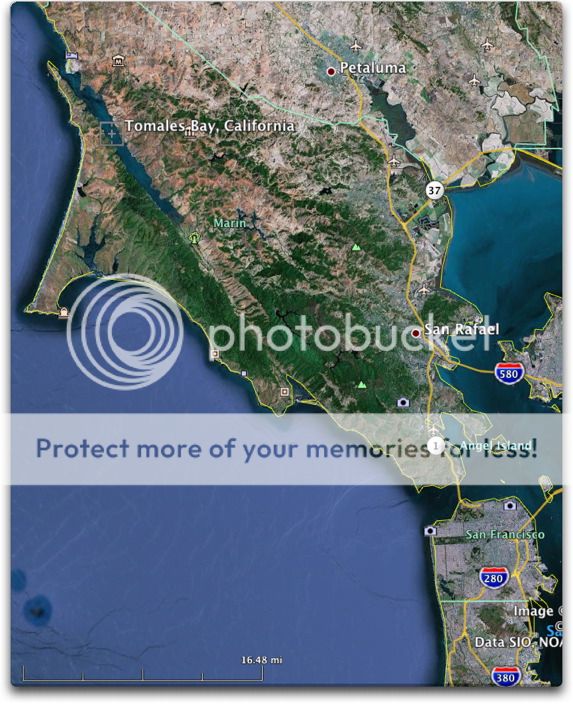
Now, Tomales Bay is long and narrow, with the opening pointing directly into the prevailing northwest winds, and hills on both sides of the bay. Tides around here have about a six-foot (two-metre) swing.
So as you can imagine, when the bottom of the atmosphere above Tomales Bay drops by six feet, it will definitely take some air coming in to fill up that space. The infilling wind, for whatever reasons, doesn’t come off of the hills on either side of the bay. It comes right down from the mouth.
Just as with the terminator wind, the tidal wind sometimes opposed and sometimes increased the prevailing northwest wind. We always tried to play that to our advantage, because we had to row from home to the fishing grounds, which were sometimes miles upwind.
That tidal wind leads to another curious condition. The tidal wind will blow in times of dead calm. Sometimes these would last for a couple of days, and then the wind was like the whole Bay breathing in and out through the mouth. Anyhow, in those conditions the curious thing is that the tidal current is always moving opposite to the wind. When the tide is coming in, the wind is going out. That tends to set up the funny steep-sided little choppy waves that you get when the wind is opposed to the current.
Anyhow, the moon wind is not a tidal wind. As you can see, I am intimate with tidal winds, I’ve seen them in action.
w.
Willis,tThanks for an interesting post!
The “dawn wind” is very evident on a still morning or light wind where I live. The wind will drift towards the sun. Time to adjust the deer stand or relocate,
As far as wildlife goes, daytime freshwater fishing sucks on a full moon. Same with deer and grouse hunting.
Interesting observations as to the effect of the moon on winds. I’ll keep this in mind and watch /observe closely.
Thank you for this fascinating and beautifully written post. A really cheering start to Christmas morning!
lsvalgaard says:
December 24, 2012 at 8:37 pm
/////////////////////////////////////////////////////
It has many many effects on climate, for example it influences the length of the Earth day (which may have been only about 7 to 8 hours in duration, shortly after the moon’s formation, and which is slowly increasing in length now standing at about 24 hours) and of course, it plays a part in the atmospheric diurnal bulge whereunder the atmosphere is constantly being pulled and flexed. Whilst some of these effects may be small, the fact is that we do not fully understand what effect these (and others) may have and to what extent they may be material.
Whilst this is only anedotal, I have the impression that in autumn/winter, it often feels colder on full moon nights.
PS. Interesting article Willis, Happy Christmas to all.
A very Happy Christmas to all at WUWT and thank you for a fascinating read.
I was also reading about the UK RNLI who are working on a new design of lifeboat for those days and nights when the weather is not so pleasant (make to cope with a real hurricain not a Sandy)
http://www.telegraph.co.uk/motoring/news/9745940/The-Christmas-road-test-Shannon-class-lifeboat.html
It has some very interesting features which are very suited to the work it will have to do and it seems to be a great toy on a good day!
All the best for the new year to you all
James Bull
The farmers in the area often planted by the moon. Whether that did any good I don’t know.
The gardeners here in france still and the farmers may but I’m not sure. I asked my neighbours why and the response ?
The moon pulls the oceans and the water table. Therefore the water table is nearer the surface at full moon than at new moon.
Not sure that I believe it but they grow great veg.
Thank you Anthony Willis and all who sail on the good ship WUWT
Talking about the moon reminded me of Dylan Thomas’s poem And Death Shall Have No Dominion
And death shall have no dominion.
Dead man naked they shall be one
With the man in the wind and the west moon;
When their bones are picked clean and the clean bones gone,
They shall have stars at elbow and foot;
Though they go mad they shall be sane,
Though they sink through the sea they shall rise again;
Though lovers be lost love shall not;
And death shall have no dominion.