From the Carnegie Institution and Stanford University comes word of this paper in JGR.
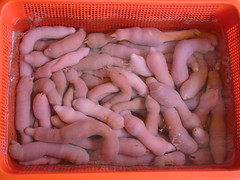
Washington, D.C. — Coral reefs are extremely diverse ecosystems that support enormous biodiversity. But they are at risk. Carbon dioxide emissions are acidifying the ocean, threatening reefs and other marine organisms. New research led by Carnegie’s Kenneth Schneider analyzed the role of sea cucumbers in portions of the Great Barrier Reef and determined that their dietary process of dissolving calcium carbonate (CaCO3) from the surrounding reef accounts for about half of at the total nighttime dissolution for the reef. The work is published December 23 by the Journal of Geophysical Research.
Reefs are formed through the biological deposition of calcium carbonate (CaCO3). Many of the marine organisms living on and around a reef contribute to either its destruction or construction. Therefore it is crucial that the amount of calcium carbonate remain in balance. When this delicate balance is disrupted, the reef ceases to grow and its foundations can be weakened.
In order to fully understand a reef’s ability to deposit carbonate and grow, it is necessary to understand the roles that the various elements of sea life play in this process. This is especially important because increased atmospheric carbon dioxide is predicted to decrease the amount of carbonate available due to acidification.
The research group set out to examine the role that sea cucumbers play in the reef environment.
Schneider’s team included Carnegie’s Ken Caldeira, as well as Jacob Silverman, of the Israeli Limnology and Oceanography Institute; Maria Byrne and Erika Woolsey, both of the University of Sydney and the latter also from James Cook University; and Hampus Eriksson of Stockholm University.
They studied the growth and dissolution of One Tree Reef, which surrounds One Tree Island in Australia’s Great Barrier Reef. Focusing on an area of the reef known as “DK13”, they found that sea cucumbers were abundant. They collected some of these sea cucumbers and placed them in aquaria to study the effect on sea water resulting from the sand and rubble transported through their gut system as part of their digestive process.
As part of another ongoing study in this area, the team found that the coral reef was dissolving at night. They found that sea cucumbers play a crucial part in this process. They live off the bits of organic matter in the carbonate sand and rubble that they ingest; in this process, their digestive systems produce acids that dissolve parts of these carbonate minerals. The dissolved carbonate minerals are then released into the surrounding environment. The researchers found that these lowly organisms might be responsible for half of the CaCO3 of the reef observed at night.
The burning of coal, oil, and gas releases CO2 into the atmosphere, which is later absorbed by the ocean, causing the ocean to acidify. Ocean acidification is expected to slow reef growth. With slower reef growth, the dissolution of CaCO3 within the guts of sea cucumbers is expected to become even more important to the reef CaCO3 budget.
“Even though the sea cucumbers dissolve CaCO3 on the reef, in a lagoon such as the one at One Tree Reef, where there is limited seawater exchange with the surrounding ocean, they can be important in recycling of nutrients to support primary productivity. They also increase sea water buffer capacity to partially offset ocean acidification effects, helping to maintain the overall health of the coral reef,” Schneider said. “Although sea cucumbers may play a part in reef dissolution, they are also an important part of an incredible marine environment.”
This research was supported by the Moore foundation. The authors thank the University of Sydney’s One Tree Island Research Station facility.
The Department of Global Ecology was established in 2002 to help build the scientific foundations for a sustainable future. The department is located on the campus of Stanford University, but is an independent research organization funded by the Carnegie Institution. Its scientists conduct basic research on a wide range of large-scale environmental issues, including climate change, ocean acidification, biological invasions, and changes in biodiversity.
The Carnegie Institution for Science (carnegiescience.edu) is a private, nonprofit organization headquartered in Washington, D.C., with six research departments throughout the U.S. Since its founding in 1902, the Carnegie Institution has been a pioneering force in basic scientific research. Carnegie scientists are leaders in plant biology, developmental biology, astronomy, materials science, global ecology, and Earth and planetary science.
Rob Painting saysTo Combern-
“But what do you think is happening to oyster larvae recruitment in the wild, given that they cannot artificially alter the ambient seawater?
The answer is the same thing that happened to them in 1940s, 1960s and 1970’s. Here is a better question why if CO2 was the cause and CO2 has been steadily increasing was 2010 the highest oyster set (best) in recorded history- but the upwelling event of 2009 was evidence of fossil fuel driven CO2 death?
Plus the oysters your are talking about are “invasives” with most to the native oysters having crashed nearly 100 years ago-but we’re not supposed to talk or care about that are we? In your world theoretical problems that advance an ideology are always more relevant than known oyster problems like Vibrio, habitat (substrate) loss, over harvest and the invasion of the Pacific Oyster that you seem to care so much about. It is this incessant hostage taking by environmentalists – greed if you will- that requires every single environmental problem to conform to the crisis du jour that has prevented us from correcting many of the very real problems we face.
The greatest threat to environmental improvement are environmentalists. They’re goal is not to fix the environment but rather to fix us.
We need a new name for those that care about the quality of our natural resources– environmentalist is no longer applicable and I’m not sure what word we might use to replace it.
Smokey
I wasn’t expecting that when I hit your link- made me laugh.
Pat;
De-humanists?
Rob Painting says:
December 26, 2011 at 8:24 pm
philincalifornia – “Go on, ask me a chemistry question. I’ll educate you”
Thanks, but you’ve clearly illustrated you know nothing about ocean acidification. I’ll stick with the peer-reviewed literature. You know, real experts.
+++++++++++++++++++++++
Did I say I did ? I know barely anything about ocean acidification, but it’s still more than you know.
Experts don’t put “Conclusions” before “Results and Discussion”.
Bear that in in mind …..
….. naaaah forget it.
You’re a dupe. Learn from this thread.
The mistake is allowing trolls like the lazy teenager to frame the discussion.
Since there is no evidence at all that CO2in the atmosphere is causing the oceans to do anything dangerous, before allowing the living embodiment of Donna Laframboise’s book to take over the discussion, it would be interesting to see if the teen troll can do more than dissemble and play word games.
If not (and I will be the troll can’t), then starvation is the only cure for trolls.
Oooops,
as to the Oregon Oyster problem: If youactually read the article, it is clear that the author lied- it was not about CO2 in the atmosphere. It was about deep water upwelling and being used at an oyster farm whose owners were too cheap to monitor and manage the pH of the water they used for commercial purposes.
IOW, the teen troll has been permitted to hijack a good discussion by probably deliberately lying.
Lesson? Never permit lazy teens to take over a conversation.
For everyone that missed Rob Paintings reference to Klump 2010 – Rob is trying to say the addition of a hundred ppm or so of the CO2 in the last 100 years is the equivalent of the Permian Mass Extinction- and that CO2 was the cause for the end of Permian. If the Siberian Traps were to return today- we wouldn’t need a computer model to tell us “the end is near”- thats if the H2S didn’t kill us before we could even have a thought. It is amazing how simple everything is once you know its all caused by CO2. I ‘m waiting for word from Rob that Plate tectonics are also caused by CO2 so that my understanding of geology is complete.
Anyone else wonder why we are spending so much money on research about subjects that are so well understood? Perhaps the best way to stop all this nonsense is to say OK its CO2 no more research money needed and watch Academia trip all over itself.
Brian H,
Thats one. Perhaps Tannerists is another. Dr Howard Tanner is the only man that ever kicked the modern environmental movement’s ass beating them at their own game, while simultaneously trumping NOAA, EPA and powerful commercial fishing interests. As an example he orchestrated Michigan’s governor throwing NOAA out of the State when they tried to take over management of the Great Lakes while building a $12 billion dollar recreation salmon fishery from a “dead” resource. (Remember when nothing would Iive in Lake Erie for 200 years)EPA and NOAA while never giving up have never been able to supplant the Great Lakes Basin Commission- which should be a model for how to resolve natural resource issues.
How he did this should be known to everyone fighting against this insanity- but for another time.
philincalifornia said:
although I do know the old saying – “some fell on stony ground”.
Phil, I think nowadays it is – “some fell on stoned ground.” (There is a positive correlation between feel-good ‘science’ and cannabis use.)
It’s interesting how a post about sea cucumbers brought out the active trolls. A lot of protection presented for the environment of see cucumbers these days.
Nothing here written on effects of CAGW- just human behaviour causing depletion of beche-de-mer.
http://aciar.gov.au/files/node/10097/MN135.pdf
source: http://aciar.gov.au/publication/mn135
Commercial trepang (sea cucumbers) – study in India
http://eprints.cmfri.org.in/3445/1/Article5.pdf
Also trade with Asia, alternate medicine and American Cancer Society have studies going
One Tree Island Research station (site of study). Can not see any villagers living there eeking out a living for the benefit of the social development engineers and academic tourists.
http://sydney.edu.au/science/biology/research/oti/
Report of commercial harvesting in the same area
http://www.abc.net.au/rural/content/2008/s2557906.htm
The researchers found that these lowly organisms might be responsible for half of the CaCO3 of the reef observed at night.
So these orgasms are ejecting lots of CaCO3 at night. How much is being ejected in the daytime?
Should we attempt to modify the behavior of these cucumbers to increase or decrease the ejections?
Geoff Sherrington says: December 26, 2011 at 8:11 pm
Thanks, Geoff, best wishes to you too, and I hope you didn’t get pounded by the hail. I agree that there are exceptions, and the big one is redox, though there’s a pattern there too (after which oxygen is named).
As to the pH stratification, my understanding was that it rises at the bottom because of contact with CaCO3, and has a minimum because of the effect of organic detritus. There’s an article here.
But I’d better not say too much more. I’ve picked up a post-Xmas lurgi, which isn’t improving my responses.
Pat Moffitt – “Rob is trying to say the addition of a hundred ppm or so of the CO2 in the last 100 years is the equivalent of the Permian Mass Extinction”
No. You just made that up Pat. Strawman much?
“It is amazing how simple everything is once you know its all caused by CO2”
If you read the Kump paper you’ll discover it’s a wee bit more complex than that, but you’ll only find out by reading that peer-reviewed paper.
“Anyone else wonder why we are spending so much money on research about subjects that are so well understood?”
You mean like the quantum mechanics and the Higgs Boson?
Pat, all your bluster won’t fool an informed casual reader of this thread. You’ve been found out – you claim expertise on ocean chemistry but don’t know the fundamentals. Throwing out smokebombs only confirms that you’re trying to direct attention away from your lack of knowledge on this topic.
Hunter – “If you actually read the article, it is clear that the author lied’
Seriously, is that the best you’ve got? The science disagrees with you so it’s a fraud?
philincalifornia – a question, seeing you’re so keen on educating.
How do you know the pH of the ocean back in the Permian? If you are an expert as you claim you should be able to answer this off the top of your head. Take far too long in answering and it’ll appear like you had to use google to find the answer.
philincalifornia – “Did I say I did ? I know barely anything about ocean acidification, but it’s still more than you know
You’ve yet to demonstrate that. Earlier you wrote:
Go on, ask me a chemistry question. I’ll educate you
Other commenters on this thread seem to think pH was lower in the past based on modeled estimates of very high atmospheric CO2. How would you calculate the ocean pH back then? And what peer-reviewed papers support such a notion?
LazyTeenager says:
December 26, 2011 at 3:43 pm
If the corrals have to work harder to extract calcium from the water at lower alkalinity reef growth slows. If the rate of growth does not equal or exceed the processes producing rubble then the reef will eventually disappear.
=============================================================================
If Ca is not abundant enough, the reef building corals, acropora sp, etc., will substitute with Mg for example. BTW, the Ca taken up by the corals does not come exclusively from coral rubble being ‘dissolved’ … corals grow a lot more quickly than what one is led to believe, so it would, in my experience growing coral artificially, seem impossible for sea cucumbers to hold the ‘balance of power’ in this regard. You might also consider the high dolomite content of the old fossilised reefs.
Thought I’d just pop up a quick reference for the ‘believers’ to catch up on some ‘ocean acidification’ education. 🙂
http://www.co2science.org/data/acidification/results.php
Pat Moffitt says:
Show me the calculations that can resolve a hundredth of a pH unit change.
They’d also need to show that such a change is not some sort of artifact of the calculations and that it could be reliably measured.
All too often claims from the “greenies”/”warmists” come down to things so tiny that it would make more sense to all them “noise” rather than “signal”.
I was confused by that article, for sure. Here they are, talking about CO2 acidifying the ocean and eroding the reefs, and then quoting a study that seems to indicate that sea cucumbers are contributing to the reef erosion in a significant way, AND that the sea cucumbers are helping to keep the ocean alkaline balance. Talk about your contradictions in logic.
By the way, like other cucumbers, I would prefer my sea cucumbers to be quite pickled.
All the research currently done has shown that ocean pH does not fall below 7.8 which is within its natural variation and alkali NOT acid. The term acidification gives completely the wrong impression that something unnatural is happening it is NOT.
Ocean surface waters are kept alkali by the bicarbonate feedback mechanism which alters the carbonic acid to bicarbonate, the ocean water being an ionic chemical solute, and this bicarbonate raises the pH. At times of very high, 1000’s ppmv, the fossil record shows that corals flourished as did molluscs.
deep ocean waters surrounding the ridge vents can have a pH as low as 4.5, which is very acidic and due to the gasses from the volcanic vents , and molluscs live in this water with no shell dissolution because of protection by a layer of mucus rather like our stomachs protection from the hydrochloric acid used there to help digest food.
This is just sooooo transparent.
The ozone hysteria is over. The acid rain is history. Globull Warning is debunked.
And now this. Solheim, the socialist minister in Norway declared they would finance a new center in Norway for this new scare. My guess is they will do so in all western countries.
And all the Globull Warning “scientists” will slowly and silently migrate away from the Globull Warning Centers over to these new acid-ocean centers. And the ministers giving money to this new scare will get well paid jobs in the UN.
Just waiting for the new scary stories every fall, when next years budgets are made.
Rob Painting-
I finally get it– you’re a science Kop patrolling in the proud tradition of Lysenko.
Strawman about your Permian extinction comments ? Lets remember what you said at Yale 360:
“Many of the earth’s extinction events were associated with ocean acidification events. The PETM and the greatest extinction event of all time, the end-Permian extinction, are 2 notable examples.
Those who deny global warming, climate change and ocean acidification frequently misinterpret geology, concluding that nature, not man, is causing today’s changes.”
You accuse me of arm waving when you are flapping around like Chicken Little .
From two consecutive posts by Rob Painting:
philincalifornia – a question, seeing you’re so keen on educating.
How do you know the pH of the ocean back in the Permian? If you are an expert as you claim you should be able to answer this off the top of your head. Take far too long in answering and it’ll appear like you had to use google to find the answer.
Rob Painting says:
December 26, 2011 at 11:54 pm
philincalifornia – “Did I say I did ? I know barely anything about ocean acidification, but it’s still more than you know
==========================================
Not very good with analysis are you Rob ?
1. I say “I know barely anything about ocean acidification”. You even cut and paste the quote but have come to the conclusion “If you are an expert as you claim”.
2. It’s been about six hours since you posted just before midnight last night. You still want to go with the image of me Googling all night or can you think of other explanations ?
On this topic, I can’t top Streetcred’s reference. I learnt a lot from it.
http://www.co2science.org/data/acidification/results.php
Thank you for that Streetcred.
Let’s try some actual chemistry and maybe we can get some perspective. Here’s a simple equation:
CH3CH2OH + O2 -> CH3CO2H + H2O
i.e. ethyl alcohol can be oxidized to acetic acid (vinegar). While this process can happen in various ways, it in no sense requires what we commonly call a base to be produced. Now someone brought up Lewis acids and bases above and so we can correctly call O2 a Lewis acid and make the acidity balance out. Take another equation:
2 Fe + O2 + 2H2O -> 2 Fe(OH)2
This is a bit more tricky as we have both Lewis acids and Lewis bases involved, (and the ferrous iron isn’t very stable), but again you can see that in this case a base can be created when what would usually be considered a neutral substance (Iron) is present. Since the entire core of our planet is composed of iron-nickel, and O2 is 20% of the atmosphere, it’s silly to argue much about a small “acidification” without considering all the possible reactions which will balance it.
BTW, there was a question above about the ocean as a sink or source of CO2. The deep ocean is actually still a source of CO2 if you work out the CO2 equivalent per unit volume. This could change in the future if the surface CO2 concentration increases. But given that plants like additional CO2 it may be that CO2 will increasingly be turned into organic material, which will ultimately sink (in part) much more rapidly than the general turnover via ocean currents, and thus surface CO2 won’t rise nearly as fast as is often considered to be the case.