A strange juxtaposition in the news today about our older generation, carbon dioxide, and climate change. It seems the past 60 crowd produce less CO2 in their activities than the rest of us. It seems they also believe it affects climate less than say, generation X. Here’s both stories:
From Tom Nelson:
Pew: Among Americans aged 66 to 83, only 22% say that global warming is caused mostly by human activity. Section 8: Domestic and Foreign Policy Views | Pew Research Center for the People and the Press
Millennials are almost twice as likely as Silents to say that global warming is caused mostly by human activity (43% vs. 22%).

From the Max Planck Institute:
Individual CO2 emissions decline in old age
Ageing could influence climate change
November 07, 2011
New demographic analysis reveals that the CO2 emissions of the average American increase until around the age of 65, and then start to decrease. For the United States this means that, although the ageing of the population will lead to a slight overall rise in CO2 emissions over the next four decades, the long-term trends indicate that increasing life expectancy will result in a reduction in emissions.
 Zoom image
© MPIDR, Emilio Zagheni
For the first time, demographer Emilio Zagheni of the Max Planck Institute for Demographic Research in Rostock (MPIDR) has calculated a profile that illustrates the relationship between age and average per capita CO2 emissions. This profile applies to U.S. citizens, as data for this group were easily accessible. But the demographic-economic model developed for the analysis is universally valid, and can be applied to other countries.
Carbon dioxide projections, like those of the Intergovernmental Panel on Climate Change (IPCC), depend greatly on future population developments. Most projection models only take into account the anticipated size of populations, but not their age composition, which will change considerably as life expectancy increases. According to the United Nations, the worldwide share of people aged 65 and older will grow from around eight percent currently to around 13 percent by 2030.
Zagheni’s profile suggests that societies with a growing share of elderly people will tend to produce lower CO2 emissions—at least in developed countries with consumption patterns similar to those of the U.S.A. This is because people appear to do less damage to the climate after the age of 65. As they enter retirement, Americans are producing more carbon dioxide emissions than at any other point in their lives: i.e., around 14.9 metric tons per person annually. Thereafter, the amount produced decreases continuously, falling to 13.1 metric tons by age 80. No data are available for higher ages, but it is expected that emissions fall further. The impact of this age group on climate projections will be significant. This is because, while life expectancy in the U.S. is currently (2010) 78.3 years, it is projected to rise to 83.1 years by 2050, according to the U.S. Census Bureau. Moreover, life expectancy is expected to be even higher in other developed countries.
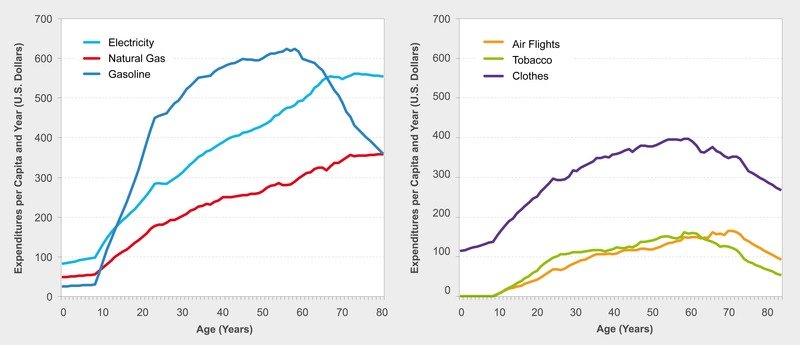
In order to calculate the per capita emissions profile, Zagheni compiled figures on how many dollars an average U.S. residents spend at different ages on nine energy-intensive—and thus CO2-intensive—products and services, including electricity, gasoline, and air travel. By assigning carbon dioxide emissions weights to the consumption of these goods, he combined the nine consumption profiles to produce a single CO2 profile.
 Zoom image
© MPIDR, Emilio Zagheni
The per person expenditures in the nine areas change considerably over the course of life (see Figure 2). First they increase with age, along with income: middle-aged adults fly and drive cars more frequently than young people, and they use more electricity. But as people grow older, this trend often changes. The elderly spend more on average than younger adults, but a growing share of their consumption is devoted to their health. Thus, a double effect can be observed: health care services generally produce low levels of greenhouse gas emissions; and, as less money is available for energy-intensive goods, older people tend to spend less in these areas. Clothing expenditures start to decline at age 58, and gasoline consumption decreases from age 60 onwards—a sign that older people start to reduce their driving relatively early. However, because they spend more time at home, the consumption of electricity and natural gas rises among the elderly until they reach age 80. Only then does home energy usage appear to reach a plateau.
Electricity and natural gas have the greatest impact on the per capita emissions profile, as CO2 emissions are the highest per U.S. dollar spent for these types of energy. Electricity produces 8.7 kilograms of carbon dioxide per dollar (kg CO2/$), and thus tops Zagheni’s list of climate-killers. This is followed by natural gas, which generates 7.5 kg CO2/$; and gasoline, which produces 6 kg CO2/$. Other types of energy usage have relatively small effects. One flight generates around 2.3 kg CO2/$, while one dollar spent on tobacco produces only around 0.5 kg of CO2.
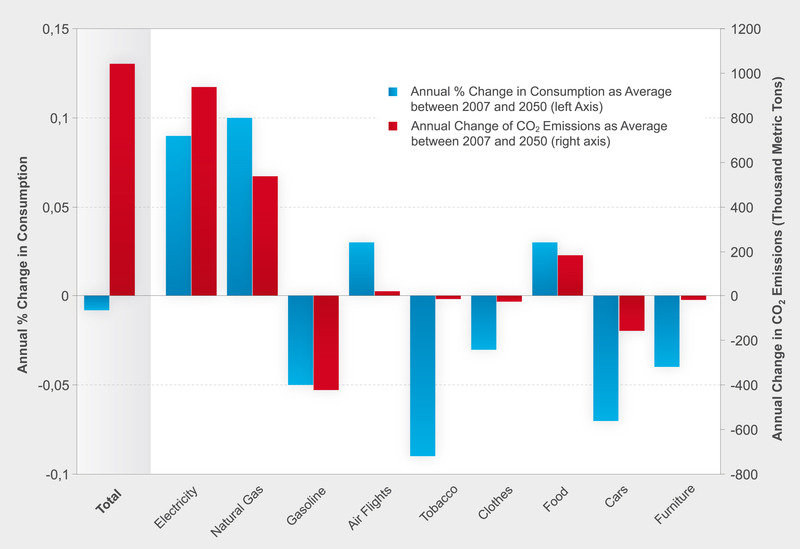
Will the reductions in CO2 emissions among the elderly alter the effects on climate of the population as a whole? To investigate this question, Zagheni projected future carbon dioxide emissions for the U.S. by creating a model in which the population of around 300 million grew older, but did not increase in size. Results showed that, on average, about one million metric ton of additional CO2 emissions would be produced in each of the years between 2007 and 2050 (see Figure 3). Thus, the effect of age is comparatively small. Total CO2 emissions in the U.S. in recent years have amounted to around 5.9 billion metric tons per year. Moreover, rising life expectancy is likely to lead to higher greenhouse gas emissions in the medium term, despite the declining per capita profile among the elderly. Why is this the case?
 Zoom image
© MPIDR, Emilio Zagheni
It is likely that the ageing of the population will not lead to a decrease in CO2 emissions between 2007 and 2050 because the process is not yet sufficiently advanced. This is despite the fact that the changing age structure will lead to a reduction in consumption of certain energy-intensive goods. For example, on the one hand, the shares of carbon dioxide emissions that come from burning gasoline (around 400,000 fewer metric tons) and wear-and-tear on cars (around 150,000 fewer metric tons) will tend to decrease, because cars are being used less (on average, around -0.05 to -0.7 percent; see Figure 3). On the other hand, this trend will be more than counteracted by increasing consumption of electricity and natural gas (by 0.09 or 0.1 percent per year), that will lead to significant additional emissions (estimates range from around 900,000 or 500,000 additional metric tons).
Overall, the balance in the medium term is expected to be positive. One reason for this is that the baby boomer cohorts, who will turn age 65 in the years to come, are also the age groups with the highest emissions values. This will not change until after 2030, when large numbers of baby boomers will have reached age 80, and reductions in CO2 emissions will outweigh increases. This shift cannot be discerned from Zagheni’s results due to the method used: it produces only a single average value for each of the years from 2007 to 2050. The averaging conceals the possibility that emissions could decline at the end of the simulation period.
Also, Zagheni’s study isolates the effect of ageing but does not account for potential improvements in technology. However, if it turns out that new technologies will be more carbon-efficient in the future, that might even leverage age structure effects for the good of the climate. This could be the case, for instance, if electricity, of which the old use a lot, could be generated and distributed with fewer emissions. The economic models of other researchers show that a reduction in carbon dioxide through changes in the age structure can only be seen after 2050. Then, however, reductions of up to 20 percent could occur.
Discover more from Watts Up With That?
Subscribe to get the latest posts sent to your email.


DirkH says:
November 7, 2011 at 1:25 pm
“Somebody should teach Mr. Zagheni how to operate a broom so that he can spend the rest of his life doing something useful.”
A dangerous suggestion. These folks obviously inhabit a universe where the laws of nature work differently than in our contunuum. Cause and effect are effected by stringing esoteric symbols into incomprehensible formulae and pulling finagle factors out of hats. They can command the elements. They are constantly fighting apocalyptic dangers no Muggle has seen. Allegiance is determined by which House you belong to: Hufflepuff or Slytherin.
You know what they do with broomsticks there…
@ur momisugly Pamela Gray says:
November 7, 2011 at 8:09 pm
I’m so old that I don’t know the code for the X gen, the silent gen, or the mil gen. Can we just go with age span please?
=======================================================================
There’s some interesting psychology associated with that kind of “instant soundbite grouping” . Used to be that folks objected to being lumped into a group without their consent. Seems that individuality ( and individual thinking) has gone by the wayside. WUWT?
I was BORN in NE Oregon and can be found with the locals every Friday night at the Lostine Tavern.
There is no better way to spend a day than to walk the banks of the Wallowa and Lostine Rivers hunting for fish. And I do mean hunt. Those rivers change every year, and the fishing holes with it. You can’t just plunk in a hook and expect a fish to find it. You have to read the river, walk the banks, know where the fish like to be, and hunt for them there. Not an easy walk or hunt by any measure. The stretches of river I fish are behind private land or in wilderness areas. Of course, recently, I’ve had to add cougar and wolf awareness to my solo fishing trips. I’m just a little Irish elf and I look like a mid-morning snack to them.
As someone in the +60 category, I try to limit my CO2 output as much as possible by resting on the sofa in front of the tv….
As an aside – here’s a little gem for all you cynics out there. Headline today in our local daily paper (Cambridge Evening News):
‘Speed camera blaze blamed on arsonists..’
Who’d have thought it, eh..??
How about a new NSF study: “Solution to Global Warming Crisis: Methane/CO2 capture via sofa/couch sequestration techniques.”
“Pumping into the natural gas pipe line system save the Planet.”
I think the reason there are fewer CO2 emissions from older people is because there is less heavy breathing. I know that is so my own case……
Here’s an email that landed in my mailbox the other day..
****************************************************
The Green Thing
Checking out at the store, the young cashier suggested to the older woman that she should bring her own grocery bags because plastic bags weren’t good for the environment.
The woman apologized and explained, “We didn’t have this green thing back in my earlier days.”
The clerk responded, “That’s our problem today. Your generation did not care enough to save our environment for future generations.”
She was right — our generation didn’t have the green thing in its day.
Back then, we returned milk bottles, soda bottles and beer bottles to the store. The store sent them back to the plant to be washed and sterilized and refilled, so it could use the same bottles over and over. So they really were recycled. But we didn’t have the green thing back in our day.
We walked up stairs, because we didn’t have an escalator in every store and office building. We walked to the grocery store and didn’t climb into a 300-horsepower machine every time we had to go two blocks. But she was right. We didn’t have the green thing in our day.
Back then, we washed the baby’s diapers because we didn’t have the throw-away kind. We dried clothes on a line, not in an energy gobbling machine burning up 220 volts — wind and solar power really did dry our clothes back in our early days. Kids got hand-me-down clothes from their brothers or sisters, not always brand-new clothing. But that young lady is right. We didn’t have the green thing back in our day.
Back then, we had one TV, or radio, in the house — not a TV in every room. And the TV had a small screen the size of a handkerchief (remember them?), not a screen the size of the state of Montana. In the kitchen, we blended and stirred by hand because we didn’t have electric machines to do everything for us. When we packaged a fragile item to send in the mail, we used wadded up old newspapers to cushion it, not Styrofoam or plastic bubble wrap. Back then, we didn’t fire up an engine and burn gasoline just to cut the lawn. We used a push mower that ran on human power. We exercised by working so we didn’t need to go to a health club to run on treadmills that operate on electricity. But she’s right. We didn’t have the green thing back then.
We drank from a fountain when we were thirsty instead of using a cup or a plastic bottle every time we had a drink of water. We refilled writing pens with ink instead of buying a new pen, and we replaced the razor blades in a razor instead of throwing away the whole razor just because the blade got dull. But we didn’t have the green thing back then.
Back then, people took the streetcar or a bus, and kids rode their bikes to school or walked instead of turning their moms into a 24-hour taxi service. We had one electrical outlet in a room, not an entire bank of sockets to power a dozen appliances. And we didn’t need a computerized gadget to receive a signal beamed from satellites 2,000 miles out in space in order to find the nearest pizza joint.
But isn’t it sad the current generation laments how wasteful we old folks were just because we didn’t have the green thing back then?
Please forward this on to another selfish old person who needs a lesson in conservation from a smart-mouth young person.
Remember: Don’t make old people mad.
We don’t like being old in the first place, so it doesn’t take much to tee us off.
Measuring individual CO2 emissions by purchases of airplane tickets and estimates of how much driving one does sounds about as scientific as tree rings. It’s true that chain-saw use probably dies down, as does leaf-blower use.[ I’m not sure about all you people who wnat to make flatulence jokes.] Anyone over 60 will remember the panic over global cooling and nuclear winter in the 70s, and folks in their 80s will recall the hot years in the early 30s. When you have experienced floods, blizzards, temperatures of 20 below and more, been snowed in, and sweltered in Phoenix in the summer— you’re just not too impressed with a climate that supposedly warms by one degree.
Anthony, My last letter to the ER on the subject, I had written once before, was written in hopes of a response, it didn’t matter who. I did get two responses with some name calling and some very bad science. When I wanted to go on with the debate, David Little told me the “debate” had run its course (two letters). I have my own take on global warming that involves “warm air rising”, a phrase you may remember from your highschool physics classes on the weather and the trans- mission of heat. The “warm air” I’m presently talking about is natural, carbon dioxide from respiration and plant decay and water vapor from evaporation of water surfaces and man caused carbon dioxide from combustion. Millions and millions of tons of carbon and water rise into the atmosphere from all over the globe, carried there by a correspondingly enormous amount of energy that was released from carbon and water when they were turned into gases. The scientic term for this process is “convection” the transmission of heat energy through fluid media, in our case carbon dioxide, water vapor and methane. Is this the “weather trap”? Is my science wrong? Frankly, I write my letters with some trepidation. What if I’m wrong? I gave my theory to the scientist who came to Chico recently but I have not heard from him. I believe I pissed him off when I asked at the end why he didn’t use the Keeling Curve in his presentation along with all those fancy graphs he displayed. I wanted him to give me a good argument for global warming which he did not do. FXF
What they lack in CO2 emissions, they make up for in CH4.
All the numbers are a downer. And educational propaganda is making them worse with each generation.