A strange juxtaposition in the news today about our older generation, carbon dioxide, and climate change. It seems the past 60 crowd produce less CO2 in their activities than the rest of us. It seems they also believe it affects climate less than say, generation X. Here’s both stories:
From Tom Nelson:
Pew: Among Americans aged 66 to 83, only 22% say that global warming is caused mostly by human activity. Section 8: Domestic and Foreign Policy Views | Pew Research Center for the People and the Press
Millennials are almost twice as likely as Silents to say that global warming is caused mostly by human activity (43% vs. 22%).

From the Max Planck Institute:
Individual CO2 emissions decline in old age
Ageing could influence climate change
November 07, 2011
New demographic analysis reveals that the CO2 emissions of the average American increase until around the age of 65, and then start to decrease. For the United States this means that, although the ageing of the population will lead to a slight overall rise in CO2 emissions over the next four decades, the long-term trends indicate that increasing life expectancy will result in a reduction in emissions.
 Zoom image
© MPIDR, Emilio Zagheni
For the first time, demographer Emilio Zagheni of the Max Planck Institute for Demographic Research in Rostock (MPIDR) has calculated a profile that illustrates the relationship between age and average per capita CO2 emissions. This profile applies to U.S. citizens, as data for this group were easily accessible. But the demographic-economic model developed for the analysis is universally valid, and can be applied to other countries.
Carbon dioxide projections, like those of the Intergovernmental Panel on Climate Change (IPCC), depend greatly on future population developments. Most projection models only take into account the anticipated size of populations, but not their age composition, which will change considerably as life expectancy increases. According to the United Nations, the worldwide share of people aged 65 and older will grow from around eight percent currently to around 13 percent by 2030.
Zagheni’s profile suggests that societies with a growing share of elderly people will tend to produce lower CO2 emissions—at least in developed countries with consumption patterns similar to those of the U.S.A. This is because people appear to do less damage to the climate after the age of 65. As they enter retirement, Americans are producing more carbon dioxide emissions than at any other point in their lives: i.e., around 14.9 metric tons per person annually. Thereafter, the amount produced decreases continuously, falling to 13.1 metric tons by age 80. No data are available for higher ages, but it is expected that emissions fall further. The impact of this age group on climate projections will be significant. This is because, while life expectancy in the U.S. is currently (2010) 78.3 years, it is projected to rise to 83.1 years by 2050, according to the U.S. Census Bureau. Moreover, life expectancy is expected to be even higher in other developed countries.
In order to calculate the per capita emissions profile, Zagheni compiled figures on how many dollars an average U.S. residents spend at different ages on nine energy-intensive—and thus CO2-intensive—products and services, including electricity, gasoline, and air travel. By assigning carbon dioxide emissions weights to the consumption of these goods, he combined the nine consumption profiles to produce a single CO2 profile.
 Zoom image
© MPIDR, Emilio Zagheni
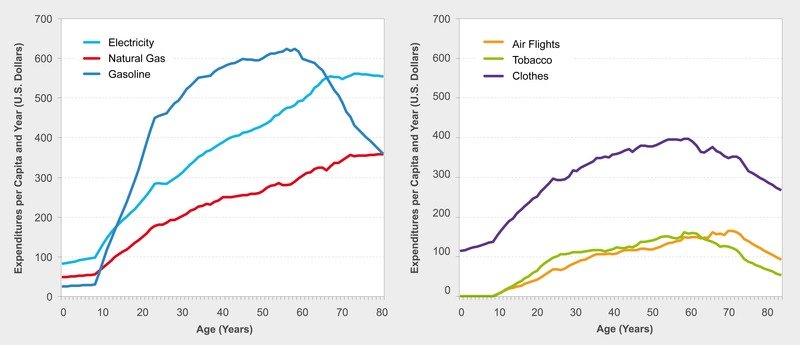
The per person expenditures in the nine areas change considerably over the course of life (see Figure 2). First they increase with age, along with income: middle-aged adults fly and drive cars more frequently than young people, and they use more electricity. But as people grow older, this trend often changes. The elderly spend more on average than younger adults, but a growing share of their consumption is devoted to their health. Thus, a double effect can be observed: health care services generally produce low levels of greenhouse gas emissions; and, as less money is available for energy-intensive goods, older people tend to spend less in these areas. Clothing expenditures start to decline at age 58, and gasoline consumption decreases from age 60 onwards—a sign that older people start to reduce their driving relatively early. However, because they spend more time at home, the consumption of electricity and natural gas rises among the elderly until they reach age 80. Only then does home energy usage appear to reach a plateau.
Electricity and natural gas have the greatest impact on the per capita emissions profile, as CO2 emissions are the highest per U.S. dollar spent for these types of energy. Electricity produces 8.7 kilograms of carbon dioxide per dollar (kg CO2/$), and thus tops Zagheni’s list of climate-killers. This is followed by natural gas, which generates 7.5 kg CO2/$; and gasoline, which produces 6 kg CO2/$. Other types of energy usage have relatively small effects. One flight generates around 2.3 kg CO2/$, while one dollar spent on tobacco produces only around 0.5 kg of CO2.
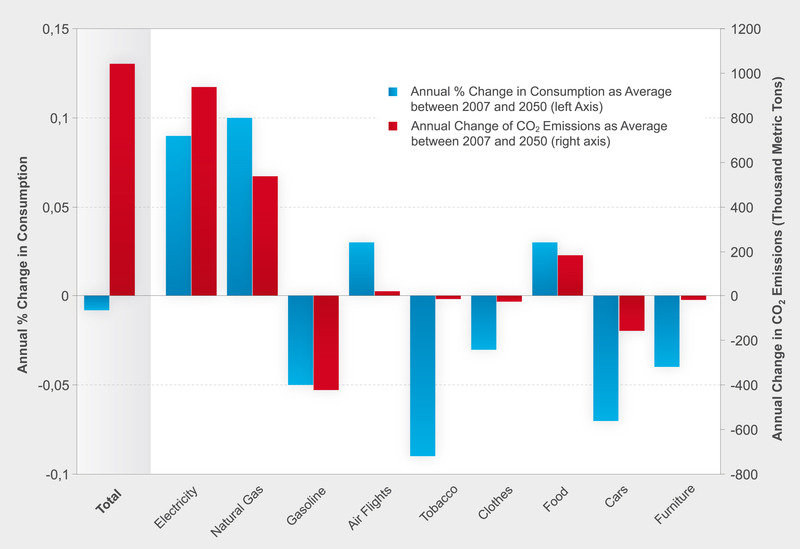
Will the reductions in CO2 emissions among the elderly alter the effects on climate of the population as a whole? To investigate this question, Zagheni projected future carbon dioxide emissions for the U.S. by creating a model in which the population of around 300 million grew older, but did not increase in size. Results showed that, on average, about one million metric ton of additional CO2 emissions would be produced in each of the years between 2007 and 2050 (see Figure 3). Thus, the effect of age is comparatively small. Total CO2 emissions in the U.S. in recent years have amounted to around 5.9 billion metric tons per year. Moreover, rising life expectancy is likely to lead to higher greenhouse gas emissions in the medium term, despite the declining per capita profile among the elderly. Why is this the case?
 Zoom image
© MPIDR, Emilio Zagheni
It is likely that the ageing of the population will not lead to a decrease in CO2 emissions between 2007 and 2050 because the process is not yet sufficiently advanced. This is despite the fact that the changing age structure will lead to a reduction in consumption of certain energy-intensive goods. For example, on the one hand, the shares of carbon dioxide emissions that come from burning gasoline (around 400,000 fewer metric tons) and wear-and-tear on cars (around 150,000 fewer metric tons) will tend to decrease, because cars are being used less (on average, around -0.05 to -0.7 percent; see Figure 3). On the other hand, this trend will be more than counteracted by increasing consumption of electricity and natural gas (by 0.09 or 0.1 percent per year), that will lead to significant additional emissions (estimates range from around 900,000 or 500,000 additional metric tons).
Overall, the balance in the medium term is expected to be positive. One reason for this is that the baby boomer cohorts, who will turn age 65 in the years to come, are also the age groups with the highest emissions values. This will not change until after 2030, when large numbers of baby boomers will have reached age 80, and reductions in CO2 emissions will outweigh increases. This shift cannot be discerned from Zagheni’s results due to the method used: it produces only a single average value for each of the years from 2007 to 2050. The averaging conceals the possibility that emissions could decline at the end of the simulation period.
Also, Zagheni’s study isolates the effect of ageing but does not account for potential improvements in technology. However, if it turns out that new technologies will be more carbon-efficient in the future, that might even leverage age structure effects for the good of the climate. This could be the case, for instance, if electricity, of which the old use a lot, could be generated and distributed with fewer emissions. The economic models of other researchers show that a reduction in carbon dioxide through changes in the age structure can only be seen after 2050. Then, however, reductions of up to 20 percent could occur.
Discover more from Watts Up With That?
Subscribe to get the latest posts sent to your email.


That institute is in the former DDR?
Got it.
“Is there solid evidence the earth is warming ?”
This is one of those questions that makes me tear my hair out over whether pollsters will ever do anything worth a bean. It is meaningless without specifying a timeframe. I have no idea how I would have answered since the earth has not warmed for the last 10-15 years but the underlying trend has been warming since the low point of the Maunder Minimum.
Is this calculated before, or after, you take away the car keys?
“Millennial generation”
“Millennial” is correctly spelled as “Pokemon” and pronounced “poh-kay-mon”.
So, essentially, electricity and gas are, what, two natural substances, and here I was thinking natural gas was often times used to create electricity. :p
In response to my comment ““WUWT is starting to become a pro-sceptic gossip column.”
Sparks says ” What is your context? as opposed to what? where are you coming from?”
My context is this type of article is not something I expected to see on a well regarded site such as WUWT. In my opinion such pieces provide ammunition for the pro-AGW proponents to denigrate those who are less sure of the role of AGW in climate change.
As opposed to blogs such as RealClimate and Climate Audit. I can’t Imagine either posting such an insubstantial puff piece.
I’m coming from a science background. I’m a PhD qualified biochemist who has deep reservations about the statement “the science is settled” It rarely is on any topic let alone a chaotic phenomenon like climate and weather. Quite sure climate is changing but a lot less sure of the extent to which humans have contributed to this change. I also dislike intensely the smug superiority of the AGW proponents, their snide comments, their use of the term deniers and an apparent inability to exam recognise anything that doesn’t agree with their view. But as Matt Riley points out, we are all guilty of confirmation bias.
I hope this adequately answers your questions.
Interstellar Bill says: November 7, 2011 at 3:29 pm
Did they include each person’s breathing?
4% CO2 at 20 liters/min is 48 liters per hour of pure CO2
air density is 1.22 g/liter, CO2 is 44/28 times heavier,
so those 48 liters @ur momisugly 1.92 g/L mass 92 g
a little over 2 moles of CO2 per hour
A metric ton is 1E6 g/(44 g/mole) = 22727 moles,
or 11,000 breathing-hours, about 15 months to exhale a metric ton of CO2.
—————————————————————–
Bill, you don’t need to do all those calculations. Measured CO2 production from a sedentary person (working at a desk) is .97 kg/day. Several times higher while doing heavy manual labor. That’s 30 kg/month or 360 kg CO2 per year per adult person, not very different from your calculations.
Source: Safety and Operational Guidelines for Undersea Vehicles.
Ian says:
November 7, 2011 at 4:17 pm
Yes, that sure did answers my questions, thank you very much.
Those of us in the methane-producing years are less inclined to believe that the sky is falling since we have already survived the predicted DOOM of Total Nuclear Warfare, Rock and Roll, Giant Hogweed, Eco-spasm, the explosion of the old WW2 arms-ships in the Thames Estuary, AIDS, SARS, Bird Flu, and Y2K, to name but a few.
We’re doomed, of course, but we’ve got a bit blasé about it.
When I put global warming in the context of weather, Anthony wrote in the local paper that I had fallen into the “weather trap” and that pictures of human suffering following extreme weathers were ” media propaganda” , part of a plot by the liberal media and environmentalists. I believe you’re on the wrong track, Anthony. You are confused about “heat” and the concept of heat. You don’t seem to understand the weather either. If Anthony would tell me what he means by the “weather trap”, I would take it under advisement. What is the weather and what role does heat play in the weather? Just Anthony to reply, please. At 88 I can tell you I do produce less CO2. I ride my bike and have a garden. The CO2 from the compost bins is natural, not from trains, planes or automobiles. FXF
REPLY: Mr Farley, there’s a good reason I didn’t respond to your recent letter in the newspaper.
“Never argue with a fool, onlookers may not be able to tell the difference” -Mark Twain
And no, I’m not interested in having a conversation with you here so you can distort it in yet another foolish letter. In fact you’ll probably distort this response, and not include the Mark Twain quote when you write angry letter #604 to the Enterprise Record. – Anthony
Only 36% think global warming is happening AND humans are responsible. That says the warmists ARE in the minority … though in charge of the money trough.
Are the Australians really so different? What happened there could happen here.
Ian says:
November 7, 2011 at 4:17 pm
========================
Ian, there’s a lot of us that get a kick out of the puff pieces….
..sometimes you can’t tell the difference……… 😉
RoHa says:
November 7, 2011 at 4:54 pm
Those of us in the methane-producing years are less inclined to believe that the sky is falling since we have already survived the predicted DOOM of Total Nuclear Warfare, Rock and Roll, Giant Hogweed, Eco-spasm, the explosion of the old WW2 arms-ships in the Thames Estuary, AIDS, SARS, Bird Flu, and Y2K, to name but a few.
We’re doomed, of course, but we’ve got a bit blasé about it.
==============================================================
Let me add Kudzu (imported to control erosion) to that list. And the Kudzu Bug ( an asian beetle imported to eat the vine) which loves kudzu, but when that’s gone will turn it’s attention to soybeans. A huge cash crop. I wonder what the cure for the bug will be. Elephants maybe?
People over 60 remember the Club of Rome, Limits to Growth, and The Population Bomb. Because of this, they know the lunatic fringe is always out there to try and scare people into desired behavior pattern (give us money, give us power, give us prestige).
Because of past experiences, they are not as excitable as younger people, recalling how worried they were about past projections of disaster.
So they are not as inclined to believe the human race has that much effect on the globe.
There are probably a multitude of reasons why younger people are more susceptible to the AGW hypothesis, many are mentioned above (and apologies if I repeat some of them). I boil it all down like this:
1. With the AMDO and PDO oscillations being on the order of typically 20-30 years, if you were born during the most recent positive cycle, then what you witnessed were mostly warm years. If you have lived through several of them, as I have, then not so easily persuaded.
2. If you happened to live through and were a part of the anti-establishment 60’s and 70’s brouhaha then appeals to authority carry only so much weight. If you have never witnessed a Nixon/Watergate, Iran/Contra or Clinton/Lewinski style reverse/pretzel meltdown yet then dependence on authority may trump your very own eyes with such as Climategate. The word fool exists for a reason. Many may not yet know, or may never know, what a BS sensor is and how to grow one between your ears.
3. The entire education system has indeed changed, particularly with regard to k-12 matriculation and college entrance. The emphasis is on educational matriculation not necessarily critical thinking. It is one thing to memorize a thing and regurgitate it, quite another to cogitate it. A good old chem lab can get at this problem.
4. And so few are even exposed to the scientific method even if they end up being so-called scientists. I work with hundreds of these.
5. And then there is when we live. The present iteration of the genus homo appears to be genetically burdened. There is the Nine Times Rule which states that the present iteration is nine times more susceptible to rumor than it is to fact. The proof is simplicity itself, just answer the question, accurately mind you, as to which of all mankind’s religions is the correct one?
An element of this was most recently described in Xie, et al, 2011, “Social consensus through the influence of committed minorities”, PHYSICAL REVIEW E 84, 011130 (2011),
“We show how the prevailing majority opinion in a population can be rapidly reversed by a small fraction p of randomly distributed committed agents who consistently proselytize the opposing opinion and are immune to influence. Specifically, we show that when the committed fraction grows beyond a critical value pc ≈ 10%, there is a dramatic decrease in the time Tc taken for the entire population to adopt the committed opinion.” http://pre.aps.org/abstract/PRE/v84/i1/e011130
(paywalled)
6. So, at best, right out of the gate, there is something like a 10% chance that any of us will ever be able to tell the difference between fact and fiction. And therefore being able to rub more than one fact together at the same time becomes a time-domain variable. Less time, less facts. I offer myself as the example. I tend to doubt that any high-school kid of my era had not heard of the ice ages. But it took a few years of undergraduate geology, specifically sedimentation, paleontology and tectonics before I really integrated on climate. Climate and tectonics controlled what got deposited where and whether or not any era life was deposited and preserved in it. And what a climate story all of that told! That was about 1.4 AMDO/PDO oscillations ago. More time, more facts, more experience, some of that moving on to expertise???
Yet again it is one thing to have lived it, something else entirely to have understood it. How do you think you are doing? A question best asked at least once per day.
I’m so old that I don’t know the code for the X gen, the silent gen, or the mil gen. Can we just go with age span please?
Well, I dunno about all of that. I’m 65, and I’m doing my best to keep things warm by driving my Yukon to eastern Oregon as often as possible.
😉
Mike,
Burns, OR, and parts other than the Blue Mountains? The NW edge of the Basin and Range Province? Nice! I was through there a month ago……
Argh. Damage to the environment = CO2 emissions. That would be the part of the environment not composed of plants and the animals that live off them?
Fundamental foolishness is so infuriating.
WUWT comes up with all sorts of drivel funded by the taxpayer. How do we get some of this tax funding for our own more serious climate related studies?
tonyb
To get some public funding for senseless research projects (in demographic, social and other “sciences”), it helps a lot (not only in Germany), to include some link to Climate Change (=CO2) in grant applications. Specially with the patronage (or co-authorship) by a big name in the milieu, papers will be easily accepted (via pal/peer review) by “highly respected” Journals, and authors will be named henceforth “Climate Scientists”. After such a groudbreaking archivement, nothing stands in the way to get more funding for silly research. I have 2 proposals for intersdisciplinary research with funds guaranteed:
“Effect of increasing CO2 concentrations on the respiratory behavior of middle-class white farmers over 85 in the mid-west”. (Interdisciplinary research for a group of scientists in Social Sciences, Demography, Medicine, Chemistry, Gerontology, Atmospheric Physics, etc.; paper to be accepted by Science, with 6-7 authors, one of them a member of the National Academy of Sciences).
“Global warming as driver of German emigration to Norway”. (Paper to be published in Nature, presented by a prominent PIK-“Climate Scientist” and co-authored by two Sociologists, one Economist and a “Demographist”.
Joking aside, above fake paper titles sound absolutely realistic in view of the junk (“climate”) science appearing almost daily in “respected” Journals; we have seen a lot of them here, at WWUT, e.g. as “crasiness of the week”.. What a waste of public funds!
Another load of CO2 claptrap.
CO2 does NOT drive climate.
Curiousgeorge says:
November 7, 2011 at 1:00 pm
I agree that seniors produce less CO2. But it’s a different story for methane. 😉
Having worked with seniors in residential and nursing homes I can certainly agree with this. My scientific analysis of the situation is that it is due to the increased consumption of prunes. So I need lots of cash to do proper research into this and then get a campaign going to ban prunes.
Some comments have been a little derogatory of the oft flippant nature of some of the posts on this site. Well, the rather dubious science that seems to be paid for by our tax dollars is in serious need of ridicule.
Some who profess to be smart at our expense deserve to be held accountable, as this has become impossible a little roasting is a fair thing.
Do the real science and thinking people will applaud your efforts, take us for fools and the fickle finger of fate will be applied.
Here’s another reason to trust anybody over 30