By Steve Goddard
Over the last few weeks I have been tracking what is becoming a large discrepancy between various Arctic sea ice measurements. NSIDC graphs show almost no difference between 2010 and 2007.

http://nsidc.org/data/seaice_index/images/daily_images/N_timeseries.png
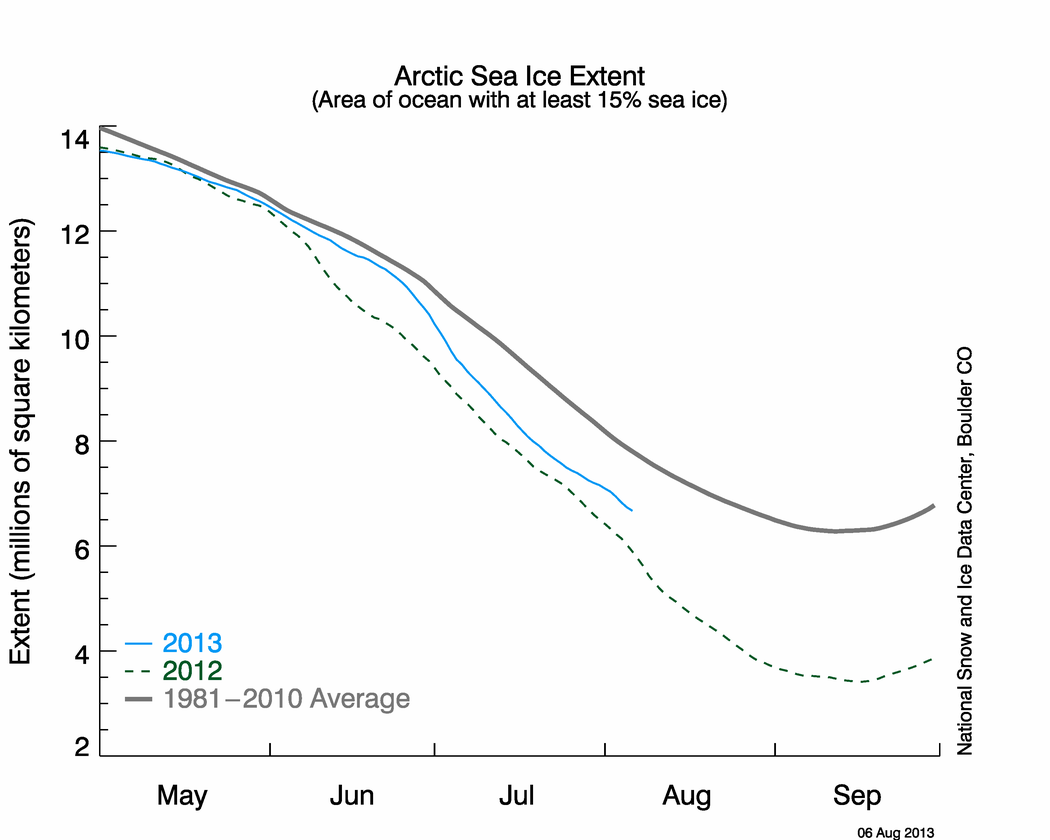
By contrast, DMI graphs show nearly one million km² more ice in 2010.


http://ocean.dmi.dk/arctic/icecover.uk.php
Here is the graph above zoomed:

The video below shows 2010 started to diverge in mid June, and 2007 started to diverge in early July. At this point we have a major discrepancy between the two.
DMI uses 30% concentration ice and NSIDC uses 15%, which affects absolute values . But the relative year over year numbers shouldn’t vary very much.
The image below shows NSIDC August 03, 2010 compared with the same date in 2007. Green areas have more ice in 2010. Red areas had more ice in 2007.

The NSIDC maps show 7.5% more ice in 2010 than 2007, but their graph shows less than 3% difference.
The period from August 3 through August 15 was when most of the ice compaction occurred during 2007. Unless something unexpected happens with winds in the Arctic, NSIDC graphs should start to diverge from 2007 – more like the DMI graph.
R. Gates
Lots of things have increased over the past few centuries. That doesn’t mean they have much affect the climate.
R. Gates: August 5, 2010 at 5:43 pm
And then to suggest in any way, that anything that we could get out of this single season would indicate that any type of “recovery” is indicated seems to me to be the epitome of reaching for a conclusion that simply isn’t indicated by the data. We haven’t had a positive Arctic Sea ice anomaly since 2004! How can a recovery be underway if the ice extent remains well below the longer term average???
Well, let’s look at a *longer* term average.
The Northwest Passage (NWP) has been icebound during the “modern instrumental period” and ships haven’t been able to transit without the aid of icebreakers, correct? If ships *could* transit the NWP without the aid of icebreakers, that would mean that the ice extent was well below average, correct? The historical record shows that ships transited the NWP without the aid of icebreakers at least twice in the mid-19th Century, and at least four times in the 20th Century, therefore, the ice extent was well below average during those periods, correct? Since ships have *not* been able to do that in recent years, then the ice extent must now be *above* the longer term average, correct?
If you look at the “longer term average,” you’ll see that the ice extent is *never* average — it’s either above or below, and since we’ve only been getting pictures of the extent for thirty years, we can’t honestly claim we even know what the “longer term average” happens to be.
stevengoddard says:
August 5, 2010 at 3:48 pm
No one can accurately forecast what ice conditions will be like in the spring, because it depends on the weather between now and then.
——-
Steve,
So you see each year as an independent event and are unable to make any assessment beyond 6 months in the future?
In that case you shouldn’t be making grand pronouncements that sea ice is in recovery because you have no idea what is going to happen 6 months from now. In that one line above you have invalidated every forward looking statement you have ever made about ice extent.
You are admitting here you have no clue what ice extent will be in 2011, 2012 or 2013 yet you continue to say that sea ice is in a long term recovery.
Either you don’t know or you do but you can’t have it both ways.
Bill Tuttle says:
August 6, 2010 at 3:12 am
R. Gates: August 5, 2010 at 5:43 pm
And then to suggest in any way, that anything that we could get out of this single season would indicate that any type of “recovery” is indicated seems to me to be the epitome of reaching for a conclusion that simply isn’t indicated by the data. We haven’t had a positive Arctic Sea ice anomaly since 2004! How can a recovery be underway if the ice extent remains well below the longer term average???
Well, let’s look at a *longer* term average.
The Northwest Passage (NWP) has been icebound during the “modern instrumental period” and ships haven’t been able to transit without the aid of icebreakers, correct?
During the last 3 summers the NWP has not been icebound and has been transited even by yachts and this summer will follow suit.
If ships *could* transit the NWP without the aid of icebreakers, that would mean that the ice extent was well below average, correct?
As it has been.
The historical record shows that ships transited the NWP without the aid of icebreakers at least twice in the mid-19th Century,
Not that I’m aware of.
and at least four times in the 20th Century, therefore, the ice extent was well below average during those periods, correct?
In a single season the first was the St Roche once in the 40s, and de Roos in 1977 when were the others?
Since ships have *not* been able to do that in recent years, then the ice extent must now be *above* the longer term average, correct?
But they have been for the last three years and shortly this year so your premise seems flawed.
If you look at the “longer term average,” you’ll see that the ice extent is *never* average — it’s either above or below, and since we’ve only been getting pictures of the extent for thirty years, we can’t honestly claim we even know what the “longer term average” happens to be.
Ralph Dwyer says:
August 5, 2010 at 8:39 pm
R. Gates says:
August 5, 2010 at 4:38 pm
“…Here’s the point: GCM’s are about trends because climate is about trends….”
Reply: First off, I must applaud your tenacity. Given your statement above, would you say that the GCM’s are linearly trending or are they cyclically trending? A simple question, is it not? Because historical climate has been cyclical. Is it your belief that anthropogenic CO2 forcing is sufficent to disrupt the cyclical nature of climate? I await your well-reasoned response.
Thank you,
Ralph Dwyer
_______
First of all, yes, absolutely I believe the rapid increase (geologically speakinng) of CO2 is likely to be able to impact the cyclical nature of the climate to SOME extent. Certainly the Milanovitch cycles drive the climate in long term, but even longer than that are the geological cycles of CO2 and rock weathering. We know that during periods of high CO2, the hydrological cycle speeds up, weathering rock faster, which actually removes CO2 from the atmosphere, cooling the planet, slowing down the hydrological cycle, until slowly CO2 builds again, melting the ice sheets, and the cycle begins again.
But a 40% increase in CO2 since the 1700’s is potentially a huge shock to a system, and the entire issue with CO2 is how sensitive the natural cycles are to such a rapid increase. GCM’s predict the TRENDS of AGW from this increase, which will be seen (and is being seen) in melting ice sheets, reduced Arctic sea ice, cooler stratospheric temps, ocean acidification, etc. If only one of these things were happening, then I be less the my 75% convinced that AGW is happening, but there seems to be too many indications that indeed the 40% increase in CO2 is having an effect. Though, as with any system on the edge of chaos, the exact path and feedbacks are not going to be predictable and we know know about them until they’ve started.
Bill Tuttle says:
August 6, 2010 at 3:12 am
R. Gates: August 5, 2010 at 5:43 pm
And then to suggest in any way, that anything that we could get out of this single season would indicate that any type of “recovery” is indicated seems to me to be the epitome of reaching for a conclusion that simply isn’t indicated by the data. We haven’t had a positive Arctic Sea ice anomaly since 2004! How can a recovery be underway if the ice extent remains well below the longer term average???
Well, let’s look at a *longer* term average.
The Northwest Passage (NWP) has been icebound during the “modern instrumental period” and ships haven’t been able to transit without the aid of icebreakers, correct? If ships *could* transit the NWP without the aid of icebreakers, that would mean that the ice extent was well below average, correct? The historical record shows that ships transited the NWP without the aid of icebreakers at least twice in the mid-19th Century, and at least four times in the 20th Century, therefore, the ice extent was well below average during those periods, correct? Since ships have *not* been able to do that in recent years, then the ice extent must now be *above* the longer term average, correct?
If you look at the “longer term average,” you’ll see that the ice extent is *never* average — it’s either above or below, and since we’ve only been getting pictures of the extent for thirty years, we can’t honestly claim we even know what the “longer term average” happens to be.
_______________
We only have the data we have. Even a transit of the NWP does not tell us about the overall extent of Arctic sea ice, but only of the NWP. We know that the Arctic Sea ice has not had a positive anomaly since 2004 based on the 30+ year average of solid reliable data. Anything else beyond this is somewhat speculation, though sediments and other data can give us some idea of the longer term sea ice extent in specific areas.
I favor the satellite data over any for a reliable record of sea ice. Next, I favor ice core samples over any other data for a reliable record of CO2.
R. Gates: August 6, 2010 at 7:52 am
I favor the satellite data over any for a reliable record of sea ice.
Then you’re limiting the record to the period between 1979 and today. The ice is cyclical, and the cycle may be quite a bit longer than 31 years.
Next, I favor ice core samples over any other data for a reliable record of CO2.
I like ice core samples, too — “During deglaciation the two [temperature and CO2 levels] varied simultaneously, but during times of cooling the CO2 changed after the temperature change, by up to 1000 years. This order of events is not what one would expect from the enhanced greenhouse effect.”
http://www-das.uwyo.edu/~geerts/cwx/notes/chap01/icecore.html
(Mods: we’ve gone somewhat OT, but I think the discussion is valuable.)
R. Gates says:
August 6, 2010 at 7:45 am
Reply: Thanks for your response. A few more questions if you don’t mind? Given Bill Tuttle’s timely link above (thanks Bill), and that humans were probably of little consequence, if any, for the first 155,000 years covered by the graph (Fig. 1),
1) what do you think causes the past CO2 increases as stated in your comment?
2) From the same graph it appears to me that an approx. 100ppm rise in CO2 (+/- 180ppm to =/- 280ppm) accompanies an approx. rise of 6 to 8 deg. C (twice in the graph) could we not anticipate a further 6 to 8 deg. C?
And,
3) given the graph in Fig. 2 which depicts the current rise in CO2, which is approaching a 100ppm increase (with the human contribution somewhat miniscule), what do you propose we do about it?
I think we’d better adapt and learn to enjoy the benefits of increased CO2. How about you?
Is a pressure ridge forming in view of the north pole cam featured on the Sea Ice page?
Speaking of discrepancies, doesn’t anyone try to reconcile the various extent and area calculations, or are they all done by separate parties, each paying little attention to the others?
Note: My assumptions are that 30% extent is calculated by adding up the total number of 25 km2 squares containing at least 30% ice cover, and similarly for 15% extent, and that area is a calculation adding up the figures for the actual ice cover in all squares containing at least 15% ice cover. If my assumptions are wrong, stop reading here, as the rest is probably nonsense.
Anyway, here’s what I mean: Take the AMSR-E 15% extent figure at the maximum of 2010, which was approx 14.4 mil km2 at the end of March. Now compare that to two other figures (taken from the graphs on the Sea Ice page and approximated): The Danish (DMI) 30% extent at the maximum in March/April appears to be approx 11.7 mil km2, and the total sea ice area appears to be approx 13.7 mil km2 from the NORSEX graph.
Do these make sense taken together? Let’s assume for the sake of argument that ALL of the 30% graph is actually 100%, so that would add its entire value of 11.7 mil km2 to the area calculation. (Obviously this is high, but assume it anyway) Now, the difference between the 30% graph and the 15% graph is 2.7 mil km2 (14.4-11.7). Assume that all of that difference is 29.999% concentration. (Again, obviously too high, but assume it anyway) If that 2.7 mil km2 is 30% (29.999%) concentrated, it would contribute just 800 mil km2 to area. Thus, adding the absolute maximum contribution from the 30% graph and the 15-to-30% portion of the 15% graph, we get a total sea area (maximum possible if the graphs are correct) of 11.7 + 0.8 = 12.5 mil km2.
Yet, the sea area graph shows 13.7 mil km2, a figure 1.2 million higher than the maximum possible derived from using the two extent graphs.
To make the numbers work, either the 15% extent would have to be raised by over 4 mil km2 (to add the missing 1.2 mil km2 to area), or the 30% extent would have to be raised by 1.7 mil km2 (to again add the missing 1.2, bearing in mind that the portion coming from the 15% extent would be reduced by 0.5). Alternatively, the sea area calculation could be lowered by the 1.2 mil km2 discrepancy, a discrepancy that is obviously larger than that, due to the assumptions made here. (Again these are all April 1, 2010 approximated numbers, not present day)
Most likely it’s some combination of the three adjustments, but something doesn’t appear to add up and the adjustments required to bring things into balance seem quite large. Did I go wrong somewhere; if so, where?