By Steve Goddard
Over the last few weeks I have been tracking what is becoming a large discrepancy between various Arctic sea ice measurements. NSIDC graphs show almost no difference between 2010 and 2007.

http://nsidc.org/data/seaice_index/images/daily_images/N_timeseries.png
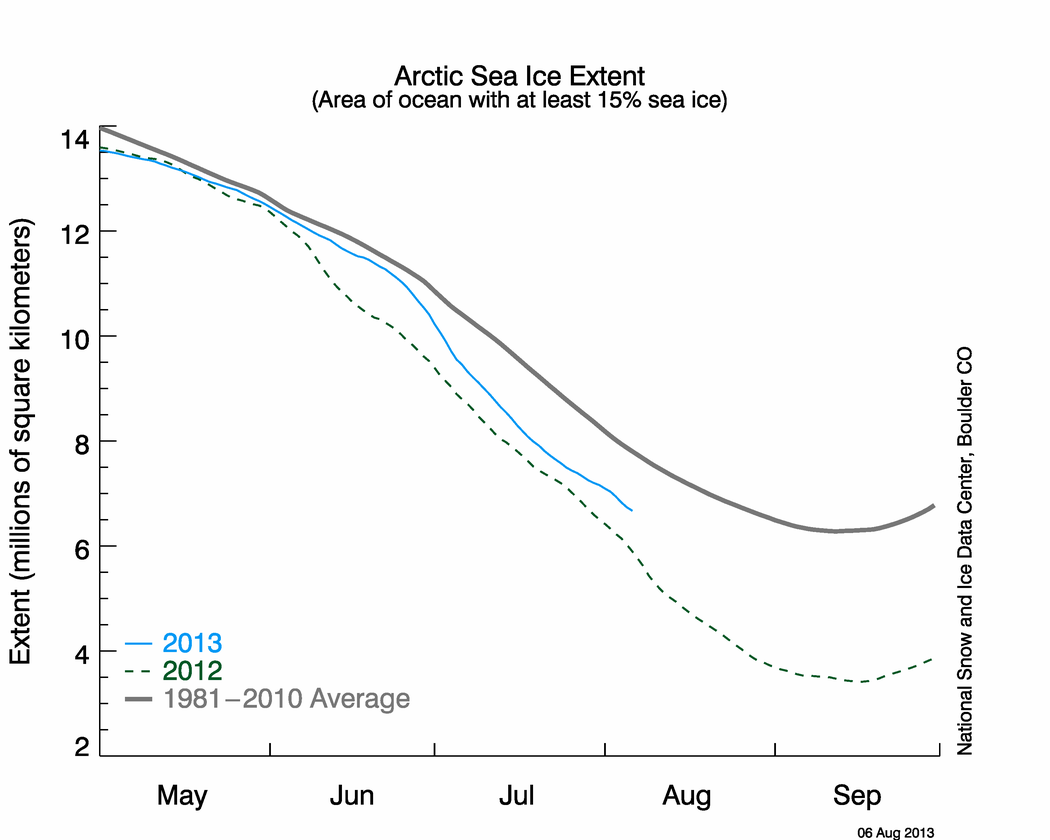
By contrast, DMI graphs show nearly one million km² more ice in 2010.


http://ocean.dmi.dk/arctic/icecover.uk.php
Here is the graph above zoomed:

The video below shows 2010 started to diverge in mid June, and 2007 started to diverge in early July. At this point we have a major discrepancy between the two.
DMI uses 30% concentration ice and NSIDC uses 15%, which affects absolute values . But the relative year over year numbers shouldn’t vary very much.
The image below shows NSIDC August 03, 2010 compared with the same date in 2007. Green areas have more ice in 2010. Red areas had more ice in 2007.

The NSIDC maps show 7.5% more ice in 2010 than 2007, but their graph shows less than 3% difference.
The period from August 3 through August 15 was when most of the ice compaction occurred during 2007. Unless something unexpected happens with winds in the Arctic, NSIDC graphs should start to diverge from 2007 – more like the DMI graph.
Discover more from Watts Up With That?
Subscribe to get the latest posts sent to your email.
Steve,
Excellent article! I also see that the AMSR-E Sea Ice Area shows little to no melt in the past week. It’s all due to the wind.
Hey Steve, you might want to do a report on this: It looks like Antarctic Sea Ice had the highest July Extent ever.
http://nsidc.org/data/seaice_index/images/s_plot_hires.png
Snowlover,
NSIDC apparently decided that their broken Arctic graph was more important than their record Antarctic graph for the August newsletter
I invite anyone to download the sea ice concentration data and do their own calculations, using a 15% or 30% threshold. For the near-real-time data used in NSIDC’s ice extent graphs go here: ftp://sidads.colorado.edu/pub/DATASETS/seaice/polar-stereo/nasateam/near-real-time/north/
you will also need to grab the pixel area per pixel file to do the extent calculations correctly since the data are not on an equal area grid (ftp://sidads.colorado.edu/pub/DATASETS/seaice/polar-stereo/tools/)
Nothing has changed in the NSIDC data processing stream. Differences in ice extent between institutions has to do with differences in data sources (AMSR-E vs SSM/I), different algorithms (NASA team, Bootstrap, Bristol, AES-York, Bremen, etc.) and differences in threholds used for defining the ice edge). All algorithms that use passive microwave brightness temperatures for sea ice concentration retrieval will have problems once melt water is on the surface of the ice (the main reason to use extent rather than ice area). The important thing is to be consistent with the processing method and satellite instrument when doing time-series analysis.
For more information on the sea ice processing done at NSIDC go here:
http://nsidc.org/arcticseaicenews/faq.html#image_data
stevengoddard says:
August 5, 2010 at 11:17 am
How could I forecast summer 2011, before seeing what happens in winter 2010-11?
————
You already have with statements like ” Arctic sea ice is in recovery.” And there’s all the work you’ve done with PIPS models and data analysis to show that ice is in recovery.
So I’d love to see you put some numbers on the table. Why stop with 2011?
What do you see as minimum ice extents for 2011, 20012 and the infamous 2013.
Some have said that the Arctic will be ice free in 2013, obviously they are idiots, but what do you predict for 2013?
If you can’t do more than 6 months in advance you’re just doing weather, not climate.
Julienne,
I don’t know what is going on, but there is no way that these two extents from 2010 and 2007 are within a couple of percent of each other – as the graph indicates.
http://nsidc.org/data/seaice_index/images/daily_images/N_daily_extent.png
http://nsidc.org/data/seaice_index/images/daily_images/N_record_extent.png
http://nsidc.org/images/arcticseaicenews/20100804_Figure2.png
Jeff P
Modelers consider climate forecasting to be in the range of “months to seasons.”
No one can accurately forecast what ice conditions will be like in the spring, because it depends on the weather between now and then.
Paul Birch ,
Of course conspiracies exist. That is not what the maxim is about. The point is that conspiracy theory thinking is not a rational way of examining the world. Your starting point should always, without fail, be that there has been an error made by someone. If you can demonstrate that there has been no error made by anyone, only then should you move into looking for conspiracies. Further, even at this point you should look for the smallest possible conspiracy. If your conspiracy starts to contain dozens of people, that is strong – although of course not conclusive – evidence that there is no such conspiracy.
As to leftists trying to convince everyone that conspiracies aren’t real, those of us on the left are, unfortunately, just as infected with anti-rational conspiracy thinking as those on the right – see 911 Truthers, for example.
Amino Acids in Meteorites,
The two measure differing concentrations of arctic ice, so they are almost bound to show different results.
Spector,
True – I term these ‘conspiracies of self-interest’. However, when such a conspiracy relies on fraud being independently committed – and that is what is being asserted by some people above – I think sceptism about the existence of such a conspiracy of self-interest is the most rational course.
timheyes says:
August 5, 2010 at 11:13 am
“Give us some numbers from the “theory”, for a reasonable period in the future, with error bars, then we will pay attention to GCMs. Until then, argue your case with science please not this post-modern/post-normal quackery which is doing untold damage to the climatological scientific reputation.”
________
This is the difference between what Steve does and what climate science is all about…which is essentially the weather vs climate issue. GCM’s are NOT MEANT to predict exact numbers because climate is about the longer term TRENDS, not how hot or cold it is right now or what the date in 2010 is that the shore fast sea ice broke away from Pt. Barrow.
Here’s the point: GCM’s are about trends because climate is about trends.
In this sense, climate is easier to predict than weather, because all it has to get right to be right is the trend, not the specifics, so long as it has the physical basis for forecasting those trends, which is of course the additional 40% CO2 that has been added to Earth’s atmosphere in the past few hundred years. Additionally, we’ve got consistent climate records going back hundreds of thousands of years, but of course no consistent weather data exists beyond a century or or two.
The most recent and dramatic failure of GCM’s is not that they missed the general downward trend of Arctic Sea ice over the past many decades, which they got right, but that they failed to get the severity of the slope correct. So it was not one of direction but of degree. Certainly unaccounted for feedback issues are the reason, as will exist with a system existing on the edge of chaos.
If somehow the Arctic sea ice reverses the downward trend over the next few years in some meaningful way (meaning heading back toward the 8 million sq. km. minimum), then I’ll reconsider my belief that the GCM’s are generally correct because a trend they have predicted (based on CO2 forcing) will not be happening.
David Gould
There are differences between :
NSIDC and DMI
NSIDC and JAXA
NSIDC maps and NSIDC graphs.
Blaming it on concentration thresholds isn’t going to fly.
Julienne Stroeve says:
August 5, 2010 at 3:05 pm
……
Nothing has changed in the NSIDC data processing stream. Differences in ice extent between institutions has to do with differences in data sources (AMSR-E vs SSM/I), different algorithms (NASA team, Bootstrap, Bristol, AES-York, Bremen, etc.) and differences in threholds used for defining the ice edge). All algorithms that use passive microwave brightness temperatures for sea ice concentration retrieval will have problems once melt water is on the surface of the ice (the main reason to use extent rather than ice area). The important thing is to be consistent with the processing method and satellite instrument when doing time-series analysis.”
I beg to differ Julienne. If the difference is in the incorrect measurement of melt water ponds on the surface as decreased ice and one model picks this up and records this as an anomaly and another model does not, then consistency in processing the data for a time series will not help.
What NDISC is potentially showing is an increase in melt ponds at this time of year. I agree this is not necessarily a good sign but its not the same as saying ice has been lost altogether in an area compared to previous years which is the impression their chart provides.
Incidentally, the JAXA number for 4/8 has been adjusted down by about 20,000 sq km making the second day in a row of downward adjustments. Given the averaging method they use this hints a slowdown in the melt. although I would prefer to see a few more days before drawing a conclusion.
I’m still with Steven on the minimum being in the 5.5 million sq km range. Although, we would need to match the 2006 ice loss for the remainder of the season though to acheive this. Looking at the ice loss on an area by area basis and then factoring in drift from the buoy measurements and DMI temps, I do think this is a possibility.
We need to watch the DMI temps very closely in the coming weeks. In 2006, the temps (north of 80N) dropped below zero quite early and you cant help but conclude this contributed to the slow late season melt in that year.
If we see the temps drop below zero in the coming week on the DMI chart then perhaps we’ll see a JAXA minimum over 5.5 million sq km. Given the 5.25 million sq km result in 2009 I would have to say this would support a recovering ice pack.
R. Gates
GCMs can’t model wind effectively – so there is no way that could have forecast the wind compaction which occurred in 2007.
David W. says:
“If we see the temps drop below zero in the coming week on the DMI chart then perhaps we’ll see a JAXA minimum over 5.5 million sq km. Given the 5.25 million sq km result in 2009 I would have to say this would support a recovering ice pack.”
____
Really? Is that your definition of a recovering ice pack? It seems the bar has been set quite low for some reason. So anything less than 5.25 million sq. km. you would say shows no recovery, right?
And BTW, the primary cause of melt right now is not air temps, but water temps, and they continue to run higher than normal throughout the Arctic from Greenland and the Barents Sea over to the Bering Sea, as they have for quite some time.
______
Steve Goddard said:
R. Gates,
GCMs can’t model wind effectively – so there is no way that could have forecast the wind compaction which occurred in 2007.
_____
I agree with that to some extent, but I don’t agree with your underlying assumption that changes in wind patterns might not be related changes in other atmospheric and ocean circulation patterns that could have as their root cause AGW. I must go back here to our discussion of the Arctic Dipole Anomaly and the TREND of increasing frequency of the what might soon be called a “former” anomaly. You certainly are aware of research being done to link the frequency of DA to atmospheric pressure changes that could be the resulting of global warming? I believe even Julienne, who is far more versed in this sort of thing has discussed that here.
stevengoddard,
They do explain the differences between DMI and NSIDC. So we can cross that one off the list straight away.
NSIDC and JAXA have *always* differed. They have different record minimums, for example. This is because they use different algorithms. So we can cross that one off the list.
Apparent NSIDC internal differences have already been explained by Walt. Nothing unusual has happened. So we can cross that one off the list.
And really, just one look at this graph:
http://nsidc.org/data/seaice_index/images/daily_images/N_stddev_timeseries.png
And this graph:
http://arctic.atmos.uiuc.edu/cryosphere/IMAGES/sea.ice.anomaly.timeseries.jpg
And this graph:
http://arctic.atmos.uiuc.edu/cryosphere/IMAGES/seaice.anomaly.arctic.png
And then to suggest in any way, that anything that we could get out of this single season would indicate that any type of “recovery” is indicated seems to me to be the epitome of reaching for a conclusion that simply isn’t indicated by the data. We haven’t had a positive Arctic Sea ice anomaly since 2004! How can a recovery be underway if the ice extent remains well below the longer term average???
R Gates,
Given that GCMs can’t model wind very well, you are going to have a very tough time making a case that the 2007 winds had anything to do with CO2.
David Gould
BTW – If we did correct for pixel aspect ratios – the discrepancy would become greater, not less.
As an example of the differences between JAXA and NSIDC, these are the averages for April, May, June and July. The top line is NSIDC, the bottom line JAXA.
14.69 13.1 10.87 8.39
13.84 12.00 10.03 7.90
The differences vary considerably, from .48 to 1.1. These are averages over the whole month, so daily differences are likely to show even greater variation.
stevengoddard,
If the sea ice map and the sea ice graph are generated from the same data, how can supposed discrepancies be real? Or are you saying that the two are created independently from separate data sets?
David Gould
I have no idea what the problem is. I am just an observer.
Walt Meier says:
August 4, 2010 at 8:31 pm
To begin, a thank you for monitoring and addressing the earlier posts up to 8/4. Alot of information designed to accurately identify what is actually occurring with arctic ice has come out. Would you care to update your assessment?
stevengoddard says:
August 5, 2010 at 5:49 pm
R Gates,
Given that GCMs can’t model wind very well, you are going to have a very tough time making a case that the 2007 winds had anything to do with CO2.
________
Fortunately (or perhaps unfortunately) it’s not my job to find the evidence that shows a link between the 40% rise in CO2 over the past few centuries and changes in wind patterns and atmospheric presssures in the Arctic. But undoubtedly at least a few dedicated researchers are looking at this very thing. GCM’s will only tell us that the pot will eventually boil (i.e. the Arctic will be ice free this century in the summertime), but they can’t tell us the exact path we’ll be taking to get their own what kind of feedbacks we’ll meet along the way…
R. Gates says:
August 5, 2010 at 4:38 pm
“…Here’s the point: GCM’s are about trends because climate is about trends….”
Reply: First off, I must applaud your tenacity. Given your statement above, would you say that the GCM’s are linearly trending or are they cyclically trending? A simple question, is it not? Because historical climate has been cyclical. Is it your belief that anthropogenic CO2 forcing is sufficent to disrupt the cyclical nature of climate? I await your well-reasoned response.
Thank you,
Ralph Dwyer