By Steve Goddard
Over the last few weeks I have been tracking what is becoming a large discrepancy between various Arctic sea ice measurements. NSIDC graphs show almost no difference between 2010 and 2007.

http://nsidc.org/data/seaice_index/images/daily_images/N_timeseries.png
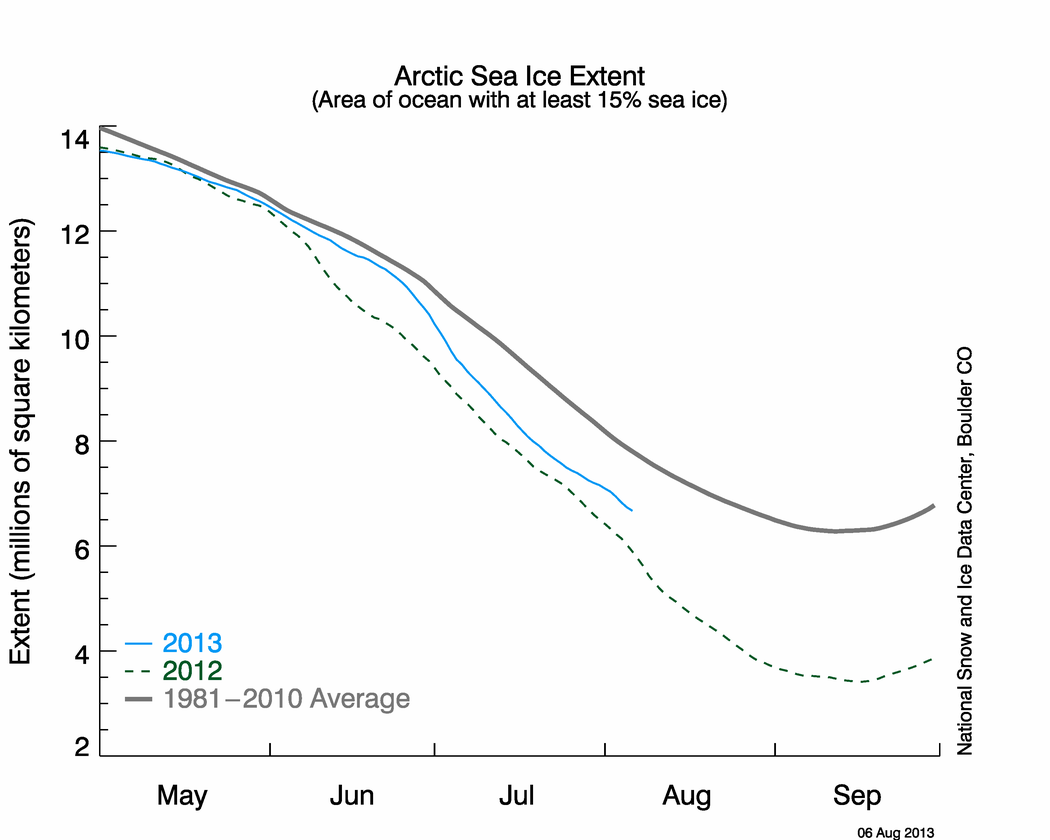
By contrast, DMI graphs show nearly one million km² more ice in 2010.


http://ocean.dmi.dk/arctic/icecover.uk.php
Here is the graph above zoomed:

The video below shows 2010 started to diverge in mid June, and 2007 started to diverge in early July. At this point we have a major discrepancy between the two.
DMI uses 30% concentration ice and NSIDC uses 15%, which affects absolute values . But the relative year over year numbers shouldn’t vary very much.
The image below shows NSIDC August 03, 2010 compared with the same date in 2007. Green areas have more ice in 2010. Red areas had more ice in 2007.

The NSIDC maps show 7.5% more ice in 2010 than 2007, but their graph shows less than 3% difference.
The period from August 3 through August 15 was when most of the ice compaction occurred during 2007. Unless something unexpected happens with winds in the Arctic, NSIDC graphs should start to diverge from 2007 – more like the DMI graph.
stevengoddard says:
August 5, 2010 at 7:06 am
Jeff P
So far, my forecast has been too conservative.
JAXA shows ice extent well above my prediction for the date. Odds are at this point that my 5.5 million forecast is too low.
————
Hmmm….current JAXA and NSIDC graphs show 2010 heading right toward that gap between the 2008 and 2007 lows…sort of exactly where I forecast we’d end up last March. You think the extent loss will only be 1 million sq. or less during the next 4-5 weeks of solid melt? Even with all the higher than normal water temps in the region? Interesting prediction…
Steven
could you remind us your prediction for the year minimum? Didn’t you state it would fall close to 2006 and be higher than the 3 previous years?
R. Gates says:
August 4, 2010 at 10:27 pm
…
http://psc.apl.washington.edu/zhang/Pubs/Zhang_Antarctic_20-11-2515.pdf
Thanks a ton for this link. To a skeptic who agrees with:
1) the earth is getting warmer, and
2) CO2 contributes,
but not with:
3) this is a problem that needs fixing,
this paper is powerful. It assumes (correctly) 1, while making a mild argument against 3. It doesn’t project that there’s no problem — in fact, it notes major uncertainty — but it details a mechanism by which sea level isn’t skyrocketing now and may not later. Since sea level rise is one of the most prominent “catastrophic” effects of CAGW, this matters.
from NSIDC ~ 75 percent down the Page, is OPEN about the Differences:
[My] “Exec Summary”: AMSR-E / JAXA updated their algorithm so it is More accurate — but — AMSR-E comparisons with previous years are INVALID now ! Other than that, every method is just different –except in that ALL show a downward trend.
— Note: I would caveat that HALF the “trend” is 2007. … MOST of their “trend” is a few UNUSUAL events.
— (NSIDC = uses Passive MW with NASA mark I Algorithm)
Quotes: … “Gloerson and Campbell (1991) estimate that ice concentration retrievals are accurate to within five to nine percent ” … ” Based on comparisons with analyses of synthetic aperture radar data, passive microwave overestimates open water by three to five times in winter (Kwok 2002). The winter coverage of open water is only about 0.3 percent.” [ie x5 reduces Ice area 1.2 percent = no big deal: real meat follows:]
“A study based on digital versions of the U.S. National Ice Center’s (NIC) charts covering the Arctic every week from 1972-1994 (Partington et al. 2003), shows that NIC charts consistently report about four percent more ice per unit area than passive microwave retrievals from the NASA Team algorithm. This holds for November through May. Beginning in June, the difference rises to about 23 percent, and falls off gradually over the summer and into fall freeze-up. The difference after freeze-up, which begins in September over most of the Arctic, is probably due to the insensitivity of the passive microwave algorithm to thin ice. Both chart data and passive microwave data show a negative trend in integrated arctic-wide concentration over the period 1979-1994. The difference between the passive microwave and chart trends is statistically significant only in the summer, where it is about two percent per decade steeper in passive microwave data.
A comparison of ice-covered area from the NASA Team algorithm with 18 years of Canadian Ice Service charts showed that passive microwave data markedly underestimate ice area by 30 to 40 percent during spring melt and fall freeze-up, for the Hudson Bay and East Coast regions. There is considerable scatter in the differences rather than a consistent pattern (Agnew and Howell 2002a) and (Agnew and Howell 2002b). The difference between chart and passive microwave-derived ice areas is greater for the Canadian charts than the U.S. charts. This is likely a reflection of the fact that the U.S. National Ice Center uses passive microwave when other data are not available, which is often the case for the central Arctic and other remote areas, while the Canadian Ice Service only rarely uses passive microwave data, relying instead on airborne and satellite radar, satellite optical, and visual observations for charts of the Canadian Arctic. These methods detect thin ice, lower concentrations of ice, and flooded ice much better than passive microwave data allows (personal communication, J. Falkingham, Chief of Operations, Canadian Ice Service, December 2002).
Spot checks of the ice edge position using a 15 percent concentration cutoff against NIC ice charts show that when there is a broad, diffuse ice edge, the NRTSI and Standard Team products sometimes do not detect ice where the concentration can be as high as 60 percent. When the ice edge is more compact, the 15 percent concentration cutoff reflects its location fairly well. The large footprint of the 19 GHz channel means that a compact ice edge is smeared out in passive microwave imagery.
A study comparing passive microwave sea ice concentration data with approximately 1 km resolution imagery from the Advanced Very High Resolution Radiometer (Meier 2005) focuses on the ice edge. Four SSM/I algorithms are used. The work illustrates how algorithms often underestimate concentration. The NASA Team underestimates concentration by about 10 percent on average, and by much more in some circumstances.
Newer algorithms were developed that perform better than the NASA Team algorithm. An enhanced version of the NASA Team algorithm, NT2, incorporates the SSM/I 85 GHz channel and applies a forward-radiative transfer model to correct for weather effects that are exacerbated by use of the 85 GHz channel. This algorithm is the standard algorithm for arctic sea ice concentration retrievals with the AMSR-E instrument (Markus and Dokken 2002).
We have considered using one of the newer algorithms for the Sea Ice Index, but this would require research and reprocessing in order to ensure that the record is consistent over the entire time series. The SMMR instrument did not include a high frequency channel like that used in newer SSM/I and AMSR-E sea ice algorithms.”
PS: The Canadian sounds best – because, like PIOMAS, they add Every Ship & plane’s reports & pics. This produces long waits for updates.
Can anyone find a Canadian data site ? I ran into their service’s site once, only got a weekly map — I’ll try to re-find it.
PSS: THE best map for us is the ICE-AGE map http://nsidc.org/images/arcticseaicenews/20100804_Figure4.png
Maslanik only produces about 1 a month though.
or, again: http://iabp.apl.washington.edu/maps_daily_nsidcice.html
…. note how the second, Bouy Map background shows a big area off Alaska of mixed Ice & water where there is a GAP in the Ice opposite Alaska in the first map. Also the Buoy map clearly shows the “bar” of thick ice crossing the Arctic Canada-to-Russia well “west” of the Pole — such as I talked about in the censored part of my July Sea Ice Outlook. Also seeable in TOPAZ http://topaz.nersc.no/topazVisual/matlab_static_image.php?action=NA_ARC_NWA_Function&file_prefix=ARC&match_date=20100803&depth=0005&variable_name=hice … wish I knew what “hice” was … try substituting 2009 : WOW — so different !! more ice by Volume is in that hugely thick area up against Canada & Greenland than in the whole 2010 map ! BUT the half of the Arctic (Russian side) where 2007,8, & 2009 lost most of their area – – it was like thin LACE then & is MUCH thicker this year.
Believe me, this is in Brazil. Yesterday
http://www.metsul.com/__editor/filemanager/files/2010/a18.JPG
I wish I knew a way to make these a side by side comparison but I played on the JAXA site to get these images. The first one is from 8/4/2007:
http://www.ijis.iarc.uaf.edu/cgi-bin/seaice-monitor.cgi?lang=e
And this one is from 8/4/2010:
http://www.ijis.iarc.uaf.edu/cgi-bin/seaice-monitor.cgi?lang=e
And from what I can tell is that there is a lot more ice still in 2010 then there was in 2007. So I’m not sure how NSIDC is getting their graph which makes it look like the amount of ice is similiar to what it was in 2007.
I hate to give an ego surge to R Gates by mentioning the name, but this is hardly the first time that arctic sea ice has had long periods of fluctuation. At least twice in the 20th century there was low arctic sea ice to the extent that the “northwest passage” was open – even for wooden ships. How have the GCM’s portray these transformations in the past? They haven’t and they can’t. They are stuck in extending a trend that experience has shown is quite variable and the models can’t portray these swings. They are imperfect to the extent that I continue to be amazed that anyone with any exposure to awareness of the periodic oscillation between glaciation and inter-glacial periods would give them any credence at all.
R. Gates: August 5, 2010 at 7:12 am
Show me the evidence that runs contrary to the GCM’s specifically about the slow decline in Arctic summer sea ice, leading to an ice free Arctic sometime this century.
Show me the evidence that the Arctic is doing anything except what the Arctic has been doing for the past few million years — cooling, then warming, then cooling, then warming — and it was much warmer only tens of thousands of years ago.
The Arctic sea ice has been showing a long term decline and permafrost is warming and melting in the arctic regions.
Long-term? You mean since 1979? And permafrost thaws in the summer — that’s the reason the people up there can find mammoths that were frozen into it 45,000 years years ago (when it was warm enough for mammoths to survive through the winter, btw, because they *couldn’t survive there today).
The biggest deficit of the GCM’s is that they didn’t predict the acceleration in the melt that began a few years back, having obviously not accounted for some positive feedback.
It wasn’t a melt, and it wasn’t some imaginary feedback — it was a wind event which increased compaction coupled with the collapse of an ice bridge in the Framm which allowed more sea ice through the strait and into the Atlantic.
So in general, the GCM’s have pretty much got it right, and the science get’s better and more robust ocean-atmosphere linkages can be added to the models.
In general, the GCMs are models and it appears they’ve gotten it wrong, because they can’t replicate the observations.
As of today, NSIDC maps show a 10% increase over 2007, but their graph shows less than 3%.
R. Gates
And you also thought that the ice was tanking in June, based on the same methodology of extrapolating the graphs. My analysis considers a lot more variables, which is why I have been able to provide very precise predictions about trends and dates.
stevengoddard says:
August 5, 2010 at 4:15 am
toho
You are correct. Pixels further from the pole represent larger areas in a polar projection, so any correction would increase the discrepancy. Walt has been alerted to this issue in the past, but seems to have forgotten it.
Quid pro quo…. Et tu Bruté? 😉
When you have a mission, it is hard to look in the areas where you do not “find” supportive evidence. When you do find potentially divergent information, generally it is discounted as being an aberration or an artifact etc. Scientific research is always subject to human interpretation, especially in its formative stages.
Being unbiased and impartial is not a human characteristic but can be cultivated with practice. This forum is the battleground, not for supremacy but for tolerance and understanding. There is no fraud but there is definitely conviction.
Anyone know if there are MODIS image archives, to compare images for the last few years?
BTW, can see the ice east of Barrow well today: http://ice-map.appspot.com/
Well, I said my next checkpoint was Aug. 5, and here we are. I think it’s reasonably clear my 6.0-6.2M prediction from late March will miss low. My bad for letting Anthony’s sage/seer/soothsayer taunting with an early prediction of his own taunt me into making a prediction that early. I won’t make that mistake again. Still waiting for minimum to make a full analysis. 5.5M or higher still lets me “beat the field” (median of the establishment-approved prognosticators).
As I suggested three weeks ago, we’ve got a bunch-up at August 5th again, tho clearly 2010 is on the low side of it. But not enough to be overly worried about –just enough to take my original prediction out of the running.
The next three weeks should be where the increase in 2nd/3rd year ice begins to make itself visibly felt in the extent trend and 2010 turns decisively (and positively) away from 2008.
See you Sept 1.
Sorry, more accurate to say my guess will have been high, not that it will “miss low”. I was being me-centric there and thinking of the extent missing my guess, instead of the other way around.
stevengoddard says:
August 5, 2010 at 8:38 am
R. Gates
And you also thought that the ice was tanking in June, based on the same methodology of extrapolating the graphs. My analysis considers a lot more variables, which is why I have been able to provide very precise predictions about trends and dates…
______
Steve, the Arctic Sea ice WAS “tanking” in June, as it saw the largest decrease during the month ever.
But really, let’s talk climate here, and stop talking about weather. When is your proposed seasonal recovery of Arctic Sea ice set to commence, and what will the mechanism for it? If it was all “southerly winds” that have caused this decline…when are these “southerly winds” set to reverse? Of course I disagree with this simplistic explanation, as I think these “southerly winds” are Arctic Dipole Anomaly related winds and have been increasing since around 2000, as the DA is becoming less of an anomaly and more a frequent player on the Arctic weather scene and as it becomes a more frequent event it moves from weather to climate.
R Gates,
Look for a significant increase in MYI in 2011.
Reply to Dave Wendt
August 5, 2010 at 2:36 am:
Thanks for taking the time for such a thorough response. I’ve read much of this before, and it is at least one of the reasons that I’m still partially skeptical about AGW and it’s relationship to Arctic Sea ice loss. Though I’m not a scientist, my educated guess is that the dynamics of what is truly happening with the Arctic is more complicated than any models are able to currently forecast, and it’s not just one simple mechanism, like the gyre, or winds, or what have you, but a complicated relationship of physics, with feedbacks, both positive and negative, that aren’t well understood, and because we are dealing with a complex system existing at the edge of chaos, probably we’re not able to ever model.
I’ve long said the next few years will be “make or break” for me, related to my general belief in the validity of the AGW hypothesis, and specifically I use the Arctic sea ice as my test case. If we don’t see a new summertime low Arctic extent by 2015 then I may pull back my belief to a 50/50 level from the 75/25 split I’m at now. Personally, with the solar max in 2013 and a likely new El Nino in 2012-2013, then there will certainly be enough global warmth to push down the summer extent, and I’m guessing we will and it will fall to around 2.5 million sq. km. in this time frame.
R. Gates–
Look at JAXA for Aug 5th-Sep 10 for 2008 vs 2009. What was the mechanism for the difference in results there when at the starting point (Aug 5th) there were practically identical?
Same mechanism as will happen this year –increase in multi-year ice.
I see NSIDC did their August update –they seem to be sitting on 5.0-5.27 as their prediction (not quite stated that way, but inferred, with wiggle room to be lower than that).
stevengoddard says:
August 5, 2010 at 10:26 am
R Gates,
Look for a significant increase in MYI in 2011.
———
Steve,
Why wait?
How about a prediction of Arctic sea ice minimum for 2011 from you today.
Since you assert that sea ice is recovering perhaps you’d like to put a marker at 6 million K^2. Or maybe 6.5?
Surely if sea ice is recovering your prediction for next year should be higher than the 5.5 you predicted for this year.
R. Gates says:
August 4, 2010 at 10:27 pm
James Allison says:
August 4, 2010 at 5:52 pm
R. Gates says:
August 4, 2010 at 4:30 pm
“I believe the onus is on you …
[self snip]
James, I don’t have any “onus on me” to prove anything…”
I’m sorry to go back to this again in this thread but I cannot let it slide, Mr Gates. You claim that you do not need to prove anything because the GCMs tell you that arctic sea-ice will decrease (I paraphrase). This is conflation of science with the strange post-modern/post-normal “science” with which the climate debate is riddled.
The GCMs are “THEORY”. They “predict” that arctic sea-ice will “decrease”. Well woopee-do. They have a 50% chance of being right. Now if they predicted the extent of sea-ice with error bars for next month/quarter/year then I think we could accept that GCMs model sea-ice reasonably well and they might have some value over some timeframe.
The above interesting discussion on the minutiae of sea-ice measurement and comparison of data sets is very informative and is a discussion about OBSERVATION (EXPERIMENTAL OBSERVATION if you will). You cannot claim that you have nothing to prove in the discussion because your “theoretical” GUESS (with 50% probablity of being right) happens to be correct.
Give us some numbers from the “theory”, for a reasonable period in the future, with error bars, then we will pay attention to GCMs. Until then, argue your case with science please not this post-modern/post-normal quackery which is doing untold damage to the climatological scientific reputation.
R Gates,
How could I forecast summer 2011, before seeing what happens in winter 2010-11?
Sorry, last message was directed at Jeff P
RE: Jimbo says: (August 4, 2010 at 4:20 pm) “Joe Bastardi said around mid July 2010: ‘… The recovery of the northern ice caps will become more obvious in a two-steps-up, one-step-back fashion, but the Southern Hemisphere ice will retreat back to near normal. Overall global ice is right on top of normal and has had no change in the past 30 years. ‘”
This sounds very much like we are only seeing the result of an annual competition between the Arctic and the Antarctic regions for a relatively fixed allotment of total global sea ice extent.
R. Gates says:
August 5, 2010 at 10:26 am
Reply to Dave Wendt
August 5, 2010 at 2:36 am:
Thanks for taking the time for such a thorough response.
You’re very welcome, and I mean that not just as the conventional response to an expression of gratitude. To me what has always made Anthony’s site an attractive place to spend time is the presence of a significant coterie of commenters who are are willing and able to articulate arguments that are against the grain of the majority. It’s a sad commentary on the present state of the discussion that WUWT is such a rarity in that regard. I respect the fact that, at the present state of our “knowledge”, there are many points of view that are least arguable, even AGW, though to my mind CAGW, not so much.
You and those other commenters who are willing to come here and honestly advocate for your positions do us all a service by preventing the skeptical argument from degenerating to the levels of highly unfounded certitude that dominate on so many sites on both sides of this debate. To my mind no one in the this kerfuffle is completely “right” about what is occurring with our climate, myself in particular, and unless we are all willing to engage each other with honesty and mutual respect, the prospect of a “right” understanding of the climate arising is incredibly small.
There are those among the denizens here who seem to have a negative attitude toward those argue for the AGW position, but for myself, I am appreciative and am grateful for your contributions. As Grandpa always said, “you can’t sharpen your knife on a stick of warm butter.”