By Steve Goddard
Over the last few weeks I have been tracking what is becoming a large discrepancy between various Arctic sea ice measurements. NSIDC graphs show almost no difference between 2010 and 2007.

http://nsidc.org/data/seaice_index/images/daily_images/N_timeseries.png
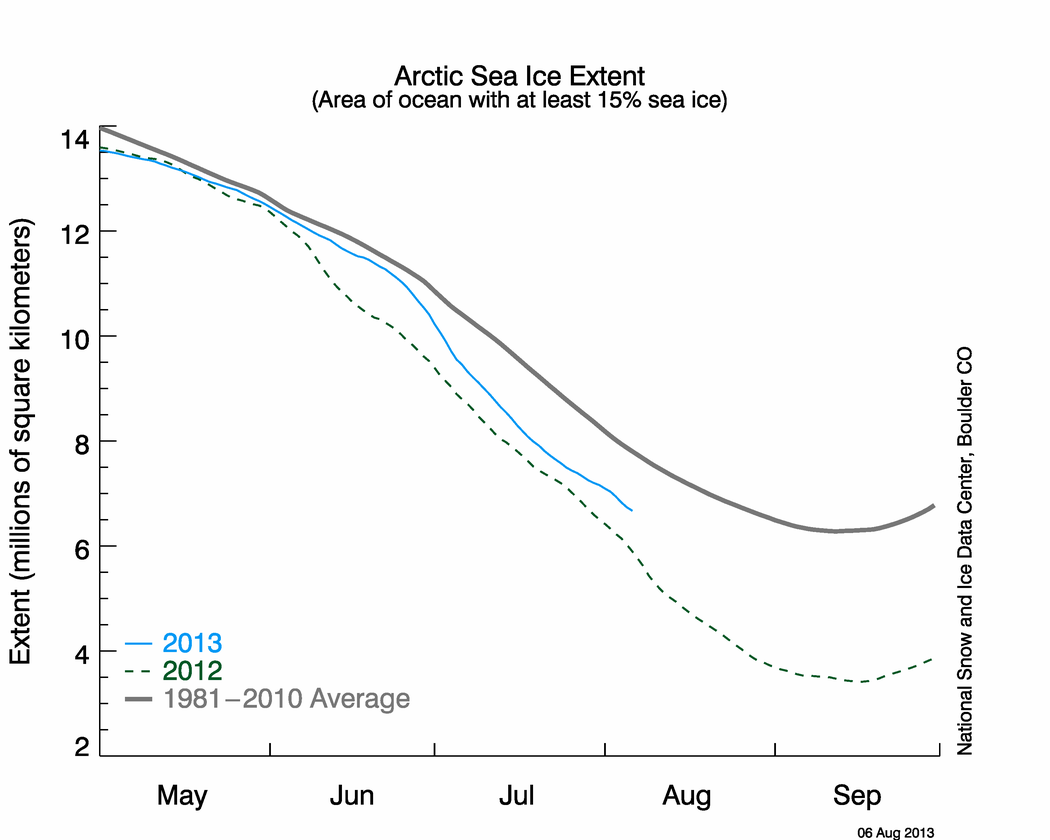
By contrast, DMI graphs show nearly one million km² more ice in 2010.


http://ocean.dmi.dk/arctic/icecover.uk.php
Here is the graph above zoomed:

The video below shows 2010 started to diverge in mid June, and 2007 started to diverge in early July. At this point we have a major discrepancy between the two.
DMI uses 30% concentration ice and NSIDC uses 15%, which affects absolute values . But the relative year over year numbers shouldn’t vary very much.
The image below shows NSIDC August 03, 2010 compared with the same date in 2007. Green areas have more ice in 2010. Red areas had more ice in 2007.

The NSIDC maps show 7.5% more ice in 2010 than 2007, but their graph shows less than 3% difference.
The period from August 3 through August 15 was when most of the ice compaction occurred during 2007. Unless something unexpected happens with winds in the Arctic, NSIDC graphs should start to diverge from 2007 – more like the DMI graph.
For anyone trying to understand cycles I very much recommend Joe Bastardi’s video on sea ice. He clearly shows the connection the Pacific decadal oscillation, which as it has reverted you can see the ice coming back.
I’m surprised the PDO has been dismissed by some people as not being the cause, when it is clearly in synch. with the ice recovery.
This has been posited by Don Easterbrook, so I would suggest anyone who wants a scientific viewpoint to visit his website, i.e. that a delay before the recovery kicks in is to be expected. This does fit in with historical observations of the past.
Dinostratus has a good suggestion as do EthicallyCivil (way up in beginning with 2nd posting) in explaining the divergence. Walt Meier comes across with valid points (as usual) as does John F. Hultquist with regards to the… “fun” theories.
Hmmm….DMI’s site has gone back to showing Tuesday’s ice graphic. I saw Wednesday’s yesterday and would normally be looking at today’s at this time of the morning in the UK (0945 BST).
WUWT?
R. Gates says:
August 4, 2010 at 4:30 pm
1) By what physical known mechanism will this reversal take place (i.e. what natural cycle will be swinging back the other way) GCM’s are predicting an eventual ice free summer Arctic, so what do the skeptics know that multiple GCM’s have left out. I’m sure they’d like to know this secret information.
2) What is the anticipated year that we will see this uptrend begin?
3) Will this be a “spiral” up, or should we anticipate a bee-line back to 8 million sq. km. summer minimums?
I’m having an attack of insomnia so I thought I’d give this a shot.
1] Rigor and Wallace 2004 suggests that a prime influence in the decline in ice age and thickness in the Arctic was a paradigm shift in the state of the Beaufort Gyre and the TransPolar Drift that occurred at the end of the Eighties. This the commentary they included for the sea ice animation they included with the paper
This animation of the age of sea ice shows:
1.) A large Beaufort Gyre which covers most of the Arctic Ocean during the 1980s, and a transpolar drift stream shifted towards the Eurasian Arctic. Older, thicker sea ice (white ice) covers about 80% of the Arctic Ocean up to 1988. The date is shown in the upper left corner.
2.) With the step to high-AO conditions in 1989, the Beaufort Gyre shrinks and is confined to the corner between Alaska and Canada. The Transpolar Drift Stream now sweeps across most of the Arctic Ocean, carrying most of the older, thicker sea ice out of the Arctic Ocean through Fram Strait (lower right). By 1990, only about 30% of the Arctic Ocean is covered by older thicker sea ice.
3.) During the high-AO years that follow (1991 and on), this younger thinner sea ice is shown to recirculated back to the Alaskan coast where extensive open water has been observed during summer.
The age of sea ice drifting towards the coast explains over 50% of the variance in summer sea ice extent (compared to less than 15% of the variance explained by the seasonal redistribution of sea ice, and advection of heat by summer winds).
This is an updated version of that animation created by Rigor
R&W suggest that recirculation of older sea ice from along the Canadian Archipelago, where it now ends up at summer minimum, back toward the Alaskan coast is a strong determinant factor in the continuing decline of ice age and thickness.
If you watch the animation a few times, the drift pattern of the buoys illustrates how the smaller radius BG circulates the ice from along the coast and delivers it almost tangential to the TPD which is running in close alignment to the Prime Meridian. Once in the TPD the ice is expedited out through the Fram.
Based on this information I would suggest that there will not be strong rebound in the summer minimum until the BG returns to a pattern close to what prevailed in the Eighties.
From what I’ve seen the BG is not really well understood and there seem to be a number of factors suggested as influencing it with no clear winner, but most sharing the characteristic of not being controlled by or corollated with anthropogenic CO2.
2]When then might we expect to see this change back to the old circulation pattern? Like most things in this argument that is a little hard to predict with any confidence, but I’ve been watching the sea ice drift maps at DMI for a couple of years and, to my eye at least, there seemed to some indications over the last freeze up that the BG was moving toward the larger radius state;
http://ocean.dmi.dk/arctic/icedrift/index.uk.php
Unfortunately they don’t monitor the ice drift through the melt season and those sites that do aren’t entirely comparable, so it will take some time to determine if that pattern shift is real and will be able to persist. Reports of the ice in the Eighties suggested that the old ice in the western Arctic was a decade or more in age, so even if the change is semi-permanent, it will take that long or probably much longer to get back to those conditions.
In regard to the GCMs most models of the Arctic sea ice I’ve seen have indicated a long term decline, but almost none have been even remotely close to the observed
data. As I have pointed out on a number of occasions, we tend to look with more fondness on errors that are in a directions that reinforce our own prejudices, but a model that misses big, even in a direction we like, is still wrong and not to be trusted.
As you know, in late summer when most of the ice is north of 75N, the pixels are reasonably close to equal area.
By my calculation a pixel at 75N will have cos(15°), which is 96.6 % of the size of one at 90°. So it ain’t that which is causing most of the discrepancy.
BTW: every time I hear the “the AGW scientists are really smart” defence for a discrepancy, I tend to remind myself of the track record of really smart economists, such as the Nobel prizewinners at Long Term Capital Management. Which does not inspire confidence!
Walt Meier says:
August 4, 2010 at 8:31 pm
“4. Our sea ice maps are not an equal area projection. Thus one cannot compare extents by counting grid cells – this is probably the reason for the 7.5% vs. 3% discrepancy. Steve has been alerted to this issue in the past, but seems to have forgotten it.”
Well, not correcting for projection would have the opposite effect, would it not? It would tend to decrease the apparent disrepancy (very slightly), not increase it.
Excerpt from: R. Gates on August 4, 2010 at 10:27 pm
Far smarter people than you get paid to make up Global Climate Models that forecast the slow decline of Arctic sea ice due to Anthropogenic Global Warming.
Then subsequently declines in Arctic sea ice get cited as evidence of Anthropogenic Global Warming, since obviously the model was correct as declines were noted.
Meanwhile evidence that runs contrary to the models is routinely discounted and discredited as obviously in error since the models have shown themselves to be correct, namely a lack of statistically-significant warming, Arctic sea ice that is not continually declining every year, evidence showing previous declines in Arctic sea ice thus any current one is not unprecedented, etc, etc.
And that’s not even getting into why a Global Climate Model would specifically have to consider any Global Warming to be Anthropogenic in origin to forecast a decline in Arctic sea ice.
Obviously these people must be very smart indeed, since they are able to keep getting paid for making up this stuff…
The lower sea ice concentration is the more the extent algorithms differ.
Nicely we can proof concentration IS low.
http://ice-map.appspot.com/?map=Arc&sat=ter&lvl=7&lat=83&lon=171&yir=2010&day=216
This is not so much a conspiracy theory as a bubble. Scientific funding appears to be proportional to the scale of the crisis predicted. Institutions inflate to fill the budget and then are no longer able to question the science. Scientists who do question it are unlikely to be viewed favourably by their employers – because the end result of them being correct is a cut in budget. A lot of the “science” you see on this stuff looks like it was written by a re-titled environmental activist. Cap and trade has made vested interests of banks (trading profits) and industrial groups that make a fat margin on this stuff. When was the last time you saw an environmental policy analysed on cost-effectiveness in the MSM? And this is supposed to be the most expensive problem mankind has ever faced.
Bill Illis says
…This is not a climate model result, it just paleoclimate history. It should be outlined in more detail why this occurs however. Local Albedo effects are certainly the major part of the explanation however (how cold was the Arctic during the ice ages for example – 90% of the sunlight was just reflected off to space so there was no warming affect from the Sun at all during this period). GHGs might also have a bigger net effect at high latitudes is another. It could be also be that the Tropics do not change much at all (the Sun runs the show here) so global temperature changes are more a reflection of high latitude temperature changes than anything else (the math just means high latitudes need to increase/decline 2.5 for 1 to change the global average by 1).
The problem with this scenario is that there is no way it can end. Once the poles have been frozen and the CO2 has been absorbed by the cold oceans the two strongest warming effects according to AGW theory are at their minimum. So why, at this point, do we always get the fastest rate of temperature increase at any time in the paleo records? If Gates is right, there is no mechanism for recovery. The reality is that there must be a mechanism and it must be powerful enough to dwarf any greenhouse and albedo effect. The fact that no one knows what this mechanism is demonstrates how incomplete climate models are.
David Gould says:
August 4, 2010 at 8:40 pm
“There is a simple maxim: if you have to choose between explanations for something and one of them is conspiracy and the other is error, you should be choosing error every time. Conspiracy theory thinking is anti-reason.”
Your maxim is drivel. The supposedly rational “never infer malice over incompetence” notion is one widely promoted by the malicious – especially socialists, greens, authoritarian “liberals”, and other ideologues. It’s an effective propaganda cover for deliberate dishonesty. Sometimes the simplest explanation for something is that it’s a lie. If a burglar claims the door fell open when he brushed into it, he’s probably not telling the truth. If a second-hand car dealer tells you that the rust is nothing to worry about, he’s not being ignorant or incompetent; he’s trying to con you into buying the car at as inflated a price as he can get away with. If a politican or political spokesman tells you something that seems erroneous, he’s probably promulgating a porky; that’s his job. Even if it seems correct, the chances are high that you’re being subtly deceived. That’s how they get where they are – not by being stupid but by being good at lying. They can even lie to themselves, pretending that the “end justified the means”and that their selfish interests naturally align with the common good; they may even have “good intentions”, of the sort that pave the road to Hell. But they’re not thick. They’re scumbags, not idiots. Their errors are culpable errors.
As for conspiracies, dishonest people engage in them all the time. Refusal to accept the existence of conspiracies is neither reasonable nor prudent. There are millions of conspiracies, some with similar goals, some with differing goals, some with rivalrous goals. Whenever two or more people cooperate in deceiving another, there is a conspiracy. It doesn’t take a secret society of Illuminati. Conspiracy is the ground state of mankind.
toho
You are correct. Pixels further from the pole represent larger areas in a polar projection, so any correction would increase the discrepancy. Walt has been alerted to this issue in the past, but seems to have forgotten it.
Its all so 2008
http://www.theregister.co.uk/2008/08/15/goddard_arctic_ice_mystery/
I’ll throw out my cautionary remark once again. We hear from Gates, etc. that the Arctic melt is caused by AGW. But, it could very well be the other way around. As Dave Wendt pointed out above the extent may very well be related to the AO and other oscillations. If that is the driving force then we should see a warmer Arctic without any relationship to AGW. The warmer Arctic would slow down the transfer of heat from lower latitudes and could result in some overall warming of the planet.
The point is we really don’t know what is the cause and what is the effect.
Günther Kirschbaum says:
August 4, 2010 at 3:56 pm
“A chunk of old ice has broken away from the main pack and come to rest along the north coast of Alaska, east of Point Barrow, where it has begun to melt in the warm shallow shelf waters.”
Hmmmmmm……makes me think…
All we need is to stop sending out these ice-breakers filled up with AGW researchers , and all will be normal?
David Gould says:
August 4, 2010 at 8:40 pm
And in this case the error is being made by those who are claiming that there is a discrepancy. NSIDC and DMI measure two different things .
Arctic ice and Arctic ice?
Some of you suggest we are looking at conspiracies, but in actuality I’m sure none of us really want a conspiracy when it comes to tracking and watching what the Arctic ice is doing. Besides noticing this discrepency that Steve finally brought to light in this post, because it became even more pronounced in this mornings NSIDC sea ice update. I’ve been waiting and hoping that igloo.atmos.uiuc.edu would get their sea ice comparison page up and working again. I have been using that page for over three years and it seems weird that soon after WUWT that put a link to that page on it’s new Sea Ice Monitering page it went down.
I hate thinking it’s a way to keep us from easily comparing 2007 levels to what’s happening in 2010, but to me it’s a bit suspicious.
3%, 7.5%?
Having Mark Surreze chosen to head this government agency is probably a good indication why algorithms are different. It appears to be a system wide problem.
dorlomin
In 2008, the problem turned out to be with the UIUC maps, rather than with NSIDC.
This time, it looks like a problem is with the NSIDC graph.
It appears to me that the DMI graph has not changed in about 60 hours. Is that correct?
The DMI graph is about 44 pixels wide per month, and should move to the right by about 1.5 pixels per day. But zero pixel upgrades for over two days.
ClimateSanity
I was wondering what the narrative would be if Steve’s prediction of 5.5 million K^2 turned out to be wrong.
The narrative appears to be taking shape: “I wasn’t wrong… the data is wrong!!!”
I just didn’t Steve’s confidence in his prediction to melt so soon.
tommoriarty
Yes, DMI has stopped updating their graphs. Everyone in Europe goes in vacation in August.
RE David Gould: (August 4, 2010 at 8:40 pm) “There is a simple maxim: if you have to choose between explanations for something and one of them is conspiracy and the other is error, you should be choosing error every time.”
This is all quite true, however we should always be aware that what constitutes error may be in the eye of the beholder. The action of a common world view on personal perception may give those who do not share that view the appearance of a conspiracy even if no such overt plot exists.
Jeff P
So far, my forecast has been too conservative.
JAXA shows ice extent well above my prediction for the date. Odds are at this point that my 5.5 million forecast is too low.
kadaka (KD Knoebel) says:
August 5, 2010 at 3:10 am
Excerpt from: R. Gates on August 4, 2010 at 10:27 pm
I did not make up the GCM’s that forcast the slow decline of Arctic sea ice due to AGW. Far smarter people than me get paid to do that.
Far smarter people than you get paid to make up Global Climate Models that forecast the slow decline of Arctic sea ice due to Anthropogenic Global Warming.
Then subsequently declines in Arctic sea ice get cited as evidence of Anthropogenic Global Warming, since obviously the model was correct as declines were noted.
Meanwhile evidence that runs contrary to the models…
_______________
Your point is made…but let’s stop right there for a moment. Show me the evidence that runs contrary to the GCM’s specifically about the slow decline in Arctic summer sea ice, leading to an ice free Arctic sometime this century. The Arctic sea ice has been showing a long term decline and permafrost is warming and melting in the arctic regions. The biggest deficit of the GCM’s is that they didn’t predict the acceleration in the melt that began a few years back, having obviously not accounted for some positive feedback. Some of this could be related to polar amplfiication effects, such as the increased frequency of the Arctic Dipole Anomaly.
So in general, the GCM’s have pretty much got it right, and the science get’s better and more robust ocean-atmosphere linkages can be added to the models.
But regardless of some posters doubts about it, I am a partial skeptic (when it comes to AGW). There certainly could be some other longer term natural cycle that “just so happens” to be coinciding with the general predicted effects of AGW in the Arctic. I very much welcome some scientific insight into what this other long-term cycle might be…currently, the 40% increase in CO2, to levels not seen in 400,000 years, seems to be the most simple and obvious explanation.