By Steve Goddard
Over the last few weeks I have been tracking what is becoming a large discrepancy between various Arctic sea ice measurements. NSIDC graphs show almost no difference between 2010 and 2007.

http://nsidc.org/data/seaice_index/images/daily_images/N_timeseries.png
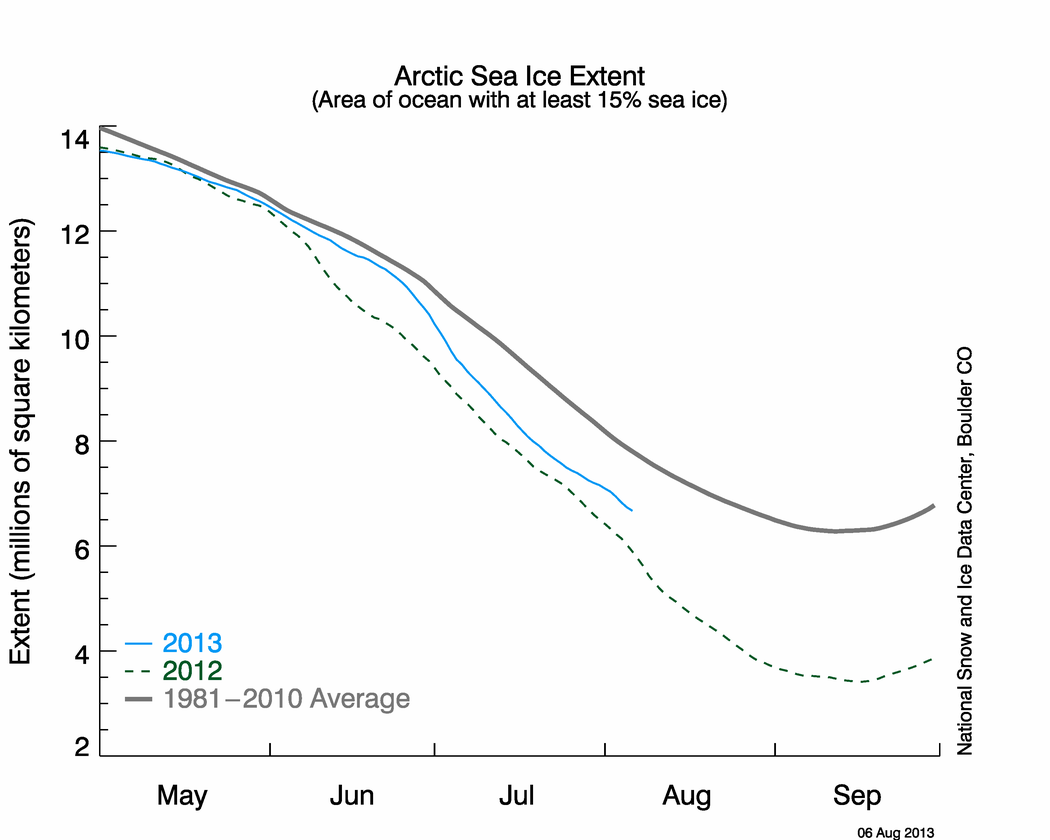
By contrast, DMI graphs show nearly one million km² more ice in 2010.


http://ocean.dmi.dk/arctic/icecover.uk.php
Here is the graph above zoomed:

The video below shows 2010 started to diverge in mid June, and 2007 started to diverge in early July. At this point we have a major discrepancy between the two.
DMI uses 30% concentration ice and NSIDC uses 15%, which affects absolute values . But the relative year over year numbers shouldn’t vary very much.
The image below shows NSIDC August 03, 2010 compared with the same date in 2007. Green areas have more ice in 2010. Red areas had more ice in 2007.

The NSIDC maps show 7.5% more ice in 2010 than 2007, but their graph shows less than 3% difference.
The period from August 3 through August 15 was when most of the ice compaction occurred during 2007. Unless something unexpected happens with winds in the Arctic, NSIDC graphs should start to diverge from 2007 – more like the DMI graph.
This has all been said before, but I suppose it bears repeating:
1. We’re dealing with operational data, so there is always the possibility of errors that need to be corrected.
2. We’re keeping an eye on our data, but we don’t see any problems in our data quality at the moment. If we do discover an issue, we’ll let users know as soon as possible and correct the data.
3. Keep in mind that the final couple of data points include some interpolation and should be assumed to be preliminary. These preliminary points get replaced with more final data and thus the apparent slope can change.
4. Our sea ice maps are not an equal area projection. Thus one cannot compare extents by counting grid cells – this is probably the reason for the 7.5% vs. 3% discrepancy. Steve has been alerted to this issue in the past, but seems to have forgotten it.
5. In comparing different products (e.g., JAXA, ROOS, DMI), it’s important to understand that there are many sources of differences, not simply the concentration threshold (30% vs. 15%): (1) sensor (JAXA uses AMSR-E; DMI uses multiple sensors), (2) type of sensor (DMI uses a combination of passive and active microwave sensors; the others use passive microwave), (3) algorithm (i.e., how the raw data gets converted into sea ice concentrations, and (4) ancillary information (e.g., land masks, quality-control parameters, etc.).
If there is a large divergence between products, it’s an indication of a possible issue with one of the products. However, there can be normal divergence between products for one or more of the 4 reasons above, particularly during summer due to things like: (1) surface melt, (2) atmospheric effects, (3) type of ice, and possibly other factors. For example, for much of the year JAXA extents are lower than NSIDC’s, but towards the end of summer NSIDC begins to estimate less ice. The same generally happens with the ROOS product.
These issue are typical in dealing with climate data. No measurement tool is perfect, all have uncertainties. Looking at multiple datasets can provide greater insight into physical processes, can illuminate errors, and when there is good overall agreement – as in the long-term decline in Arctic sea ice extent – high confidence in the results.
Walt Meier
NSIDC
Günther Kirschbaum says:
August 4, 2010 at 4:06 pm
“If weather conditions turn into those 2007 experienced there is a very good chance of a new minimum extent record. And that after 5 weeks of weather conditions that are adverse to ice melting, with all those clouds, lower temperatures and the Beaufort Gyre and Transpolar Drift Stream stalling completely (reversing even).
Despite those adverse conditions during the most important phase of the melting season, the ice looks in a terrible state and could reach a new record minimum extent, if weather conditions switch back again. Amazing, really.
If the Arctic shows another ‘recovery’, it will be because very, very thin ice managed to get spread out enough and survive long enough for the cold air to come and let the sea water between the floes freeze up again.
Come in, CryoSat-2. We need your data.”
So in other words Gunther, regardless of the result Global warming is to blame. ROFL. I can picture us entering another ice age and Gunther will still be around trying to claim that AGW has somehow brought it about.
All signs are that we are now heading into a strong La Nina event, something not seen for over a decade. Will this cause the same sort of step down in global temp anomalies (UAH satellite data) as the step up we saw following the 98 el-nino. If it does I seriously doubt you will see a continuing trend of reduced summer minimum extents in the Arctic.
Little wonder the frantic efforts by AGW advocates to get their money making schemes in place before things start to cool and people realise what type of a scam is being run.
There is a simple maxim: if you have to choose between explanations for something and one of them is conspiracy and the other is error, you should be choosing error every time. Conspiracy theory thinking is anti-reason.
And in this case the error is being made by those who are claiming that there is a discrepancy. NSIDC and DMI measure two different things .
James Sexton,
You say that ‘even if they are measuring different things, the discrepancy should not be that great’. On what basis do you make that claim?
As to the claims of other manipulation and adjustment – basically, claims of some vast conspiracy to acheive global dominance via the stealing of underpants – they are simply further examples of where conspiracy theory thinking leads one.
Scrub conspiracy theory thinking from your minds, people. The world may make less sense to you initially. But your thinking will be the better for it. 🙂
John F. Hultquist says:
August 4, 2010 at 6:57 pm
David Gould says: fraud? ~shakes head in wonder and despair~
August 4, 2010 at 5:29 pm
I have the same feeling. Many folks seem to think that someone is in charge. Who? Anyway, those calling fraud ought to spend a few days writing out a very detailed plan as to how they would accomplish what these agencies and their people are trying to do. Start with the equipment you will need. Then the people to do it. Then begin with what you would do tomorrow morning, and tomorrow afternoon. Keep repeating. Check back in a couple of weeks and let the rest of us know how you are doing.
I expect/assume that the majority of working “climate scientists” are actually no more or less honest than other scientists or the public at large. I think that the practice/process of climate science has become corrupt. The governing assumptions are “theory” led, rather than “data” led. Interpretations of data that contravene the current theory are routinely ignored/discarded in favour of interpretations of data that validate the theory.
In this way, issues with the theory are glossed over. The theory of AGW is not (to my mind) strictly incorrect – it is incomplete. Once you add in points such as “water vapour as a negative feedback” it becomes more complete.
The trouble for the true believers is that the more complete forms of the theory eliminate the catastrophism and hence the political and financial utility of the theory – scary stuff if your personal beliefs and livelyhood depend on AGW. No wonder that people working in the field look the other way, or focus on the “little window” of their research that allows them to stay within the dogma.
I’ts not fraud – just garden variety “don’t rock the boat”.
Mind you, there are people within the AGW industry who actively work on non-scientific principles that can be summarised as the silencing of dissent, and the manipulation of data – and that amounts to fraud.
Walt Meier says:
August 4, 2010 at 8:31 pm
………and when there is good overall agreement – as in the long-term decline in Arctic sea ice extent – high confidence in the results.”
Fair enough Walt, but questions are now being asked with regards the implications of whats happened since the 1997 record melt which took out a lot of multi-year ice.
If you argue theres been no recovery, you can also argue that there is no evidence of a further decline to support the death spiral argument. If anything was going to sound the death knell for Arctic Ice, surely it should have been the 2007 melt along with what were being told are record temps in 2010.
And yet here we are in August and every possible measuring indicator shows a greater extent than 2007, some showing considerable more ice than 2007. From an Artic Ice death spiral viewpoint this hardly fits.
Incidentally there is every possiblity that the 2010 minimum extent (based on JAXA data) will be within a few hundred thousand sq km of the 2002 result.
Walt
Thanks for your response.
As you know, in late summer when most of the ice is north of 75N, the pixels are reasonably close to equal area. Whatever is going on here is well beyond the variance which would be associated with pixel size variations. I do these comparisons all the time, and there is something different going on during the last week or so.
Thanks for that very straight forward explaintion on possible difference in Arctic sea ice extent estimates.
I do have a question/request, if you would be so kind.
Is it possible to obtain the DAILY Arctic sea ice area/extent digital data for the 2008, 2009, and 2010 calendar years?
And if so, who should I contact for a data request of this type, or conversely where on the WWW is this data located (website, FTP, etceteras).
NOTE: I’m not interested in the gridded data, just the daily time series of single valued Arctic sea ice area/concentration.
TIA
“DMI and NSIDC measure two different things: one is 30 per cent and the other is 15 per cent.”
Did one use 15 in 2007 and 30 in 2010, and the the reverse switch? That would pretty mush destroy comparability, but if they were consistent, I would think the definition of “extent” would fall out of the calculation.
Shows you what I know.
R. Gates says:
August 4, 2010 at 4:30 pm
Worry not Steve, 2010 is showing no great change from the general downtrend over the past few years. These little differences may be of interest if you’re looking a the variations of sea ice within a specific week, month, or season, but these little variations and differences are insignificant when talking about bigger picture of climate. 2010 falls right in line with the general downtrend in year-to-year Arctic sea ice that we’ve been seeing for several decades as well as the accelerated downtrend we started seeing in 2007. If this trend is going to reverse, as the AGW skeptics would like to contend, then I surely would like to know:
1) By what physical known mechanism will this reversal take place (i.e. what natural cycle will be swinging back the other way) GCM’s are predicting an eventual ice free summer Arctic, so what do the skeptics know that multiple GCM’s have left out. I’m sure they’d like to know this secret information.
2) What is the anticipated year that we will see this uptrend begin?
3) Will this be a “spiral” up, or should we anticipate a bee-line back to 8 million sq. km. summer minimums?
=====================================
Burden of proof is on you there. Nice try to introduce a roan fish (red herring) but it will not work anymore.
By what physical known mechanism will you ever be able to prove anything?
You can’t. You know just enough to be somewhat effective, but not enough to make the grade
I do appreciate though….how you finally (after months and months of self-congratualtory misinformation) have finally started using the term General Circulation Models….as opposed to Anthropogenic Global Warming Models….but I digress.
All the cream rises to the surface…eventually. But that still does not explain why you still believe in your religion.
Hey….I guess homo sapiens are steeped in mythology….sometimes irreparably so.
Chris
Norfolk, VA, USA
Walt Meier says:
August 4, 2010 at 8:31 pm
Please give us your take on the convergence/divergence of the Arctic/Antarctic Sea Ice phenomenon.
Use my image processing: http://www.robertb.darkhorizons.org/seaice.anomaly.Ant_arctic.jpg
or make your own.
Joe Bastardi gave his this week.
stevengoddard says:
August 4, 2010 at 5:21 pm
R Gates,
We have already seen a reversal from the southerly winds which caused the 2007 low. What else are you looking for?
_______
So your contention is that the entire last several decades of slowly declining summer Arctic sea ice, with an accleration of that decline beginning in 2007 is all related to “southerly winds”? And is it your contention also then that these winds are now going to blow from some other direction, and that will reverse the trend, and so all the GCM’s just have it wrong? I just want to understand the basis for the belief (so far not seen in the data) that the Arctic sea ice is about the show a “recovery spiral”? I would think then that we will start seeing some positive Arctic sea ice anomalies at some point, as the recovery takes hold.
And one final question…since we are also seeing an increasingly well documented slow warming and melting of permafrost across the Arctic and subarctic regions, are these “southerly winds” also blowing deep underground to move the permafrost around and warm it?
Of course, I don’t believe it was only “southerly winds” that has caused the decades long slow decline of Arctic sea ice, but a longer term slow rise in global temps, amplified in the Arctic. Changes in the winds are one of several effects from changes in temperatures in the troposphere, as for example, we see with the Arctic Dipole Anomaly.
But one final question
Looking at multiple datasets can provide greater insight into physical processes, can illuminate errors, and when there is good overall agreement – as in the long-term decline in Arctic sea ice extent – high confidence in the results.
Walt Meier
NSIDC
============================
High confidence??? I’m sorry, but will using a term like “high confidence” get you the funding you need?
You are one of the premier experts on this subject in the world….but you will resort to using this type of terminology?
What “high confidence”?
The high confidence that the sun is going to rise over the horizon tomorrow?
The high confidence that the Arctic sea ice ebbs and flows….and may have been on an ebb??
What are you trying to prove….or hide?
I would support your funding if there was high or low confidence doesn’t matter in the forecast….because I believe in the researcher (you).
What I can’t stand are the politics that provide the unnatural forcing…either direction.
What “high confidence”? On a 30 year scale?
Big ****ing deal.
Chris
Norfolk, VA, USA
James Allison says:
August 4, 2010 at 5:52 pm
R. Gates says:
August 4, 2010 at 4:30 pm
I believe the onus is on you to prove your idea that the recently observed slow decline in Arctic ice is due to AGW or human produced CO2 or whatever you are want to call it these days. You also need to provide proof to viewers here why the observed slow increase in Antarctic ice is also due to AGW.
Put up the proof or stop the tedious “caused by AGW” you continually post on this website
_______________
James, I don’t have any “onus on me” to prove anything. I did not make up the GCM’s that forcast the slow decline of Arctic sea ice due to AGW. Far smarter people than me get paid to do that. I provide plenty of links to scientific studies when I’m trying to make a specific point. The AGW hypothesis has forecast for quite some time the slow decline in sea ice with specific reasons why polar amplification of general global warming will be seen. The fact that this appears to be happening doesn’t prove that the AGW hypothesis is correct, as the causes could certainly be Steve’s “southerly winds”. But the other evidence (also predicted by AGW models) such as stratospheric cooling, ocean acidification, permafrost melt, etc. starts to lean strongly toward the AGW hypothesis likely being correct to some degree. I’ll leave it up to the Ph.D’s, such as Julienne and Walt to have the “onus on them” to discover linkages and the details of exactly how AGW will be changing the Arctic environment..
Also, in regards to the Antarctic, again, we’ve discussed this so many times here on WUWT that it really gets tedious everytime someone (usually a skeptic) trys to point at its small year-to-year positive anomaly and expect that fact to somehow refute AGW. I suggest you google it and find all the links to the science for yourself, but I’ll throw out one for free:
http://psc.apl.washington.edu/zhang/Pubs/Zhang_Antarctic_20-11-2515.pdf
The NSIDC monthly update points to which was correct between Canadian ice service and BREMEN. Bremen shows hardly any ice near the shore east of Barrow :-
http://www.iup.physik.uni-bremen.de:8084/amsr/arctic_AMSRE_nic.png
whereas the Canadian ice service shows it well
http://ice-glaces.ec.gc.ca/Ice_Can/CMMBCTCA.gif
thus indicating that the Canadians are more accurate but obviously cover a smaller area.
Andy
@R. Gates August 4, 2010 at 4:30 pm
“GCM’s are predicting an eventual ice free summer Arctic, so what do the skeptics know that multiple GCM’s have left out. I’m sure they’d like to know this secret information.”
I agree we could well have an ice free summer Arctic. Eventually.
No doubt it has happened many times before and may well happen again. Not holding my breath it will be in my life time.
And if the summer Arctic is ice free, that proves what, exactly?
If the Arctic north of the Shetland Islands was frozen solid one future winter, would you accept that the whole AGW hypothesis is nonsense? I doubt it, you’d be on here with some kind of weird explanation and be saying that actually, Arctic ice was only one tiny piece in a much bigger jigsaw. After all, the AGW hypothesis puts the bacon on most warmists’ table. Possibly yours too.
What “multiple GCM’s have left out”? Well, there is skill and integrity, for a start.
R Gates asks:
1) By what physical known mechanism will this reversal take place (i.e. what natural cycle will be swinging back the other way) GCM’s are predicting an eventual ice free summer Arctic, so what do the skeptics know that multiple GCM’s have left out. I’m sure they’d like to know this secret information.
2) What is the anticipated year that we will see this uptrend begin?
3) Will this be a “spiral” up, or should we anticipate a bee-line back to 8 million sq. km. summer minimums?
1) Cyclic natural cooling will take care of the cyclic natural warming quite nicely, it goes like this.
The planet warms and the planet cools, the poles shrink and poles grow, ocean currents flow one way and then another and winds blow the ice one way and then another. In common sense land we like to call this the natural cyclic climate and its been happening for a very long time. So dont worry R Gates be happy and be assured that the ice will return soon, there will be no death spiral and the polar ice will not melt away.
I dont know if you are aware of this but every GCM has been proven utterly wrong in the past so dont take what they proclaim seriously and remember models are not in any way shape or form reality. Models are not real, repeat this 50 times turn around and click your heels three times and you will be back in Kansas(reality) in no time.
2) Its happening right now and has been for a while and believe it or not, as the planet cools the ice regenerates very quickly so by 2012/13 ice levels in the north will be as high or higher than 30yrs ago. No need to fret and worry be happy the poles are saved.
3) Ice goes up and ice goes down this up and down is dictated by global temps and wind and ocean temperatures and currents, now remember R Gates, there is no need to panic and become despondent, what you are seeing is natural and has happened before, enjoy your life and be happy.
John H.H.;
1. Introduce “deliberate error”.
2. Pay big bux for supporting evidence and obfuscatory publications and reports.
3. Declare consensus.
4. Prevent dissemination of data tending to falsify consensus.
5. Use 3 to demand global taxes to continue and accelerate 2.
Etc.
A thanks to Walt Meier to his explanation at August 4, 2010 at 8:31 pm.
I wish he had omitted “– as in the long-term decline in Arctic sea ice extent –” as this is a wholly unnecessary comment and unrelated to the excellent clarifications he set out to provide. If he had to comment on Arctic sea ice decline, perhaps it might have been wise to also say something about the Antarctic scene and the fact that sea ice extent around the two poles are roughtly in balance with the average. It is regrettable that these people always need to plug their AGW agenda, even in cases where it is not appropriate, and I would certainly prefer to have “neutral” scientists in charge of climate statistics. That would surely do away with all the conspiracy theories.
When the real variable being measured has a high derivative, as it does now, it’s not surprising that different sampling techniques give different results.
Why not show the discrepancies on past years to see if this issue is systematic to the measuring techniques?
R. Gates says:
August 4, 2010 at 10:27 pm
I will back up R. Gates here that there really does seem to be a polar amplification effect whereby the poles warm or cool about 2 to 3 times more than the global average. This is not a climate model result, it just paleoclimate history.
It should be outlined in more detail why this occurs however. Local Albedo effects are certainly the major part of the explanation however (how cold was the Arctic during the ice ages for example – 90% of the sunlight was just reflected off to space so there was no warming affect from the Sun at all during this period). GHGs might also have a bigger net effect at high latitudes is another. It could be also be that the Tropics do not change much at all (the Sun runs the show here) so global temperature changes are more a reflection of high latitude temperature changes than anything else (the math just means high latitudes need to increase/decline 2.5 for 1 to change the global average by 1).
There is still lots and lots of ice at the poles however. There needs to be a major increase in temperatures, melting a lot of ice to result in any significant change in the current average global temperature. Some additional sea ice melt in the Arctic in August is just not going to do anything.
thank you, Cassandra King
I like Dinostratus’s suggestion too.
mikelorrey: August 4, 2010 at 3:30 pm
NSIDC counts meltwater pools on top of ice as open water, I’ll bet…DMI, on the other hand, only seems to have an agenda of measuring the ice, even if it is submerged under meltwater pools.
Swell. Now in addition to new ice, multi-year ice, rotten ice, flippy-floppy ice, thick ice, and thin ice, now we’re going to have to distinguish between “wet ice” and “dry ice” (or “non-wet ice,” since we’re not concerned with frozen CO2)…
R. Gates: August 4, 2010 at 10:01 pm
And one final question…since we are also seeing an increasingly well documented slow warming and melting of permafrost across the Arctic and subarctic regions, are these “southerly winds” also blowing deep underground to move the permafrost around and warm it?
Permafrost is frozen dirt — it doesn’t melt, it thaws, and the thaw doesn’t extend very far from the surface, so “deep underground” means about a meter or a meter-and-a-half.
*Muskeg* melts, and it’s the reason anopheles mosquitoes can survive up beyond the Arctic Circle.