By Steve Goddard
Over the last few weeks I have been tracking what is becoming a large discrepancy between various Arctic sea ice measurements. NSIDC graphs show almost no difference between 2010 and 2007.

http://nsidc.org/data/seaice_index/images/daily_images/N_timeseries.png
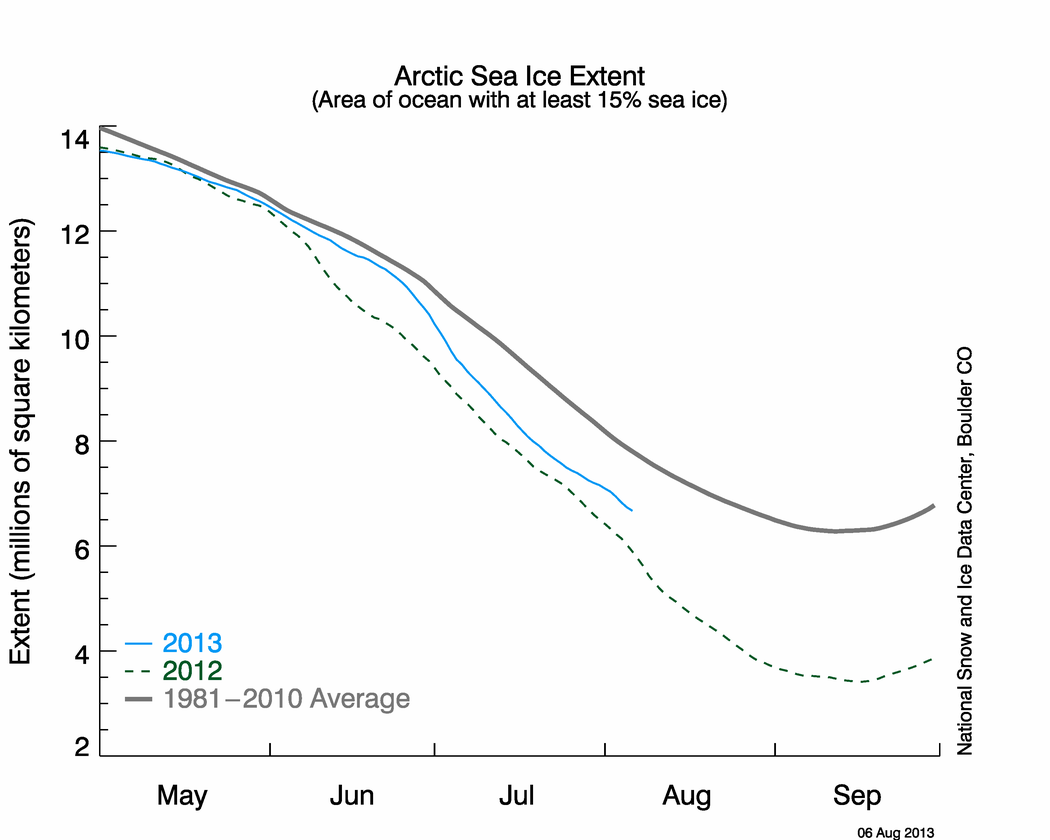
By contrast, DMI graphs show nearly one million km² more ice in 2010.


http://ocean.dmi.dk/arctic/icecover.uk.php
Here is the graph above zoomed:

The video below shows 2010 started to diverge in mid June, and 2007 started to diverge in early July. At this point we have a major discrepancy between the two.
DMI uses 30% concentration ice and NSIDC uses 15%, which affects absolute values . But the relative year over year numbers shouldn’t vary very much.
The image below shows NSIDC August 03, 2010 compared with the same date in 2007. Green areas have more ice in 2010. Red areas had more ice in 2007.

The NSIDC maps show 7.5% more ice in 2010 than 2007, but their graph shows less than 3% difference.
The period from August 3 through August 15 was when most of the ice compaction occurred during 2007. Unless something unexpected happens with winds in the Arctic, NSIDC graphs should start to diverge from 2007 – more like the DMI graph.
We are not really talking about “sea ice measurements”. We are talking about sea ice estimates. Otherwise, the divergences could not possibly be so large.
Charles Wilson says:
August 4, 2010 at 3:27 pm
PS: perhaps the reason for the “Discrepancy” is the “True” NSIDC map is the background for the Arctic Buoy site (be sure to page down, top area is blank): http://iabp.apl.washington.edu/maps_daily_nsidcice.html
… looks like Moths got at it. Presumably some of the low concentration areas are counted as “open” for 2010. But this happened in 2007 in June: then the La Nina winds compacted the ice & 2007 looked better on DMI.
____________________________________________________________
HMMmmm the satellite photo seem to shows a heck of a lot less open water than http://iabp.apl.washington.edu/maps_daily_nsidcice.html does. However I may be confusing clouds with ice.
R Gates,
We have already seen a reversal from the southerly winds which caused the 2007 low. What else are you looking for?
Gail
The satellite photo you linked was from July 5.
Some of you guys seriously think that there is fraud going on here?
~shakes head in wonder and despair~
DMI and NSIDC measure two different things: one is 30 per cent and the other is 15 per cent.
re JAXA, they have always been different than NSIDC. Look at the records, for example: NSIDC has a lower record minimum than JAXA by over 100,000 square kilometres. They use different algorithms for counting the ice, so these differences are to be expected.
What the ice graphs are telling me is that the ice is more intact and consolidated this year. 15% extent is down but 30% extent is up. Ice area is leveling off nicely. It just means that we have about as much ice now as we had in 2009 but that it is more consolidated and wasn’t broken up so much by storms/wind/wave as much as previous years.
That temperature graphic is already showing an area below 0C near the pole. The ice area should begin to level out now. Iceland is picking up 6.5 minutes of darkness per day now and the night is already nearly 6.5 hours from sunset to sunrise.
So far it looks like we are sitting good for a really solid icepack next year.
More Arctic ice news, nice. 🙂
The only thing I like more than Arctic ice news right now is news about Brett Favre. 😉
Did phytoplankton take over?
R. Gates says:
August 4, 2010 at 4:30 pm
I believe the onus is on you to prove your idea that the recently observed slow decline in Arctic ice is due to AGW or human produced CO2 or whatever you are want to call it these days. You also need to provide proof to viewers here why the observed slow increase in Antarctic ice is also due to AGW.
Put up the proof or stop the tedious “caused by AGW” you continually post on this website.
David Gould says:
August 4, 2010 at 5:29 pm
“Some of you guys seriously think that there is fraud going on here?
~shakes head in wonder and despair~”
It isn’t difficult to understand. Many here are so used to seeing intentionally manipulated data in regards to the climate, that the response is expected. In this particular instance, I’m willing to give the benefit of the doubt. But even knowing they do measure 2 different things, the discrepancy shouldn’t be that great when measuring the difference between now and 2007. Given the NSIDC’s graph and map don’t match, I’d say the grapher and the mapper are not on the same page. Oddly, though just by eyeballing, even if the graph reflected the map’s ice area, I think the year to year comparison would still be too great of a difference to reflect reality. But that’s just eyeballing.
While sea ice extent is the measure of choice (and for good reason), sea ice area is of some predictive value. Recently, the cloudy Arctic has minimized total melting. See the area graphs here:
http://arctic-roos.org/observations/satellite-data/sea-ice/ice-area-and-extent-in-arctic
and here:
http://www.ijis.iarc.uaf.edu/seaice/extent/AMSRE_Sea_Ice_Area.png
Apparently, some winds has been crowding the ice a bit, but this bodes well for the Arctic sea ice extent over the next few weeks, especially the NSIDC plot. All these sources are legit and their discrepancies typically reconcile pretty quickly.
Ed Reid says:
August 4, 2010 at 5:05 pm
We are not really talking about “sea ice measurements”. We are talking about sea ice estimates. Otherwise, the divergences could not possibly be so large.
They are measurements taken from satellite. That is why it’s odd they aren’t close to the same.
mikelorrey made an interesting comment that “NSIDC counts meltwater pools on top of ice as open water, I’ll bet” which could be the explanation. But I don’t know for sure.
David Gould says “Some of you guys seriously think that there is fraud going on here?” Bless you David, for your naivete. I sincerely hope your assumption (that the discrepancy can be legitimately explained) is correct.
But given the shenanigans revealed by Climategate E-mails, Jim Hansen’s ‘adjustments’ of NASA’s GISS data, and Phil Jones ‘adjustments’ of CRUTEM data, why wouldn’t some of us suspect Mark Serreze might ‘adjust’ NSIDC data to support his predicted “Arctic Ice Death Spiral”? By their own admission, all of these ‘climatologists’ share a common agenda. Important climate data is almost routinely manipulated to fit pre-determined outcomes, so why wouldn’t one suspect that it may be happening here?
Remove these foxes from the climate data hen house! Replace them with objective scientists who don’t ‘adjust’ data to fit agendas or psychic prognostications. Then we wouldn’t have to be conspiracy theorists.
stevengoddard says:
August 4, 2010 at 5:28 pm
Gail
The satellite photo you linked was from July 5.
______________________________________________
Weird.
If you click on the date on the right hand corner you get a calender and can up date. I am surprised the link was not update too.
HMMmmm I tried it again and the link still did not update to the map I was actually looking at – July 31 2010
I figured it out. Try this: http://ice-map.appspot.com/?map=Arc&sat=aqa&lvl=6&lat=74.571668&lon=-139.120367&yir=2010&day=212
The rotted/alarmingly thin ice hypothesis forecasts are not panning out. The hypothesis doesn’t have supporting evidence.
“If it disagrees with experiment it’s wrong.”
~Richard Feynman
David Gould says: fraud? ~shakes head in wonder and despair~
August 4, 2010 at 5:29 pm
I have the same feeling. Many folks seem to think that someone is in charge. Who? Anyway, those calling fraud ought to spend a few days writing out a very detailed plan as to how they would accomplish what these agencies and their people are trying to do. Start with the equipment you will need. Then the people to do it. Then begin with what you would do tomorrow morning, and tomorrow afternoon. Keep repeating. Check back in a couple of weeks and let the rest of us know how you are doing.
Amino Acids in Meteorites says:
August 4, 2010 at 6:39 pm
The rotted/alarmingly thin ice hypothesis forecasts are not panning out. The hypothesis doesn’t have supporting evidence.
“If it disagrees with experiment it’s wrong.”
~Richard Feynman
Ha! No Falsification Criteria will be admitted to. AGW admits to no falsification. It can’t be falsified and never will be.
Its death – apart from a few die hard adherants who will never give in – will be induced by the general popular realisation that it is a pseudo scientific dogma.
Perhaps this is a case of ‘noble cause corruption’ made manifest or just an honest difference of opinion. For a real comparison with 2007 data, it is necessary to demonstrate that they are now using the very same measurement criteria that they used to collect that 2007 data.
The only useful plot is arctic plus antarctic anyway.
There’s clearly something to do with tilt or the like which means that when the antarctic is at historic highs the arctic is low. Presumably the opposite is also true?
It’s just a media war now. Forget the science.
My ignorant bet when polled at this site months ago was for ‘more ice than 2008 but less than 2009’ at September minimum.
Time will tell whether I’ll be right or not.
Although I’m wondering which graphs will be used to make the decision!!!!
The NSIDC maps show 7.5% more ice in 2010 than 2007, but their graph shows less than 3% difference.
NSIDC has to handle the polar stereographic projection correctly, unlike bloggers that just eyeball an image or count pixels. I’d be very surprised if someone proved that the National Snow and Ice Data Center was doing this incorrectly, but you’re welcome to try and surprise me (and NSIDC).
Polar stereographic projections are conformal (preserves angles), but not isometric (preserves distances) or area-preserving.
http://nsidc.org/data/nsidc-0051.html
Stephan says:
August 4, 2010 at 3:29 pm
I only trust the Scandinavians on this one. This seems like a clear case of attempted fraud as is the SST data/graphic manipulations by the American NOAA/NSDC ect.. They are doing a tremendous disservice to the perception of American Science (must say same for British and Australian Meteorological services as well, unfortunately).
Looks like the Germans (Universität Bremen, Universität Hamburg) are in on the fraud, along with the Americans, British, Australians and Japanese:
http://img689.imageshack.us/img689/7534/iceextn8410.png
http://img412.imageshack.us/img412/7529/arclatestlarge201008030.png
When the AGW comes crashing down this year its going to be real bad news for these people
Yes, there will be plenty of explaining demanded of scientists if the Arctic summer minimum is only less than 2009 or 2008, but not 2007. “Dr. Maslowski predicted ice free Arctic summers by 2016 ± 3 years, how do you account for the fact that the Arctic is not ice free in 2010 ?” confused dilettantes will demand.
John F. Hultquist says:
August 4, 2010 at 6:57 pm
David Gould says: fraud? ~shakes head in wonder and despair~
August 4, 2010 at 5:29 pm
I have the same feeling
===============================
Are you the same person? You asked for a detailed plan, however, and here it is:
1 – Get computer and turn on
2 – All I need is me
3 – Adjust data to fit model
4 – Repeat until sky falls in
Just-ice will be done!
Man, after two decades to get used to it, I still miss Feynman. I think I’ll have to put his lecture tapes in the car again.
Rhys Jaggar says:
August 4, 2010 at 7:30 pm
The only useful plot is arctic plus antarctic anyway.
There’s clearly something to do with tilt or the like which means that when the antarctic is at historic highs the arctic is low. Presumably the opposite is also true?
This should help:
http://www.robertb.darkhorizons.org/seaice.anomaly.Ant_arctic.jpg
Apparently, the Arctic Sea Ice was higher than the Antarctic until they crossed paths in mid 1993.
Right about the time the Previous Alarmists were stung by the recovery of the Antarctic, and the Coming Ice Age of the 1970’s based on the Arctic Sea Ice growth.