By Steve Goddard
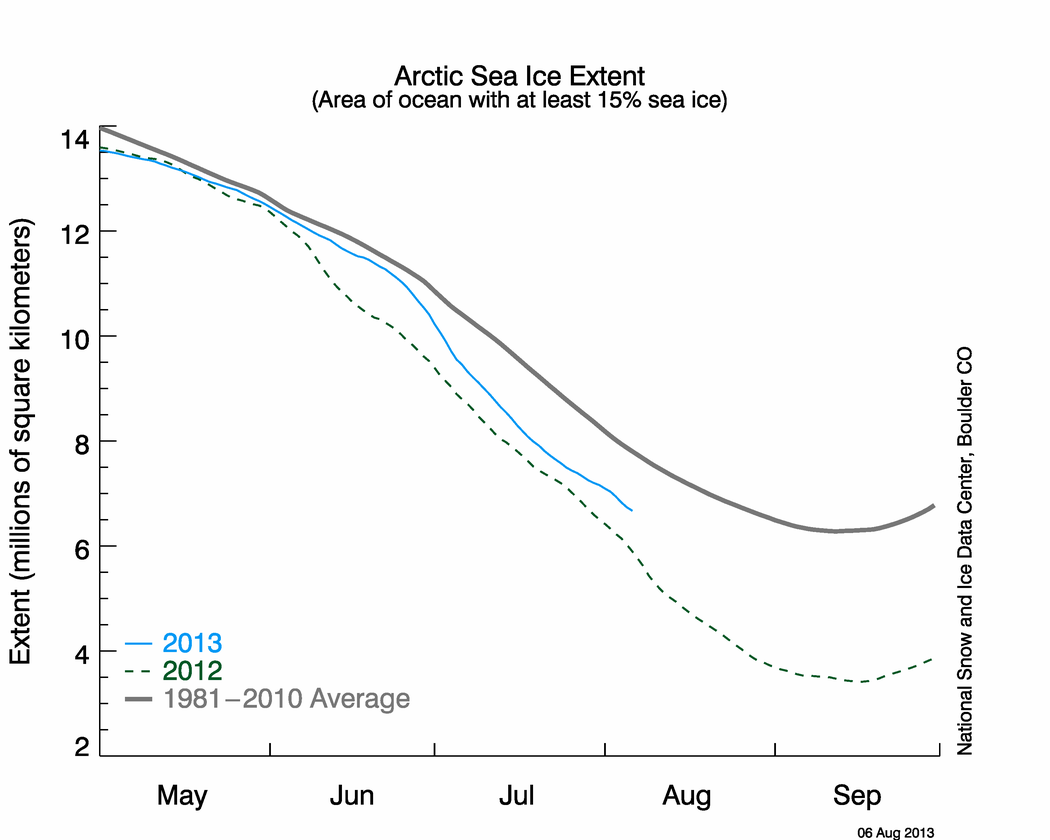
Over the last few weeks I have been tracking what is becoming a large discrepancy between various Arctic sea ice measurements. NSIDC graphs show almost no difference between 2010 and 2007.

http://nsidc.org/data/seaice_index/images/daily_images/N_timeseries.png
By contrast, DMI graphs show nearly one million km² more ice in 2010.


http://ocean.dmi.dk/arctic/icecover.uk.php
Here is the graph above zoomed:

The video below shows 2010 started to diverge in mid June, and 2007 started to diverge in early July. At this point we have a major discrepancy between the two.
DMI uses 30% concentration ice and NSIDC uses 15%, which affects absolute values . But the relative year over year numbers shouldn’t vary very much.
The image below shows NSIDC August 03, 2010 compared with the same date in 2007. Green areas have more ice in 2010. Red areas had more ice in 2007.

The NSIDC maps show 7.5% more ice in 2010 than 2007, but their graph shows less than 3% difference.
The period from August 3 through August 15 was when most of the ice compaction occurred during 2007. Unless something unexpected happens with winds in the Arctic, NSIDC graphs should start to diverge from 2007 – more like the DMI graph.
don’t worry, something “unexpected” will happen ….. or maybe it is to be expected. The Alarmists will ensure that the data fits the narrative.
It could simply be differential melt of the two populations of ice. Imagine thicker older ice which melts more slowly resulting in a slow reduction in the > 30% coverage areas, whereas at the margins the 15% < x < 30% ice population is made up of thinner, younger ice. Late season, one could easily imagine differences between these populations.
Until the 5th, when the Long range weather forecasts e.g. http://weather.unisys.com/gfsx/9panel/gfsx_500p_9panel_nhem.html say the La Nina Pattern is set to go “On” just like in 2007. Till the end of the Forecast (Aug 10th) at least. But the CTI index suggests for about 2 months.
Surprise ! !
PS: perhaps the reason for the “Discrepancy” is the “True” NSIDC map is the background for the Arctic Buoy site (be sure to page down, top area is blank): http://iabp.apl.washington.edu/maps_daily_nsidcice.html
… looks like Moths got at it. Presumably some of the low concentration areas are counted as “open” for 2010. But this happened in 2007 in June: then the La Nina winds compacted the ice & 2007 looked better on DMI.
By the way, would you post my FULL Sea Ice Outlook ? — the parts about the La Nina were censored. Like 70% of the text. There I show the various indexes & the apparent time lags in 2007 for standard (9 weeks) CTI (6 weeks), etc. Looks like CTI won.
PS sorry for the duplicate post on your color change post.
The JAXA numbers also appear to be more inline with the DMI numbers (noting their different cutoffs of 15% vs 30%).
I too, noticed the NSIDC trend line was diverging from the JAXA trend line several days ago.
I don’t think the following is in your sea ice links, but I could be wrong;
http://nsidc.org/data/seaice_index/images/daily_images/N_daily_concentration_hires.png
taken from this NSIDC link;
http://nsidc.org/data/seaice_index/
It shows the daily concentration image (NOTE: it shows zero concentration but does not show 0% < concentration < 15% data, in other words, it is their 15%+ concentration map).
I only trust the Scandinavians on this one. This seems like a clear case of attempted fraud as is the SST data/graphic manipulations by the American NOAA/NSDC ect.. They are doing a tremendous disservice to the perception of American Science (must say same for British and Australian Meteorological services as well, unfortunately). There is a litany of ice data graphics manipulations since 4 years ago by these people here.
http://mikelm.blogspot.com/2007/09/left-image-was-downloaded-from.html
someone might care to add this one for the record….
When the AGW comes crashing down this year its going to be real bad news for these people
2010 looks like it’s going to be a rerun of 2009 from here on in to me.
But I could be wrong.
NSIDC counts meltwater pools on top of ice as open water, I’ll bet. Since the NSIDC agenda is to estimate when “all the ice will be gone from the arctic”, this is understandable, as meltwater ponds have a corrosive effect on ice in general. DMI, on the other hand, only seems to have an agenda of measuring the ice, even if it is submerged under meltwater pools.
The warmist could not accept any NH ice even close to 2005-2006 the whole thing will crash that is why NSCDC cannot accept DMI graph.
I asked this on the last Sea Ice update thread, but didn’t get any response. Has any explanation been offered for the large discrepancy between the Arctic Ice Area numbers for CT and Nansen ArcticROOS? CT is quoting less than 4.4mkm2, while Nansen’s graph is indicating more than 5mkm2 and the gap appears to be widening.
The NSIDC maps show 7.5% more ice in 2010 than 2007, but their graph shows less than 3% difference.
Another case of ‘rotten ice?’
Or maybe it’s just ice termite-ridden?
:o)
There is also a discrepancy between JAXA and NSIDC. NSIDC reports a loss of 603,770 km^2 of ice from July 29 to August 2, and JAXA reports much less 355,469 km^2 during that same time period.
NSIDC
20100729 = 7.1605200
20100730 = 7.0599500
20100731 = 6.8812300
20100801 = 6.7729500
20100802 = 6.5567500
JAXA
7,086,719
7,008,750
6,922,031
6,819,531
6,731,250
Nansen does not agree with NSIDC either and uses 15%.
http://arctic-roos.org/observations/satellite-data/sea-ice/ice-area-and-extent-in-arctic
NSIDC has their monthly update out:
High-resolution (250-meter) visible imagery from the NASA Moderate Resolution Imaging Spectroradiometer (MODIS) sensor vividly shows the loss of the old, thick ice. A chunk of old ice has broken away from the main pack and come to rest along the north coast of Alaska, east of Point Barrow, where it has begun to melt in the warm shallow shelf waters. While cloud cover obscures some areas, it is clear that the old ice floe has broken up into many smaller floes. Whether this old ice will completely melt out by the end of summer will depend to some extent on weather conditions. However, smaller floes melt more easily than consolidated ice. This behavior is becoming more typical of the ice pack as the ice thins.
Barrow! Barrow played an essential in previous analyses here. What does this event at Barrow Point tell us about the rest of the Arctic? [Snip. You know why. ~db stealey, mod.]
Steve: you have a site for digital NSIDC data !
Could you share it ? ? Please ?
899 says:
August 4, 2010 at 3:43 pm
The NSIDC maps show 7.5% more ice in 2010 than 2007, but their graph shows less than 3% difference.
Another case of ‘rotten ice?’
Or maybe it’s just ice termite-ridden?
No just Steve doing his pixel counting without allowing for the projection used, same as usual.
mikelorrey says:
August 4, 2010 at 3:30 pm
The DMI Graph of 80N is close to freezing, and is staying put.
The Aug3 NOAA polecam showed frozen pond and some new snow.
NOAA/NSIDC and it’s subsidiaries are digging themselves a hole.
Congress will be less than thrilled about that.
Ships are not the only things capable of getting stuck in the pack ice.
If weather conditions turn into those 2007 experienced there is a very good chance of a new minimum extent record. And that after 5 weeks of weather conditions that are adverse to ice melting, with all those clouds, lower temperatures and the Beaufort Gyre and Transpolar Drift Stream stalling completely (reversing even).
Despite those adverse conditions during the most important phase of the melting season, the ice looks in a terrible state and could reach a new record minimum extent, if weather conditions switch back again. Amazing, really.
If the Arctic shows another ‘recovery’, it will be because very, very thin ice managed to get spread out enough and survive long enough for the cold air to come and let the sea water between the floes freeze up again.
Come in, CryoSat-2. We need your data.
Charles Wilson
I got the NSIDC data from Julienne’s post yesterday. Sorry.
Do NSIDC and the other agencies publish standards for measuring ice? Has anyone published a revised set of standards recently? Can these standards be checked against the graphs?
Joe Bastardi said around mid July 2010:
“The coming drop of global temperatures over the next year, to levels not seen since the 1990s, should put to an end to the AGW argument for good except for the most radical elements…………… Once the Atlantic, still warm, goes into its cool stage in 10-15 years, global temps will fall even further, back to where they were in the 1970s.
The recovery of the northern ice caps will become more obvious in a two-steps-up, one-step-back fashion, but the Southern Hemisphere ice will retreat back to near normal. Overall global ice is right on top of normal and has had no change in the past 30 years. ”
http://www.accuweather.com/world-bastardi-europe-blog.asp?partner=accuweather
http://pgosselin.wordpress.com/2010/07/17/will-2010-stay-hot-and-joe-bastardi-return-to-1970s-cold/
Günther
I don’t see any evidence that the ice is in a “terrible state.” US Navy PIPS data shows ice thickness as the highest in three years.
Worry not Steve, 2010 is showing no great change from the general downtrend over the past few years. These little differences may be of interest if you’re looking a the variations of sea ice within a specific week, month, or season, but these little variations and differences are insignificant when talking about bigger picture of climate. 2010 falls right in line with the general downtrend in year-to-year Arctic sea ice that we’ve been seeing for several decades as well as the accelerated downtrend we started seeing in 2007. If this trend is going to reverse, as the AGW skeptics would like to contend, then I surely would like to know:
1) By what physical known mechanism will this reversal take place (i.e. what natural cycle will be swinging back the other way) GCM’s are predicting an eventual ice free summer Arctic, so what do the skeptics know that multiple GCM’s have left out. I’m sure they’d like to know this secret information.
2) What is the anticipated year that we will see this uptrend begin?
3) Will this be a “spiral” up, or should we anticipate a bee-line back to 8 million sq. km. summer minimums?
‘Way’ down in the North Pole and record up in the South Pole. Global ice unchanged for 30 years, i.e. normal. Does the Earth care? What’s to be alarmed about I tells ya?
http://nsidc.org/data/seaice_index/images/daily_images/S_timeseries.png
Haven’t they learned that we’re watching this stuff daily and they cannot get away with fudging ANYTHING?
Perhaps a person well informed on this topic with appropriate credentials could ask the director of NSIDC what his agency is doing differently this year from 2007 that leads to results that are so inconsistent with their results in 2007 and with other major systems in 2010? Perhaps they are not aware of the discrepancies? If they are aware one would think they also know why.
Or (sarcastically) is all of this proprietary information that the agency is contracted with entities across the globe not to disclose?