Guest post by Steven Goddard
Hell Hath No Fury….

Catlin team member Ann Daniels had another very difficult day.
Today has been a difficult day of highs and lows, particularly for Ann, whose morning got off to a particularly bad start. In order to power the different technical components of the kit, the team use large batteries, which need to be heated to a certain temperature in order to extract the maximum amount of power. The process of heating batteries involves Ann, sitting by her stoves for several hours, using a specially insulated piece of equipment to capture the steam from boiling water, in order to get the batteries to the correct temperature.
Ann reached her lowest point of the expedition so far, when after tending the boiling pans of water for several hours, she realised she had pre-heated the wrong battery and had accidently picked up the dead battery from the previous day. It was a painful and frustrating realisation at the end of a cold morning.
On the plus side, at the end of the day, Ann felt warm enough to take off her sledging jacket when getting into her sleeping bag for the night. This is the first time in the 41 days of the expedition so far that she has felt warm enough for this luxury. She adds that she was still wearing 3 pairs of trousers, 2 thermal top layers, 2 hats and 4 pairs of gloves, but still, quite a landmark in the expedition so far!
Consider the following scenario. All goes well and the team arrives home safely some time in the next six weeks. Now, suppose that the Arctic continues to show recovery this summer, and the realization sinks in that the very premise of the expedition may have been flawed.
Such a surface Survey has never before been attempted, and the need for the information has never been greater. Current estimates for the disappearance of the Arctic Ocean’s sea ice cover vary from 100 years away down to just 4 years from now. Whatever happens, the consequences of its meltdown will be of global significance in terms of sea level rise(due to thermal expansion of the oceans), the geo-politics of energy resources, rainfall patterns and the availability of water supplies and, of course, the impact on biodiversity, including polar bear.
How would she feel? One can only speculate. But as the Catlin team suffers on the ground, the satellites are watching the ice recover.
Since 2007, the global sea ice area anomaly has increased by more than 3,000,000 km2 and is now more than 600,000 km2 above the 1979-2000 mean. You could fit England, Spain, France and Mexico inside the recovered ice area.

http://arctic.atmos.uiuc.edu/cryosphere/iphone/images/iphone.anomaly.global.png
Arctic sea ice extent is rapidly approaching an eight year high for the date:
.
http://www.ijis.iarc.uaf.edu/seaice/extent/AMSRE_Sea_Ice_Extent.png
Arctic ice extent is converging on the 1979-2000 mean:
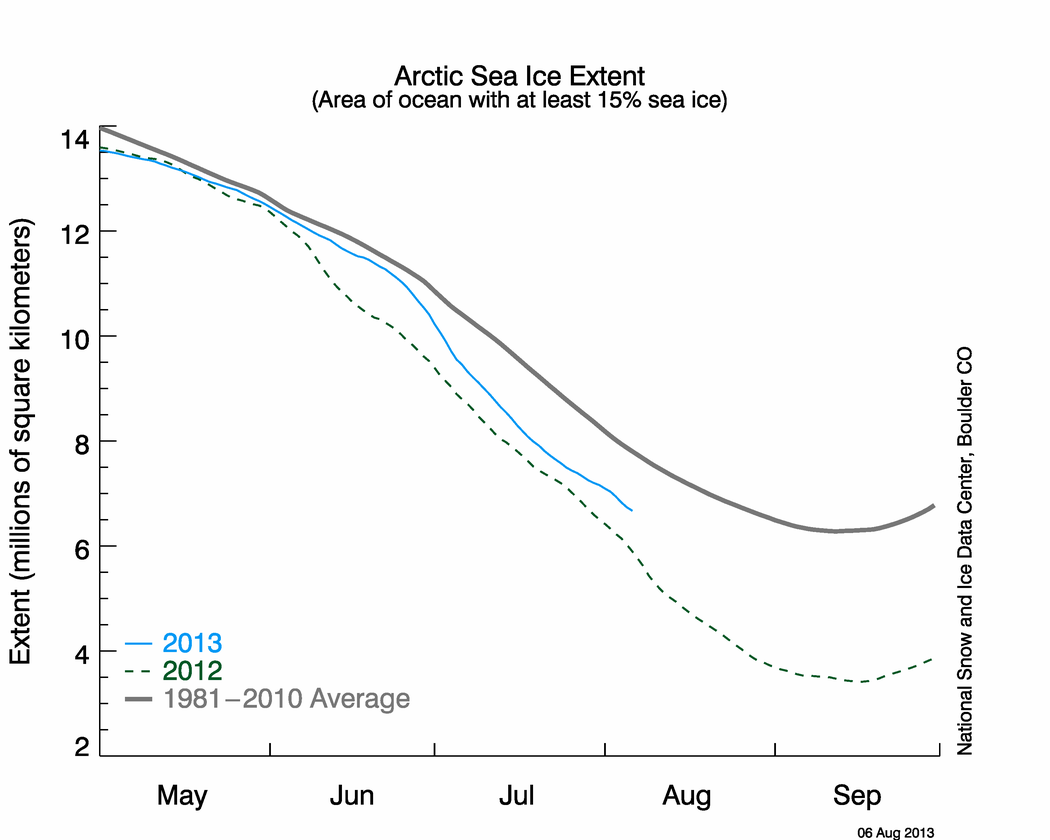
http://nsidc.org/data/seaice_index/images/daily_images/N_timeseries.png
Smokey,
“Aren’t you doing the same thing, when you leave out the entire southern hemisphere? The issue is about global cooling, isn’t it?”
The title of this article is “…Arctic Ice Survey…”, so it’s not unreasonable to present the data from the appropriate hemisphere.
But I quite accept the Antarctic has shown no long-term indication of ice loss:
http://arctic.atmos.uiuc.edu/cryosphere/IMAGES/current.anom.south.jpg
You would not expect the two regions to respond in the same way to climate change – most of the Antarctic ice is on rock rather than water and this has stabilised the surrounding sea ice. Similarly only the Arctic ice round Greenland and the Canadian Arctic Achipeligo has remained relatively impervious to the warming trend there.
http://nsidc.org/images/arcticseaicenews/20090406_Figure5.png
Looking at the ice areas of the Arctic and Antarctic separately is therefore the best way of sorting out these two very different responses.
Pierre Gosselin (01:14:49) : This all reminds me of Jack London’s short story:
“TO BUILD A FIRE”.
Which see:
http://www.jacklondons.net/buildafire.html
Frederick Michael (10:08:00) :
Check:
http://nsidc.org/data/seaice_index/images/daily_images/N_daily_extent_hires.png
Note that the main gap between the current sea ice and the 1979-2000 average is in the Sea of Okhotsk, which is separate from the main body of arctic sea ice. This means that, as spring progresses, this part of the shortfall will disappear and not contribute to the ultimate melting (or not) of the main body.
Thus, all else being equal, the gap between the current arctic sea ice and the 1979-2000 average should close even further.
Except that in the next week or so all that new ice (2 weeks old) in the Bering will start to melt and be the main contributor followed by the Baffin Sea.
Arn,
The inclusion of the Sea of Okhotsk might be debatable, but the most important indicator of Arctic ice loss is the summer melt when the Sea of Okhotsk has always been ice free.
Much of this discussion on the extent of the ice should really wait for another six months.
ralph ellis (10:41:36) :
Or how about a micro fuel-cell? You might have to hold the day’s fuel in a bum-bag to keep it liquid, but I imagine these would work in low temperatures.
http://me.queensu.ca/courses/MECH430/Assets/Files/Recommended%20Reading/Micro%20Technical%20Fuel%20Cells.pdf
Perhaps that’s why they took one with them, the waste heat from which was used to warm the batteries.
http://www.catlinarcticsurvey.com/Perran_on_Power_Supplies_for_the_expedition
” The expedition has access to two sources of electrical power. The first is a fuel cell powered by Methanol. This early production unit is packaged in an insulated case together with 4 litres of Methanol and a number of Military grade Lithium rechargeable batteries.The latter actually provide the electrical power to the scientific equipment. The fuel cell runs continuously supplying the average power whilst the batteries supply the peak power. Waste heat from the fuel cell keeps the batteries warm so they will accept a charge as Lithium batteries will not charge properly at temperatures below zero centigrade. The byproduct of the conversion process of methanol to electricity is water vapour (steam) and carbon dioxide.”
“The second available power souce is from Lithium Thionyl Chloride (non rechargeable) batteries. Each battery is an array of 16 D cells from SAFT with a total weight of 1.6 Kg. It is necessary to preheat the batteries before use and to then maintain their temperature during use if their remarkable capacity is to be realised. A special battery heating ‘cooker’ has been made which avoids any contamination of the water that is used to heat the battery. This allows the water to be used for food preparation or drinking which minimises fuel usage”
Insulting Gilligan’s Island
April E. Coggins (10:06:28);
I think The Professor would have seen to far more suitable science protocol under The Skipper than the Catlin group are practicing!
… And, they filmed all their procedures and broadcast them to the nation each week!
No, no: obviously, the Catlin crew failed to watch those invaluable Gilligan’s Island reruns! 😉
Other research methods in use in the Antarctic region:
http://edition.cnn.com/2009/TECH/04/08/eco.internatpolaryear/index.html
It will not take long before there is not an animal found in the wild without glued or strapped gps or sensor equipment.
Ron: When they run out of animals to glue & strap gps to, they’ll start looking around for more. Tag, we’re it.
Ian Plimer
“Arctic ice reached a larger maximum area this winter than in the last few years, scientists say, but the long-term trend still shows it declining.”
http://news.bbc.co.uk/2/hi/science/nature/7987354.stm
Jon Jewett (06:20:31) : But didn’t Darwin say that stupid people were supposed to die young before they had stupid children?
Only to the extent that ‘stupid’ is not a survival advantage for their genes. “Smart” is not always better from a Darwinian point of view (in fact, in the modern age it is a definite negative for Darwinian survival).
OK, I’ll walk you through it…
Darwinian ‘fitness’ is only about the number of viable offspring. Not happiness nor number of toes not frozen, nor dying before childbearing. Just number that go on to have children. THE single thing that correlates most strongly with reduced childbearing on a population dynamics basis is a higher education for women. To the extent genetically smarter people get more education, it is a negative selector for Darwinian survival of their genes.
In the modern era, having a below average I.Q. and octuplets then going on the dole (and / or doing a book deal) is ‘better’ from a Darwinian survival point of view. Similarly, being a bit daft and losing some toes on the ice might result in more ‘sack time’ back home later along with the book deal. Where having a ChemE or EE degree will, on average, result in fewer offspring. Even the well educated ghost writer may have few children compared to the subject.
But it’s even more subtile that that. The High School drop out who has 4 kids and dies at age 30 from stupidity has better Darwinian Survival than the very smart kid that delays childbearing until 30 getting a PhD or M.D. then only gets one born before an infertility problem hits (or before being killed in the same stupid car accident caused by our HS dropout). There is a subtile timing based impact thanks to advanced education delaying childbirth and the constant risk of accident or health problems that favors the “stupid but fast to birth”.
So while Darwinian Fitness will select against the incredibly daft by having them die off before child bearing, in the modern age it mostly selects for the somewhat daft who can’t figure out how to use a tiny little rain coat on Mr. Happy, or who can’t do a boring but safe trip to the N. Pole with no notoriety and no book deal…
(Have I mentioned lately that Economics, and especially the population dynamics part of Economics, is not called The Dismal Science for nothing? Sigh. Sad, but all true and presented without political bias nor agenda. But at least now you know why we aren’t all geniuses… because it isn’t a ‘feature’ in most cases… )
Caitlin Crew, a typical case of Cognitive Dissonance:
“The End Of The World Is/Is Not Nigh!”
Throughout history, many competing cults have attempted to predict dire catastrophes for the Earth. With respect to these cults, the key psychological and sociological question is: “What happens when the predictions fail?” Following on from yesterday’s post [see: ‘Cognitive Dissonance’, August 19], in which I analysed the growing gap between a hot media obsessed with ‘global warming’ disasters and a world in which the climate is currently cooling, I thought it might be helpful to explore the phenomenon of ‘cognitive dissonance’ further.
Failed Predictions
During World War I, the official publication of the Assemblies of God, The Weekly Evangel, made a classic doomsday prediction: “We are not yet in the Armageddon struggle proper, but at its commencement, and it may be, if students of prophecy read the signs aright, that Christ will come before the present war closes, and before Armageddon … The war preliminary to Armageddon, it seems, has commenced.” Specific dates were mentioned, declaring that ‘The End’ would come no later than 1934 or 1935. Interestingly, there are parallels here with belief in ‘global warming’, in that it too is seen as being “at its commencement”, and that it is either too late already, or that it will come in its full force within, as some claim, ten years or less.
Such failed predictions comprise the core of the work of New York social psychologist, Leon Festinger (1919 – 1989) [pictured], who wrote a classic book, When Prophecy Fails: A Social and Psychological Study of A Modern Group that Predicted the Destruction of the World (University of Minnesota Press, 1956), with Henry W. Riecken, and Stanley Schachter.
This was about a UFO cult who believed that the end of the world was imminent. A Chicago housewife, Marion Keech, received messages in her house in the form of ‘automatic writing’ from alien beings on the planet Clarion. These revealed that the Earth would end in a mighty flood before dawn on December 21. A group of believers, headed by Keech, then exhibited strong behavioural adaptations to demonstrate their degree of commitment. They abandoned jobs, college, and spouses, and they gave away their money and possessions in order to prepare for their departure on the flying saucer, which would come to rescue all true believers.
For Festinger and his colleagues, the failure of Keech’s prediction became a classic ‘disconfirmed expectancy’, which increased ‘dissonance’ between ‘cognitions’, thereby causing many members of the cult to lessen the ‘dissonance’ by accepting a new prophecy, namely that the aliens had decided to spare the planet for the sake of them, the believers.
Festinger then built on this famous study to produce his masterpiece, A Theory of Cognitive Dissonance (Stanford University Press, 1957).
Cognitive Dissonance
In this important theory, ‘cognitions’ embrace ‘knowledge’, attitude, emotion (or ‘ambivalence’), belief, and behaviour. Cognitions that contradict each other are termed ‘dissonant,’ while cognitions that agree with each other are ‘consonant.’ Cognitions which neither agree nor disagree are ‘irrelevant.’ The sudden arrival of a new cognition that is dissonant with a currently-held cognition creates a ‘state of dissonance.’ The important issue then becomes how can this disruptive dissonance be reduced, or eased, for the believer.
Amelioration may be achieved by trying either to eliminate one of the cognitions altogether or to create a new, consonant cognition between the two competing cognitions. We should also note that there can be significant degrees of dissonance. The maximum possible dissonance is equal to the resistance to change of the less ‘resistant cognition’. Thus, once dissonance attains a level that overcomes the resistance of one of the cognitions, that cognition will be amended, or eliminated, and dissonance will be reduced for the believer.
In terms of social behaviour, this will cause people who suffer the pain of dissonance either to seek out actively ‘knowledge’ that will reduce the dissonance for them personally, or to avoid/ignore the competing ‘knowledge’ completely. If the latter, then people who are involuntarily exposed to such ‘knowledge’ will do their level-best to discount that ‘knowledge’, either by deliberately misinterpreting it or by denying it vigorously, at least to themselves.
A Hot Media In A Cooling World
As I pointed out yesterday, this is precisely what is happening to our media with respect to the increasingly unequivocal ‘knowledge’ that we have now entered a cooling period in climate. They are starting to experience a powerful dissonance because of their strong promulgation over the last 20 years of the doomsday, catastrophic view of ‘global warming’.
Media reaction to the new ‘cognition’ is thus classic. It involves, above all, ignoring the cooling, but also mis-reporting the cooling, denying the cooling, or trying to create a new consonant cognition, one in which the cooling actually becomes a part of the catastrophic ‘global warming’ belief.
For some media, the dissonance is especially high, not because of the science of climate change, but because they have involuntarily invested so much air time, print, and uncritical emotion in hyping the more doomsday, cult-like elements of the ‘global warming’ trope, with dramatic images of drowning polar bears, collapsing ice sheets, flooded lands, and hard-baked deserts.
What Is Likely To Happen?
If the cooling phase in climate continues, media and political dissonance will increase to stress point. This will have one of two effects.
First, some media may become even more rabid in their presentation of ‘global warming’ disasters, showing yet more drowning polar bears, plunging ice sheets, dangerous mosquitoes, flooded cities, and barren lands. For this to happen, Festinger states that two conditions must be met:
1.
(1)The belief must be held with very deep conviction, and it must have relevance to promoted actions, that is, to what the believer does, or how they want people to behave. For the ‘global warming’ cult, and for those in the media who have uncritically adopted editorial positions as champions of the ‘Green’ agenda, this is precisely the case, ranging from changing light bulbs to recycling, from abandoning SUVs to wearing hemp undies, from wind farms to solar panels; and,
2.
(2) The person holding the belief must have committed to it. Such is worryingly true of some media that have abandoned their normal critical stance as journalists in favour of preaching.
Alternatively, however, – and I think that this may be the increasing likely outcome – the media will ultimately turn against those whom they have finally come to believe have duped them, so that they will begin to vent all their journalistic spleen against the ‘believers’. Above all, they will regret their folly in falling for a ‘science’ which focuses on only one factor out of thousands, and, by contrast, to revel in their new-found grasp of complex science, economics, and politics. The process will be facilitated by journalistic boredom with the old trope, and by the search for the novel in ‘News’. For this to happen:
1.
(1)Strong disconfirmatory evidence must occur (e.g. continued cooling); and,
2.
(2)This evidence must actually be recognized and acknowledged by the person holding the original belief.
In either of the above two cases, there must also be a fifth factor, especially for strong believers, in that such a person must have social support for ‘change’ or for ‘no change’. In other words, if an increasing number of media outlets start to question ‘the belief’, it will be much easier for a formerly strong believer to begin to follow suit. In this, there will be a classic cascade effect. Until recently, the cascade effect has been working in the direction of supporting a belief in catastrophic ‘global warming’, with both the media and scientists frightened of seeming to be heretics and out-of-step. Increasingly, however, there are signs that the cascade is reversing direction.
Historians, long hence, will surely have a fascinating time analysing the rise and fall of the cult of catastrophic ‘global warming’. Even now it is possible to detect close parallels with the pattern of many traditional doomsday cults. And, it is particularly interesting to note that scientists are just as susceptible to such cults as non-scientists.
As a mere academic, I shall observe the progress of this particular cognitive dissonance with enthusiasm.
http://web.mac.com/sinfonia1/Global_Warming_Politics/A_Hot_Topic_Blog/Entries/2008/8/20_More_On_Cognitive_Dissonance.html
Susan,
The recovered ice area is well in excess of 3Mkm2. That is a different measure from the excess ice area.
“If the facts don’t fit the theory, change the facts.”
– Albert Einstein
The kicker for me is that over my lifetime, the sea has risen less than 7″.
That’s <7″ that is totally lost in the noise of high & low tides.
I cannot walk down to the ocean and tell you that change is occuring.
Phil. (11:31:31) :
Except that in the next week or so all that new ice (2 weeks old) in the Bering will start to melt and be the main contributor followed by the Baffin Sea.
Ah, yes. Murphy’s law says that all else won’t be equal.
However, I can tell you from watching that map (which is updated daily) that the ice in the Bering sea is more than 2 weeks old. It’s obviously not multi-year ice, but it formed months ago and has been consistently greater than the 1979-2000 avg all this winter. While the melt in the Bering and Baffin may be greater than that in the Okhotsk, the Okhotsk still always melts completely and so the delta there will go to zero and, since it’s separate, will not affect the melt rate of the main body.
By the way, to those who think the Okhotsk sea ice should not be included, the rule is all salt water sea ice and that seems fair to me. Any other rule would be hard to defend.
Ted Clayton (06:59:01) : The Battery Drama
There is something inexplicably strange about “steaming” batteries for “hours” to get them up to temperature.
My solution would be a thermistor on the battery, a styrofoam container, and a thermostat circuit that cuts down current flow as the battery warms. Apply to battery (with battery providing current). This would use the battery power to maintain it’s temperature. You use more batteries, but a lot less fuel and have no vapor issue to deal with. (If you use enough batteries, it becomes weight efficient to take along a dinky generator like the Honda 600 w job and use it to charge and thus warm the batteries… and perhaps power some of the equipment avoiding cold batteries all together… oh, and ether in the fuel works way cold…)
FWIW the 600 w unit weighs 26 lbs; but I have the 1000w unit that uses the same engine at 29 lbs.
Then again, if they just took a snowmobile they could have used it as a battery charger… but I digress toward a discussion of Darwin …
Steven Goddard (12:30:20) :
Susan,
“Since 2007, the global sea ice area anomaly has increased by more than 3,000,000 km2 and is now more than 600,000 km2 above the 1979-2000 mean. You could fit England, Spain, France and Mexico inside the recovered ice area.”
The recovered ice area is well in excess of 3Mkm2. That is a different measure from the excess ice area.
And this is another example of the absolute nonsense you continue to spout! Can we expect to see a post by you around September announcing the dramatic loss of 3-4Mm^2 in the same metric since April?
Steven Goddard (12:32:46) :
“If the facts don’t fit the theory, change the facts.”
We’d noticed that you’d adopted this practice, however to paraphase Senator Bentsen: you’re no Albert Einstein!
Skeptic Tank (06:17:35) : “Never assume what you’re trying to prove unless you’re trying to prove you’re an idiot.”
Or unless you work for the main stream media.
Tom P (11:33:51) :
Arn,
“Much of this discussion on the extent of the ice should really wait for another six months.”
On this, we can agree.
Robert Bateman (12:05:26) :
“Ron: When they run out of animals to glue & strap gps to, they’ll start looking around for more. Tag, we’re it.”
Yes Robert, in order to estimate our carbon footprint.
Time to stop this nonsense.
Above all, they will regret their folly in falling for a ‘science’
From which it will take ‘science’ a long time to recover, I fear, whereas it is practitioners like Hansen, politicians like Gore and an uncritical media that should carry the can. They’re not going to report that though, are they?
I’ll field this one: No, the heat you feel is from CPU and some support circuitry ICs using up the energy from the battery. Depending on battery chemistry, some battery self-heating can be when charging, notably past the full-charge state, but this is highly dependent on the battery chemistry like I say …
Of note: List of CPU power dissipations. This page covers from the early CPUs through the later Intel and AMD processors including dual core and quad core.
Phil.
Since you have started writing in the third person “we” – I’m curious who you are writing for other than yourself and the mouse in your pocket.
BTW – If you don’t consider sea ice anomaly to be a valid quantitative measure, you probably shouldn’t waste everybody’s time commenting on a thread about Arctic ice.
Phil,
Here is some basic information about the term “sea ice anomaly,” and how it is used by NASA and NSIDC. Perhaps you and your mouse friend can read it before posting further.
http://earthobservatory.nasa.gov/IOTD/view.php?id=4887
It is interesting how alarmists like yourself loved to discuss the anomaly decline in 2007, and now consider it much less interesting. \