Seas have been rising and falling for thousands of years – without help from the EPA or IPCC
Guest essay by Robert W. Endlich
Sea levels are rising rapidly! Coastal communities are becoming more vulnerable to storms and storm surges! Small island nations are going to disappear beneath the waves!
Climate alarmists have been making these claims for years, trying to tie them to events like “Superstorm” Sandy, which was below Category 1 hurricane strength when it struck New York City in October 2012, and Typhoon Haiyan, which plowed into the low-lying central Philippines in November 2013.
For alarmists, it does not seem to matter that the strength and frequency of tropical storms have been decreasing in recent years, while the rate of sea level rise has fallen to about seven inches per century. Nor does it seem to matter that the lost lives and property have little to do with the storms’ sheer power. Their destructive impact was caused by their hitting heavily populated areas, where governments had not adequately informed citizens of the size and ferocity of imminent storm surges, too few people had evacuated – and people, buildings and emergency equipment were insufficiently prepared to withstand the furious storm onslaughts.

The alarmist cries are not meant to be honest or factual. They are intended to generate hysterical headlines, public anxiety about climate change, and demands for changes in energy policies and use.
China is rapidly becoming one of the richest nations on Earth. It is by far the largest single emitter of carbon dioxide, which alarmists claim is causing “unprecedented” storms and sea level rise. And yet at the recent UN-sponsored climate talks in Warsaw, China led a walkout of 132 Third World countries that claim First World nations owe them hundreds of billions of dollars in “reparations” for “losses and damages” allegedly resulting from CO2 emissions.
The Obama Administration brought (perhaps “bought” is more apt) them back to the negotiating table, by promising as-yet-unspecified US taxpayer money for those supposed losses. Details for this unprecedented giveaway will be hammered out at the 2015 UN-sponsored climate confab in Paris, safely after the 2014 US mid-term elections. Meanwhile, a little history will be instructive.
In 2008, presidential candidate Barack Obama proclaimed, “This was the moment when the rise of the oceans began to slow.” He was actually right. Sea level rise has slowed, but not because of CO2 emissions, which are still increasing. Mother Nature cannot be bought.
Sea level changes over relatively recent geologic and human history demonstrate that alarmist claims do not withstand scrutiny. Sea levels rose significantly after the last ice age, fell during the Little Ice Age, and have been rising again since the LIA ended around 1850. In fact, Roman Empire and Medieval port cities are now miles from the Mediterranean, because sea levels actually fell during the Little Ice Age.
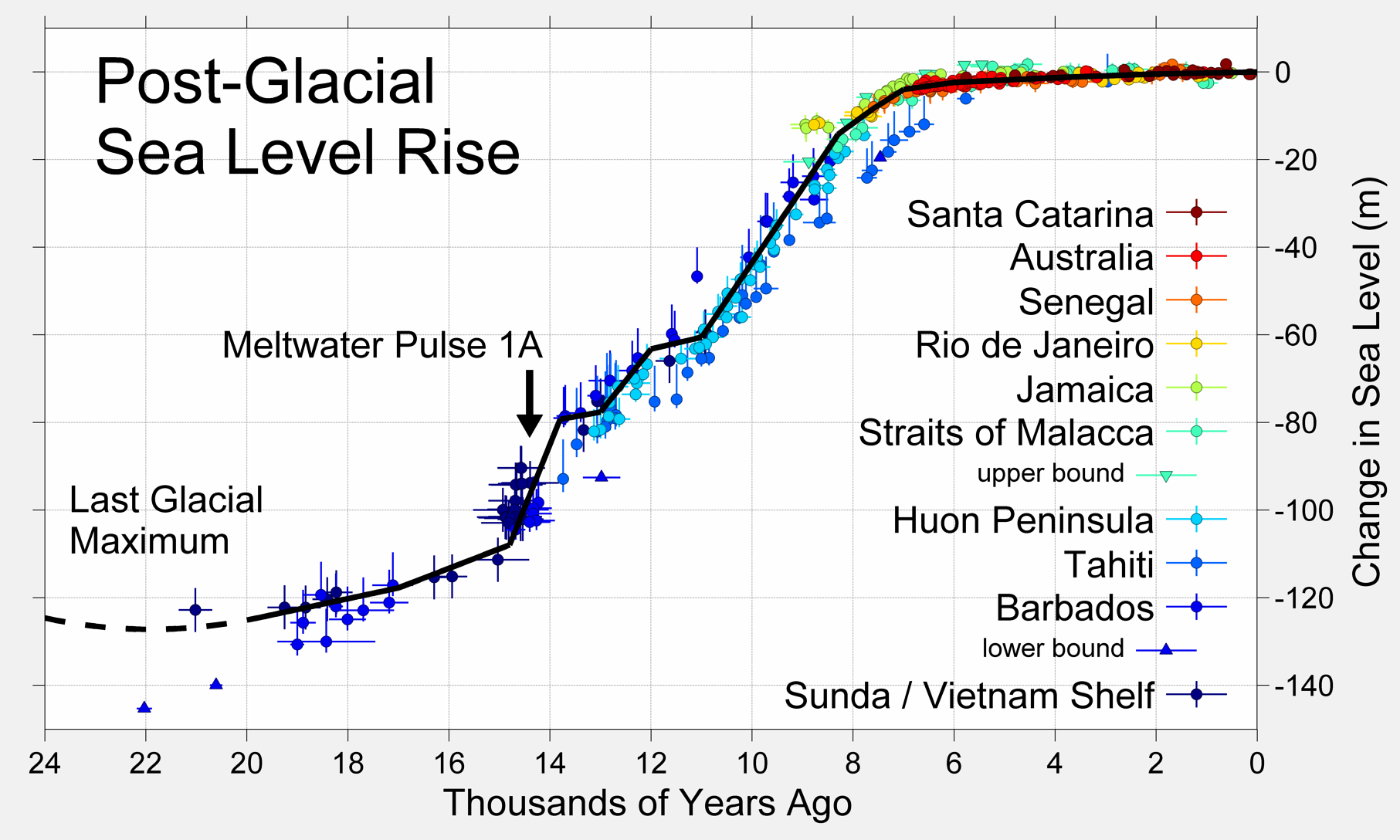
During the deepest part of the last ice age, known as the Wisconsin, sea levels were about 400 feet lower than at present. As Earth emerged from the Wisconsin some 18,000 years ago and the massive ice sheets started to melt, sea levels began rising. Rapid sea level rise during the “meltwater pulse phase,” about 15,000 years ago, was roughly five meters (16 feet) per century – but then slowed significantly since the Holocene Climate Optimum, about 8,000 years ago.

Those rising oceans created new ports for Greek and Roman naval and trade vessels. But today many of those structures and ruins are inland, out in the open, making them popular tourist destinations. How did that happen? The Little Ice Age once again turned substantial ocean water into ice, lowering sea levels, and leaving former ports stranded. Not enough ice has melted since 1850 to make them harbors again.
The ancient city of Ephesus was an important port city and commercial hub from the Bronze Age to the Minoan Warm period, and continuing through the Roman Empire. An historic map shows its location right on the sea. But today, in modern-day Turkey, Ephesus is 5 km from the Mediterranean. Some historians erroneously claim “river silting” caused the change, but the real “culprit” was sea level change.

Ruins of the old Roman port Ostia Antica, are extremely well preserved – with intact frescoes, maps and plans. Maps from the time show the port located at the mouth of the Tiber River, where it emptied into the Tyrrhenian Sea. The Battle of Ostia in 849, depicted in a painting attributed to Raphael, shows sea level high enough for warships to assemble at the mouth of the Tiber. However, today this modern-day tourist destination is two miles up-river from the mouth of the Tiber. Sea level was significantly higher in the Roman Warm Period than today.


An important turning point in British history occurred in 1066, when William the Conqueror defeated King Harold II at the Battle of Hastings. Less well-known is that, when William landed, he occupied an old Roman fort now known as Pevensey Castle, which at the time was located on a small island in a harbor on England’s south coast. A draw bridge connected it to the mainland. Pevensey is infamous because unfortunate prisoners were thrown into this “Sea Gate,” so that their bodies would be washed away by the tide. Pevensey Castle is now a mile from the coast – further proof of a much higher sea level fewer than 1000 years ago.
Before modern Italy, the region was dominated by the famous City States of the Mediterranean, among which is Pisa, with its picturesque Cathedral Square and famous Leaning Tower. Located near the mouth of the Arno River, Pisa was a powerful city, because maritime trade brought goods from sailing ships right into the port. Its reign ended after 1300 AD, the onset of the Little Ice Age, when sea levels fell and ships could no longer sail to her port. Once again, some say “river silting” was the cause.

However, Pisa is now seven miles from the Tyrrhenian Sea, with large meanders upstream from Pisa and little meandering downstream. When a river is “at grade,” the downstream gradient is as low as possible, as with the meandering Mississippi River and delta in Louisiana. Rivers with a strong downstream gradient flow to the sea in a direct route, with few meanders, as with the Rio Grande in New Mexico.
The facts of history are clear. Sea level was 400 feet lower at the end of the Wisconsin Ice Age, 18,000 years ago. Sea levels rose rapidly until 8,000 years ago. As recently as 1066, when the Normans conquered England, sea levels were quite a bit higher than today.
During the Little Ice Age, 1300 to 1850 – when temperatures were the coldest during any time in the past 10,000 years – snow and ice accumulated in Greenland, Antarctica, Europe and glaciers worldwide. As a consequence, sea levels fell so much that important Roman Era and Medieval port cities (like Ephesus, Ostia Antica and Pisa) were left miles from the Mediterranean.
Since the Little Ice Age ended about 160 years ago, tide gages show that sea level has risen at a steady rate – with no correlation to the rise in atmospheric carbon dioxide levels.
Sea level is a dynamic property in our planet’s climate cycles, which are closely linked to changes in solar energy output and other natural factors. It is unlikely to change in response to tax policies that make energy more expensive and economies less robust – no matter what politicians in Washington, Brussels or the United Nations might say.
Much to their chagrin, Mother Nature doesn’t listen to them. She has a mind of her own.
____________
Robert W. Endlich served as a weather officer in the US Air Force for 21 years and a US Army meteorologist for 17 years. He was elected to Chi Epsilon Pi, the national Meteorology Honor Society, while a basic meteorology student at Texas A&M University. He has degrees in geology and meteorology from Rutgers University and the Pennsylvania State University, respectively, and has studied and visited the ancient sites of Rome, Ostia Antica and Pisa.
Discover more from Watts Up With That?
Subscribe to get the latest posts sent to your email.
Don’t confuse us with facts!
Is there anything that the IPCC supporters have’t lied about?
There’s a whole branch of modern geology called Sequence Stratigraphy which is basically mapping units of rock worldwide based on sea level changes (of up to around +/- 300m or so) throughout geological time.
Archeological digs in the southern US show the shoreline of the Gulf of Mexico some 50 miles inland of the present shoreline, as the ocean was 2 meters deeper some 4000 years ago. Piles of shells at indigenous people’s shoreline camp sites are undeniable.
Interesting article to which I have one minor caveat.
The case of Pevensey Castle is a little more complex than just declining sea levels. The entire South East coast of England was radically changed by the Great Storm of Feb 1287. This was no mere blow like so called Superstorm Sandy but a mass killer. Some ancient towns like Old Winchelsea were wiped off the map, The spot where it used to stand is now over a mile offshore.
In other cases such as Pevensey and New Romney great banks of gravel were dropped leaving them a mile away from the new sea front. The River Rother changed course and now emerges over 15 miles from its old outlet. Worse was to come in December 1287 when another huge storm roared down the North Sea , breaking the dikes in Holland and killing more than 50,000 people.
The inhabitants of Pevensey (and New Romney) saw the disaster as an opportunity and filled in any breaches in the new gravel banks thereby reclaimimg the land for agriculture. To this day much of the land between New Romney is below sea level and protected by dykes and has warning sirens that are sounded if the sea wall is breached.
Keith
Robert, good essay. Agree with your admonition of alarmism and ignoring of facts, but query whether the human contribution to warming will accelerate sea level rise. If one agrees that warming is caused, in part, from GHGs, and unless some natural force, e.g., solar activity, offsets the warming, then it would be logical for sea levels to rise more rapidly (in geologic terms) than without the contribution from AGW.
I don’t understand why this article should carry any scientific weight whatsoever. It’s argument is that “sea levels have been rising and falling throughout history, so the proposition that mans activities is warming the planet and causing sea level rise is ridiculous”. Same goes for the oft seen argument that “earths temperature has risen and fallen throughout history, so AGW is false, QED.” I hope none of the forums readers buy this ‘argument’ that the existence of natural patterns means there cannot be an increment caused by man.
Bruges on the other side of the Channel comes to my mind. Now wikipedia has it as “Starting around 1500, the Zwin channel, which had given the city its prosperity, also started silting.” I never understood how it could ever have been a sea port so deep into land. What changed that after hundreds of years this silting started?
I have said it before and I will say it again, go to ANY sea port along the south coast of the UK, Portsmouth, Gosport, Exeter and Plymouth etc…and you will see NO significant sea level rise at all, let alone from the 1850’s (Given we know land levels have risen since the last iceage)!
B. Fewell says:
December 2, 2013 at 4:48 am
Robert, good essay. Agree with your admonition of alarmism and ignoring of facts, but query whether the human contribution to warming will accelerate sea level rise. If one agrees that warming is caused, in part, from GHGs, and unless some natural force, e.g., solar activity, offsets the warming, then it would be logical for sea levels to rise more rapidly (in geologic terms) than without the contribution from AGW.
There is no evidence that SLR is accelerating, nor can any AGW contribution be discerned, so there is simply no logic or science to your “query”. It is based on fear, and nothing more.
Warren:
Could also be a decrement. Why would you assume that anything “caused by man” must, by definition, be of negative consequence???
What ever happened to Tuvalu?
2001 – The Guardian: FAREWELL TUVALU
Ah yes, (Dec. 2013):
Welcome to Timeless Tuvalu!
One of the smallest and most remote nations in the world, this unspoiled corner of the Pacific offers a peaceful, and non-commercialized environment that is ideal for rest and relaxation.The spectacular marine environment consisting of a vast expanse of ocean interspersed with atolls, magnificent lagoons, coral reefs and small islands all provide a unique South Seas ambiance.
In Tuvalu you will discover a distinctive Polynesian culture of atoll island people who vigorously maintain their unique social organization, art, crafts, architecture, music, dance and legends.
Link to guardian article: http://www.tuvaluislands.com/news/farewell_tuvalu.htm
Warren says:
December 2, 2013 at 5:09 am
” I don’t understand why this article should carry any scientific weight whatsoever. It’s argument is that “sea levels have been rising and falling throughout history, so the proposition that mans activities is warming the planet and causing sea level rise is ridiculous”. Same goes for the oft seen argument that “earths temperature has risen and fallen throughout history, so AGW is false, QED.” I hope none of the forums readers buy this ‘argument’ that the existence of natural patterns means there cannot be an increment caused by man. ”
The article, as far as I can see, does not claim that ” there cannot be an increment caused by man.” It points out that the case for the ” increment caused by man ” leading to a significant sea level rise, has not been adequately made.
Before so much is spent on solving an undemonstrated problem, there are other very well demonstrated problems which impact daily lives, such as energy shortages, which seem to be in much more need of funding.
Going forward, global cooling, more ice, less sea water, sea levels fall. What will the elite Washington D.C. types do with their live on yahts tied up down at the basin where the money changes hand aboard ship where no prying eyes would see, seems they would have to move the sin farther out to sea.
@ur momisugly Warren:
It’s great to see natural patterns and variations receiving due considerations. I mean – you wouldn’t want to base a theory and whole movement on a small ~10 yr trend line – would you ?
CodeTech says:
December 2, 2013 at 5:44 am
Warren:
Could also be a decrement. Why would you assume that anything “caused by man” must, by definition, be of negative consequence???
—
What I find fascinating is that folks like Warren actually believe that global actions that “mankind” can take (like reducing our quality of life in the name of climate science) can have a measurable impact on global sea level. There is NO proof of this whatsoever…yet they try to impose their ways upon us all.
Warren, what is important is that warmists prove that “this time it’s different”. So far, nada.
Another point is that you are leaving out crucial arguments in your presentation of skeptics views. One of the main points being that Co2 has been far higher, yet no “runaway” GHE.
Very handsome strawman, though.
Several errors here. “Wisconsin” as a name for the last Ice Age is only valid in North America, it has other names in other places. And Wisconsin is a name for the whole 100 000 year cycle not just the “deepest part”. That is normally known as the Last Glacial Maximum, LGM for short.
Also using sites around the Mediterranean as examples to show sea-level change is very risky. It is more often land-level change. Most of the Mediterranean Basin is tectonically active, and it is just as easy to find sites that “prove” that the sea level was lower during the Roman Period, Cumae near Neapel for example, or Serapis where there are marine mollusks on the temple pillars several meters above sea-level, showing that the relative sealevel has gone up and down since the roman period.
That said there is no doubt that the sealevel was slightly higher during the climatic optimum, particularly in the Pacific Basin.
Jimmy Haigh. says:
December 2, 2013 at 4:26 am
“There’s a whole branch of modern geology called Sequence Stratigraphy which is basically mapping units of rock worldwide based on sea level changes (of up to around +/- 300m or so) throughout geological time.”
—————–
Many people have a problem imagining what the “coast line” looked like when sea levels were +/- 300m lower than what they currently are.
Now most everyone pretty much knows what New York Harbor, Long Island and the Hudson River outflow into the ocean currently looks like.
But during past Glacial Maximums it all looked much different with the Hudson River outflow into the ocean being quite a few miles past the current Continental Shelf where over thousands of years the forces exerted by the outflow of its waters eroded the Hudson Canyon.
So, take a look-see at the following two (2) graphics to see what the New York/New Jersey coastline looked like some 23,000+ years ago when it was located at the “east end” or lower right end of the Hudson Canyon as pictured on the graphics.
Hudson Canyon
http://www.nefsc.noaa.gov/press_release/2010/SciSpot/SS1003/HudCanFinderMap.jpg
http://content.answers.com/main/content/img/McGrawHill/Encyclopedia/images/CE159100FG0010.gif
@ur momisugly Frank K – “yet they try to impose their ways upon us all”
No, not their ways, they don’t think the rules they seek to impose apply to them, otherwise wouldn’t Climate Conferences be online – thus elimiating the need for thousands of Scietivists and Eco-terrorists to fly to some (often exotic) location.
Whooooop! Better than Manziel to Evans!
We need to be careful not to mix up ice ages and glaciations. We are in the second major ice age, about 2.5 million years into a 12 million year period. During this ice age we have glacial and interglacial periods. The last 12 million year ice age was 450 million years ago.
I vaguely recall that the IPCC says that post 1950 is when MAN began to have a stronger / discernible effect on the climate / global warming. Global sea level has been rising since 1850. The onus is on you to show man’s responsibility. There is no solid evidence of acceleration in the rate of sea level rise, despite claims to the contrary. I will post something after this on groundwater abstraction. Think it all over again. Sea level rise is a difficult one to say the least.
The whole piece is not very scientific : feet, miles (statute or nautical?), why not degrees F, fluid ounces (or not fluid?), pounds, grains, stones, and the like? Are we still in the eighteenth century?