This is truly spectacular. From NASA and ESA. comes this photo taken by the Hubble Space Telescope which clearly proves [one] of Einstein’s theories – gravitational lensing.

Via Wikipedia:
The bending of light by a gravitational body was predicted by Albert Einstein in 1912, a few years before the publication of general relativity in 1916 (Renn et al. 1997). The ring effect was first mentioned in academic literature by Orest Chwolson in 1924. Einstein remarked upon this effect in 1936 in a paper prompted by a letter by a Czech engineer, R W Mandl, but stated,
Of course, there is no hope of observing this phenomenon directly. First, we shall scarcely ever approach closely enough to such a central line. Second, the angle β will defy the resolving power of our instruments.
Science vol 84 p 506 1936
Now there is.
These graceful arcs are examples of a cosmic phenomenon known as an Einstein ring. The ring is created as the light from a distant objects, like galaxies, pass by an extremely large mass, like this galaxy cluster. In this image, the light from a background galaxy is diverted and distorted around the massive intervening cluster and forced to travel along many different light paths toward Earth, making it seem as though the galaxy is in several places at once.

This image from Hubble is packed full of galaxies. A keen eye can spot exquisite elliptical galaxies and spectacular spirals, seen at various orientations: edge-on with the plane of the galaxy visible, face-on to show off magnificent spiral arms, and everything in between.The vast majority of these specks are galaxies, but to spot a foreground star from our own galaxy, you can look for a point of light with tell-tale diffraction spikes. The most alluring subject sits at the centre of the frame. With the charming name of SDSSJ0146-0929, the glowing central bulge is a galaxy cluster — a monstrous collection of hundreds of galaxies all shackled together in the unyielding grip of gravity.
With the charming name of SDSS J0146-0929, this is a galaxy cluster — a monstrous collection of hundreds of galaxies all shackled together in the unyielding grip of gravity. The mass of this galaxy cluster is large enough to severely distort the space-time around it, creating the odd, looping curves that almost encircle the center of the cluster.
Can this not also be explained by simple refraction? Obviously, space is not a pure vacuum, and one would expect that there be a radial density variation around the galaxies.
Of course , a cloud of gas would do the same thing , it has to be all around anyway , what else would the stars form from
It definitely appears to be an optical phenomenon that has nothing to do with gravity.
Leif, can you comment on this, please.
would expect that there be a radial density variation around the galaxies.
Leif, can you comment on this, please.
Not sure what you mean, but even if there were such a variation, it would not ‘bend’ the light, and presumably would be around every galaxy, not just this rare one. So, Einstein was right. There has never been an experiment where he has failed at scale sizes larger than quantum mechanics.
Thanks 🙂
Hmmm … I guess I’m not clear. Light refracts as it passes through an interface with a density difference. If there is a plasma halo around a galaxy — which I assume decreases in density the farther one gets away from the galaxy — will the light not refract?
if there is a plasma halo around a galaxy
The intergalactic medium is much too tenuous to have any effect, but more importantly, if one galaxy has such a halo, all galaxies should have one too, so we should see rings around all galaxies and we don’t.
Gravitational lensing was first observed by Eddington during a solar eclipse in 1919 thus confirming Einstein’s general relativity theory, published only 4 years earlier. His 1905 paper was special relativity and did not deal with gravity.
The only place where this lensing can be observed is where there is one galaxy directly behind another galaxy. So even if this phenomena were being caused by refraction instead of gravity, it still wouldn’t be happening at every galaxy.
Wouldn’t refraction case a splitting of the different colors of light?
Could it be electromagnetic lensing?
Refraction of light due to the plasma contained within the galactic helosphere. Not “Gravitational lensing”
OK DOes the red-shift distance estimate of the hidden galaxy match with th geometrically assessed distance?
My understanding is that observation of gravitational lensing and rings have occurred since Hubble first took pictures in the area known as “deep field”.
e.g.
http://imgsrc.hubblesite.org/hvi/uploads/image_file/image_attachment/21609/web_print.jpg
http://imgsrc.hubblesite.org/hvi/uploads/image_file/image_attachment/21370/large_web.jpg
http://imgsrc.hubblesite.org/hvi/uploads/image_file/image_attachment/19654/compass_large_web.jpg
http://hubblesite.org/news_release/news/2014-33/104-annotated
http://imgsrc.hubblesite.org/hvi/uploads/image_file/image_attachment/21603/full_jpg.jpg
Dr. lsvalgaard
You should be proud! That one achievement and the results are worth a life of pride. Then, there is your other accomplishments worth a few more lifetimes of pride.
Most of my windows backgrounds are images from Hubble.
I agree with the mod; thank you!
Nope, all interpretation which added denial of the other explanation. Refraction explains all of this.
But lets pretend refraction does not exist, like we pretend so much explanation in climate science doesn’t exist
Those images contain no explicit evidence for Einstein rings, and have an explanation we can calculate and replicate.
Mark
I agree that diffraction and curved space-time both produce lensing. However, diffraction should produce a radial rainbow. O.T.O.H. maybe if different coloured photons have different energy they will have different mass and will be separated also.Grounds for more Google.
Woops
Different masses with the same velocity follow the same orbit. Curved space-time should not separate colours.
Unless
different colours have different velocities in a very diffuse gas. (That is the basis of diffraction)
Surely some competent physicist has followed this particular rabbit already,
Goodnight.
I saw an article recently in which lensing has actually magnified the image of a distant galaxy. Making a galaxy that would normally be too faint to be visible, visible.
MarkW:
Picture numbers one and two in my comment above illustrate your point.
In no way does this clearly prove (one) of Einstein’s theories – there are no empirical physics involved. In no way are “spacetime” – the modern aether – or “dark matter” proved either. Have we forgotten that the latter is a placeholder for what we simply do not know – the fudge factor in an equation where only gravity is the force factor?
This may possibly pertain to one of Einstein’s theories, and “dark matter” may pertain to as-yet unexplained phenomenon but since dark matter is, as a material phenomenon, so far entirely fictional – the missing factor – I’d bet that the gravitational lens is hardly more robust than it.
We’ve forgotten what a proof is. This simply isn’t that thing. This is nothing more than an observed effect.
Proofs are only for mathematical theorems. All of science is “observed effects.” If you jump off the Eiffel tower, all we see is you fall. We don’t see gravity. You can argue metaphysically that there’s no such thing as gravity. We can only claim you fell, nothing more, nothing less. But physicists don’t like metaphysics so we invent theories like gravity and it works. We can predict things and it helps engineers build real things like electric generators and airplanes. Maybe it’s all a delusion but it’s a very useful delusion. So we just ignore the philosophers shouting delusion! Delusion! As Feynman said, the philosophy of science is important to scientists as ornithology is important to birds.
Gravity is a good example of a functioning construct, yet “science’s” quaint reliance on abject placeholders that then become undisputed fact is remarkable. First, science isn’t conscious, meaning that *science* relies on no such things as imaginary infinity holes or explosions that produce everything from nothing or matter that doesn’t exist because only *instantaneous scientific consensus* temporarily may (and technically should not) while something quite unscientific – our belief systems – does because it’s fed to us through endless corruptions of original premises. That is, imaginary matter *does not exist* as such, yet on and on we go saying dark matter and in this case, gravitational lensing are core physical components of the universe itself.
Second the putative Einsteinian Theory This or Theory That is, as often as not, just another assumption based on popular myth. Here again the layman has an entirely constructed faith system erected for him by guys writing press releases, Hollywood special effect engineers, or anything that feeds the simplistic momentum of conventional wisdom, such as anything conventional can be wise. Nine out of ten of claims on the man probably relate to things he himself either didn’t formulate or rejected outright.
Does gravity exist? Sure, and nobody knows what it is. But that example of a local placeholder with enumerated properties should not be conflated with the purported properties of a universe that as likely as not, originate with some antiquated theory that over the decades have taken on a whole new meanings and claimed import. The big bang was configured to join creation myth with astrophysics. The Ort Cloud, for another example, is pure conjecture, and given how many scores of settled cosmic sciences have recently fallen on hard times, it should come as no surprise that its supposed comets have none of the properties lent to it. The same is likely true for scores of major placeholders cosmologists use to maintain this facade.
Einstein has become a cult. He’d never have stood for it. Does this photo prove his theory? We do not know but we like to believe and we love our heroes of the sciences, as we call it.
That said, the birds will continue to do bird things despite the rant of ornithologists that they are not acting like birds. Feynman was right.
First of all, Dr. Strangelove, Richard Feynman never said that. The general form of that particular bromide goes back to the expressionist artists of the early twentieth century, who tried to use it as a weak and pathetic defense against their critics. If Feynman said that, he did nothing more than rip it off; but his claim to ever having said it is dubious to begin with.
Secondly, any scientist who attacks philosophy reveals himself to be nothing more than a shallow-pated buffoon. All purported “science” is nothing but the philosophy of earlier and profounder thinkers. Science is “world-outlook” (i.e. metaphysics) re-conceived as mechanistic knowledge. There would not and could not be any such thing as science without an antecedent philosophy to bastardize. Scientists are intrinsically second rate thinkers and ungrateful brats.
Thirdly, Richard Feynman was an overrated idiot who has made no meaningful contributions whatsoever to the human condition. Quantum mechanics is not only wrong, it is maliciously obscurantist and anti-truthful in the extreme, a fountainhead of all sorts of perversion and nonsense.
Strangelove:
“…birds will continue to do bird things despite the rant of ornithologists that they are not acting like birds.”
Given *ornithologists*, birds are observable phenomenon, as I recall, and as such are inclined to do bird-like things. Invisible matter and everything-from-nothing and regions that defy Einstein to suck everything back into nothing and so forth are conjectured phenomenon and in some cases actually do what we tell them to do. Invisible matter’s sole purpose is in fact to fulfill both of those unique properties together.
In other words, “scientific theory” commonly resembles unempirical physics, so to put it, because unlike birds, it performs unempirically physical things frighteningly well. For example, the common charge against pseudoscience – while we all hope it’s a much different thing – actually applies to it about as well. Not a good place to be – the universe, as we’ve devised it, appears to be its own spooky action at a distance, not surprisingly, and it could be me but I vote some of these lofty “scientific theories” might want to dial down the hubris a notch.
I don’t think you’re wrong, per se, not here or elsewhere in the thread. No reason to. I just find that the Purportedly Scientific basis for X is assumed and asserted far too often for X to be a scientific verity or even scientific to start with. Birds, not so much. X should ideally be *demonstrated*; these being scientists and all.
Your premise works when you add “only” to it: Only birds will continue to do bird things despite the rant of ornithologists that they are not acting like birds, assuming ornithology also genuinely fulfills its definition. Let’s ask the ornithologists…
What is new here? What a buzz?
There are tons of pictures with gravitational lensing.
That image is deserving of the descriptor ‘Truly Awesome!’
It’s not an Einstein ring, the universe should be full of them ffs.
Alleged, that can still be calculated as refraction.
If there are two explanations then it cannot be called evidence for lens effect.
#climatesciencelogic would allow you to claim one and ignore the other
This proves it wrong, no light distortion around an alleged super massive black hole
https://youtu.be/u_gggKHvfGw
Observational science 1 – 0 Claims based on dogma
Alteration of colour is a property of refraction.
lens effect of gravity is light traveling an altered space time path, ie, the light is not actually bending, to the light it is a straight line, space has changed. So light should not alter in frequency.
Note the uniformity of the colour.
Stop promoting JUNK science
“There are more things in heaven and earth, Horatio,
Than are dreamt of in your philosophy.”-Hamlet
“Abstract.
We study the gravitational lensing in the weak field approximation assuming
the presence of a plasma and of a magnetic field around a compact gravitational source.
The external magnetic field causes the split of the image, as the counterpart of the Zeeman
effect. The magnetic field affects the magnification of images, creating additional components.
We also study the time delay of an electromagnetic signal due to the geometry and the
gravitational field around the source. We show that the time delay strongly depends on
the plasma parameters. Lastly, we consider the effects of the presence of an inhomogeneous
plasma on the gravitational lensing”…
…”Conclusions
In this paper we have studied the gravitational lensing in the weak field approximation,
extending previous work in the literature. We have considered a plasma and a magnetic field
around a gravitational source. Our results can be summarized as follows:
•
In the presence of a magnetic field, we may observe the split of the Einstein ring, as
the counterpart of the Zeeman effect. When the cyclotron frequency approaches the
plasma frequency, the size and the form of the ring change because of the presence of
a resonance state. This is a pure magnetic effect and can potentially help to study
magnetic fields through gravitational lensing effects.
•
We have studied the magnification of the image source due to weak lensing in the
presence of a homogeneous plasma and of a magnetic field. Due to the magnetic “Zeeman
effect”, the magnification splits into two additional components with respect to the
unmagnetized plasma case.
•
We have also studied the time delay due to the geometry and the gravitational field
around a gravitational source. We found that the presence of a plasma and of a magnetic
field sufficiently changes the time delay depending on the angle β.
•
As a toy model, we have considered a power law density plasma. Inhomogeneities in
the plasma also lead to image source magnifications. We found that an inhomogeneous
plasma increases the source image magnification.”-
https://arxiv.org/pdf/1802.03293.pdf
______
It is a pity that Einstein died just before the dawn of the space age ushered in observations that space was not a void, but is indeed populated with a plasma medium and it’s attendant magnetic fields and forces. He died in 1955, Sputnik was launched in 1957. I wonder how He would be inspired by the universe revealed by the Hubble Telescope.
The notion that gravity is the only force that operates at cosmic scales seems incomplete/simplistic. If the force of Gravity is assigned a value of 1, the electromagnetic force has a comparative value of 1×10^39. Gravity is a weak force operating over great distance (and is it’s origin is not understood). EM is a strong force operating over short distances. The current solar wind has a density of 5.7 protons/cm3 and a speed of 312.6 km/sec.
Your image has the appearance of a bubble or cell, a characteristic of plasma. Inhomogeneous plasmas create optical effects.
Gravitational lensing, ‘we think’.
How many times have Hubble telescope articles contained the words ‘unexpectedly’ or ‘back to the drawing board’.
Aye, the Universe is a Grand Mystery is it not.
What amazes me here is, I see the exact same type of tactics and logic used in defense of climate science, used to defend this nonsense. One of the primary ones is complete exclusion of the most solid observational evidence, and instead interpretation of images with more than one explanation, used as “proof” of some kind.
Furthermore. The logic of bending light is nonsense.
Light will should should traverse ANY space time distortion, as space time is the path light must travel, so light must be affected by ANY space time distortion, Gravitational force is not in play, that is phase 1, it effects space time, phase 2 is light traveling that path along space time. This is Einstein’s work.. Gravitational force is Newton, and is incompatible in this respect, as Einstein’s theory directly opposes Newton’s. Einstein’s theory does not use forces, nor does it understand them, distortion of space time != force.
With Einstein’s theory, all objects affect space-time curvature, all of them, because Gravity is not a two way attraction in Einstein’s theory, it is a static field when no objects are present and one object alone in this theory can create a space time distortion and therefor gravity, another object is not needed.
So this means all objects create space time distortions.
Space time is the road light must travel, it cannot travel outside of it, and if every object creates a distortion then every object must bend light. This is not true, as it is not observed.
Mass of an object is irrelevant in Einstein’s theory as ALL objects MUST bent light
With Newton’s theory, mass matters when considering gravitational effect.
Thinking is hard mmkay
“Mass of an object is irrelevant in Einstein’s theory as ALL objects MUST bent light”
Mass is relevant in Einstein’s theory because the curvature of spacetime depends on mass. Greater mass, greater curvature. Less mass, less curvature. So you can’t detect gravitational lensing if mass is not huge. You can detect it if light passes near a star as the curvature is greater near the center of mass. This is all known since 1915.
When you break it down into plain English, it is exposed for what it is, junk science.
What makes this refraction a “ring” is our position of observation, change position a significant amount and in all likelihood the ring shape will change.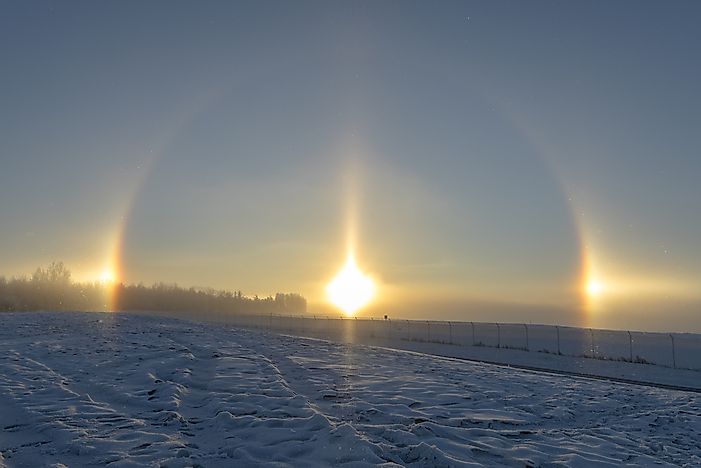
Claiming they are Einstein rings are like claiming this is one too
View this from the top of the atmosphere, ie change your position relative to the refraction source, and your ring disappears
and our position relative to refraction source, is why there is a distinct undeniable lack of Einstein rings in the sky.
Einstein Rings are JUNK SCIENCE
An Einstein stick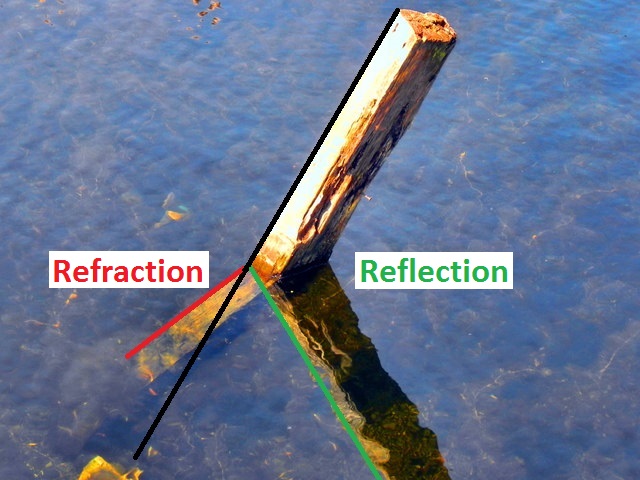
Einstein man
same as
The main argument of the flat earth society is that you can clearly see things that should be obstructed by the earths curvature. But it is, f course, due to the refraction of light.
If gravity bends light, wouldn’t that mean light has mass? If so, how then would light travel at the speed of light? It would take an infinite force to move any mass the speed of light. Lastly, if light doesn’t have mass, then gravity must have properties other than just working on mass. Gravity then must have an index of refraction if it bends light, or somehow distort light if it is a wave.Another issue is gravity accelerates things, can gravity accelerate light? If light has mass, why can’t gravity accelerate light? Things to ponder.
co2islife
There is a gravitational red shift. Light has momentum of (energy/speed of light) but at constant speed.
That would explain light lengthening, but the graphic shows light bending, as if gravity has an index of refraction. What about gravity bends light?
There is no need to look at light in order to expose this as Pseudo science.
All you have to do is understand Einstein’s theory, the theory that is the basis for much junk science.
Space time is the path upon which everything in the universe must travel (if you believe in “space time”, personally I think the concept is NONSENSE).
and it logically follows that if space time is distorted, and it is related to a mass present (any mass of any size as force is not a question to be answered), any mass of any size can alter the static field that is space time without mass present.
It then follows that any distortion that is created, everything must follow that path because it is the ONLY route to take, unless you go outside of space time.
It then follows that there MUST be light distortion created by every mass that distorts space time.
It then follow that we MUST be able to observe this alteration of the light’s path from objects say, the mass of a human being.
BOLLOCKS, space time is BOLLOCKs
Space is the distance between predetermined coordinates on the x y and z axis, it is a CONCEPT, not a physical thing
Have you calculated the angular deflection you’d expect in a ray of light around an object with the mass of a human being?
There are (at least) two ways gravity can bend the path of light. One would be that light has mass. Another is that the space light moves through is being bent.
General relativity posits that gravity bends space-time so that what would normally be a straight-line path is now curved. An object with mass would normally move in a straight line, and in flat space-time, this is true. In curved space-time, it normally moves in a curved path, and it takes force to move it away from that path. That’s what we perceive as the force of gravity.
Light moves, pretty much by definition, along straight lines in space-time. But when you curve space-time, the path light considers “a straight line” is no longer what we see as straight. So light bends.
Gravity doesn’t accelerate light. If you point a ray of light straight up, it loses energy as it moves upward. However, this loss of energy doesn’t show up as slowing down, but rather as a lengthening of the wave length. This can be measured in the lab using cobalt-57 gamma rays and the Mossbauer effect.
“One would be that light has mass.” if Light has mass it can’t go the speed of light. It takes an infinite force to move any mass the speed of light.
How would light bend space without losing any of its energy?
What is bending the light? If space is a vacuum, what is exerting the force to bend the light, especially if light doesn’t have mass?
If light is lengthening, the lead end would be traveling faster than the speed of light as it stretches. If the lead end isn’t surpassing the speed of light, the light behind it must develop a blue tilt, or slow down, or both to compensate for the stretching.
Once you stretch light, you have fewer photons per unit. Where did that energy go? Did it simply get backed up behind the new red light and a single beam of light can be viewed as red and blue depending of where you are observing it?
Fascinating subject, any insight would be appreciated.
co2islife
“If gravity bends light, wouldn’t that mean light has mass? If so, how then would light travel at the speed of light?”
Is the speed of light the ultimate speed, or only the ultimate speed humanity knows of?
We measure things by what we think we know, not by what we don’t know.
And I contend, humanity knows little of what we don’t know.
Speed of light? A convenient, known measurement against which we judge almost everything, until we discover something faster.
Not that I’m telling you anything I’m sure you haven’t considered.
Nor am I a scientist, I just like beer.
Theoretically, nothing can exceed the speed of light, especially if it has any mass at all. Things gain mass as they speed up, and at the speed of light mass goes to infinity, and it would take an infinite force to accelerate it beyond the speed of light.
co2islife
as far as we are aware.
🙂
Remembering that we see here a 2D picture of 3D objects, the particular image does tempt the imagination to draw spiral arms so often seen in galaxy images, here added in pale yellow, roughly. It is almost certainly meaningless, but it does again show the power if the eye/brain system to make people want to see patterns.
http://www.geoffstuff.com/einstein_arms.jpg
Relativity tells us that there is no absolute motion. But this fails to explain rotation. The is clearly an absolute rotation. Otherwise there would be no problem with the earth rotating thousands of times per second with respect to a distant galaxy.
But the question then becomes. What mechanism allows rotation to be absolute over the vast distances involved.
Without an explanation for absolute rotation, that apparently provides a common reference over the observed universe, a reasonable explanation for dark energy and dark matter is that they are a result of the absolute nature of rotation. Rotation at a galactic level is associated with dark matter. Perhaps rotation at the scale of the observed universe is dark energy.
An interesting thought experiment is to apply the Einstein thought experiment for an elevator/gravity to rotation.
What if you could sit at the heart of a rapidly spinning neutron star. Would the gravity of the star cause you to feel as though you were spinning if you were actually not spinning with respect to the rest of the universe. Mach’s principle?
The ring appears in this photograph as distinctly more red, hence more distant, than the foreground galaxies. This is the best Einstein ring image yet.
How much of our current view of the universe is potentially distorted by gravitational lensing?