Retraction request to Bioscience: FOIA emails document another harsh criticism of Amstrup’s 2007 polar bear model

Essay by Dr. Susan Crockford (republished from her website https://polarbearscience.com )on Retraction request to Bioscience: FOIA emails document another harsh criticism of Amstrup’s 2007 polar bear model
Today I sent a letter to the editors of the journal Bioscience requesting retraction of the shoddy and malicious paper by Harvey et al. (Internet blogs, polar bears, and climate-change denial by proxy) published online last week.
The letter reveals information about the workings of the polar bear expert inner circle not known before now, so grab your popcorn.

I have copied the letter below, which contains emails obtained via FOIA requests to the US Geological Survey and the US Fish and Wildlife Service by the Energy and Environment Legal Institute, E&E Legal, and the Free Market Environmental Law Clinic (USFWS request; USGS request) and sent to me by lawyer Chris Horner in 2014, unsolicited. I reveal some of them now, with his permission (most of the emails are boring, involving mostly technical topics not relevant to anything, as might be expected).
The emails in question, sent in 2014, pertain to preparations by three members of the Polar Bear Specialist Group for the IUCN Red List assessment due in 2015 (Kristin Laidre, University of Washington, Eric Regehr, US Fish and Wildlife Service, and Østein Wiig, Museum of Natural History, University of Olso), and Steven Amstrup (formerly head of the polar bear research at the US Geological Survey, now “head scientist” for conservation organization Polar Bears International.
They include frank discussions about a harsh critique of Amstrup et al.’s 2007 report and 2008 paper used to support listing polar bears as ‘threatened’ on the US Endangered Species List. The criticisms come from modeling expert and chair of the IUCN Red List Standards and Petitions Subcommittee (which develops guidelines for threatened and endangered species assessments, and evaluates petitions against the red-listing of these species), H. Resit Akçakaya. The IUCN is the world’s leading conservation organization, of which the PBSG is a part.
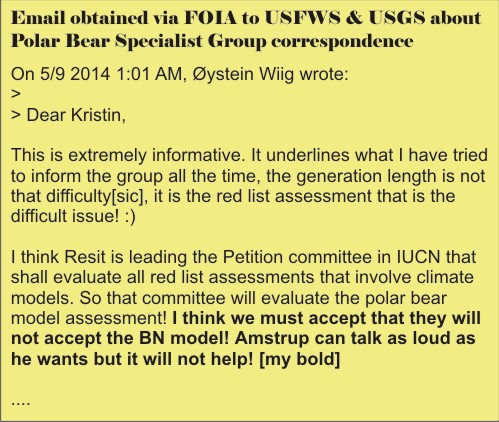
These records are a damning indictment that the “best available science” was not used to assess conservation status of polar bears under the ESA in 2008 and 2014 and show that I am not the only scientist who thinks Amstrup’s model is fatally flawed. The letter is copied in full below, the emails are copied at the end. A file of all of the entire pertinent email thread is available as a pdf below. Here’s a sample:
Susan Crockford, Ph.D. (Zoology)
University of Victoria
and
Polar Bear Science
December 5, 2017
Scott Collins,
Editor-in-Chief
University of New Mexico
(505) xxxxxxxx
scollins@xxxxxxxx
and
James Verdier
Senior Editor
American Institute of Biological Sciences
(703) xxxxxxxxxx
jverdier@xxxxxxx
Dear Sirs,
You recently published an article by Harvey et al. (Internet blogs, polar bears, and climate-change denial by proxy), which maliciously made a variety of defamatory and untrue allegations against me. These false allegations include: that I have no published peer-reviewed papers on polar bears, that I have manufactured my expertise, that I criticize polar bear researchers without supporting evidence, and that I have ignored or misrepresented science. Over and above these accusations and allegations being untrue, defamatory and malicious, the paper misrepresents my actual expertise. The paper pointedly leaves out the fact that I am a professional zoologist with a Ph.D. and over forty years of experience and dozens of peer-reviewed papers on various topics, and also fails to mention that I have recently published a detailed academic critique on the issue of polar bear conservation status.
MISREPRESENTING MY CREDENTIALS AND EXPERTISE
You (referring here, and below, to the journal collectively with the authors) falsely alleged that I have no expertise on the subject of polar bears.
The paper states: “Notably, as of this writing, Crockford has neither conducted any original research nor published any articles in the peer-reviewed literature on polar bears.”
The paper fails to mention that my Ph.D. dissertation on speciation included polar bears: the paper only says that the Global Warming Policy Foundation describes me as “an expert on polar bear evolution” (as if this is probably a lie). Zoology is the relevant general field for the study of polar bears. My particular specialty of evolutionary theory has a zero field or laboratory component but that does not mean I am not a qualified zoologist, or that I lack expertise in polar bear biology.
In addition to my dissertation that features polar bears, I have an article on evolution in a peer-reviewed journal in which polar bears are prominently featured (Crockford 2003), and two official comments, with references, on polar bear hybridization (which is how official responses to published papers are handled in these two journals). I also have a paper in a peer-reviewed book chapter on ringed seals, the primary prey of polar bears (Crockford and Frederick 2011), and a peer-reviewed journal article on the paleohistory of Bering Sea ice, the habitat of Chukchi Sea polar bears (Crockford and Frederick 2007).
Crockford, S. J. 2003. Thyroid hormone phenotypes and hominid evolution: a new paradigm implicates pulsatile thyroid hormone secretion in speciation and adaptation changes. International Journal of Comparative Biochemistry and Physiology Part A 135(1):105-129. [peer reviewed journal, includes polar bear evolution discussion]
Crockford, S. and Frederick, G. 2007. Sea ice expansion in the Bering Sea during the Neoglacial: evidence from archaeozoology. The Holocene 17 (6):699-706. [peer reviewed journal, an Arctic sea ice paper]
Crockford, S. J. 2012. Directionality in polar bear hybridization. [Official comment with references to Hailer et al. 2012], Science336:344-347.
Crockford, S. J. 2012. Directionality in polar bear hybridization. [Official comment with references to Edwards et al. 2011], Current Biology 21: 1251-1258.
Crockford, S. J. and Frederick, G. 2011. Neoglacial sea ice and life history flexibility in ringed and fur seals. pg. 65-91 In T. Braje and R. Torrey, eds. Human and Marine Ecosystems: Archaeology and Historical Ecology of Northeastern Pacific Seals, Sea Lions, and Sea Otters. U. California Press, LA. [a peer-reviewed book chapter]
While it is true that these peer-reviewed papers are not the result of field research on polar bears and most do not focus exclusively on polar bears, they do deal with the history of polar bear habitat, the ecology and physiology of their primary prey, and the evolution of polar bears as a species (which requires a firm understanding of their zoogeography, ecology, genetics, physiology, behaviour, and life history). I don’t believe that the definition of a peer-reviewed paper on polar bears implies it be only about polar bears. These topics are all valid and important aspects of polar bear biology and cannot be dismissed as irrelevant to my zoological expertise as it pertains to this species. The citations to these papers are listed on my blog “about” page.
I have never claimed expertise based on field experience. My expertise comes from an intimate knowledge of the veritable mountain of polar bear and Arctic sea ice literature that I have studied for more than a decade. To my knowledge, no one else with a background in zoology outside the rather insular circle of polar bear field researchers has bothered to take on this task, and thus no one else has been able to critically comment on recent polar bear papers and reports with reference to previous work.
In January 2017 I published a detailed scientific critique on the issue of polar bear conservation status (Crockford 2017) that demonstrates my extensive knowledge of the relevant literature. One might disagree with the conclusions of the paper but it is indisputably a scientific paper in structure, tone, and content. It was peer-reviewed by several well-qualified colleagues before publication (and revised accordingly) but was not peer-reviewed again by the PeerJ organization, as is their policy. The journal does, however, provide an easy venue for online review by colleagues. None of the polar bear researchers whose work I criticized have posted a review or comment in the 10 months it has been available.
Crockford, S.J. 2017. Testing the hypothesis that routine sea ice coverage of 3-5 mkm2 results in a greater than 30% decline in population size of polar bears (Ursus maritimus). PeerJ Preprints 2 March 2017. Doi: 10.7287/peerj.preprints.2737v3 Open access. https://doi.org/10.7287/peerj.preprints.2737v3
Harvey et al. state: “…scientists such as Crockford who are described as “experts” on denier blogs in fact typically have little in the way of relevant expertise, and their expertise is often self-manufactured to serve alternative agendas.” The implication that I have self-manufactured my expertise is simply malicious, and an egregious breach of professional ethics. Due diligence requires that before making allegations of lack of expertise on polar bears and self-manufactured expertise, you should have contacted me. It is professionally inexcusable that no one emailed or phoned me, either prior to submission of this paper or while it was in review, about these accusations.
UNTRUE STATEMENTS
1) “Crockford vigorously criticizes, without supporting evidence, the findings of several leading researchers who have studied polar bears in the field for decades.”
Contrary to the quoted statement above, all of my blog posts contain the evidence to support critical comments I’ve made, or provide links to previous posts where that evidence is supplied.
Example a) Crockford (2017, cited above) is a fully referenced document that supplies all of the evidence needed to support the conclusion that Amstrup and colleagues’ model of polar bear demise with diminishing sea ice is a failed hypothesis.
Example b) I spent considerable time and effort in 2014 going through the scientific literature on the topic of sea ice cover and walrus haulout behaviour. I wrote a series of blog posts which included quotes from those papers and, where possible, copies of the papers themselves. In the end, there were four detailed blog posts on the topic (all are listed in this post https://polarbearscience.com/2014/10/01/mass-haulouts-of-pacific-walrus-and-stampede-deaths-are-not-new-not-due-to-low-ice-cover/ ). At this point the Global Warming Policy Foundation asked me to compile those into one fully referenced document, for which I was paid – as scientists and science writers are paid for science magazine features (Crockford, S.J. 2014. On The Beach: Walrus haulouts are nothing new. GWPF Briefing 11. The Global Warming Policy Foundation, London. Pdf here). Note that my conclusion that Pacific walrus show no particular increased risk to survival from sea ice declines has been vindicated: the US Fish and Wildlife Service recently declared that walrus are not in need of ESA protection as they have shown an ability to adapt to sea ice loss that was “not foreseen.”https://polarbearscience.com/2017/10/04/breaking-pacific-walrus-is-not-threatened-with-extinction-says-us-fish-wildlife/ [includes a copy of the USFWS press release, the Federal Register announcement, and the 2017 USFWS Species Assessment Report for the Pacific Walrus]
Example c) In a 2014 post, I criticized Steven Amstrup for his continued promotion of his model predicting the demise of polar bears due to sea ice loss when he knew that a high-level member of the IUCN Red List had harshly criticized the validity of his work: https://polarbearscience.com/2014/11/29/amstrup-knows-his-polar-bear-predictions-are-flawed-but-continues-to-promote-them/ I quoted directly from Polar Bear Specialist Group (PBSG) documents available online and posted the entire documents for confirmation.
Evidence provided in that post is substantiated here by emails to and from US federal government members of the PBSG (obtained via FOIA requests to the US Geological Survey and the US Fish and Wildlife Service by the Energy and Environment Legal Institute, E&E Legal, and the Free Market Environmental Law Clinic, available on request) and sent to me by lawyer Chris Horner in 2014. Until these documents arrived via email, unsolicited, I had no knowledge this FOIA had been initiated. I did nothing with them at the time but reveal them now, with permission.
These emails show that the IUCN Red List official discussed in my blog post (Dr. Resit Akçakaya, “Resit” in the emails, Professor in the Department of Ecology and Evolution at Stony Brook University, a modeling expert) not only spoke in disparaging terms about Amstrup et al.’s 2007/2008 model that was used to justify placing polar bears on the US endangered species list (“…he [Resit] says it has very little value for anything”), he warned the PBSG that if they insisted on basing their 2015 polar bear assessment on the same model it would be rejected and polar bears would be declared “data deficient” – a result that would be “like a catastrophe” according to member Øystein Wiig, the PBSG assessment chairman (Natural History Museum, University of Oslo). The emails show several of Amstrup’s PBSG colleagues (if not all of them) had been aware of this harsh criticism since 2012.
Amstrup clearly resented this censure and his colleagues were quite aware of his anger (quotes transcribed below, copies of emails they are taken from are copied at the end of the letter):
“Overall he [Resit] is very negative to the Amstrup et al. model and says it has very little value for anything, or the Red List…He said it is difficult to fill out just one conditional probability table, but having thousands all merged together in the BN is just crazy and tells you nothing (he actually said “only Bayesians would accept ‘a belief’ to be a probability!”). [Kirsten Laidre, University of Washington to Øystein Wiig and Eric Regeher, USFWS, 8 May 2014, after a lunch meeting with Resit Akçakaya]
He [Resit] said he felt if PBSG used the BN model again this time for the new Red List it would very likely NOT be accepted and the polar bear would be listed as “Data Deficient”, which he felt would be a shame and also not a good thing politically. (if we cannot figure out where polar bears get listed how can we do it for other species) [Laidre to Wiig and Regher, same email as above, 8 May 2014]
Between the 3 of us, this is a difficult thing to navigate in the PBSG because Amstrup plays a big role and is very sensitive about his model” [Laidre to Wiig and Regeher, same email as above, 8 May 2014]
“I think we must accept that they [IUCN Red List] will not accept the BN [Bayesian Network] model. Amstrup can talk as loud as he wants but it will not help” [Wiig to Laidre, 9 May 2014]
“He [Resit] repeated what he told us in 2012 and was very clear that the BN [Bayesian Network] model was not suitable to be used in this red list assessment. He indicated that an assessment based on the BN model would not be accepted by the IUCN Standards and Petition Subcommittee which he chairs.” [Wiig to Steven Amstrup, Polar Bears International, 16 May 2014]
“It was a good mail to Steve [Amstrup]…hopefully he will not shoot the messenger” [Wiig, who told Amstrup his model could not be used for the 2015 IUCN Red List assessment].[Laidre to Wiig and Regehr, 16 May 2014, on receiving a copy of the email Wiig sent to Amstrup]
Amstrup, S.C., Marcot, B.G., Douglas, D.C. 2008. A Bayesian network modeling approach to forecasting the 21st century worldwide status of polar bears. Pgs. 213-268 in Arctic Sea Ice Decline: Observations, Projections, Mechanisms, and Implications, E.T. DeWeaver, C.M. Bitz, and L.B. Tremblay (eds.). Geophysical Monograph 180. American Geophysical Union, Washington, D.C. http://onlinelibrary.wiley.com/doi/10.1029/180GM14/summary and http://alaska.usgs.gov/science/biology/polar_bears/pubs.html [this is the peer-reviewed version of the USGS internal report published in 2007 by the same authors]
These email records demonstrate that I am not the only one to harshly criticize Amstrup’s work and that the best available science was not used to support the ESA listing in 2008. As early as 2012, Akçakaya’s scathing opinion of Amstrup’s model was known to several (if not all) PBSG members including Amstrup.
Akçakaya’s critique is absolutely damning for the validity of the ESA listing: it indicates that USGS biologists did not use the “best available science” in supporting the listing of ‘threatened’ – it used a method considered to be scientifically inadequate for assessing a future threat. Akçakaya’s criticisms were not made public, however, and the same flawed method was used again in 2014 to uphold the ESA listing, based on the same type of Bayesian Network model as Amstrup et al.’s 2007/2008 version, with the addition of opinions from four additional experts (Atwood et al. 2014, USGS Open File Report 2014-1254). The 2015 Red List assessment used a completely different method (Regehr et al. 2016, Biology Letters).
While Amstrup was clearly outraged at his IUCN Red List colleague, Akçakaya had the balance of power and Amstrup could not retaliate. Amstrup appears to be even more outraged over the criticisms expressed in my 2017 paper (Crockford 2017) but this time, he engaged with 13 other colleagues to belittle my work and scientific reputation in print. The editors of Bioscience assisted Amstrup and his colleagues in that objective by publishing the paper, made worse by making it an “Editor’s Choice”.
2) “Crockford’s blog frequently extracts partial research out¬comes and portrays them as contrary to the documented effects of AGW on sea ice or polar bears—supporting a “scientific uncertainty” frame. For example, when alleging sea ice recovered after 2012, Crockford downplayed the contribution of sea-ice loss to polar-bear population declines in the Beaufort Sea.”
I have “downplayed” the contribution of summer sea ice loss to polar bear population declines in the Southern Beaufort Sea (I presume they mean the “Southern Beaufort Sea” subpopulation, as there is no “Beaufort Sea” population) because Amstrup, Stirling, and other researchers have themselves downplayed the well-documented effects of thick spring ice conditions on polar bear population declines between 2001 and 2010. Thick spring ice conditions in 2004-2006 (which have occurred in this region about every 10 years since the 1960s with devastating results on polar bear numbers, documented by Stirling and colleagues in various papers, which I have cited numerous times in blog posts and in Crockford 2017) occurred in the middle of the polar bear population survey period. However, because summer sea ice had also occurred over that period, a correlation was made between loss of summer sea ice and population decline. The paper reporting the population decline from 2001-2010 (Bromaghin et al. 2015) acknowledges that the population began to recover after 2007 (described in this post, with quotes and references) https://polarbearscience.com/2014/11/18/s-beaufort-polar-bears-largely-recovered-from-known-2004-2006-decline-says-new-study/ ), even though 2007 was the first markedly low sea ice year. There has not been another population count since 2010.
My primary issue with Amstrup and Stirling is that none of the models that predict a future outcome for polar bears take the documented negative effects of thick winter and spring ice (as well as thick snow cover over ice in the spring) into account, phenomena that are documented for a few regions but almost certainly relevant to all. Amstrup and Stirling ignore these important impacts on survival and instead focus exclusively on summer sea ice loss. Crockford (2017) explains these issues thoroughly, as do my blog posts on this topic (with references and quotes from original documents, summarized in this post: https://polarbearscience.com/2013/07/04/great-polar-bear-red-herring-in-the-southern-beaufort/ In other words, this is a professional, scientific disagreement: it is not an attempt to sow scientific uncertainty. Therefore, the claim that “Crockford’s blog frequently extracts partial research out¬comes and portrays them as contrary to the documented effects of AGW on sea ice or polar bears—supporting a “scientific uncertainty” frame” is without merit.
3) “Some of the most prominent AGW deniers, including Crockford, are linked with or receive support from corporate-funded think tanks that downplay AGW (e.g., the Heartland Institute) and/or receive direct funding from fossil-fuel companies (Oreskes and Conway 2011).”
I am not “linked with” nor do I “receive support” from The Heartland Institute or any other corporate-funded think tank. I was paid $750 a month from 2011 to 2013 (through a contract, not a salary) to make summaries of published papers relating to vertebrate animals that I thought might not be covered by the next IPCC report. These summaries were to be included in the NIPCC report to ensure that a balanced perspective of the literature was available to the public, which the Heartland Institute published. I chose which papers to examine and what to write. The monthly payments ended (as did the contract) when my work on the NIPCC report was finished in early 2014. I have not received any money from Heartland since, except for travel expenses to their 2017 conference.
The Global Warming Policy Foundation has occasionally paid me for summary papers and video content (see item 1b above, for example), just as science magazines that publish lengthy features would do. I have also written articles for magazines aimed at general readers, for which I have also been paid.
No one pays me to write my Polar Bear Science blog.
FLAWED METHODOLOGY
One of the co-authors (Bart Verheggen) released the SI document containing the methodology on 5 December 2017, which had not been published along with the paper on 29 November 2017 on the Bioscience website.
Flaws were immediately apparent in the choice of blogs used to generate Figures 1 and 2 in the paper. One outlet was counted twice (The Daily Caller, and Daily Caller), the error enhanced because this is not a blog at all but a news site called The Daily Caller News Foundation.
While Harvey et al. define a blog as “a website that contains regularly updated online personal ideas, com¬ments, and/or hyperlinks provided by the writer (Nisbet and Kotcher 2013),” the lists include a website that is a scientific literature aggregator with content based on press releases (ScienceDaily), not a blog, and the aforementioned news outlet (Daily Caller), also not a blog.
In addition, The View From Here has not been updated since 20 Dec 2015 and the Tom Nelson blog similarly has no recent content, being last updated 11 April 2015 (he now communicates on twitter).
There is also the reprehensible and entirely unscientific use of the “denier” slur throughout the Harvey et al. paper, a derogatory term originally coined by journalist Ellen Goodman in 2007:
“I would like to say we’re at a point where global warming is impossible to deny. Let’s just say that global warming deniers are now on a par with Holocaust deniers, though one denies the past and the other denies the present and future.” Boston Globe, February 9, 2007 “No change in political climate.” Wayback Machine, here
Such damning errors and inappropriate language are appalling for something purporting to be a peer-reviewed science paper.
Conclusion
By identifying and discussing the above issues, I do not mean to imply that there aren’t other issues that could be raised about this paper. But these are enough.
You accuse me of having no expertise regarding polar bears, no peer-reviewed papers about polar bears, allege that I support a “scientific uncertainty” frame, and state that I criticize the work of Amstrup and colleagues without supporting evidence.
These allegations are untrue, defamatory and malicious, but in addition, the failure to mention my Ph.D. and my recent scientific critique constitute a falsification of my expertise and work output. In addition, the purported scientific analysis is shoddy and the language used is reprehensible.
I formally request that you retract this paper.
Yours truly,
Dr. Susan J. Crockford
http://www.polarbearscience.com
University of Victoria, Victoria, B.C. Canada
scrock@xxxxx and sjcrock@xxxxxx
Phone 250-xxxxxxxxx
XXXXXXXXXXXXXXXXXXXXXXXXXX
EMAILS, WITH EMAIL ADDRESSES AND PHONE NUMBERS REDACTED
From: Kristin Laidre klaidre@xxxxxxxx
Sent: Thu May 08 2014 17:35:58 GMT-0600 (MDT)
To: 0ystein Wiig
Subject: Re: FW: Polar bear Red List – meeting with Resit
I hope you have a nice time celebrating your independence from that small, very flat country. It is extra gratifying to celebrate it with some Danes 🙂
I wanted you to know I had lunch with Resit today. It was very informative and we had good talks about the polar bear Red List issues. I wanted to let you know what I learned. I cc Eric since it seems the 3 of us are the most involved in the Red List issue at the moment. I also thought I should write you both in case you think of anything more specific I should ask Resit tomorrow, our last day here.
I am not entirely sure of Resit’s position within IUCN (?) but I guess he is peer reviewing the proposed listings? He struck me as a very nice, smart person (with good humor, which helps).
-Overall he is very negative to the Amstrup et al. model and says it has very little value for anything, or the Red List.
-He said it is difficult to fill out just one conditional probability table, but having thousands all merged together in the BN is just crazy and tells you nothing (he actually said “only Bayesians would accept ‘a belief’ to be a “probability!”)
-He said he felt if PBSG used the BN model again this time for the new Red List it would very likely NOT be accepted and the polar bear would be listed as “Data Deficient”, which he felt would be a shame and also not a good thing politically. (if we cannot figure out where polar bears get listed how can we do it for other species).
-He gave me a few suggestions on what he thought would work – he wisely said to root the analysis in actual data and mechanistic things we understand and do not go crazy. I think some of these things Eric is already doing with his models, but I am not sure.
-He was very positive to help us with modeling we needed or wanted his involvement or assistance.
-He said he will be at a IUCN Marine Red List in Vancouver, BC this October and we could meet there if convenient. He said there are some very quantitative marine people there (shark specialists) that could be useful for us.
-He suggested we discuss the issue in June at PBSG and make a small working group of people that could contribute to an analysis that can actually be used for the Red List.
-He has just submitted a paper modeling warning times to extinction under the Red List criteria.
That is what I learned. Between the 3 of us, this is a difficult thing to navigate in the PBSG because Amstrup plays a big role and is very sensitive about his model. We as a group will have to decide what we put forward for polar bears .. even if some are not happy.
If I should inform Dag about this meeting let me know. Or, if I should ask Resit more questions tomorrow I can probably ask him to lunch again!
Kristin
xxxxxxxxxxxxxxxxxxxxxxx
Wiig to Laidre, 9 May 2014, response to lunch with Resit notes:
On 5/9 2014 1:01 AM, Øystein Wiig wrote:
>
> Dear Kristin,
This is extremely informative. It underlines what I have tried to inform the group all the time, the generation length is not that difficulty[sic], it is the red list assessment that is the difficult issue! 🙂
I think Resit is leading the Petition committee in IUCN that shall evaluate all red list assessments that involve climate models. So that committee will evaluate the polar bear model assessment! I think we must accept that they will not accept the BN model! Amstrup can talk as loud as he wants but it will not help!
[It?] would be very good if we could involve Resit more in the process. I suggested earlier he should be invited to Ft. Collins. I assume it is late but not impossible if he was willing. I talked to Dag [Vongraven] Wednesday. We have 1.5h for the red list stuff at the meeting.
When I worked on the red list issue in 2012 I had an idea on assessing it by subpopulation and use the projected optimal habitat changes weighed in relation to subpop [subpopulation] sizes. Then the problem is to relate habitat change to population change. The big question [is] how can we use the info we have from some populations to extrapolate to other populations and into the future. I enclose the spreadsheet I started on. I hope you understand what I mean, but I am not certain how good the idea is. How would Eric’s modeling fit in hear[sic]? This would be relevant in relation to the A criteria. You could ask Resit a bit more on how to do assessments by subpopulation and expected optimal habitat change? We are allowed to come up with a range of red list categories in order to express uncertainty. Could you also ask him about the software he has developed for red list assessment.
We might also assess (by subpopulation) in relation to the C criterion
[Message ends; the message on the next page (13) in the pdf is another email, from Wiig to Resit, sent on 19 October 2012, transcribed above]
xxxxxxxxxxxxxxxxxx
Wiig to Laidre and Regehr, 10 May 2014, response to lunch notes, especially, “it would be like a catastrophe for IUCN and us if we end of with DD” [Data Deficient]:
From: Østein Wiig
Sent: Sal May 10 2014 02:43:05 GMT.0600 (MDT)
To: Kristin Laldre klaidre@xxxxxxxxxxxx, Eric Regehr@xxxxxxxx
Subject: RE: FW: Polar bear Red List – meeting with Resit #2
Dear Kristin,
Thank you very much!!
It would be like a “catastrophy” for IUCN and us if we end up with DD [“Data Deficient”]. I think a meeting with Resit would be best but I do know how to get that done. Was he at all able to come to Ft. Collins?? I think this issue is so serious that I could use any evening and night to discuss procedures with him in a small group.
The way I understand you is that also Resit is concerned for the IUCN if we ends [sic] up with DD. So Simon Stewart might be willing to pay for a meeting between some of us.
How many pops [populations] do we have useable that from: SB, WH and SH?? How could we actually use other response variables??
A workshop is the way to go. I do not believe a telephone conference will solve it, but it could certainly help to change focus from the BN modeling to other ways to look at the problem!
Resit earlier has suggested that we could use a subjective evaluation by say twenty experts and estimate uncertainty based on the difference between evaluators. Did you discuss that option at all. [sic]
What do you and Eric think about the way to go?
We shall have a small reception in our new house for friends in some hours and have to prepare for that. On Monday I am occupied with lecture [sic] on polar bear conservation at the University. After that I can concentrate more on the red list issue.
Thank you very much for talking to Resit!! 🙂
Hilsen
Øystein
xxxxxxxxxxxxxxxxxx
Copy of a message from Resit to Wiig in 2012, re: Red List assessment
–Original Message–
: From: Resit Akcakaya [mailto:resit.akcakaya@xxxxxxxx)
: Sent: Monday, October 22, 2012 2:55 PM
; To: oystein.wiig@xxxxxx
Cc: Craig Hilton-Taylor
I Subject: Re: Polar bear Red List
Hi Øystein,
I wanted to remind you that the SPSC had a large number of reservations about the BN modeling of Amstrup et al.
I would therefore recommend against relying heavily on that paper.
Also, attached is a recent paper on another BN modeling approach that was proposed for red listing. The issues we discuss in this paper are not the same as SPSC’s reservations about the Amstrup et al. paper, but there are some similarities.
I hope you have a productive meeting.
Resit
H. Resit Akcakaya
Professor and Graduate Program Director
Department of Ecology and Evolution
Stony Brook University
Stony Brook, New York 11794 USA
Tel: 1-631-xxxxxxxx
Fax: 1-631-xxxxxxxxx
Resit.Akcakaya@xxxxxxxxxxxx
http://life.bio.sunysb.edu/xxxxxxxxxxxx
xxxxxxxxxxxxxxx
Wiig to Laidre and Regehr, sending a copy of his email to Amstrup informing him that his model could not be used for the 2015 IUCN Red List assessment:
On 5/16/2014 1:18 AM Øystein Wiig wrote:
Hi Kristin and Eric,
I copy you my mail to Steve for information. I hope my mail does not offend him in any way.
Thanks to Eric for your mail . It is very interesting what you are proposing. I rely [sic] hope you are able (will find time!) to contribute to the red list assessment with those ideas. Our deadline is June next year.
I think we should try to arrange a telephone call with Resit as soon as possible, but it could be interesting to know Steve’s react ion first.
We need to hear a bit more from Resit about ideas on what red list criterion he assumes we could use, if he is available for an evening call after we have discussed the red list issue at the meeting, and how we could proceed with his involvement. Do you know when the Vancouver meeting is scheduled?
With regard to our presentation at the meeting I suggest I take up general issues and future plans regarding the assessment and you present the status of the GL work. Would that be ok?
Hilsen
Øystein
xxxxxxxxxxxxxxxxxxxxxxxx
Wiig to Amstrup and Vongraven, PBSG Chairman, 16 May 2014, informing him that his model could not be used for the 2015 IUCN Red List assessment:
—–Original Message—-
From: Øystein Wiig
Sent: Friday, May 16, 2014 9:29 AM
To: Steve Amstrup
Cc: Dag Vongraven
Subject: Redlist
Dear Steve,
I hope you are doing well!
I have been thinking a lot on how to proceed with the red list process.
The GL [generation length] issue is now taken care of through the work that are [sic] done basically by Eric and Kristin. We had a good workshop in Seattle in January and have received data from most of the requested populations. We will present GL results at the meeting.
The next and more difficult step is the assessment itself, which we also were working on in 2012. Last week Kristin was at a NASA meeting in WA DC where also Resit Ackakaya was attending. Kristin knew that I had been in contact with him before and asked me if she should contact him and discuss the difficulties we feel we have with the red list assessment. I certainly asked her to do that!
Kristin had a very good discussion wlth Resit and he was really interested in the polar bear issue! He repeated what he told us in 2012 and was very clear that the BN model was not suitable to be used in this red list assessment. He indicated that an assessment based on the BN model would not be accepted by the IUCN Standards and Petition Subcommittee which he chairs.
The polar bear would then be declared Data Deficient (DD) by the IUCN! I think that would be dramatic for all parts involved and must be avoided!
Resit has been involved in several red list assessments and was certain it was possible to do the polar bear assessment based on the data we have. We need to find some population rate data that can be related to change in population size. He was actually very willing to be involved and help us. The polar bear assessment is also very important for IUCN. Resit believed that Simon Stuart would support such a cooperation. I think it will be very important and productive to involve Resit. Then we can (hopefully ) find a way to do an assessment that is acceptable for IUCN. Resit is probably willing to have a telephone meeting with a smaller red list group in Ft. Collins to discuss this further. In October he will be at a IUCN marine red list meeting in Vancouver. It could be possible to have a small workshop with him there. I will try to have a call with him next week to learn more.
So my suggestion would be to assign a small dedicated group to work together with Resit on the red list assessment. The group could meet with him in October. The group could include you, Eric [Regehr], Kristin [Laidre], Andy [Derocher], me [Wiig] and a few others that are willing to spend time on this.
Looking forward to see you in Ft.Collins!
Best wishes
Øystein
xxxxxxxxxxxxxxxxxx
Laidre to Wiig and Regehr, 16 May 2014, reaction to the emai to Amstrup
—–Original Message—–
From: Kristin Laidre [mailto:klaidre@xxxxxxxx
Sent: Friday, May 16, 2014 4:40 PM
To: 0ystein Wiig; Eric Regehr
Subject: Re: FW: Redlist
Hi Øystein ,
It was a good mail to Steve and I hope he reacts positively. I would be interested to see the follow-up discussion you have with him. Hopefully he does not shoot the messenger 🙂
Should we wait to see what Steve says before I write Resit?
The Vancouver meeting is scheduled in October.
I think your suggestions for the Red List session in CO sound good. I suggest Eric present the GL analysis and then he talk about this modeling plans (if he does not have it done by June). I am willing to presenc anything you guys would like but Eric is the one doing the hard work. I guess Steve will also be presenting the BN based on the request from Dag? Or maybe he will change his mind after seeing your email.
Best wishes for a wonderful celebration tomorrow!
Kristin
xxxxxxxxxxx END OF SELECTED EMAILS
Pdf of transcribed emails from original scans, marked:
Lunch with Resit (May 2014) and Crockford – — again! (June 2014: Bonus emails not mentioned in the letter: you may remember the incident discussed at the time here. https://polarbearscience.com/2014/05/30/iucn-polar-bear-specialist-group-says-its-global-population-estimate-was-a-qualified-guess/
At what point does this become a libel proceeding? These seem to me to be knowingly false statements (about background and approach to documentation) that are ENTIRELY written to damage reputation.
I would get a lawyer [Dr Crockford]. This first step to request a retraction may be the first on a long path.
Susan, I admire your fortitude.
Could I suggest that you do a world-wide press-release in the form of a Christmas message to children everywhere that they can rejoice, as in your opinion as a leading expert the good news is that Polar Bears are NOT an endangered species.
I like it!
Dear Susan, here is a link to a disgusting Slate.fr article about the whole affair…
https://m.slate.fr/story/154751/blogs-climato-sceptiques-seule-meme-personne
Courage!
“…contrary to the documented effects of AGW on sea ice…”
Just what documented effects would those be? To date, the sea ice has stubbornly refused to comply with how it is supposed to act, according to the models. It takes a special kind of stupid to continue to insist model data is the same as actual observations.
Don’t let the AGW trolls take you down Susan, keep on exposing them for what they are, greedy people masquerading as scientists to get grants to fund their bogus research!
PMK
From the paper (unsubstantiated & prophecy based on poor model prediction):
“Summer sea ice did not disappear entirely during past interglacial periods (Stein et al. 2017), as it ultimately will with unabated GHG rise.”
Also from the paper:
“Acknowledgments;
The authors wish to thank the three anonymous reviewers for their helpful comments on the manuscript.”
Anyone seen a polar bear ad by Co-cola lately?
Singing Merry Christmas.
Lewandowsky has form when it comes to publishing defamatory rubbish. Any paper with his name on it isn’t worth spit.
I’m getting a little bored with all of this Dr Crockford worship, so let’s get back to a little science.
Since Dr Crockford has chosen to describe the Akçakaya critique of the Amstrup model as “absolutely damming” I decided to look up what he actually said. The following quote appears on Dr Crockford’s own website:
“First, BN models are mainly a vehicle for placing expert opinion into a common framework. They are not straightforward to update on the basis of observed data and there is concern that data would not be able to overwhelm the priors. Second, the BN model structure is not based on population dynamic theory. Third, the results from the BN approach are not applicable to Red List Criteria A or C, which require estimates of the amount of the decline not the probability of decline. Finally, the results are not applicable to Red List Criteria E, which requires quantitative not qualitative states.”
If this is supposed to be a good example of a damning critique then I have to say I am far from impressed. My observations are as follows:
Firstly, BN models are not “mainly a vehicle for placing expert opinion into a common framework”, although they do have that advantage. What they are is a vehicle for placing expert opinion and objective data into a common framework.
Secondly, it is not at all clear to me why Akçakaya might think it not straightforward to update a BN on the basis of observed data.
Thirdly, if the objective data available is not strong enough to “overwhelm” the Bayesian priors then this would be an indictment of the data, not the BN. If the objective data is that weak, then how does one expect to meaningfully apply population dynamic theory. Besides which, I have seen nothing in the critique to suggest that the priors didn’t have an objective basis.
Fourthly, so what if the BN model structure is not based upon population dynamic theory? This statement simply demonstrates a frequentist professional’s bias.
Finally, the implication that a BN deals with qualitative rather than quantitative states is puzzling. I can’t begin to think what qualitative states he is alluding to.
In summary, the only part of the Akçakaya critique that I cannot comment upon is the point regarding the applicability of the BN approach to Red List Criteria A or C. The rest just looks like the sort of ignorant criticism that Bayesian statisticians have historically had to put up with whenever they dare to apply the BN approach within a field operating under an established, frequentist hegemony.
Whilst I fully accept that Dr Crockford is justified in her grievance and can point to controversy within the field, I still think she may have been too quick in her judgment that the Amstrup model is “fatally flawed”. For all I know, it is. But I can’t draw that conclusion based upon the Akçakaya critique. Instead, I think all I can say is that it has been fatally chastised.
And Your qualifications are………?
That is the wrong question and asking it is falling into the same trap that we accuse our opponents of, namely, asserting that someone such as Dr. Crockford isn’t “qualified” and ignoring the truth, or not, of what she says.
I’m not saying I agree with Mr. Ridgeway or not, I’m simply stating that attacking his qualifications is a bad, bad move.
Thank you Don for making the point for me.
I am new to this game but I have already posted a number of guest essays, all of which were strongly supportive of the climate sceptic position. At no stage has anyone on this forum seen fit to question my qualifications until now, i.e. when I introduce a note of caution.
I have never made any secret of the fact that I am a layperson trying to use his life experiences to make sense of a complicated and intriguing subject. In this instance, the relevant experience is that of a safety critical systems engineer who had a vested interest in learning which techniques were the most appropriate for modelling the uncertainty of future system behavior. The frequentist techniques are applicable in data rich scenarios but Bayesianism becomes more appropriate with data deficient problems, or when expert testimony has to be spliced with objective data. Very often, however, individuals who are steeped in the frequentist tradition find it difficult to accept the thinking behind the Bayesian approach. I sense that this may be the case with Akçakaya, since most of his critique seems to be based upon his views concerning the validity of Bayesianism rather than specific criticisms of Amstrup’s model.
So I am reserving my judgement on the Amstrup model. That’s all I am saying.
Yes – the anti-Bayesian language annoyed me too. Nothing wrong with a Bayesian approach if done properly. However Bayesian statistics can be abused like any statistical approach, and because Bayesian Priors are essentially opinion, the abuse of Bayesian statistics can allow opinion to be dressed in a cloak of statistical legitimacy that it does not deserve.
Any Bayesian method must involve a proper integration of priors with measurement. The priors must be stated in a way that they can be properly tested and reevaluated as a consequence of measurement, and then that testing and reevaluation has to actually be done properly. The fact that polar bear numbers in the Southern Beaufort sea recovered from 2007 to 2010 and there have apparently been no measurements since does not give a lot of confidence that this has been done properly.
You say: “In summary, the only part of the Akçakaya critique that I cannot comment upon is the point regarding the applicability of the BN approach to Red List Criteria A or C.”
That is the most important part. The IUCN is the largest, most respected conservation organization in the world and they are insisting that if projections of future population declines based on climate change projections are used to support a conservation status of ‘threatened’, then assessors must use numbers.
Akçakaya may not be a fan of BN but the IUCN put him in charge of their Red List assessments that were being based on climate change projections. Note he did, in the end, help them find a way to get the bears listed in part because that outcome was beneficial to the IUCN.
Thank you Dr Crockford for your reply.
I think I appreciate that the IUCN expresses its predictions in terms of population numbers but I am presuming there are some quantified uncertainties associated with these figures. I have no knowledge of the details of the Amstrup model and so I am not in a position to comment upon how it fits in with the IUCN approach, e.g. is the model restricted purely to assessments of the likelihood of extinction or is it more nuanced than that. It is for that reason that I was unable to comment.
I felt more confident, however, commenting upon the other points made by Akçakaya since they seemed to be coming from a place of considerable scepticism towards Bayesianism in general. In particular, his quip regarding Bayesians treating belief as a probability is taken straight out of the ‘Frequentist’s Handbook of Bayesian Jokes’. I get it that he is in charge and he doesn’t like Bayes, but that tells me more about the current state of play within ecology than it does about the Amstrup model specifically. I would say the model was flawed if it used unrealistic priors, incorrect data or failed to account for important causations, such as winter thickening of ice, but I would not say it was flawed simply because it was Bayesian.
I’ve said it twice before on this thread, but it is worth saying again: I fully support you in your position regarding the Harvey et al paper. Jeff Harvey may be a competent scientist who is passionate in his beliefs, but he is also a bully and you do right to stand up to him. However, with respect to the Amstrup controversy, I think the most important thing you have revealed to me is that the polar bear research is, in some important respects, data deficient (enough for at least one scientist to resort to Bayesianism) and that experts claiming high levels of agreement regarding the probability of polar bear extinction can’t even agree upon what is meant by the term ‘probability’.
Please also keep in mind that you are talking to a layperson, so I cannot be expected to have a deep understanding of the field in question. I thank you in advance for your tolerance.
As a postscript to the above, I should say that I have now scan-read the Crockford 2017 paper that resulted in the Harvey et al response. It appears to me to be a thorough and professional piece of work that puts the Harvey et al paper to shame. And I am more than happy to discover that it does not repeat any of Akçakaya’s general criticisms of Bayesianism.
The trouble is the definition of ‘expert’. Bayesianism is rightly chastised when opinion unbacked by fact is considered to be as useful as actual numbers. An expert must be someone whose opinion has been borne out by testable events. When I build an expert system for a process I don’t ask a number of qualified people to make subjective guesses, I ask the one person who everyone else asks when they want it done right because he has proven to be reliable. That last word is important! In the case of Polar bear numbers we are dealing with an opinion that global warming should be important against a backdrop of history which says the bears are actually in far more danger from hunting, that they survived provably greater warming (see the Gisp-2 recon) with apparent ease and that far from being restricted to eating baby seals (which seems to be a common myth), they can and will eat almost anything including humans and each other. In such a multi-variate system someone’s untested belief about the effect of one variable is probably unreliable. Without some data and/or testing, preferably blind, Bayesianism can therefore become just a conveniently obscure mathematical cloak around pre-conceived bias. Hence the widespread criticism of it. Not to say that frequentist stats are unbiased but that an appropriate skepticism is required for both.
JasG
,
I find myself agreeing with most of what you say, other than your theory as to why most people criticize Bayesianism. In truth, there are many reasons for it being criticized but, perhaps, the main reason I would give is that some people just find it unscientific. I don’t. But, there again, I think you would have to be nuts to use it without objective data. As I’ve said, I don’t know enough about Amstrup’s model to comment any further. I don’t even know whether he was employing subjective Bayes, objective Bayes, empirical Bayes or any of the other multitude of flavours that it comes in.
When chief polar bear alarmist reverts to blogs by Slandering Sou , you know they are desperate to shoot the messengers exposing bogus climate fear mongering. Here’s an example of Slandering Sou’s evil ignorance https://goo.gl/JtZYSj. and here is an example of how polar bear numbers have been fudged https://goo.gl/V9LQJ5
Jim,
Thank you for the link above on how the polar bear numbers have been fudged https://goo.gl/V9LQJ5
Interesting and informative read.
Can you invite the Magazine editors to discuss their reasons here?
The argument about expert status is bogus on both sides.
I think your post can be safely classed as an eructation, worthy of Pujol himself, or as Shakespeare had it, with his ” …. noise, signifying nothing”
Could you post something of more ‘pith and moment’, please?
@ur momisugly Steven Mosher,
The difference being that Jeff Harvey has been a chest beating, AGW brainwashed loon inhabiting the now defunct Deltoid blog for years and years….getting away with abusing everybody with his favourite line that they “lacked the expertise”. Good on you , Susan, finally giving this narcissitic jerk some pushback.
@ur momisugly Steven Mosher,
The difference being that Jeff Harvey has been a chest beating, AGW brainwashed loon inhabiting the now defunct Deltoid blog for years and years….getting away with abusing everybody with his favourite line that they “lacked the expertise”. Good on you , Susan, finally giving this narcissitic jerk some pushback.